
The Zolotaya Moskva peach is intended for cultivation in the southern regions of the country, particularly the North Caucasus region, where yields are expected to be highest. This table variety is prolific, mid-early, and self-fertile, but it only produces its first harvest after four years.
When was the variety developed?
This peach variety was created at the Nikitsky Botanical Institute by breeders I. N. Ryabov and A. N. Ryabova. Two peach varieties, Salvey and Elberta, were used as the basis for hybridization. Its primary use is as a table peach. The variety was approved for agricultural use in 2014.
The appearance of the tree
This is a medium-sized tree, reaching a height of 320-350 cm. Growth is considered rapid, with a spherical, leafy crown. Despite this, many farmers and gardeners claim that the trees do not require pruning even when heavily overgrown, but others believe this hinders high yields.
Features of the variety:
- crown – structured type, with correctly growing strong shoots, resulting in the formation of a beautiful ball;
- leaf blades – with a smooth surface, a sharply elongated shape of medium size and a classic green hue;
- inflorescences – single type, oval in shape, with pinkish flowers like roses.
Fruits and their taste
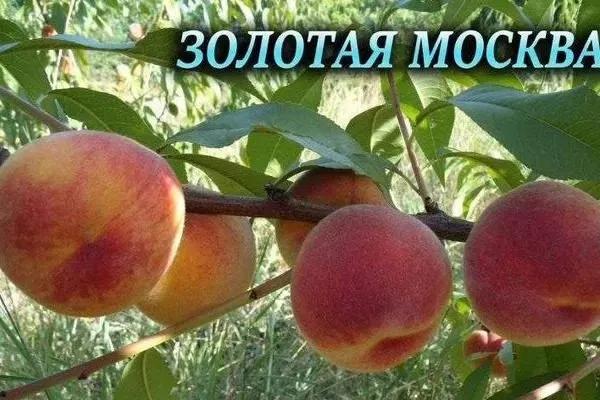
Golden Moscow is distinguished by its large fruit size – the minimum weight of a single fruit is 130 g, the average is 180 g, and the maximum reaches 230-250 g. To ensure the fruit is as large as possible, it is important to adhere to all agricultural practices, creating the most favorable growing conditions.
Other characteristic features:
- the shape of the fruit is uniformly round;
- color - exclusively yellow;
- the blush has carmine notes;
- the skin is of medium density, making it easy to remove from the pulp;
- the flesh is bright yellow, the riper the fruit, the darker the shade becomes;
- the pubescence is of medium intensity, reminiscent of velvet;
- near the stone the flesh is bright red;
- the separation of the stone from the pulp is good;
- The size of the bone is quite large, which many consider a significant drawback.
The variety is versatile in its uses: when grown on a large scale, the fruits are used to make juices, preserves, and baby food. Housewives use the pulp to make jams, preserves, compotes, and fruit drinks. The variety is also often used in desserts.
When it ripens, how it bears fruit, and the yield
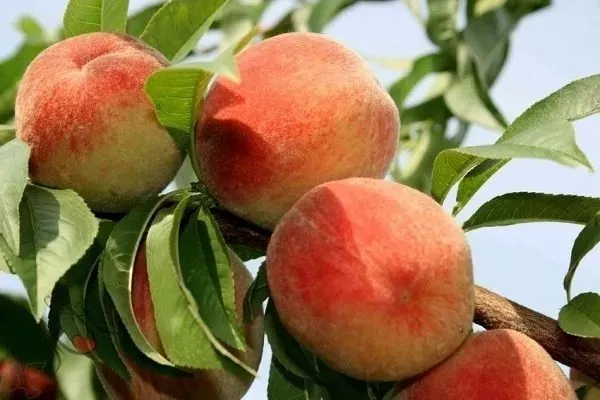
Peach blossoming begins in mid-April and lasts for a whole month. The Zolotaya Moskva variety requires an adaptation period after planting, so the first harvest can only be expected in the third or fourth year.
The peach is a mid-season variety—under favorable weather conditions, the harvest ripens by the second week of August, and the tree bears fruit for two to three weeks. This is an advantage for gardening enthusiasts, who can process the harvest without rushing.
High productivity is noticeable in mature trees, while young plants yield only 5-8 kg of fruit. Later, in full bloom, the tree can yield around 40-55 kg. In commercial farming, 140 to 220 quintals are harvested per hectare per season.
These figures may vary depending on growing conditions and local climate. Experienced gardeners strongly recommend monitoring the number of fruits on the branches to ensure larger fruit sizes. Failure to do so can result in increased fruit numbers but smaller fruit sizes. This trend is increasing each year.
Self-fertility: Do you need pollinator trees?
The Zolotaya Moskva peach is self-fertile, meaning it doesn't require external pollination. In this variety, the stamens and pistils are located close together and reach maturity at the same time, which promotes natural mixing of pollen within the flower.
Pros and cons
Golden Moscow has a number of notable advantages that deserve attention:
Gardeners note several disadvantages of this variety:
Planting a seedling
The planting season varies depending on geographic location. In the southern regions of the country, you can begin planting at any time of year—fall or spring. In cooler regions, however, it's common to plant only in spring.
This plant is a true sun worshipper and requires plenty of sunlight for rapid growth and abundant fruiting. Therefore, gardeners recommend choosing a planting site that receives consistent sun and is not subject to shade, with a moderate breeze but not too strong.
Landing features:
- Before planting, it's important to prepare the site. This should be done several weeks before planting. To do this, dig a hole measuring 90-100 cm by 60-70 cm, where the first number indicates the depth. The hole should be well-drained to prevent water accumulation.
- In the morning, before planting the seedling, you can put a layer of humus on the bottom of the hole, then lightly cover it with soil.
- After this, the seedling is carefully placed, while the roots are laid so that they are not compressed.
- The soil around the tree must be carefully compacted, paying particular attention to its contact with the trunk.
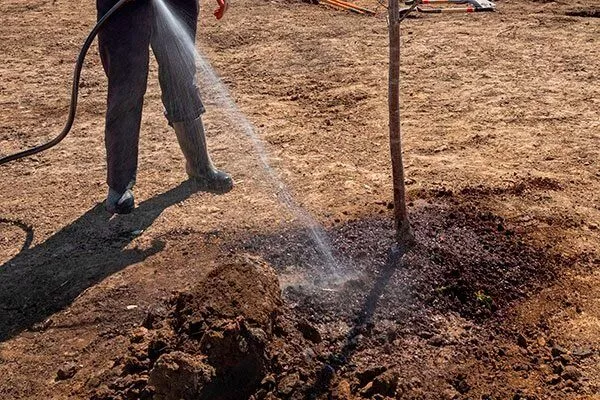
- After this, water is poured over it.
A layer of mulch made from hay or sawdust can be placed around the trunk.

Peach tree care
Caring for the variety does not create difficulties:
- During the summer, watering once every two weeks is sufficient, but this may vary depending on soil conditions and weather. Water should be added when the soil layer below 10 cm becomes dry.
- Drip irrigation is considered the best system for peach trees. If installing a system is not possible, it is recommended to cover the tree trunk with a layer of mulch to help retain moisture and minimize evaporation.
- A peach tree's annual growth rate of 20-40 cm indicates sufficient nutrients in the soil, so additional fertilizing is not required. However, if growth is less, fertilize two to three times a year.
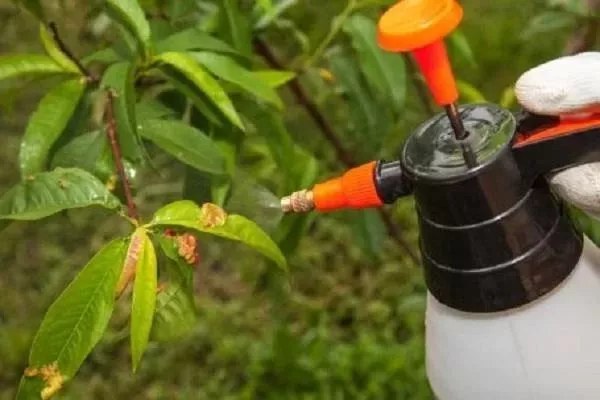
- The Zolotaya Moskva variety, which is resistant to powdery mildew, requires regular protection against pests and other diseases. For prevention, treat with a 3% Bordeaux mixture solution or a 0.5% copper sulfate solution at least three times during the season:
- before the buds open;
- after the flowers have fallen;
- after harvesting the fruits.
- To ensure sufficient sunlight and oxygen, pruning is required. Diagram:
- A year after planting the peach tree, cut back the central trunk by a third to encourage lateral growth. Select four strong, evenly growing lateral shoots around the trunk and cut them back by a third.
- It is recommended to remove fast-growing branches from trees at three years of age, leaving only those on which fruit is formed.
- After another year, only dry, damaged branches, those growing at the wrong angle, or those overlapping each other are removed.
- A mature tree needs to be renewed annually by removing some of the stems, especially those growing at an angle of more than 45° to the trunk.
Preparing for winter
To protect the trunk, whitewash it with lime. In October-November, cover the lower part of the root system with a layer of pine needles, bark, compost, and dried leaves. Avoid using straw for this purpose, as it may attract small rodents.
Reviews
The Moscow Zolotaya peach is a prominent table variety, also known for its high yield. The fruit retains its shape for a long time and does not crack, which is why large farmers cultivate it commercially. The key is to follow simple farming practices.