
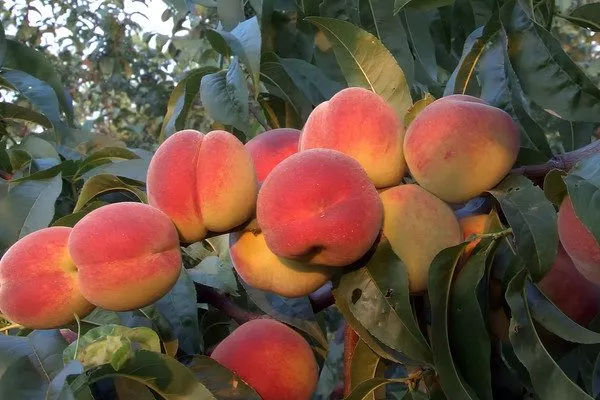
The Vulcan peach deserves its resounding and explosive name for a reason—it's truly vibrant and colorful. When ripe, the fruits acquire fiery hues and a classic, sweet flavor.
The history of the Vulcan variety
The Vulcan peach was developed in North America by Canadian breeder George Line. The variety was created by crossing NJC-95 and Veecling peaches. Vulcan was bred in the 1970s and 1980s. This variety is not listed in the Russian State Register.
Description of the tree
The Vulcan peach tree is medium-sized, reaching a height of 1.5-2 meters. When in bloom, the tree is covered in a profusion of medium-sized pink flowers.
Description of fruits
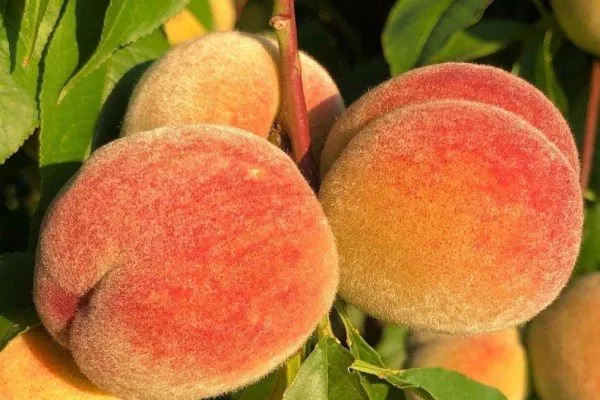
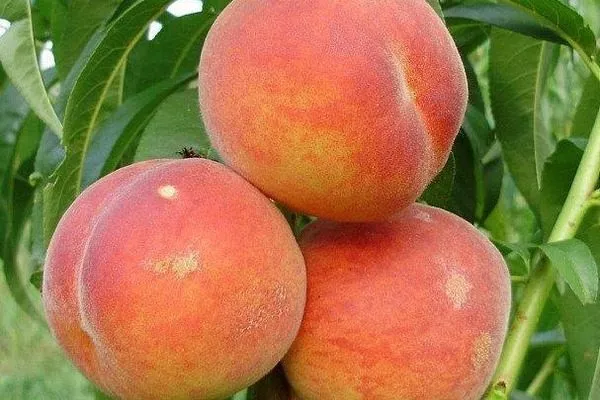
When ripe, the fruits acquire an orange color with scattered red spots or a marbled blush. The latter occupies 60-80% of the fruit's surface.
The fruit is round, with hard-to-separate seeds. Each fruit weighs 80-120 g. The skin is thick, covered with a light fuzz. The flesh is moderately firm and deep yellow.
Purpose and taste
Vulcan peaches are sweet but not cloying. They have an average tasting score of 4.7. This versatile variety is suitable not only for fresh consumption but also for various preserves.
Characteristics
The Vulcan variety is a mid-season variety. Fruiting begins in late July or early August. It is self-fertile and requires no pollinators.
Pros and cons
The Vulcan peach, although not listed in the State Register, is highly regarded by experienced gardeners. This variety has many advantages that peach lovers have appreciated. Pros:
Cons:
Landing features
The Vulcan variety, like all fruit trees, grows best in well-lit areas, but can also produce fruit in light shade. However, shade has a negative impact on yield, which decreases slightly.
- ✓ Ensure the soil pH is in the range of 6.0-7.0 for optimal growth of the Volcano peach.
- ✓ Ensure that the distance to the nearest trees or buildings is at least 3 meters to ensure sufficient space for the root system to grow.
Landing features:
- Choose a seedling 1-2 years old, with a developed main root and 2-3 lateral shoots. The height should be up to 2 m. The plant should be dormant, showing no signs of growth.
- Choose a site protected from drafts and piercing winds. You can plant the tree near a fence, either on the south or east side. The maximum groundwater level is 3 meters. A slightly elevated site is ideal. Swampy areas are unsuitable, as the tree will die in them.
- The Vulcan peach prefers black soil with a low pH. It grows worst in sandy and clayey soils, requiring adjustments to their composition. In areas with high groundwater levels, drainage of crushed stone or broken brick is essential in the planting holes.
- Cherry, apple, apricot, sweet cherry, pear, and walnut trees are considered unfavorable neighbors for peaches. These trees weaken the peach's immune system and reduce fruit production.
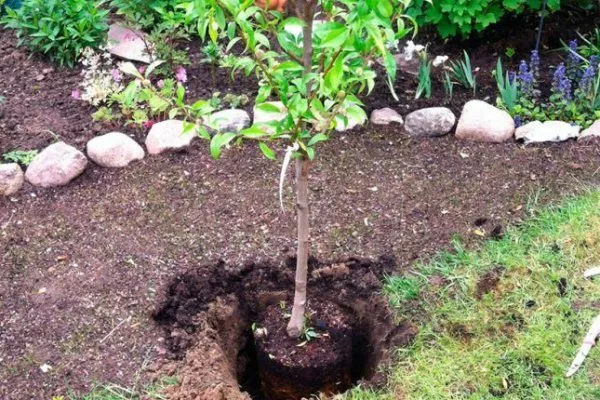
- The planting hole is prepared in advance—in the fall if planting is planned for spring. If planting is planned for the fall, the hole is prepared 3-5 weeks in advance. If necessary, add a 10-15 cm drainage layer to the bottom.
- The approximate depth of the hole is 60-80 cm, with a diameter of 1 m. First, add organic matter—humus or compost—then a nutritious soil mixture of fertile soil and mineral fertilizers, and top with soil. The hole should be one-third full.
- Before planting, inspect the seedling, trimming off any dry or rotted root sections. Three to five hours before planting, soak the roots in water, or even better, in a growth stimulant such as Kornevin or an equivalent.
- A support is driven into the center of the hole. The planting hole is watered, and the seedling is placed in it, spreading its roots. The hole is filled, the soil is compacted, and the seedling is tied to the support. After planting, the root collar of the seedling should be 3-5 cm above ground level. The planted tree is watered, and once the water has been absorbed, the soil is mulched with peat, wood chips, freshly cut grass, straw, etc.
How to take care of it properly?
There are no special requirements for growing the Vulcan peach, but it's important to do everything correctly and on time. Watering is especially important—it needs to be adjusted according to weather conditions and rainfall. The taste and aroma of the fruit depends largely on watering.
How to care for a peach tree:
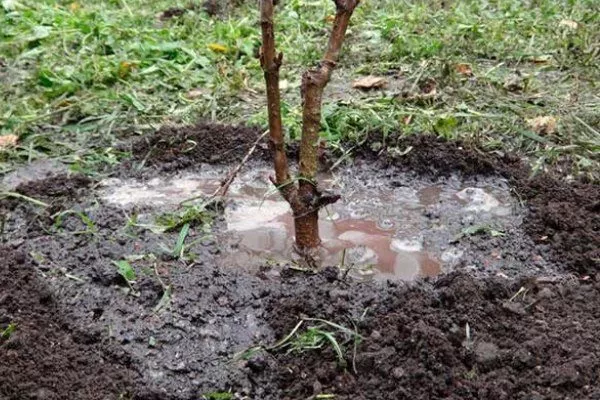
- Peach trees require special attention during the first three weeks after planting. This is a critical period for the seedling; water it frequently and do not loosen the soil to avoid damaging the roots.
- During the first month, water once every three days. The recommended watering rate is 10 liters per plant. During dry periods, use more water—15-20 liters.
- Tree trunks are mulched to slow water evaporation and weed growth. If weeds do appear, they are pulled out.
- Before fruit formation, 2-3 foliar feedings with potassium fertilizers are carried out.
- In autumn, it is recommended to spray the peach tree with Bordeaux mixture as a preventative measure.
- In the pre-winter period, organic matter and mineral fertilizers are added to the tree trunk circle.
- Peach trees are covered until the first frost. By this time, the tree should be completely bare of leaves. In the south, it's sufficient to mound the tree high; in other regions, more serious insulation is provided by covering the area around the trunk with a thick layer of mulch. For example, you can mix humus with sawdust and ash. If winters are extremely cold, the tree is completely covered. Lutrasil, spunbond, reed mats, burlap, slate, wrapping paper, wooden boards, etc. are used for insulation.
Diseases and pests
This variety is resistant to all fungal diseases. It is virtually immune to leaf curl and is not susceptible to pest infestations. Problems typically arise due to poor agricultural practices, such as fertilizer deficiency, frost damage, widespread insect infestations and infections, and other unfavorable factors. Standard fungicides and insecticides are used when symptoms of infestation appear.
Among the recommended disease treatments is Fitosporin, a highly effective biofungicide with humic acids. It not only protects the plant but also serves as a foliar fertilizer.
Among the most dangerous pests of the Vulcan peach are the oriental codling moth, peach weevil, peach bark beetle, aphids, peach mites, and peach fruit moth. Insecticides such as Skor, Aktara, Actellic, and others are used to control them.
How to harvest and store peaches?
Peaches are best picked in dry weather, in the morning or evening. Store the fruit in baskets or boxes, in a single layer, to avoid squashing.
Reviews
The Vulcan peach is an interesting variety, quite old and time-tested. While not a top-tier flavor choice, it combines many qualities that make it a very successful variety, well-suited for cultivation in a wide variety of Russian regions.