
The Saturn peach is included in the group of fig and high-yielding varieties with excellent marketability and transportability. This variety is grown for both home and commercial use by large farmers. It is characterized by its versatility, medium ripening period, self-fertility, and frost resistance.
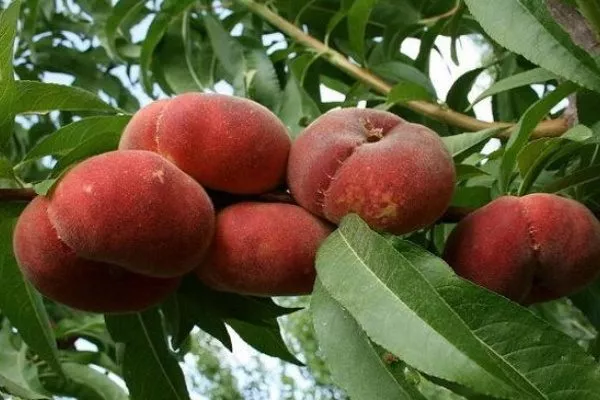
Peculiarities of the emergence of fig varieties
The fig peach originated in China, from where it spread to Great Britain and the United States in the early nineteenth century. Today, it is cultivated commercially in the United States, Mexico, Argentina, Spain, and France.
However, their fame has not faded in China, where they continue to be called Pantao. In our climate, the Saturn variety, bred in the United States in the 1960s, stands out as one of the best flat peaches.
The appearance of the tree
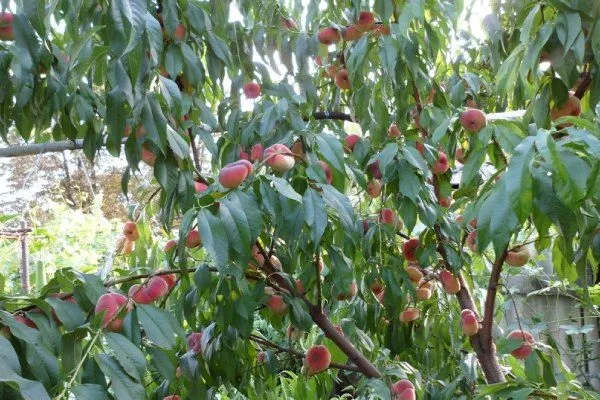
The tree is considered medium-sized, reaching a height of no more than 350-400 cm. The crown is spreading and fairly wide, characterized by a spherical shape and medium foliage. The variety can be identified by other characteristics as well:
- leaf blade – on the back side it is greyish-green, on the front side it is classic green;
- leaf shape – lanceolate, with slight pubescence on the surface;
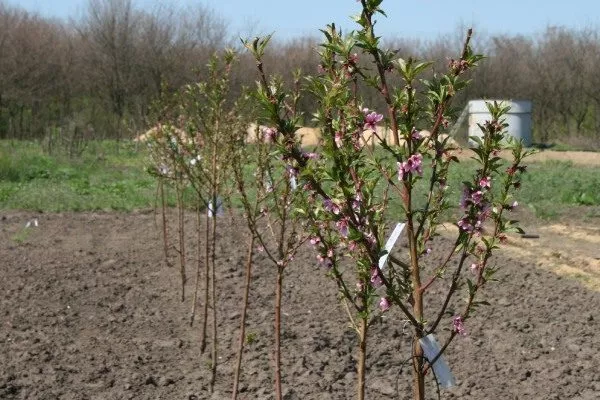
- flowers – very fragrant, pink (more pale than bright);
- stamens in inflorescences – high.
What do the fruits look like and what do they taste like?
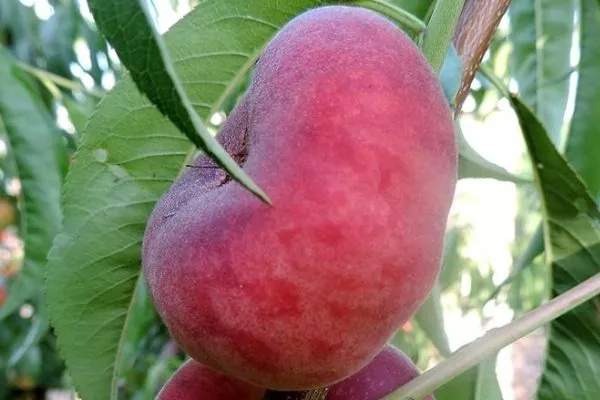
The drupe is a flattened disc-shaped fruit. It is quite large, weighing up to 120-140 g. Other characteristics:
- surface – medium pubescence;
- skin – not too dense;
- color - the main color is yellow, but a broad blush of a crimson hue spreads across it;
- pulp – with a small amount of fibers, but very juicy, creamy color;
- bone – small in size, the pulp “comes off” easily.
Ripening and fruiting
The first fruits are expected to appear in the second year. Flowering occurs in April, indicating this variety's intermediate ripening period.
The expected harvest time is the last weeks of July, but this depends on agricultural practices and weather conditions, so the exact time cannot be determined.
Productivity
The yield of this peach is comparable to other varieties, averaging 48-49 kg per tree. The harvested fruit meets all quality standards.
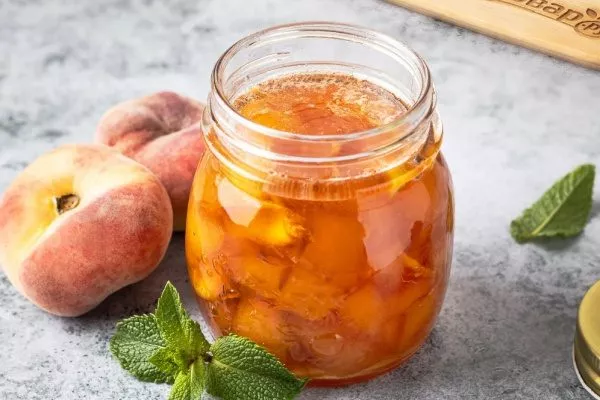
The variety is used universally - for consumption freshly picked, for cooking compote, jam, making juice and fruit drink.
Self-fertility and the need for pollinators
The Saturn peach is capable of bearing fruit without the help of pollinators, although their use is recommended to ensure the highest yields.
Requirements for soil and climatic conditions
For optimal growth, the tree prefers south-facing slopes, protected from winds and gusts. Although drought tolerance is not officially specified, reviews indicate that the variety is reasonably tolerant of drought.
Growing and care
Planting trees such as the Saturn peach is recommended in the fall before frost sets in, or in early spring after the danger of night frosts has passed. Growing tips:
- To prepare the soil for fall planting, dig a hole measuring 70-75 x 70-75 x 70-75 cm 2-4 weeks before the expected planting date and fill it with fertile soil. If the soil is too clayey, you can add sand and compost.
- Place a layer of broken brick or crushed stone at the base of the hole. Be sure to also install a stake to secure the tree.
- After this, the root shoots of the seedling are carefully spread apart and placed on the formed mound of earth, the soil is carefully filled in and compacted, leaving the graft 4-5 cm above ground level.
- Then the tree needs to be attached to the support and watered.
- The root zone should be covered with a layer of organic mulch, such as humus, sawdust or dry grass, leaving a small space around the trunk.
- The distance between plantings should be about 350-400 cm.
- During the first five years after planting, the tree needs ample watering. The average water requirement per tree is 30 to 40 liters. Once the tree reaches maturity, watering should only be done during dry weather.
- After watering, it is necessary to loosen the soil around the roots.
- The use of mulch helps to retain moisture in the soil for a longer period of time.
- In early spring, peach trees are fed with high-nitrogen fertilizers. Many gardeners prefer to apply ammonium nitrate (nitrate) to the root zone, combined with urea. It is recommended to add mineral fertilizers annually during spring tilling of the soil around the trunk. In the fall, the tree should be fed with phosphorus and potassium.
The tree responds well to organic matter – manure and humus, which are used once every two years.
Frost resistance and the need for shelter
This peach variety is marketed as frost-tolerant. However, it's important to understand that for a plant with southern roots, low-temperature tolerance is a relative term. In more severe winter conditions, protective covering will be essential.
Before the first frost, the base of the fruit tree is covered with a layer of hay, sawdust, or compost. The bark of the tree trunk is coated with lime and wrapped in burlap or other breathable material to prevent damage from frost and rodents.
Features of pruning
Pruning is performed twice throughout the season, with warm, dry weather being preferred. It's important to hold the stems of the branches by hand while pruning, as the shoots of this variety are prone to breakage.
How and what to do:
- In early spring, shorten young shoots by 3 buds, while preserving the main guiding stem branch, which should be 25-35 cm higher than the others.
- Remove branches that are close to the trunk and growing inside the bush, and direct the shoots to a horizontal position.
- Sanitary pruning includes pruning of diseased, damaged and other unnecessary branches.
- The cuts should be treated with garden pitch to prevent the spread of infection.

Advantages and disadvantages
Saturn is distinguished by many positive qualities, among which gardeners and farmers particularly emphasize the following:
Resistance to diseases and pests
Saturn's good resistance to leaf curl has been officially confirmed. To protect the plant from bacterial diseases, special attention must be paid to prevention. Saturn is not susceptible to root knot nematodes. Fruit damage by locusts is common, a common complaint among farmers.
Review of reviews
The Saturn peach is a favorite among both private gardeners and large farmers – its fruits easily withstand long-distance transportation, have a long shelf life, and have excellent marketability and flavor. It doesn't require any special care or planting. The key is to select a suitable sunny location from the start.