
Spring planting eliminates the risk of peach seedlings freezing during their first winter. If you time the planting correctly and plant the seedlings on time, the young trees will successfully establish roots, gain strength, and develop a strong immune system. In this article, we'll explore the advantages and disadvantages of spring peach planting.
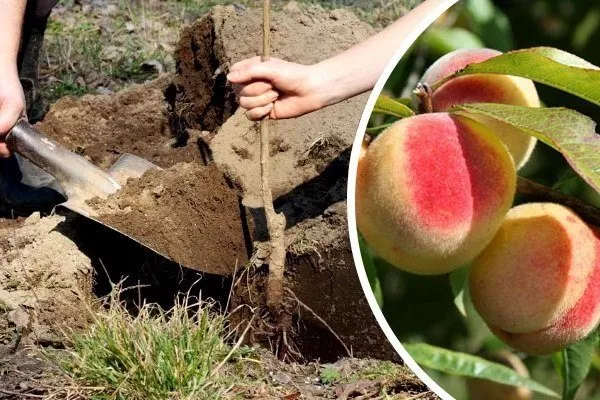
When to plant a peach?
To ensure the peach tree thrives and isn't damaged by low temperatures, it's important to plant it on time. Any mistake can lead to problems:
- If you rush and plant the seedling too early, it may suffer during subsequent frosts.
- If you delay planting, the seedling will take a long time to take root, and its immunity will be weakened.
Peaches are characterized by early growth, so it's important to plant them before the sap begins to flow. Timing varies depending on the climate. In some regions, peach trees can be planted in late March or early April, but only if the air temperature, both day and night, does not drop below 5°C.
Experienced gardeners coordinate their gardening activities with the lunar calendar. There are favorable and unfavorable days for planting peaches.
Planting peaches according to the lunar calendar for 2019:
| Months | Favorable days | Unfavorable days |
| March | — | 6, 7, 21 |
| April | 11-17; 21-26 | 5, 19 |
| May | — | 5, 19 |
| June | — | 3, 4, 17 |
Pros and cons of spring planting
Planting peach trees in spring has a number of advantages over planting them in autumn:
- Greater chance of survival. A seedling planted in the spring enters winter strengthened during the spring and summer seasons—it is better prepared for extreme conditions than a peach tree planted a month or six weeks before frost. This advantage is especially important in regions with harsh winters.
- During spring and summer, the gardener, by reacting promptly to drought, disease or pest infestations, quickly eliminates them.
- In spring, there is a lot of moisture in the soil, which promotes the rooting of the seedling and accelerates its adaptation.
Spring peach planting dates in different regions and countries
Recommended planting dates for peaches in Russia and neighboring countries:
- Volga region. There's a risk of early drought here. The recommended planting time is late March. Delaying planting will reduce the seedling's survival rate.
- Central Russia and Moscow region. Here, it is best to plant a peach in April - earlier frosts are possible, which can destroy the seedling.
- Siberia and the Urals. It's important to consider the frost resistance and ripening time of a particular variety. Here, it's best to plant varieties with the highest frost resistance and early ripening times. The recommended planting period is late April.
In Belarus, peaches are planted in early April, while in Ukraine, planting dates vary by region: in the south, planting occurs in early March, and in the north, in early April.
The video below explains and demonstrates how to plant a peach tree in the spring:
Preparing for spring planting
The peach is a fast-growing tree. If all planting conditions and cultivation practices are met, it will quickly begin bearing fruit. Successful planting depends on the correct:
- site selection;
- selection and preparation of planting material;
- soil preparation.
Characteristics of an ideal site for planting a peach tree:
- southern side of the site;
- no drafts;
- the presence of a wall or other protection from the wind.
Peaches should not be planted in the shade of other trees. Insufficient sunlight will cause the fruit to become smaller and their flavor to deteriorate.
Soil requirements
Before planting a peach tree, check the soil composition—it affects the seedling's survival rate. If the composition is unfavorable, it will need to be adjusted.
Soil requirements for planting peaches:
- The best option is fertile soil with good drainage. Peaches prefer chernozem and medium loamy soils with good air and moisture exchange.
- Peach trees can grow in any type of soil, as long as good drainage is provided. To achieve this, add stones, gravel, or broken brick to the bottom of the planting hole.
- Light sandy soils with a high groundwater level are not suitable.
- Waterlogged and heavy loamy soils are not suitable.
Fertilizers
The soil for planting is dug over in the fall. Digging oxygenates the soil. If the soil is deficient in micronutrients, this deficiency is corrected a year before planting.
The soil for planting a peach is prepared as follows:
- Manure, wood ash, superphosphate and potassium chloride are added during digging.
- A soil mixture made from topsoil and fertilizer is added to the planting hole. The hole is filled 2/3 full. The soil mixture consists of:
- wood ash – 200 g;
- rotted manure – 6 kg;
- superphosphate – 200 g;
- for 2 parts topsoil – 1 part peat.
The soil mixture added during planting is subsequently amended each spring. If the soil is fertile, then planting is limited to adding ash and complex mineral fertilizers.
Respect for the neighborhood
Peaches should not be grown in areas where strawberries, melons, or nightshades were grown, as these crops are susceptible to diseases that are dangerous to the tree. It is not recommended to sow alfalfa and clover in areas where peach seedlings are planted, as they can stifle the growth of young trees.
It is not recommended to plant peaches near:
- apple trees;
- apricots;
- pears;
- walnuts;
- cherries;
- cherries.
When a peach tree is planted near cherries, the side adjacent to these trees gradually becomes bare. The tree's immunity declines, the branches begin to dry out, and gum begins to leak from them. This peach tree freezes in winter.
What is the distance between seedlings?
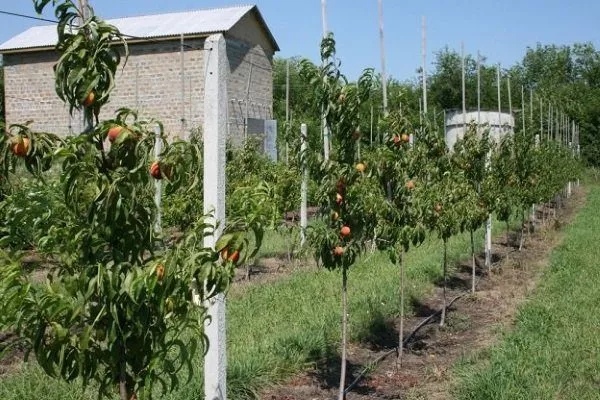
As the peach tree matures, it develops into a spreading tree. It's important to plan ahead for spacing between neighboring trees—trees in the garden shouldn't interfere with each other. There should be at least 3.5-4 meters between trees, and 5 meters between rows. If the spacing isn't maintained, the plants will gradually crowd each other out.
Planting hole
Pits for spring peach planting are prepared in the fall, before the cold weather sets in. If multiple trees are being planted on level ground, the rows are arranged from south to north. If on a slope, the rows are directed across the slope.
Approximate dimensions of the planting hole:
- Depth – 60-70 cm.
- Diameter – 50-60 cm.
Place drainage material on the bottom immediately, and then add potting soil on top. Over the winter, the soil will settle to the desired level.
How to choose a seedling?
Rules for selecting seedlings:
- Buy peach seedlings, as well as any fruit trees, only in nurseries and specialized stores.
- Before you buy a seedling, decide which variety you need. To do this, read the article about the best varieties of peachesConsider its frost resistance and ripening time—the peach should be suitable for the climate of your region.
- Inspect the junction between the rootstock and scion—it should be smooth. No sap or burls are allowed.
- Inspect the roots and bark. Cut off a piece of the root with pruning shears; the cut should be white. This confirms the seedling is alive. Also check the health and freshness of the seedling by chipping off a small piece of bark; the underlying layer should be green, not brown.
- ✓ The presence of at least three main roots with a length of 20 cm.
- ✓ No mechanical damage to the bark and roots.
Preparing the seedling
Nurseries sell the majority of seedlings in the fall. Therefore, many gardeners, having purchased planting material in the fall, bury it until spring. Such seedlings must be handled with particular care—heat and moisture cause their buds to swell early, which are easily damaged if handled roughly.
How to prepare a seedling for planting:
- Before planting, inspect the seedling. If it appears sickly or weak, it likely lacked moisture. Soak the roots in water for 24 hours. If desired, add a root stimulant such as Zircon or Kornerost.
- Trim off any dry or damaged roots. Damaged roots can be identified by their color—they're gray or brown. Trim down to the white part.
- If the seedling was purchased just before planting and is being transported to the planting site, wrap its roots in a damp cloth. Wrap it in plastic wrap to retain moisture. Trim the leaves.
Landing algorithm
If the planting time has come, the hole is ready, and the seedling is prepared, follow this plan:
- Insert a support into the hole—a wooden stake or concrete post. The support should be long enough so that, when it reaches 50 cm into the ground, it is 20 cm below the base of the seedling's crown.
- The hole contains loose soil mixture, which was added in the fall. Make a hole in it large enough to comfortably accommodate the roots of the seedling.
- Pour two buckets of water into the hole you made and wait for the soil to absorb the moisture.
- After spreading the roots, place the seedling in the center of the hole. The distance from the root collar to the ground level should be 3-4 cm.
- Shaking the seedling occasionally, cover its roots with fertile soil. Shaking helps fill the spaces between the roots.
- Compact the soil around the base of the seedling with your hands.
- Form a 10 cm high ridge around the seedling.
- Attach the peach to the support with soft rope.
- Water the tree with two buckets of water. Once the water has been absorbed, level the tree.
- After a day, loosen the soil around the peach tree, and then sprinkle it with mulch (you will learn about mulching Here) – peat, straw, humus.
Tree care
When planting a peach tree in the spring, its growth and development are immediately monitored. Future harvests and the health of the peach tree depend on timely and proper care.
Watering
To ensure the peach tree takes root well and prevents its roots from drying out, it's important to regularly moisten the soil. If there's no seasonal rain, water the tree weekly. The recommended watering rate is two buckets of water per peach tree.
A small mound is created around the tree to retain moisture and prevent the soil from drying out. To prevent crusting after watering and to ensure good soil aeration, the area around the tree trunk is mulched with humus, compost, and straw.
Protection from diseases and parasites
Peach needs regular preventative protection from pests.
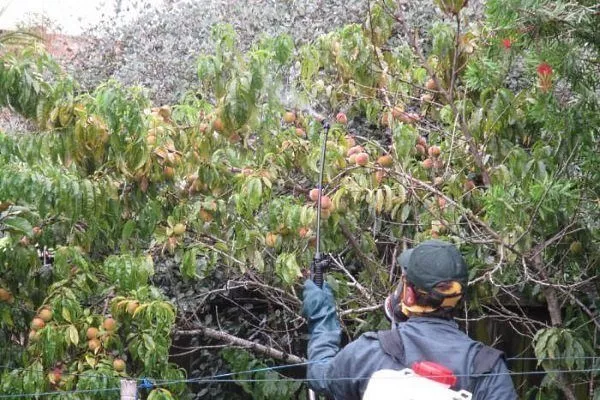
A set of protective measures is recommended:
- whitewashing the trunk in spring;
- spraying before the buds begin to emerge;
- spraying at the budding stage;
- post-flowering treatment.
Spring spraying helps protect trees from a wide range of diseases and pests. Moreover, it's possible to spray with both fungicides and insecticides.
Most often, peach is affected by leaf curl, and its main pests are:
- pliers;
- fruit moth;
- weevils;
- aphid.
Processing scheme from diseases and pests of peaches:
| Tree development period | Diseases and pests | What do they use? |
| Swelling of the buds | Clasterosporium leaf curl | Copper-containing drugs |
| Pink buds | Aphids, flower beetles, leaf rollers, fruit moths, weevils | Condifor, Delan |
| Bloom | Moniliosis | Horus |
| End of flowering | Scab, curliness | Horus, Delan |
| 2 weeks after flowering | Mites, powdery mildew | Skor |
Top dressing
In the first year after planting, the peach tree doesn't need any additional feeding—adequate fertilizer is added to the planting hole and to the soil during digging. However, in the second year, fertilizer will be needed: early in the spring, apply nitrogen fertilizers, urea, or carbamide at 120 g per square meter, as well as ammonium or calcium nitrate at 60 g per square meter.
What else is useful to know about fertilizers:
- Sod-podzolic light soils with a small percentage of organic matter are annually fertilized with mineral and organic fertilizers.
- Podzolized soils are fertilized once a year with nitrogen, phosphorus, potassium and, somewhat less frequently, organic fertilizers.
- When applying fertilizer, consider the frequency of garden watering. The more frequent the watering, the more fertilizer is washed away. Therefore, a regularly watered garden requires more fertilizer.
The key to successful spring planting is autumn preparation and precise timing. If everything is done correctly and the young tree's needs are met promptly, the peach will thrive and delight you with its first fruits within 3-4 years.