
Apricots are delicate plants that require proper attention and care. A good harvest of ripe fruit can only be achieved by putting maximum effort into choosing the right variety, planting the young plant, preparing the soil for planting, and subsequent care.
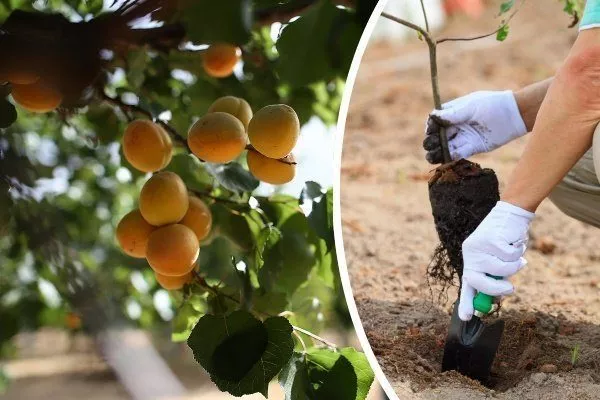
Selecting and preparing seedlings for planting
When selecting an apricot tree for fall planting, the characteristics of the specific variety and its winter hardiness should be taken into account. The planting material should be suitable for the climate zone in which it will grow. This is important to avoid frost damage.
Before choosing a seedling, we recommend reading our article about the best varieties of apricots.
When selecting a specific seedling for a future apricot tree, pay attention to the following important details:
- The trunk of the seedling must contain a clearly visible grafting zone. This indicates that the tree belongs to a specific variety and guarantees the ripening of fleshy and sweet fruits when compared to trees grown from seeds.
- When choosing a seedling for fall planting, it should be two years old. This stage is the most favorable for the plant's adaptation to its new location.
- The selected specimen cannot contain any kind of damage, cracks in the bark, the main trunk must be stronger than the side shoots, without thorns.
- The apricot tree should be between 1 m and 1.5 m tall. Anything higher or lower indicates improper tree care, as well as an excess of nitrogen-containing fertilizers.
- Apricot seedling roots should consist of one main shoot and two or three lateral shoots, each 20-25 cm long. They should not be broken, rotten, or overdried.
- ✓ Check for the presence of a varietal certificate.
- ✓ Make sure there are no signs of diseases or pests on the bark and leaves.
Don't buy seedlings with obvious signs of vegetative growth. Such trees will quickly die.
The shade of the bark plays a significant role when selecting an apricot seedling:
- A red trunk or one with a dark shade of brown is typical for winter-hardy varieties;
- A light green trunk is typical of southern fruit trees.
- ✓ The presence of live, not dried out buds on the branches.
- ✓ No mechanical damage to the trunk and branches.
What kind of soil is suitable?
The main requirement for soil for planting apricots is excellent air permeability. This is essential for the plant's root system, which requires a regular flow of atmospheric air during the growing season.
Even short-term excess moisture can negatively impact apricots. Flooding in the area where the seedling is located often results in the tree's death. Wilting leaves will help you notice the deterioration of the plant's condition.
When choosing a site for planting an apricot tree, consider the soil composition. Black soil is ideal. Sandy loam and medium loam soils are suitable because they allow moisture, air, and solar heat to pass through well.
Planting apricot trees in soils with high clay content is not recommended, as they retain water, leading to slower growth during the cold season and, consequently, poor wintering and fruiting. Soil pH can be slightly alkaline or neutral.
Acidic soils require liming and the addition of dolomite flour. Planting in sandy soil requires adding a layer of clay to the bottom of the hole, and in clayey soil, a layer of sand. This simple step will give the tree a chance to develop a strong and robust root system until the roots reach the main soil.
Soil preparation
Before planting apricots, prepare the land by digging the soil to a shovel's depth and clearing it of weeds and roots. Next, level the surface soil, fill in any depressions, and remove any high spots.
The ideal method is to prepare the soil for apricot trees 1-2 years before planting. The soil is cultivated to improve soil fertility. In the fall, the area should be plowed to a depth of 15 cm around the trees.
Selecting Fertilizers
To ensure the seedling adapts and thrives, the planting hole must be fertilized with nutrients and minerals. Therefore, it's best to fill it with a special mixture of the following components:
- 1.5 shares of the top soil layer;
- 5 parts of soil from rotted leaves;
- 1 share of mullein;
- 60 g of wood ash;
- 50 g superphosphate.
These ingredients must be mixed and the hole filled with fertilizer 7 days before planting.
Nitrogen-containing fertilizers are not applied at planting. This negatively impacts plant establishment and significantly prolongs the adaptation period.
Preparing the planting hole
Planting an apricot seedling in the ground in the fall requires special soil preparation. If you decide to plant the seedling in airy loamy soil with zero or slight acidity, it's best to prepare the soil in advance:
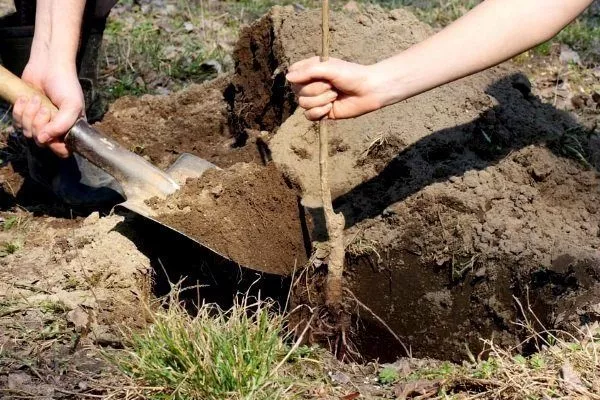
- After September 15th or early October, dig a 0.5-meter-deep hole, 50 cm deep and 60-80 cm wide, in the selected area. Drive a wooden stake 1.5 meters high into the hole and add drainage (pebbles, broken brick, or crushed stone).
- Fertilize the dug soil in a 2:1 ratio with peat and humus, add 500 g of superphosphate and 1.5-2 kg of wood ash and mix everything.
- Pour the prepared soil into the hole and form a mound, leave it until planting time, so that the soil settles a little.
Before planting, prepare the plants. If you purchased a young tree with a covered rhizome, remove the packaging and shake off the seedling when replanting. All steps should be done carefully to avoid damaging the rhizome.
Apricot plants with exposed roots are inspected for dried or rotted roots that require removal. Healthy roots are trimmed back by a third of their length. The tree is then immersed in a clay mixture with added mullein. This will prevent the apricot from drying out and soften the initial contact with the soil when planting.
Boarding procedure
Planting and initially growing an apricot tree requires continuous care and protection from harmful insects and diseases. If frost is likely, it is recommended to use plastic insulation for still-weak plants.
To ensure rapid rooting of a seedling, it's important to follow a specific planting procedure. Ignoring any of the following steps is unacceptable:
- Soak the apricot root 24 hours before planting. This will restore biological processes in the root system and nourish the roots with moisture.
- Make a clay mixture with manure until the texture resembles sour cream.
- Dip the tree rhizome into the prepared mixture and wait for the roots to dry.
- Prepare a hole in the planting hole the size of the roots and water it well.
- Place the tree in the center of the depression and remove any broken roots.
- The root collar of the apricot should be 4-5 cm above the ground.
- Cover the rhizome with soil and compact the soil to eliminate the voids between the roots.
- Create a 10cm high edge around the planting hole.
- Tie the apricot to the support with a cord and fix it in a precise position.
- Water the tree generously with 2 buckets of water, then smooth out the edge.
- Conduct soil mulching around the trunk circumference with a 4 cm layer of peat mixture or humus.
Fall planting is the ideal opportunity to ensure good conditions for hardening off the seedling. This is achieved by allowing a month between the first frost and planting. This time is sufficient for the plant to successfully establish itself and survive the winter.
Apricot planting scheme
Apricot trees thrive on light and warmth, but do not tolerate gusty winds or cold air currents well, so it's recommended to prepare planting holes in advance. The distance between trees in the garden should be more than 3-4 meters.
The planting hole should be 0.5 meters deep and at least 0.8 meters wide. The bottom should be lined with drainage material, topped with a fertile layer of soil, and the plant should be placed in the hole.
We apply fertilizers
Growing an apricot tree isn't particularly difficult. Once the tree begins bearing fruit, it's important to apply fertilizer once a year, using 8 g of superphosphate, 30 g of ammonium nitrate, and 20 g of potassium salt per square meter of trunk circumference.
Organic fertilizers are applied once every three years. Apricot crops respond well to nitrogen-containing fertilizers. However, it's important to remember that an excess of such fertilizers can delay fruit ripening and gummosis, and also reduce apricot resistance. diseases.
Watering
A planted apricot tree requires moisture from the very beginning. When planting seedlings, small roots, which play a key role in moisture absorption, are often torn. Larger roots can also absorb water if they are in firm contact with the soil. Therefore, planting requires ample watering in all weather conditions.
Water, by filling the entire "vacuum" around the roots, promotes maximum soil compaction, ensuring optimal water supply during the tree's first months of life. Planting in the fall makes caring for the seedling easier—it only needs to be watered once, and rain will take care of the rest.
Apricots do not tolerate excess moisture well, so retaining moisture near the rhizome is undesirable. Compared to apple and pear trees, apricots prefer to dormant in dry soil. Even a small amount of water creates the conditions for root growth, which is undesirable before winter.
Do I need to prune an apricot tree when planting it?
After planting apricots in the fall, it's important to perform formative pruning every year in early spring. Prune away weak and frozen branches, as well as the tallest and densest branches. The cuts should be treated with garden pitch. Apricot seedlings grown from pits lack a central trunk, which allows for precise shaping.
Pruning is important for the growth and ripening of apricots. They need to create a crown and remove parasitic branches. To achieve this, the crown is pruned, after which the plant is tied to a sturdy base to ensure proper ripening. Learn how and when to prune apricots from this article.
One-year-old shoots are pruned to 80 cm above the ground. Skeletal branches of fresh apricots are shortened by one-third, leaving the main trunk 30 cm above nearby skeletal shoots. Numerous branches growing from a single point are prohibited. In the spring, fruiting branches are slightly pruned, stimulating bud growth on other shoots.
In his video, a gardener shares his experience planting apricots in the fall:
Caring for a tree after planting
To speed up the rooting of the seedling in its new location, it is recommended to fertilize it with rooting agent at a rate of 5 g per 5 liters of water. All subsequent care of the tree includes timely watering, in the absence of rain, and preventing overwatering and drying out of the root system.
The appearance of initial signs of pests and diseases requires spraying with special solutions. During the first months of the seedling's life, no additional feeding is necessary, as all nutrients and minerals were added to the hole before planting.
Planting apricot seedlings in the fall is considered the best option, as this method allows the tree to fully adapt to its new location by spring. To speed up rooting, simply water the apricot properly and prepare it for the upcoming winter.