
Peach leaf curl is considered a common affliction, resulting in fruit and leaf loss, as well as poor tree growth and development. Peaches require special care and attention. Any improper handling or treatment can cause irreparable damage to the health and development of not only a young sapling but also a fully mature tree.
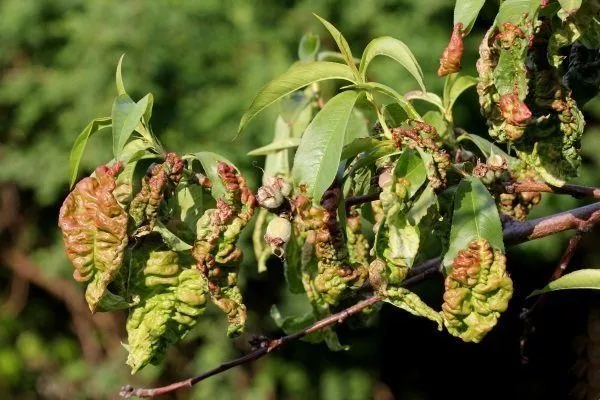
How does the disease manifest itself and what is the danger?
Peach leaf curl is a fungal disease that appears in the spring. With the arrival of warmer weather, shoots begin to grow vigorously, and the fungus quickly overwhelms the peaches. The disease manifests itself on young foliage and shoots. Leaves that are five days old are more likely to become infected than their two-week-old counterparts.
The disease manifests itself as blister-like growths on the leaves. Initially light green, they later acquire an amber-reddish color, and then turn brown with a waxy gray coating. This is where the fungal spores mature.
The blisters on the foliage gradually become brittle, and the leaves themselves thicken, dry out, turn black, and fall off. First, the lower ones, then those in the middle of the shoot. Eventually, only a few leaves remain at the tip of the shoot.
Shoots aged 1-2 years and the branches themselves are affected. They become yellow, thickened, and twisted, and soon dry out. Trees without shoots cease to bear fruit. Affected buds die off in the first year of infection, without producing fruit. If they do form, they are deformed.
Symptoms of plant damage
The disease manifests itself early in the growing season. Young, newly opened leaves are characterized by a yellowish or reddish-pink coloration and a corrugated surface.
Affected leaves are much larger than healthy green ones. Over time, the undersides of infected leaves develop a waxy white coating—the result of fungal sporulation. Diseased leaves soon turn brown and fall off, exposing the base of the shoot. Infected shoots dry out, while surviving ones usually freeze at the onset of frost.
Failure to spray a peach tree for leaf curl, or not spraying it in a timely manner, will ultimately result in the entire tree being bare. It will weaken and will likely not survive the next winter frost.
Removing affected leaves
Removing infected leaves from peach trees is considered a preventative and sanitizing measure. This should be done in the spring or fall.
Spring pruning involves cutting off curl-infected and dried shoots before swollen buds. These should be collected and burned outside the garden plot to prevent the spread of fungal spores.
In the fall, branches with obvious symptoms of the disease are pruned, fallen affected leaves are collected, taken to a remote area and burned.
How to combat peach leaf curl?
Control of unsightly leaf curl on peach trees includes:
- removal and burning of infected parts of wood;
- loosening the soil between plants;
- autumn and spring spraying with a sulfur-lime solution.
Peaches are very susceptible to leaf curl. Therefore, seedlings must be carefully inspected during the growing season to detect the disease. Prolonged wet weather increases the risk of spreading the disease.
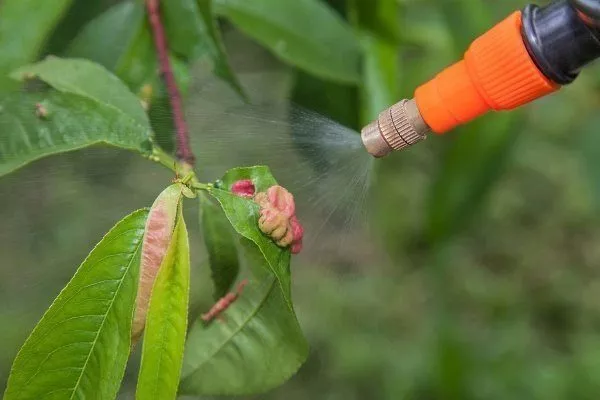
Agrotechnical control measures
Pruning of affected branches should be carried out using the following tools: garden knife, saw;
- pruning shears;
- lopper.
Instruments must be sharp and disinfected.
Peach trees don't take kindly to any disturbance. Therefore, to prevent the plant from becoming diseased, pruning must be done quickly and correctly, with subsequent treatment of the cuts if necessary.
Chemical control measures
To effectively treat peach leaf curl, fungicides containing copper (Skor, Raek, Folpan), 3% Bordeaux mixture, and copper sulfate are used.
To use "Skor" you need to:
- for 100 square meters of garden, dissolve 1 capsule (2 ml) of the product in 10 liters of water;
- The therapeutic effect is achieved after 5 days, prophylaxis lasts 10 days.
The use of "Abiga-Peak" occurs as follows:
- 40-50 g of the preparation is dissolved in 10 liters of water;
- spray 4 times at intervals of 14 days.
The products are non-toxic and virtually harmless to hobby gardeners and the environment.
What to spray against curl?
Gardeners consider copper-containing products to be the most optimal products for combating the disease, as they effectively destroy the fungal disease and the harmful insects that spread it.
Biological products (Guapsin, Planriz, Trichodermin) have become widely used. They have no negative impact on green plantings and do not accumulate inside seedlings.
These products combat the disease before and after peach tree flowering. During fruiting, the products do not affect the taste of the fruit. The effects of bacterial sprays become apparent within 2-3 days.
- ✓ Spray in calm weather to avoid the product drifting onto other plants.
- ✓ The air temperature should be between 12-25°C for maximum effectiveness of the drugs.
Experienced gardeners recommend a combination spraying method, which is widely used and produces positive results:
- Early in spring, before buds open, apply a 3% copper sulfate emulsion or Bordeaux mixture.
- Time of the pink ovary phase: if the temperature is less than 20°C – “Horus”, if more than 20°C – “Stroby”.
- Immediately after flowering - "Skor", "Tilt".
- 14 days after the last treatment (in obvious areas of infection) – “Skor”, “Bayleton”.
- After the leaves have fallen - 3% solution of copper sulfate, Bordeaux mixture.
Clay processing
They are treating peach tree diseases Using traditional methods. One effective method is a clay solution with lime, which has fungicidal properties and increases the peach trees' self-defense against fungus.
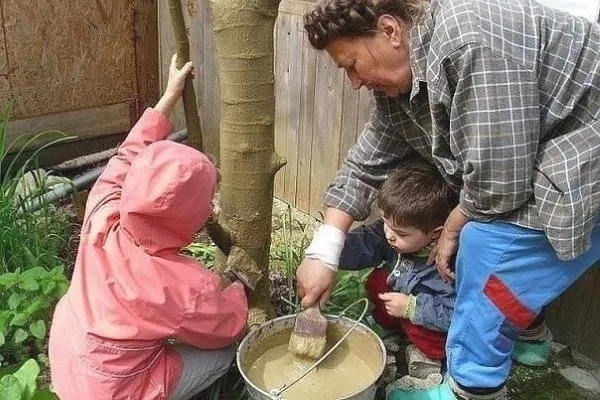
To prepare this miracle cure, take:
- 10 liters of water;
- 350 g soft clay;
- 90 g quicklime (pre-slaked).
- ✓ Use only soft clay without sand for better adhesion to the leaves.
- ✓ Lime slaking should be carried out in advance, at least 24 hours before preparing the solution, to avoid leaf burns.
Then:
- combine water with added clay;
- stir well;
- Pour the white milk in a weak stream.
The mixture must be uniform, without any sediment. Make the emulsion solution precisely at the time of spraying.
Treatment with Bordeaux mixture
Bordeaux mixture has varying effectiveness depending on how it's prepared. The most effective solution for treating fungal infections is a 3% Bordeaux mixture, made by adding a diluted solution of copper sulfate to white milk.
To treat a peach seedling, prepare a 3% Bordeaux mixture as follows:
- per 10 liters of water, take 300 g of copper sulfate, 300 g of slaked lime;
- dissolve copper sulfate in 5 liters of warm water;
- separately in a container (non-metallic) dissolve lime milk in 5 liters of water;
- Pour the copper sulfate mixture in a small stream into the lime milk, remembering to stir constantly.
Please note that the quality of Bordeaux mixture will be poor if you mix strong solutions of copper sulfate and lime milk, or if you pour a strong solution of copper sulfate into a weak solution of lime milk.
How to speed up the recovery of a damaged peach?
Rehabilitation of trees after disease is possible by taking the following measures:
- Ensure the supply of the required amount of nutrients: systematically fertilize the soil with minerals and organic matter.
- In autumn, take care to protect weak seedlings from freezing in winter.
- If trees have been damaged by frost, perform proper pruning to restore foliage. For severely damaged trees, remove all buds.
- Carry out treatments with various immunostimulating drugs, growth stimulants, and phytoactivators of disease resistance: (Stimmunol, Novosil, Zircon).
Peach shoots need to be pruned depending on the level of damage to the wood:
- If some of the buds have frozen, but the wood is not damaged, cut out the branches without flowers;
- if all ovaries are damaged or shoots are frozen, cut off longitudinal branches up to 4-5 year old wood and transfer them to lateral branching;
- If skeletal shoots are affected, prune in the summer (in June), when new branches grow from the awakened buds and it will be possible to assess the picture of the wood infection.
Correctly performed measures to restore a peach tree after an illness will increase the chances of the tree recovering and obtaining a good harvest.
In his video, a gardener talks about how he saved a peach tree from leaf curl:
Disease prevention
Timely measures will protect peach trees from a parasitic disease that is easier to prevent than to cure.
Protective measures are carried out before the ovaries open, early in the spring. In different regions of Russia, the timing of preventative treatments varies depending on the weather conditions: in the south, treatments are carried out in early March, while in northern regions, they are carried out in April. The final treatment is carried out in the fall.
Begin preventative measures against foliar damage in the fall. As soon as the air temperature drops to 5 degrees Celsius, carry out the following procedures:
- cut off infected trees and spray with copper sulfate or a gray-lime solution;
- clear the area around the trunk of debris, burn leaves and branches, loosen the soil;
- in early March, treat the tree by spraying it with a 1% mixture of copper sulfate;
- repeat the procedure after 7 days;
- It is possible to use a 3% solution of Bordeaux mixture.
To reduce the risk of disease, choose dry, sun-free garden areas for planting peach seedlings.
Disease-resistant peach varieties
| Name | Disease resistance | Ripening period | Productivity |
|---|---|---|---|
| Golden Moscow | High | Average | High |
| Early Kyiv | Average | Early | Average |
| Golden Jubilee | High | Average | High |
| Early Simferopol | Average | Early | Average |
| Early Kuban | High | Early | High |
According to gardeners, peach tree varieties with yellow, fleshy fruit are less susceptible to leaf curl. The following varieties have been shown to be the most resistant to fungal diseases:
- Golden Moscow;
- Kyiv early;
- Golden Jubilee;
- Early Simferopol;
- Early Kuban.
Regardless of the peach variety chosen, prevention is the best way to protect the plant from leaf curl. Peach trees are delicate, heat-loving areas. The tree will quickly die if proper agricultural practices and preventative measures against fungal and pest damage are not followed.
Limestone isn't actually slaked, because it's a rock. It's slaked lime, either in piles or as slaked lime for processing solutions. LIMESTONE and LIME are NOT the same thing.
My mother-in-law also says "limestone" when she means lime. This is a common saying among the common people, but as you, Natalia, rightly pointed out, it's not entirely true. Lime is made from limestone (a type of rock). The calcium in lime reduces soil acidity, which means it's easier for plants to absorb important micronutrients from the soil. Lime also reduces nitrate levels in the soil, increases crop yields, and helps plants become less susceptible to fungal diseases and better able to withstand stress and drought. It's a good and inexpensive product!