
When growing hazelnuts, it's important to familiarize yourself with all planting and propagation methods in advance, and understand the requirements of agricultural technology—how and when to water, what fertilizers to apply, and other necessary steps. Only then can you achieve maximum yield, obtain large fruits, and prevent tree diseases.
Botanical description
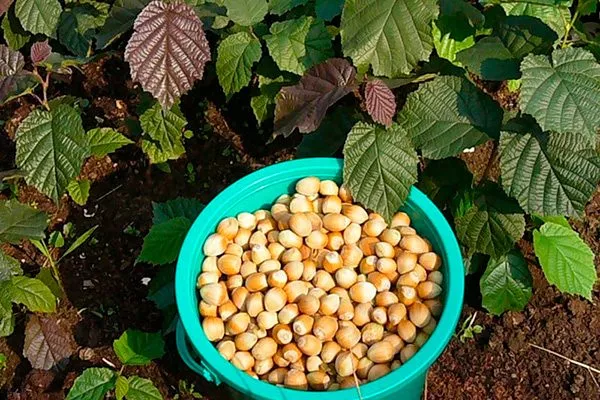
Hazel, also known as filbert, is a shrub-like tree that grows up to 6-8 meters in height. There are over 20 varieties, but they all share similar characteristics:
- crown – round, broadly oval or conical;
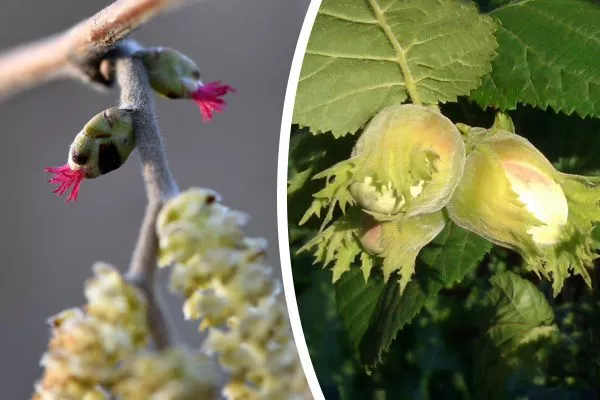
- flowers are unisexual and monoecious, contributing to the formation of cylindrical catkins and kidney-shaped inflorescences;
- flowering – from the end of March to mid-April;
- nuts – about 2 cm (diameter), spherical, yellow-brown in color.
The root system deserves special attention from the gardener—its type determines the planting method and pattern. Features:
- root length – 50-70 cm;
- skeletal roots – horizontally located at a depth of 25-30 cm;
- the growth is numerous.
Selection of varieties by region
| Name | Disease resistance | Ripening period | Fruit size |
|---|---|---|---|
| Academician Yablokov | High | Average | Large |
| Ivanteevsky red | Average | Early | Average |
| Early Moscow | High | Early | Large |
| Kudraif | Average | Average | Average |
| Firstborn | High | Late | Large |
| Moscow Ruby | Average | Average | Large |
| Tambov early | High | Early | Average |
| Sugar | Average | Late | Large |
| Confession | High | Average | Large |
When growing hazelnut You need to focus on climate conditions. There are varieties suited to specific regions. Large-scale hazelnut production is currently only widespread in the Adygeya region. Despite this, bountiful harvests are also achieved in other regions of the country:
- Central Russia, Belarus. The central part, which is also part of the Middle Belt, is famous for its moderate continental climate, where snowy weather prevails in winter, there are no excessively sharp temperature changes, and the summer is relatively cool.
For such conditions, breeders have developed special varieties: Academician Yablokov, Ivanteevsky Red, Moskovsky Ranniy, Kudraif, Pervenets, Moskovsky Rubin, Tambovsky Ranniy, Sakharny, Priznanie. - North, Siberia, Urals. The climate in these regions is mixed, so it's advisable to use universal varieties with maximum frost resistance. The short summer season plays a key role.
The optimal varieties are Alida, Lentina, Biysk red-fruited and green. - Southern regions. Absolutely all varieties are suitable for such a warm climate (22 of them are registered in the State Register of Russia), but there are also those that prefer exclusively southern weather - Adygeysky-1, Kavkaz, Ata-Baba, Cherkessky, Kuban, President, Rimsky, Louise, Panakhessky.
When to plant?
There are only two periods for hazelnut plantings - autumn and spring. Each season has its own characteristics.
Autumn planting
Young trees or seeds can be susceptible to frost damage, so they are planted in the fall 15-20 days before the expected first frost. During this period, it's important to properly prepare the seedlings—they should be leafless. They must have at least three shoots per bush (1 to 1.5 cm in diameter) and a well-developed root system.
Choose roots 50-60 cm long, but trim them back to 25 cm before planting. Be sure to prepare the planting hole 30 days in advance and add fertilizer.
How to plant in spring?
Unlike autumn planting, in spring, the leaves are left on the cutting, but only the top ones. The hole is prepared before the first autumn frosts, after which it is covered with thick plastic film. This will ensure proper soil compaction and moisture saturation.
This will allow the seedling to take root and grow faster. For this reason, experienced gardeners recommend planting hazelnuts in the spring.
Growing from a nut
Hazelnuts reproduce successfully by seeds, which produce nuts that are eaten as food. However, there is a significant drawback: the seedlings take too long to germinate and grow.
Choice
Not all nuts germinate and take root, so it's important to use only high-quality planting material. Key criteria for seed selection:
- collect fully ripe specimens (from the end of September to the beginning of October);
- only large nuts are selected;
- There should be no signs of rot, damage, or presence of insects on the surface of the shell;
- the core inside must be healthy;
- the nut should be heavy;
- harvest - only this year;
- Pay attention to the variety – it must be adapted to your climate.
Soak
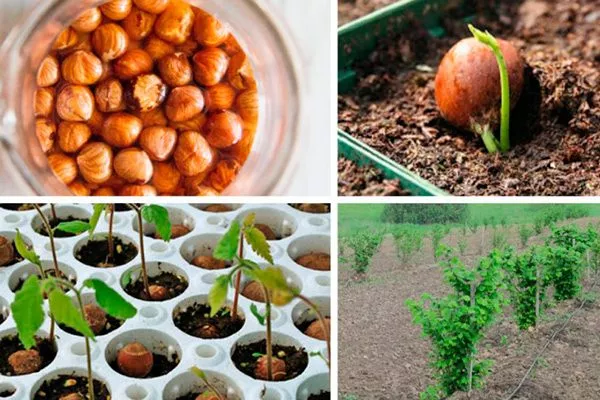
To speed up germination, soak the nuts in warm water for 48-60 hours. Replace the water at least twice a day with fresh, warm water. Additionally, be sure to disinfect the nuts by soaking them in a pink solution of potassium permanganate (medium strength) for 30 minutes. This will protect the plant from infection.
Stratification and germination
To germinate a nut, it undergoes stratification, which involves placing the nut in a specific substrate. Here's how to do it correctly:
- Choose a wooden box or plastic container. Poke holes in the bottom to allow drainage after watering. Make sure to provide a tray to collect this water.
- Mix equal parts turf and fallen leaves. Spread the mixture in a layer of about 10 cm at the bottom of the container.
- Pour a layer of river sand on top, about 5 cm thick.
- Place the nuts on the sand. Hazelnuts can be combined with other varieties, even chestnuts and acorns.
- Spray the fruit generously with a spray bottle. Make sure the water also penetrates the leaf and soil substrate.
- Cover with leaves immediately. Hornbeam or beech are the best, as they don't contain large amounts of tannins.
- Re-moisten by spraying.
- Place them on a balcony or in a basement, but the ideal solution is to bury them in the ground so that snow can fall on them. Don't plant nuts in open ground; it's important to use a box to prevent rodents and pests from destroying the planting material over the winter.
If winters are not snowy, add another layer of foliage. - In the spring, wait until the snow melts and inspect the planting. If the seeds were of good quality, you'll see young shoots.
Now all that's left is to transplant the hazelnut to its permanent location. If the climate is harsh, it's best to transplant it into a pot. Grow the seedling there for two years.
Growing from a seedling
This method allows you to quickly get a healthy tree, and therefore a better harvest. Planting material can be purchased at a nursery, garden center, or market, or grown yourself. There are many ways to do this.
How to choose?
Regardless of how you obtained your seedlings, you need to select the very best specimens from the mass. Pay attention to the following key criteria:
- Type of cutting. It can be either closed-root or open-root. In the former case, you can't see the condition of the roots, but they won't be dried out. In the latter case, you can carefully inspect each shoot and trim off any damaged ones, but the roots may dry out a bit.
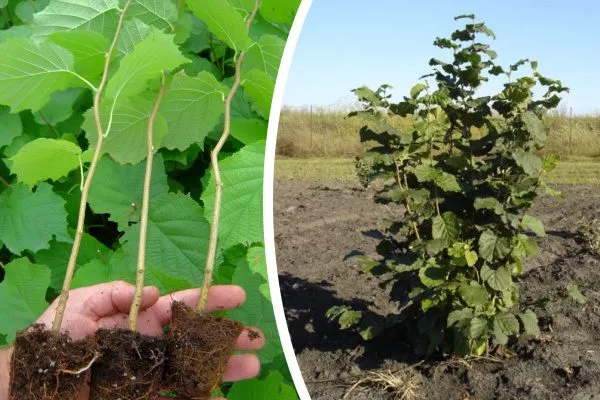
- Aboveground part. It should contain at least three stems, a maximum of six, and must have live buds. The leaves should not be yellow or dry. Height: 1 to 1.3 m.
- Age. The best choice is a two-year-old plant. This way, fruiting will begin the following season. If you buy or use a one-year-old cutting, you'll have to wait another season; if it's older, planting may be a challenge, as the roots have grown too much.
- Root system. Well developed, with shoots on the sides and several shoots in the crown.
- ✓ Check for at least 3 shoots on the bush with a diameter of 1 to 1.5 cm.
- ✓ Ensure a well-developed root system with roots 50-60 cm long before pruning to 25 cm.
Preparation before planting
Before planting, carefully inspect the cutting, starting from the tip and ending at the roots. If the roots are too long, trim them to 25 cm. Be sure to remove any leaves. To speed up rooting, soak the seedling in a manure solution (slurry) for 10-15 minutes.
Growing
Growing hazelnuts isn't as difficult as it might seem at first glance. The key is to plant them correctly and follow proper care guidelines.
Growing conditions
Hazelnuts bloom early, as they are considered frost-hardy shrubs. For example, their roots and stems easily tolerate temperatures down to -40°C (-40°F), flower buds can withstand temperatures down to -30°C (-22°F), and bud swelling can withstand temperatures down to -10°C (-12°F). Despite these favorable characteristics, hazelnuts struggle with strong cold winds, which damage the flowers and prevent fruit from setting.
Other considerations when choosing a site:
- the presence of shade and even shaded areas is completely excluded - the hazel needs a lot of sun;
- the surface of the land must be level, so slopes and valleys are not suitable;
- groundwater level – no more than 1.5 m;
- side of the site relative to buildings – south, west;
- location next to other garden trees – minimum 4 m.
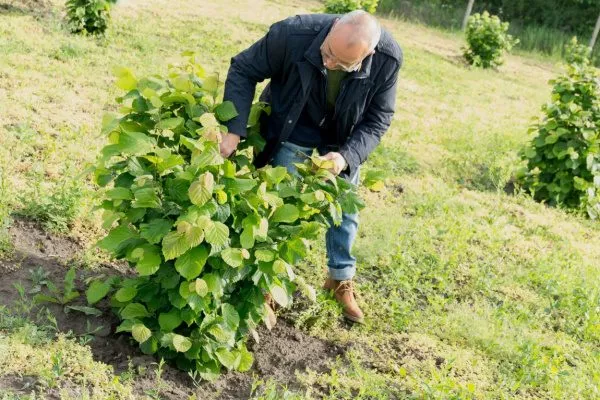
It's important to plant hazelnuts in soil suitable for the variety: fertile, aerated, and rich in humus. The best soil types are brown soil, black soil, clay-sandy soil, and carbonate soil. Sandy soil and heavy soil are absolutely unsuitable.
Site and soil preparation
First, dig the area to a depth of one and a half spade depths, first removing all debris, branches, leaves, and plant debris. This should be done approximately three weeks before planting. Afterward, level the soil with a rake and mark the area using one of the following patterns:
- if space is limited, you can plant in squares with a distance of 5 or 7 m between bushes (there are 8 to 12 shoots in one bush);
- To achieve maximum yield, plants are formed on standard trees, then in one row the bushes are located every 2 m (this is the “Tatura” method);
- In Turkey, a nest-type scheme is used: bushes are planted in a circle at a distance of 1.5 m from the opposite side.
Prepare the planting hole about 15 days in advance. Its depth and diameter should be equal to the root system's dimensions, approximately 50 x 80 cm.
How to do it right:
- Dig a hole so that the top layer lies in a separate pile.
- Mix this soil with fertilizer. You'll need 150-200 g of superphosphate (depending on the soil's depletion level), 50 g of potassium salt, 15 kg of humus, and 400 g of wood ash. Mix all ingredients with the turf soil and return it to the planting hole.
- Cover with plastic wrap and leave to rot until planting day.
Planting in open ground
When the time is right, open the planting hole and water it generously. Once the water has been absorbed, you can begin:
- Form a low mound from the soil mixture inside the hole.
- Dip the root system of the seedling into a clay mixture for a minute.
- Place the cutting in the center of the mound, spreading the shoots along the slopes. Keep in mind that the root collar is located 3 cm below ground level.
- Add 400-600 g of soil, which should be removed from under the hazel tree in advance. This is necessary to ensure that the young tree has the necessary microorganisms.
- Cover with soil mixture. This should be prepared using the same principle as when preparing the hole, only the soil will be from the lower layers.
- Compact the surface.
- Add 5 liters of water, even if the humidity outside is high.
- Cut off the above-ground part so that a stump 25 cm high is formed.
- Place mulch (sawdust, peat) in the trunk area.
Watch the video below to see how gardeners plant hazelnuts:
Watering
The first watering of hazelnuts after planting is done exactly one week later. The amount of water is 20-30 liters. Then, follow these rules:
- frequency of liquid application – twice a month;
- amount of water – 70-80 liters per bush;
- During droughts, water more often, during rains, water less often;
- use only settled water;
- Do not pour in the entire volume at once, divide the amount of liquid into 3 portions with intervals of 20-30 minutes, as the moisture needs to be absorbed.
Top dressing
The first fertilization of hazelnuts after planting in open ground is done in the fifth year. Further fertilization instructions:
- annually in the spring, add 120 g of phosphorus-nitrogen agents and 20 kg of humus under each bush;
- Do not fertilize with nitrogen-containing products separately, otherwise only green mass will grow; it is better to combine them with other substances;
- Apply organic fertilizers twice a year: in spring at 60% of the annual volume, in autumn at 40%;
- If nitrogen deficiency is observed, spray the bush with a solution of 10 liters of water and 1 tablespoon of urea;
- In the fall, after harvesting, be sure to add 25g of potassium salt and 50g of Superphosphate, as well as up to 4kg of manure.
A favorite organic fertilizer for hazelnuts is liquid manure. It's easy to make:
- Fill an empty barrel with manure about 1/3 full.
- Pour in room temperature water to the very top.
- Allow the mixture to ferment for 14 days. Stir occasionally.
Care during flowering
Hazelnuts bloom around April, before the leaves open. During this period, the catkins, which prefer dry air, also begin to grow. Under such conditions, they quickly soften and release pollen over a short period of time—4 to 12 days. Therefore, no measures should be taken during this time.
Artificial pollination
If the weather is calm or the humidity is high, gardeners must resort to artificial pollination. Otherwise, the fruit will not form. This method is also necessary in other situations, such as when there is no hazelnut tree nearby, the male flowers have frozen, etc.
How to pollinate a bush yourself:
- In early February, cut 4-6 branches from the hazel tree.
- Place them in plastic containers and add water. The liquid should be just enough to cover the tips of the shoots.
- Place plastic film around to collect pollen.
- Cover the container with another film - this will provide the necessary conditions for the development of male inflorescences.
- When dusting starts, open the shelter.
All that's left is to collect the fallen pollen and store it in a glass container with a lid. When the female flowers open, apply the pollen with a brush. Repeat the process in a week.
Wintering of hazel
Hazelnuts tolerate winter frosts down to -40°C (-40°F), so they don't require shelter. However, this applies primarily to mature bushes, starting from the fourth or fifth year after planting.
Before this moment, a week before the frost, the bush branches are wrapped in non-woven material, bent to the ground and covered with spruce branches.
Pruning hazelnut trees
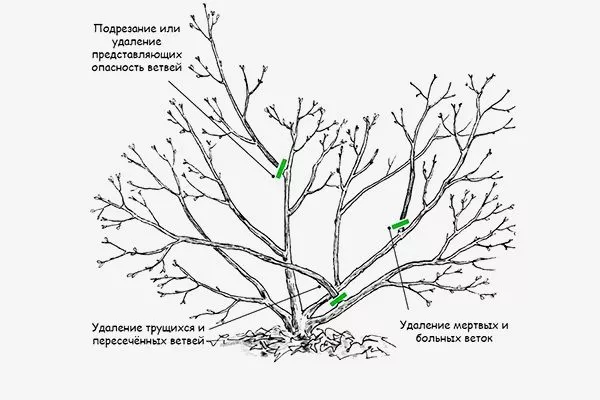
Unlike other nut crops, pruning is more important for the root system, as a large number of root suckers are produced each year. This leads to the bush growing laterally, which results in a tree that lacks shape. But most importantly, the yield will decrease, as all the nutrients will be used to develop these suckers.
To form the crown, start work the following year after planting:
- If the seedling has only one shoot, then shorten it to 1 m;
- If there are lateral branches, shorten them by 1/3.
No further pruning is necessary until the first major pruning. The main pruning after planting is performed in the year the tree begins bearing fruit. This involves thinning out branches, i.e., those that are growing abnormally (inward).
Reproduction of hazel
Hazelnuts can be propagated in a variety of ways, but if preserving the parent plant's characteristics is essential, the generative method (layering) is best. Seed propagation is rarely used, although many novice gardeners enjoy it.
Propagation by layering
Layering allows you to obtain multiple cuttings from a single hazel bush without much effort. There are three methods, each requiring selection of the strongest and healthiest shoots.
Types::
- Horizontal. Used only for low-growing hazelnuts with flexible shoots. How to obtain a seedling:
- Make grooves about 12-15 cm deep under the shoots.
- Bend the branches and press them into the bottom of the furrows.
- Secure with wire, but do not cover with soil.
- After a while, shoots will appear in some places, growing upward. Hill them up and remove any emerging leaves.
- After 1-2 years, depending on the intensity of development, separate the shoots and transplant to a permanent location.
- Arched. This is also used for flexible but long branches. In this case, the groove depth should be 25-30 cm. The process:
- Make a cut in the bark approximately in the middle of the branch.
- Dig a hole.
- Bend the shoot so that the cut end is in the hole.
- Sprinkle with soil, compact it and make a high hilling.
- Be sure to install a stake nearby to which you will tie the future seedling.
- After 6 months, separate the cutting from the mother bush.
- Transplant into a pot or another place, and to a permanent location only after 1-2 years.
There is also a vertical method, but it is rarely used because it causes a lot of trouble.
Reproduction by offspring
Root suckers are the easiest way to propagate hazelnuts, as numerous offspring grow each season. Look for offspring within a 100-120 meter radius of the mother plant. The process is simple: simply select a sucker, dig up some soil, and remove it, root and all, from the main root system, then plant it in its permanent location.
Propagation by grafting
This is another good method for propagating hazelnuts, but it's time-consuming and labor-intensive. Any hazelnut tree can serve as rootstock—hazelnut, bear nut, etc. The main thing is to prepare cuttings for the winter.
Watch the video below to see how experienced gardeners graft hazelnuts:
Propagation by dividing the bush
This is a simplified procedure used by both experienced and novice hazelnut growers. How to propagate:
- Remove the entire bush from the soil. It shouldn't be older than 6-7 years.
- Divide it into several parts so that each has a root length of at least 15 cm.
- Sprinkle the cut areas with wood ash.
- Plant the parts from the bush in a permanent place using the classic method.
Nut collection and storage
Hazelnuts are harvested when they fall, that is, directly from the ground. Immediately after storage, it's important to dry the nuts without removing the husks. This can be done in an oven or in direct sunlight.
Store hazelnuts, shelled or unshelled, at room temperature. Natural fabric bags or cardboard boxes can be used as containers.
Pests
Hazelnuts are a favorite among insects of all types. The most common are:
- Hazel bud mite (Phytoptus avellanae). The pest is small—maximum 0.22 mm—and has an oval body with a shiny surface. It attacks leaf and female buds, causing growth to be stunted and fruit buds to fail to form. The buds become swollen and eventually die.
Insecticides such as Zeon and Karate are used for control. Spraying is carried out twice. - Spider mite (Eotetranychus coryli). The mites live in large colonies on the undersides of leaves, so a green coating can be seen upon closer inspection. After sucking the sap, the leaves fall off.
Spraying with brown laundry soap is used for control. Chemicals are used only in cases of severe infestation. - Walnut weevil (Curculio nucum). The beetle is olive-brown in color and 0.8 cm long. Its larvae are light yellow with a dark head. Fruits and leaves are susceptible to attack, so these nuts are not eaten.
To get rid of the pest, use Calypso, Fastac, Decis. - Nut-roller (Apoderus coryli). Another weevil, approximately 9 mm long and orange in color, curls the leaves after feeding on the plant.
To fight you will have to buy Zeon or Karate. - Longhorn beetle (Oberea linearis). The beetle is easy to recognize—it has long antennae and an elongated body. It feeds on young shoots, causing numerous corridor-like holes in the bark.
The same means are suitable for treating hazelnut as in the previous case. - Leaf elephants (Phyllobius). This is a small beetle with a shiny body and a curved head. The insect feeds on foliage, which stunts plant growth. The pest then moves to the root system, resulting in the death of the plant.
To destroy them, buy the same preparations as for fighting weevils. - Northern birch sawfly. This is a distinctive black wasp with a shiny surface. Its larvae are greenish and are found on the outer edges of leaves.
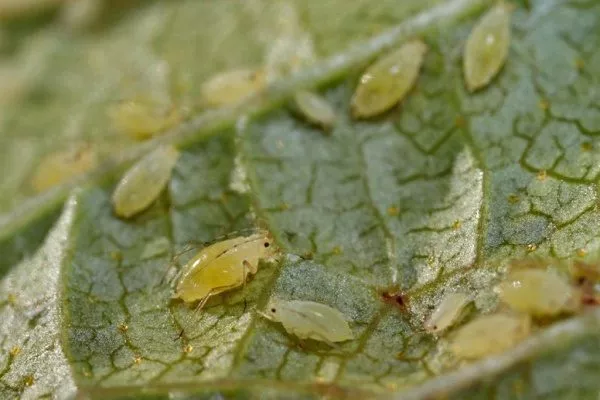
Zeon and Karate are used for destruction. - Hazel aphid. The body is elongated—about 2.5 mm. The color is light green, but can vary. It attacks young branches, then leaves, causing the bush to wilt.
The best way to protect and destroy them is to spray with laundry soap and release ladybugs.
Diseases
Hazelnuts have a relatively good immune system, so the crop is considered disease-resistant. However, three diseases are considered dangerous:
- Hazel moniliosis. The fungus destroys 70-80% of the crop and thrives in densely populated areas and high humidity. Symptoms include the formation of brown spots on foliage, reduced fruit size, fruit rot, and massive fruit drop.
Topsin or Neotec is used for treatment. - Powdery mildew. This is also a fungus that inhibits hazel growth. It manifests itself as a whitish coating and premature leaf drop. In the fall, it turns black (an advanced form of the disease).
Any fungicides can be used for treatment. - Gray rot. The disease manifests itself as the formation of gray mycelium, slow growth, and a decrease in yield.
Drugs such as Nimrod and Discus will help in the fight.
Hazelnut Growing Business
Hazelnut cultivation is not widespread in Russia, so the niche is considered open. Despite this, the nut is extremely popular among consumers. Large-scale production has been established only in Adygea, but it only covers 4-6% of the population's needs. Therefore, the country's gardeners are seriously considering this type of business.
How profitable it is can be judged by the following data:
- initial investment – one seedling will cost from 400 to 1200 rubles;
- if you arrange the bushes in a nest-like manner, then 1300-1400 plants will fit on 1 hectare, with a row-like arrangement – from 600 to 800;
- It takes 2 years before the first fruiting, so the payback period begins in the third year of cultivation;
- from 1 hectare you can collect about 2 tons;
- If you sell them to a reseller, you can get 440-450 thousand rubles, if you sell them yourself, then 1 million 300 thousand rubles.
Calculating the benefits is easy; the key is choosing a growing method, finding buyers, and purchasing high-quality planting material. And if you already have several hazelnut bushes in your garden, you won't have to spend money on seedlings—you can propagate them yourself.