
Amelanchier 'Smoky' is a Canadian, multi-stemmed, medium-sized variety. Although native to North America, it thrives in the Russian climate. It's not particularly demanding in cultivation, but it does require very fertile soil, so careful fertilization is necessary.
Who developed the variety and when?
The Smoky serviceberry variety was bred in Canada and registered in 1952. It arose from open cross-pollination between the alder-leaved serviceberry and another, still-secret species. From the resulting seedlings, after careful selection, the best specimen with stable characteristics was chosen and officially named "Smoky."
The appearance of the tree
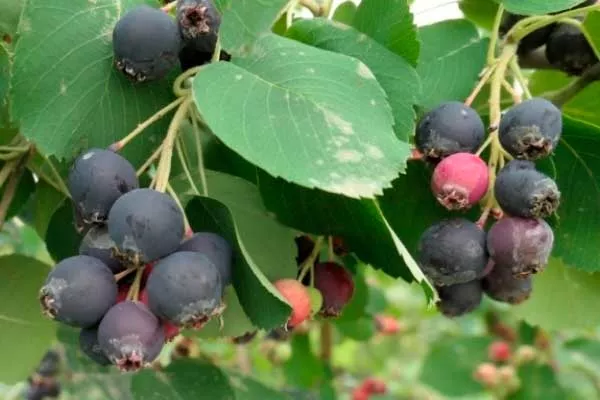
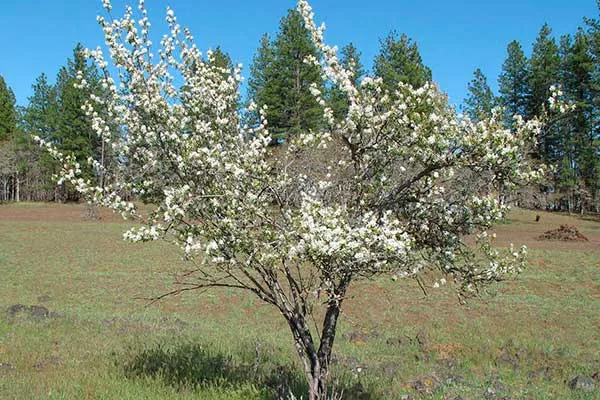
This variety is a shrub reaching 180-250 cm in height. It is characterized by a spreading, cap-shaped, umbrella-shaped crown. Other characteristic features include:
- Root system. It grows in the top (most fertile) layer of soil, as it is considered a surface soil. Its numerous, powerful shoots produce numerous basal shoots, making it possible to propagate by shoots.
- Shoots and bark. On young branches, aged one year, the bark has a reddish tint, becoming a classic brown as the tree matures, and the trunk has a brownish coating. The shoots are initially erect, but later become flexible and drooping.
- Leaf blades. They are characterized by a matte surface with pronounced veins. They are medium-sized, with leaves 8-9 cm long and about 3 cm wide. The edges of the foliage are serrated. The shrub is considered ornamental, thanks to the color of the leaves: they are red when they emerge, turn green in summer, and by autumn they acquire an orange-yellow-crimson hue.
- Flowers. Small in size, their diameter does not exceed 3 cm. The type is single, with five petals, each petal shaped like an elongated linear petal. The color is snow-white, and a single cluster produces up to 12 buds, which open before the leaves emerge.
Characteristic features of fruits and their taste
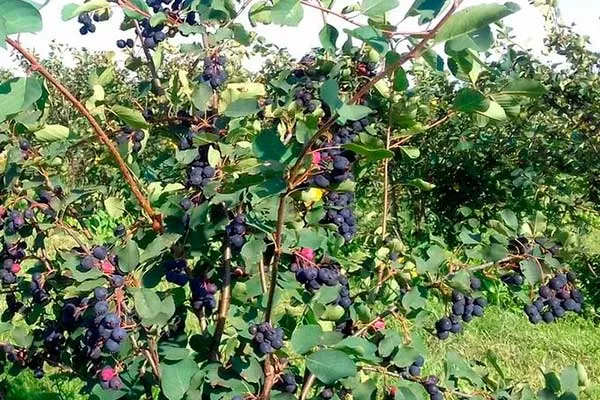
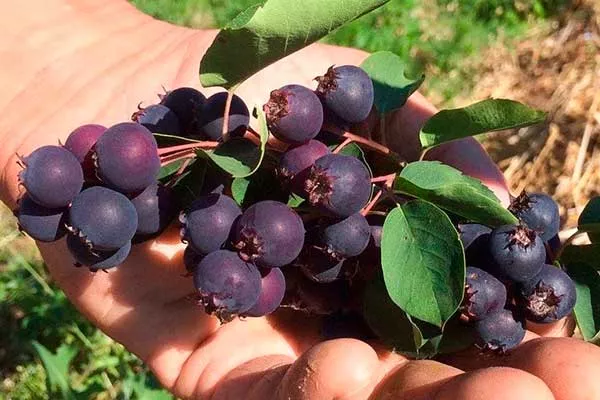
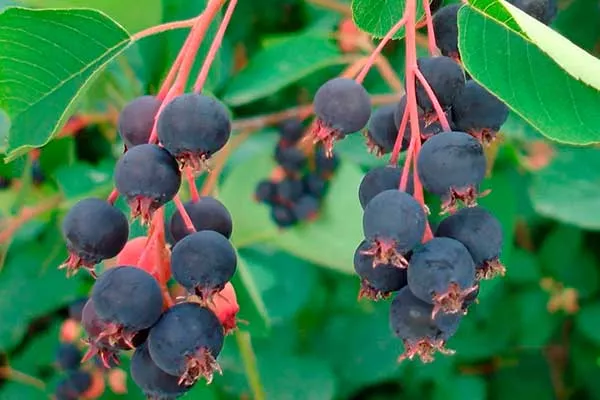
The round berries are large in size, weighing 2 g and averaging 1.5 cm in diameter. Other features:
- color - at technical maturity it is purple-red, at biological maturity it becomes black;
- surface – has a waxy coating;
- peculiarity - at the top of the fruit there are sepals that stick out in different directions;
- peel type – compacted, thanks to which the berries are stored for a long time and are easy to transport;
- pulp – increased juiciness, fleshy;
- seeds – brown and small, in large numbers, but not felt on the teeth;
- aroma – powerful;
- taste - sweet when fully ripe.
Beneficial properties
Smokey berries are rich in sugars, organic acids, tannins, bioactive substances, ascorbic acid, carotene, and manganese. Vitamin C content increases during ripening and decreases after full maturity.
Benefit:
- Thanks to this composition, eating berries has a positive effect on the functioning of the heart and blood vessels, normalizes blood pressure, promotes healthy digestive system function, and strengthens the body as a whole.
- Regular consumption of these fruits in moderation helps prevent atherosclerosis, stroke, and heart attack. This product is recommended for people with increased vascular fragility and thinning of their walls.
- The fruits of the Smoky irgi strengthen the immune system, help fight vitamin deficiency, and treat diseases of the gums, eyes, and gastrointestinal tract.
Ripening period and yield
This variety is distinguished by its early fruiting: the berries ripen in late June or early July. For maximum yield, it is recommended to harvest the fruit in several stages. A single plant can yield up to 7-8 kg of berries.
Frost resistance
The plant can withstand temperatures down to -35-40 degrees Celsius, making it very frost-hardy and immune to spring frosts. Serviceberry flowers remain viable even at temperatures as low as -5-7 degrees Celsius.
Pollination
Smoky is a self-pollinating variety, meaning that one plant in the area is enough for successful pollination.
Fruiting method
Fruit forms on the previous year's shoots, which is important to consider when pruning. During the first two years after planting, initial and sparse fruiting begins. The first full harvest appears as early as the fourth year. With proper care and favorable conditions, the tree can last up to 50 years.
Storing berries
For long-term storage, it is recommended to pick berries at the technical ripeness stage. They can be stored in the refrigerator (up to 7-10 days) and in the freezer (up to 1 year). Berries should be washed and thoroughly dried before freezing.
Growing regions
The Smoky variety bears fruit particularly successfully in the central regions of the country and in the Leningrad region, where the climate is ideal for its cultivation due to its similarity to the weather conditions of the Canadian province of Saskatchewan, where this variety was developed.
- ✓ Soil pH should be between 6.0-7.5 for optimal growth.
- ✓ The depth of the fertile layer is at least 40 cm for the development of the root system.
Selecting a location, soil
Smoky prefers sunny, well-lit areas. In partial or full shade, the plant not only stretches but also produces a smaller yield. The soil should be loamy or sandy, although acidity is not essential. Fertility is a must.
Subtleties of planting
Fall is the best time to plant, especially in warmer regions. In colder climates, spring planting is also possible. About four to five months before planting, prepare the site: dig it over and cover it with black plastic to eliminate weeds. A couple of weeks before planting, dig the site again and add phosphorus and potassium.
- 6 months before planting, analyze the soil for pH and nutrient content.
- 4-5 months before planting, add organic fertilizers (compost or humus) at a rate of 10 kg per 1 m².
- 2 weeks before planting, apply mineral fertilizers (superphosphate and potassium salt) according to the instructions.
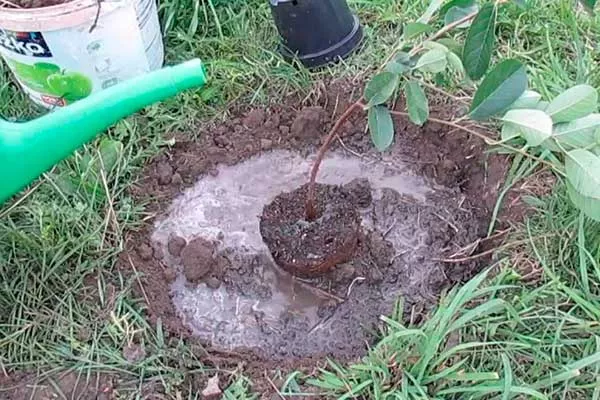
For planting, it is better to choose 1-2 year old viable and strong seedlings, placing them at a distance of 100-200 cm from each other in a checkerboard pattern.
The landing is carried out as follows:
- Dig a hole 0.5-0.6 m deep and 0.4-0.5 m wide.
- Set the removed soil aside and mix with compost and sand.
- Cover the bottom of the hole with drainage material, then add a mixture of humus, superphosphate and potassium salt.
- Place the seedling in the hole, carefully spreading out the roots.
- Fill in the excavated soil, compact it, water it and mulch the soil.
Following these recommendations will help you successfully grow healthy Smoky serviceberry plants, producing abundant harvests for many years to come.
Care and cultivation
The key aspects of caring for irga are following simple rules:
- Watering. Serviceberry should be watered infrequently, only during dry periods. However, it should be generous to create a water reserve in the soil layers. Overhead watering or sprinkling after 4:00 PM is acceptable.
- Top dressing. Serviceberry requires regular fertilization. If the planting hole was prepared according to recommendations, the fertilizer applied will last for approximately 3-4 years. After that, additional fertilization will be necessary – use nitrogen in the spring and potassium-phosphorus complexes in the fall.
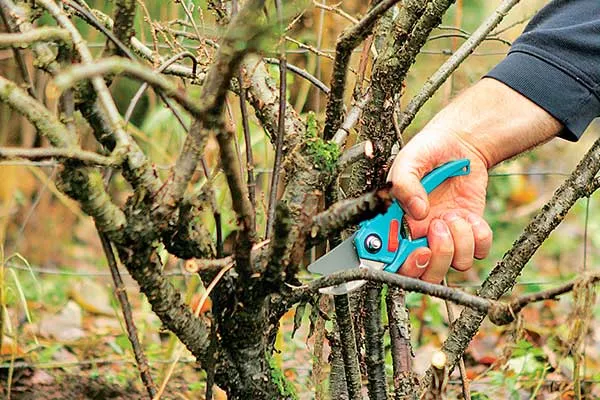
- Pruning and covering. It's important to prune after harvesting and mulch the plants well to ensure a successful winter. Young seedlings should be covered for the winter, and pruned again in the spring, thinning the shrubs.
- Protection from diseases and pests. The Smokey serviceberry has good immunity, but requires regular inspection and preventative treatment of the crown with fungicides and traditional medicine, especially to protect against harmful insects.
Diseases and pests
Serviceberry is resistant to most diseases and parasites, but is vulnerable to birds. To protect against them, it's recommended to use fine-mesh netting. If diseases such as gray mold or leaf spot appear, treat with Bordeaux mixture.
Pros and cons
The Smoky Amelanchier is a fruit tree with many advantages, which have allowed this variety to remain popular for many years. However, when choosing this plant, it's also important to consider some of its drawbacks.
Similar varieties
| Name | Frost resistance | Productivity | Fruit size |
|---|---|---|---|
| Thyssen | Up to -40°C | High | Large |
| Honeywood | Up to -40°C | High | Big ones |
If you can't buy a Smoky seedling, you can plant alternative varieties:
- Thiessen. An early Canadian variety characterized by large fruits and high yields. The plant tolerates temperatures down to -40°C, is well suited for the Northwest region, and forms a lush crown.
- Honeywood. This Canadian variety also tolerates severe frosts and produces few root shoots. The fruits are large, black when ripe, and have a spicy-sweet flavor. The first harvest appears 2-3 years after planting.
Gardeners' reviews
Growing Smoky serviceberry in your garden allows you to reap a stable harvest with minimal maintenance and adds beauty to your garden. Its productivity and ornamental qualities make it attractive to gardeners, but care must be taken to protect it from birds and adapt it to local conditions.