
The Persimmon persimmon is a Chinese variety that produces very large, seedless fruits. This sweet, large-fruited variety is characterized by high yields and hardiness. It is relatively easy to grow, but requires specific climate conditions.
Description of the Persimmon persimmon
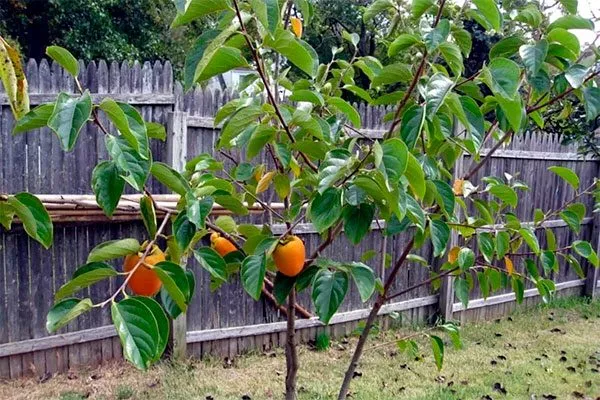
The Persimmon persimmon tree is tall, with a spreading crown. It resembles an apple tree in appearance. Because its branches grow unevenly, the crown appears untidy.
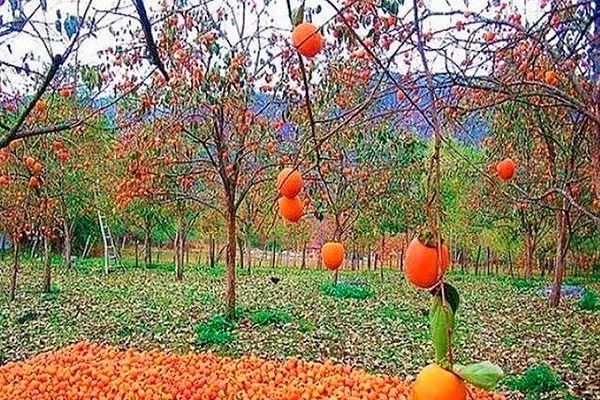
Characteristics of Persimmon persimmon:
- Tree height — up to 10-12 m.
- Escapes - thin, curved
- Leaves — dark green, oblong. Before leaf fall, they become variegated, turning various shades of red.
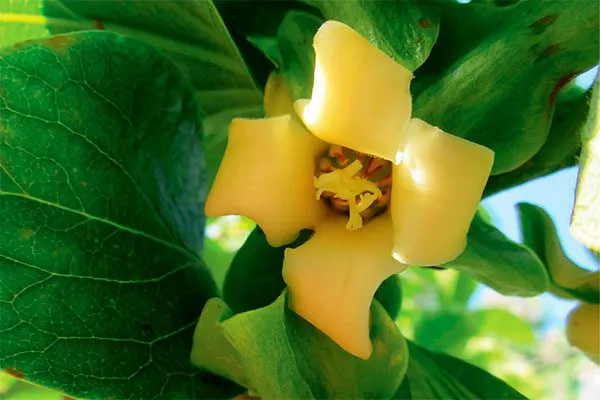
Persimmon persimmon flowers come in two types: male and female. The former are small, bell-shaped, and clustered in three-flowered clusters. Their color is greenish-yellow. Female flowers are large and creamy white. Bisexual flowers are also found, usually arranged in clusters of two to four.
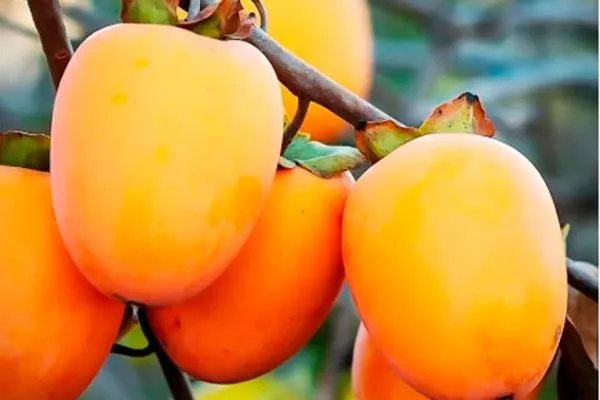
Fruit characteristics:
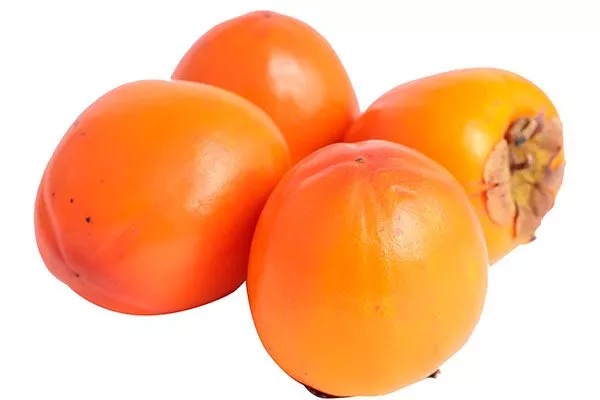
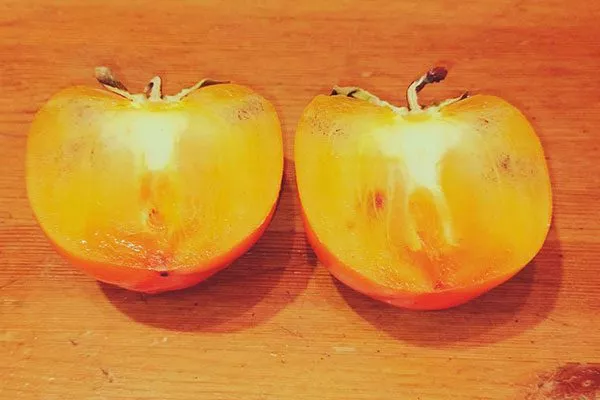
- Color: yellow-orange.
- Form: spherical.
- Weight: 500-700 g.
- Skin: smooth and shiny.
- Pulp: juicy.
Who and when developed the Persimon variety?
There is information that the Persimmon variety originates from China. More precise information about the origin of this persimmon is lacking.
This variety is grown in countries with a warm climate; in Russia, it grows in the Caucasus, Crimea, the Volgograd region, Ossetia, and Dagestan.
Characteristics
The Persimon variety not only has excellent commercial and taste qualities, but also enviable agronomic characteristics, allowing it to be grown in a variety of conditions.
Other important features:
- Ripening periods. This variety is considered a mid-season variety. The fruits typically ripen in mid-October or early November, depending on the climate in the growing region.
- Productivity. It is a high-yielding variety. A single mature tree can yield between 30 and 100 kg of fruit, depending on the tree's age, growing conditions, and care.
- Frost resistance. It has a fairly high frost resistance. This persimmon is cold-resistant and can survive temperatures down to -15°C. However, young seedlings can be damaged, so they need protection during the winter.
- Disease resistance. It is tall, but if exposed to unfavorable conditions and poor agricultural practices, it can be affected by powdery mildew, gray mold, and fire blight.
- Taste and application. Persimmons are sweet in taste and have juicy flesh that, unlike many other varieties, is not tart. The fruits are eaten fresh or preserved, added to salads, used in various desserts, dried, and frozen.
Pros and cons
The Persimmon persimmon has certain advantages, but it's not without its drawbacks. Before planting this variety in your garden (assuming the climate is suitable), it's important to weigh all its advantages and disadvantages.
Planting Persimmon persimmon
To ensure good growth and fruit production, persimmons need to be planted correctly. Choosing a good location and adding fertilizer to the planting hole is especially important.
Selecting a seedling
Avoid buying persimmon seedlings at spontaneous markets or from untrustworthy sellers—there's a risk of purchasing weakened or substandard seedlings.
What to look for when purchasing a seedling:
- The roots should be well developed, with many small shoots, without rot or dry areas.
- The height of the seedling is 50-70 cm, the diameter of the trunk at the base is about 1-1.5 cm.
- The bark is smooth, without defects, signs of disease or damage.
- Leaves - if present, they should be free of disease, spots and yellowing.
- The optimal age for a seedling is 1-2 years.
Selecting a site
To ensure that the Persimmon persimmon grows well and bears fruit, it is important to choose the right planting location.
Features of choosing a site for persimmon:
- The tree is best planted on a south or southwest facing location. The location should be protected from drafts and cold winds. Persimmons can be planted near a fence or house wall—they will reflect heat and protect the tree from gusty winds. The distance from buildings should be at least 4-5 meters.
- The location should be sunny, with 6-8 hours of sun per day. In the south, it's recommended to choose a spot with light midday shade—this will protect the leaves from the scorching sun if temperatures rise to 30°C or higher.
- The best location for persimmons is a slight slope facing south. Lowlands and depressions are not recommended, as they can trap cold air, which can damage the persimmon blossoms during spring frosts.
- The maximum groundwater level is 1.5-2 meters above the ground surface. Above this level, there is a risk of root rot, which can lead to the death of the tree.
- The optimal soil is fertile, loose loam or sandy loam with a slightly acidic reaction (pH 6.0-6.5).
Persimmons should not be planted near tall trees, as they will shade the tree. Trees with dense foliage, such as maples or lindens, are not suitable for planting persimmons.
Site preparation
Soil preparation for persimmon planting begins 1-2 months in advance. If the tree is planted in the spring, site preparation begins in the fall.
Features of preparing a site for Persimmon persimmon:
- The soil is cleared of plant debris and dug up to the depth of a shovel blade.
- If the soil is not fertile enough, add humus or compost during digging – 10 liters per 1 sq. m.
- For heavy, clayey soils, add river sand or sawdust—from 10 to 30 kg per 1 sq. m., depending on the soil structure.
- For alkaline soils (with a pH of 7.5 or higher), add 100 ml of 9% vinegar per 1 sq. m. To normalize the acidity of alkaline soils, you can also add high-moor peat, rotted pine needles, or pine sawdust.
- In overly acidic soils (with a pH of 3.8-4), add slaked lime, dolomite flour, chalk, and wood ash—from 0.2 to 0.4 kg, depending on the condition of the soil.
Planting hole
The planting hole should be prepared at least 2-3 weeks before planting. For spring planting, prepare the hole in the fall.
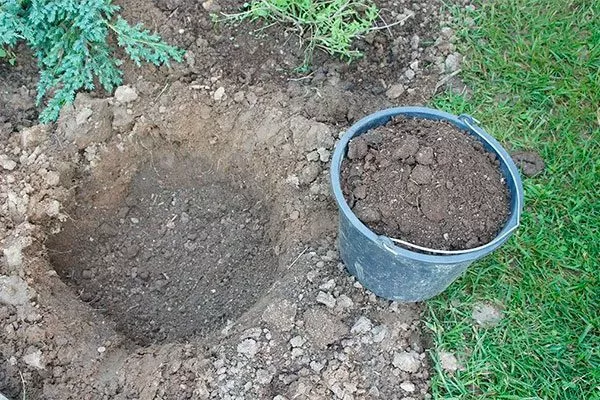
Features of preparing a planting hole for Persimmon persimmon:
- The volume of the pit must be at least 50 liters.
- The size of the hole depends on the size of the root system of the seedling and is usually 40-60 x 40-60 cm.
- A drainage layer approximately 15-20 cm thick is placed at the bottom of the hole. Crushed stone or broken brick can be used for this purpose.
- To fill the hole, prepare a nutritious soil mixture. Mix turf soil with humus, coarse sand, and peat (2:1:1:0.5). If the soil is poor, it is also recommended to add mineral fertilizer to the mixture, for example, 250 g of nitroammophoska.
- Fill the hole 2/3 full with potting soil. Form a mound around it. Place a 1.5–2 m long support (approximately 0.5 m deep) 10–1 cm from the center. Position it so that after planting the seedling, it faces south. This will protect the young tree's bark from sunburn.
Planting a seedling
Persimmons are planted in cloudy, windless weather. Before planting, the seedlings are prepared by soaking their roots in water for 24 hours or soaking them in a growth stimulant solution (for the appropriate time, as per the instructions).
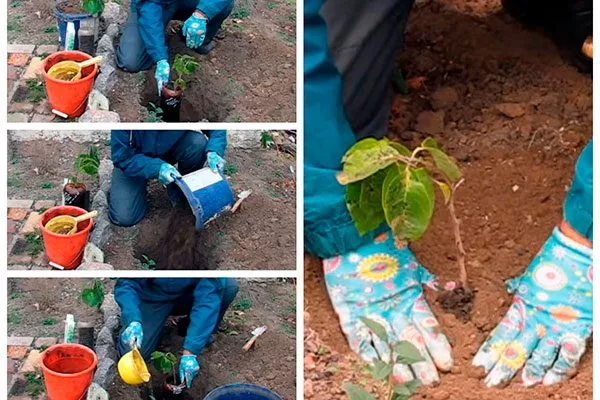
Features of planting Persimmon persimmon:
- Place the seedling on a mound of earth, carefully spreading out the root shoots. They should not bend upward or sideways.
- The roots of the seedling are covered with soil, periodically compacting it - it is important that there are no air gaps between the roots.
- After planting, the root collar of the seedling should be 3-4 cm above ground level. The soil will gradually settle, and the grafting site will be at the desired height.
- A circle is formed around the trunk and the sapling is tied to the support with soft cloth or twine. The tie is loosened as the tree grows.
- The planted tree is watered with 20-30 liters of warm, settled water. Once the water has been absorbed, the area around the tree trunk is mulched with sawdust, peat, straw, etc.
It's best to plant persimmons with a helper. One person will hold the seedling and monitor the root collar, while the other will cover the roots with soil.
Care
For persimmons to thrive and bear fruit, planting them correctly isn't enough; they also require proper care. Like any fruit tree, persimmons require watering, fertilizing, and preventative spraying.
Watering
Persimmon persimmon requires deep watering. It is recommended to water not directly into the tree's trunk, but rather into a 0.5-0.7 m deep furrow dug around the perimeter. The recommended watering rate for a tree up to three years old is 20-30 liters per watering.
Young persimmon trees are watered weekly, which helps them adapt to their new location more quickly. As the season progresses, the frequency of watering is gradually reduced, but the amount of water is increased. At the end of summer, the tree is watered.
Mature trees are watered less frequently than young ones, but more generously—50-60 liters at a time. Watering is especially important during dry periods, as well as during fruit set and ripening. About a month before the onset of frost, watering is gradually reduced to allow the tree to better prepare for winter.
Fertilizing
Persimmons don't require any additional feeding during the first year after planting; the nutrients provided in the planting hole are sufficient. However, weakened, poorly growing trees are recommended to be fed with low-concentration solutions of complex fruit fertilizers.
Approximate fertilizing regime for Persimmon persimmon:
- When the leaves begin to unfurl, apply nitrogen-containing fertilizers—30 g of urea or 50 g of ammonium nitrate per square meter. This fertilizer will help the persimmon tree grow green mass.
- In early summer, apply complex mineral fertilizers. For a mature tree, the recommended dosage is 60-70 g of superphosphate, 40 g of potassium sulfate, and 50 g of magnesium sulfate. Dissolve the granules in water and water the area around the trunk evenly.
- During the fruiting stage, persimmons require potassium. During this period, the tree can be fed with a nutrient-rich mixture of potassium sulfate and wood ash infusion—40 g and 1 liter of each, respectively, per 10 liters of water. The resulting solution is then applied to the soil—30-40 liters per tree.
- At the end of summer, repeat the combined potassium-phosphorus fertilizer. This will allow the fruit to accumulate sugar and ripen properly. Nitrogen fertilizers are contraindicated during this period, as they can stimulate the growth of shoots that will not have time to harden before the onset of cold weather.
- The last time persimmons are fed is after harvest. 100 grams of superphosphate and 70 grams of potassium sulfate are applied per tree, which are incorporated into the soil around the tree trunk.
Is pruning necessary?
Persimmon persimmon, like most fruit trees, requires pruning - sanitary and formative.
Features of pruning Persimmon persimmon:
- Immediately after planting, the tree's central conductor is shortened to approximately 1 m. All shoots growing less than 0.5 m from the ground are pruned.
- In the 2nd year, all branches are pruned except for 3-4 of the strongest, located spirally around the trunk - this will be the future basis of the crown.
- Once fruiting begins, only maintenance pruning is performed—removing dry, diseased, and inward-growing branches. Excessively long shoots are also shortened.
- Mature trees (over 15 years old) undergo rejuvenation pruning. This is done gradually over 2-3 years. Each year, 30% of the older branches are pruned, but not completely, leaving a few buds—these will be the source of new shoots.
The best time for pruning is spring, before the sap begins to flow. During this period, trees tolerate stress well, and wounds heal quickly.
Fighting diseases
Persimmon persimmon is very resistant to diseases, but under unfavorable growing conditions and poor care it can be affected by various fungal and bacterial diseases.
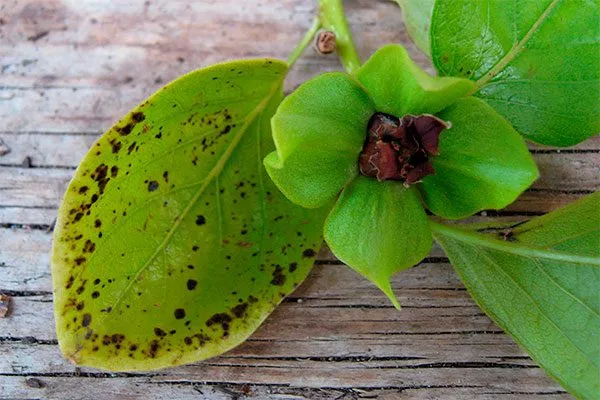
How to combat Persimmon persimmon diseases:
- Colloidal sulfur and Trichoderma-based biofungicides, such as Trichodermin, are used against powdery mildew. Disease prevention involves preventing the crown from becoming too dense.
- Gray mold can destroy an entire crop. Copper-containing preparations and biofungicides such as Fitosporin-M and Baktofit can help combat it.
- Fire blight is treated through prevention, as the disease itself is incurable. It's important to apply garden pitch to all pruning wounds and avoid mechanical damage to the bark.
Pest control
Persimmon persimmons can be affected by scale insects, codling moths, aphids, red spider mites, leafhoppers, and other insect pests. Shortly before fruiting, it is recommended to control them with biological products and folk remedies, as chemical fungicides are dangerous to use on fruit trees and are reserved for severe infestations.
In early spring, it's recommended to spray the tree with Nitrofen before bud break. Later, insecticidal soap or a garlic and hot pepper infusion can be used. The best biological products are Actofit, Akarin, Bicol, and Boverin.
Harvesting and storage
The fruits are cut with pruning shears to avoid damaging the flesh. This is done in dry weather. Persimmons are harvested from a ladder, observing safety precautions.
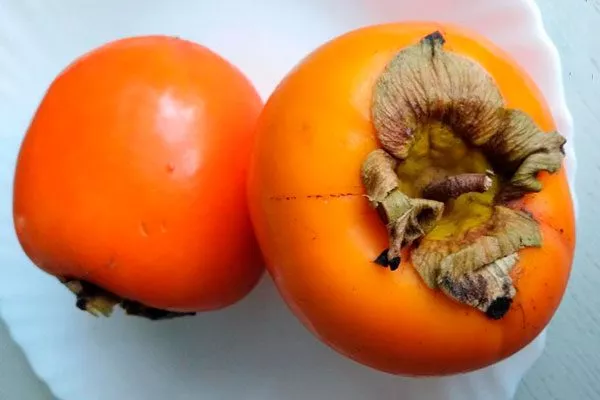
Store the fruits in wooden boxes, sprinkled with sawdust. Optimum temperature: +1°C. Recommended humidity: 70-80%.
Reviews
The Persimmon persimmon is a promising variety that produces truly good yields. This seedless Chinese persimmon is sure to please lovers of large, sweet persimmons and is also of interest for commercial cultivation.