
Growing persimmons is no easy task, as they are very heat-loving, demanding of light and soil, and require a lot of care. Success depends largely on proper planting. By following all the nuances of the proper planting procedure, you can ensure rapid rooting and continued healthy growth of the seedling.
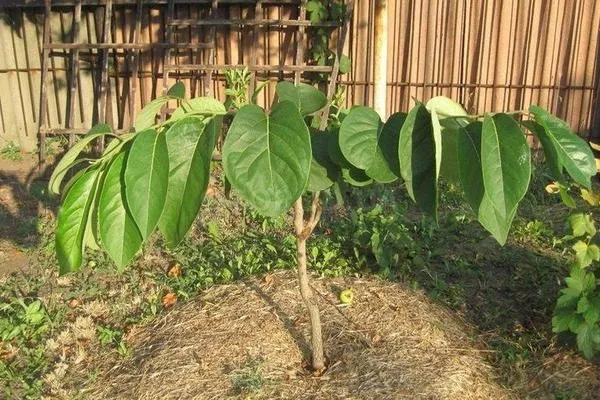
Types and varieties of persimmon for growing in open ground
This deciduous plant, producing juicy and delicious, sunny-colored fruit, belongs to the Ebenaceae family. It belongs to the genus Diospyros. It grows as a tree (5-7 m tall, up to 20 m in the wild) with a spreading crown and dark green, lanceolate foliage that turns crimson in the fall.
Persimmon blossoms in May and early June. Single or clustered yellowish-white flowers bloom in the leaf axils. They can be male, female, or mixed. Pollination occurs by bees. Parthenocarpic varieties are also found.
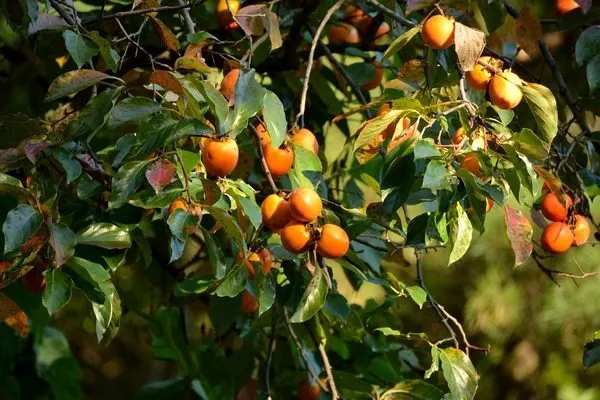
A tree grown in favorable conditions and well-cared for pleases gardeners with consistently high productivity. Gardeners harvest the fruit in October-November, after the leaves have fallen. The fruits are berries with the following characteristics:
- form - round, round-elongated, flattened (visually resembling a tomato);
- weight — 100-500 g;
- coloring — from yellow to deep orange or brownish (determined by species and variety);
- skin - smooth;
- pulp — juicy, melt-in-your-mouth, astringent and slightly bitter in taste in unripe specimens, very sweet in ripe ones, with 3-8 seeds (fruits formed from unpollinated female flowers, seedless).
There are over 725 known species and 1,500 cultivars of this fruit crop. Gardeners prefer three of the most popular persimmon varieties:
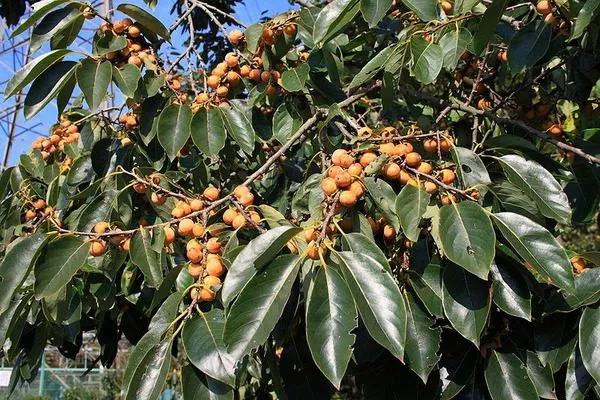
- Caucasian or ordinaryIt is widespread in China and Japan. It also grows on the Crimean Peninsula and in the Transcaucasus. It is a wild species with no cultivated varieties. It is drought- and frost-resistant (withstands temperatures down to -24°C), undemanding of soil, and produces small, tart fruits.
It can be used as a rootstock, increasing the endurance of the oriental persimmon and preventing suckers.
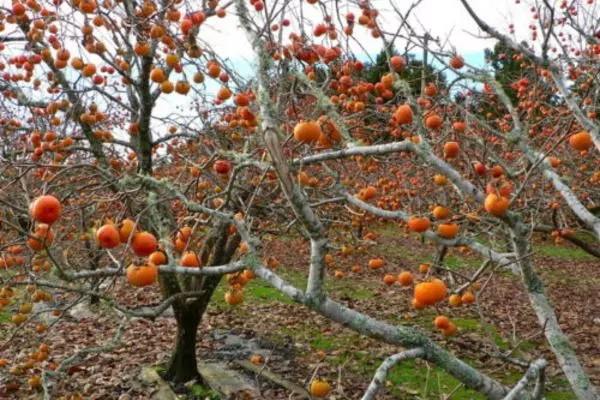
- Virginian. It is common in southern North America. It is characterized by its tall growth (tree height is up to 20 m). It is resistant to frosts down to -35°C and winter thaws. It grows even in damp and heavy soils, but does not tolerate transplanting.
This species is suitable as a rootstock. In this role, it is inferior to the Caucasian variety in terms of longevity and yield.
It is represented by cultivated varieties that gardeners call "persimmons." In Russia, its hybrids, obtained by crossing with the oriental persimmon, are in demand. Nikitskaya burgundy, To a Russian woman, Belogorye. All of them are cold-hardy (withstanding winter temperatures from -25⁰C to -30⁰C) and produce tasty fruit.
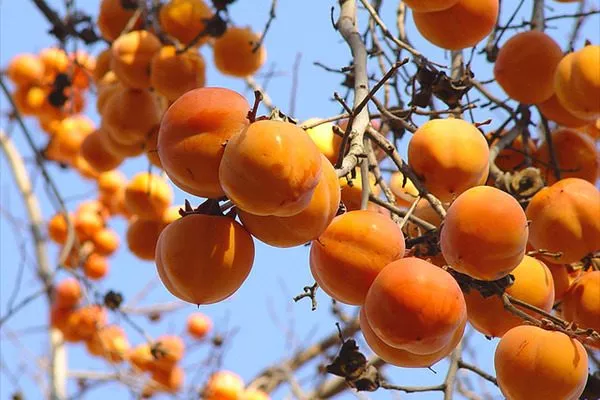
- Eastern or Japanese. Characterized by rapid growth, the trees have a loose crown and produce large, marketable fruit with a remarkably sweet flavor.
The species is represented by 1,000 varieties. They are grown in the Krasnodar Krai, Sochi, Sukhumi, and Crimea. They are not particularly frost-resistant (down to -15°C).
When choosing a persimmon variety to grow in your garden, consider not only your own preferences regarding the fruit's appearance and taste, but also the climate in your region. Gardeners consider the sweetest varieties to be:
- Giro;
- Crimean woman 55;
- Find;
- Kiara;
- Meotse saukune;
- Mishirazu;
- Chocolate kinglet;
- Crimean;
- Excellent;
- Triumph;
- Sharon;
- Hope;
- Gypsy dance;
- Hyanoume;
- Ukrainian;
- Dawn.

The largest-fruited varieties are Tanenashi and Hachia. The most cold-hardy variety, suitable for outdoor cultivation in the central zone, is represented by Rossiyanka. Mount Hoverla, Mount Roman Kosh, Korolkom, Nikitskaya maroon, Zolotistaya, Souvenir of autumn, Nakhodka.
For cultivation in temperate climates, early varieties are preferable. Among the medium- and large-fruited varieties in this group are:
- Ukrainka, Izobilnaya, Yankin-Tsura - they bear fruit in the last days of summer or at the beginning of September (ultra-early ripening);
- Sputnik, Hyakume, Chocolate, Star, Golden - the harvest falls in the second or third decade of September;
- Yuzhnoberezhnaya, Batumskogo II, Zamanchivyi, Zarya, Zorka, Suvenir oseni, Mechta, Zhuravlenka, Gayli - the fruits are ready for harvesting in early October (mid-early ripening).
Persimmon requirements for growing conditions
Before you head to the nursery to purchase a seedling of your chosen variety, familiarize yourself with the fruit tree's growing requirements. First, make sure you can create the most favorable environment for the tree in your garden.
Temperature conditions
Persimmon, a native southern plant, thrives on warmth. For good growth, abundant fruiting, and full ripening of the harvest, it requires the following:
- the sum of active temperatures for the year is not less than +3000°С;
- The number of hours of sunshine is more than 2000.
If this isn't possible in your area, grow your fruit tree in a greenhouse or hothouse. In protected soil, it will require year-round heating and lighting.
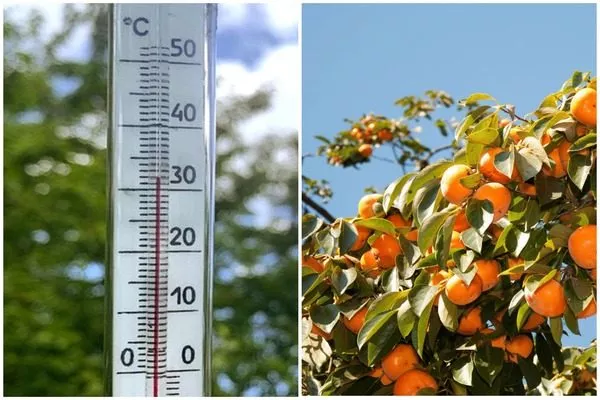
The temperature range acceptable for growing garden crops is as follows:
- +10-35⁰С — during the growing season.
- +25-30°C is the optimal temperature in summer. In addition to warmth, persimmons require plenty of sunlight and moderate humidity during the formation and ripening of their fruit. On dry days, spraying the crown with water is recommended.
- -6-8⁰C is the temperature limit for the root system during the winter months (down to -18⁰C for varieties with increased frost resistance). At lower readings, one- and two-year-old growth freezes.
- Up to -15⁰C is the maximum temperature the crown can withstand during the cold season (-27-35⁰C for the Virginian species). However, partial frost damage will still be observed.
Growing fruit trees without cover is only permissible in regions where winter temperatures reach -5 to 8°C and never drop below that. Young plants especially need insulation. Cold snaps as low as -9°C can kill them.
Lighting for persimmon
This plant, characterized by a long growing season, requires more than just warmth to thrive. It requires plenty of light. Give your persimmon the sunniest spot in your garden, away from tall trees and buildings.
Insufficient light when growing fruit crops can lead to many complications:
- insufficient development of the crown (it branches poorly);
- low productivity;
- obtaining small and tasteless fruits (their pulp will not be sugary);
- early shedding and incomplete ripening of the crop.
In open ground conditions, choose areas where the crown will be evenly illuminated by the sun throughout the day.

Make sure there's protection from drafts and piercing winds. This could be the south-facing side of a fence or the wall of a house.
Persimmon soil requirements
Fruit crops are demanding when it comes to soil. To ensure they thrive and yield a bountiful harvest, plant them in soils with the following characteristics:
- loose;
- air- and water-permeable;
- fertile;
- slightly acidic or neutral (pH 6.0-7.0).
Persimmon thrives in well-drained loamy soil or black soil. It can also be grown in sandy loam, forest soil, and soddy soil, if enriched with organic matter (humus, compost). Sandstone, gravel, clay, waterlogged, and saline soils are unsuitable.
Moisture requirements
Persimmons are moderately moisture-loving. Trees growing in open ground require 900-1200 mm of rainfall per year. They experience increased irrigation needs during periods of prolonged drought. The following watering treatments are recommended:
- regular watering in areas with little rainfall (for example, in the Krasnodar region, where less than 700 mm of precipitation falls annually);
- spraying the crown (this measure allows solving the problem of dry air).
Overwatering the soil when cultivating this southern tree is contraindicated. It does not tolerate stagnant water or waterlogged areas. Dampness threatens root rot. The groundwater level should be 75 cm or deeper.
Selecting high-quality planting material
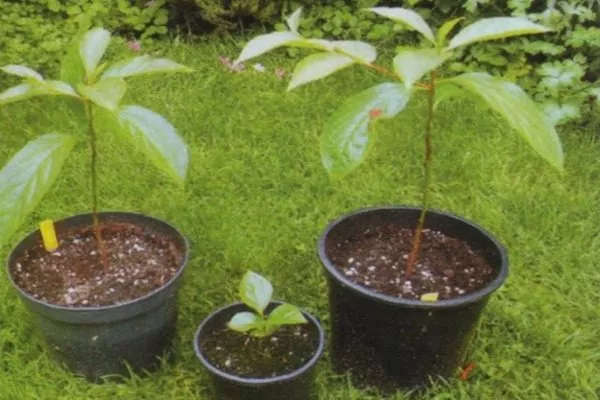
Choose one- or two-year-old persimmon seedlings for planting in your garden. Two-year-old plants are preferable. They are already established, have a developed root system, and have foliage. These specimens thrive in their new location.
Inspect the planting material carefully before purchasing. It should meet the following quality criteria:
- a straight and strong trunk, free from defects (damage, cracks, signs of disease and insect damage);
- smooth bark;
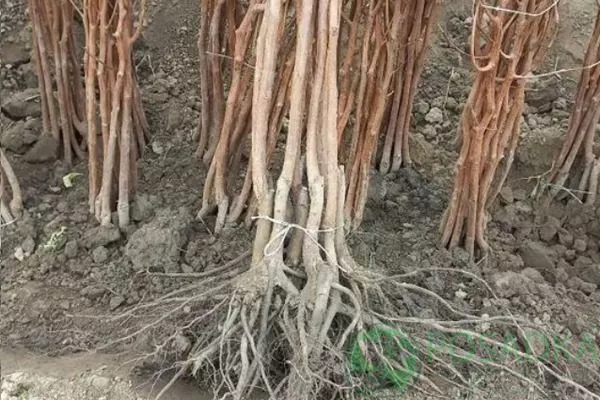
- developed fibrous root system;
- living and healthy kidneys;
- not to look faded.
The optimal choice is a seedling on a Virginia or Caucasian rootstock. The former is recommended for growing in the climate of the central part of Russia, while the latter is suitable for the Caucasus and warmer regions of the Russian Federation. These plants are more resilient and cold-resistant, and require less maintenance.
You can purchase either young bare-root trees or those growing in a container with soil for planting:
- The former are sensitive to temperature fluctuations and lack of moisture. They are better suited to being transplanted into the garden in the spring.
- The latter are considered less fussy and more resilient. They can be "relocated" to a permanent location throughout the season.
Don't buy persimmons at the market. Visit a specialized nursery. There, you'll buy a high-quality seedling, receive advice on the chosen variety, and receive recommendations for growing it.
Preparing the site
Before you plant a tree purchased from a nursery, carry out the following preparatory work in the chosen area:
- in the fall, if a spring procedure is planned;
- 3-4 weeks before the date on which you plan to transfer the persimmon to your garden in the fall.
Till the soil to a depth of 40-50 cm. Clear it of weeds, roots, debris, and stones. Add humus or compost to improve soil fertility. Dig planting holes measuring 60 x 60 x 60 cm (this should be 1/3 larger than the root mass of the plant). Space them 4-6 m apart.
Cover the bottom of the hole with a layer of crushed rock, broken brick, or pebbles. This layer should be 15-20 cm thick. This is essential if the groundwater level is close to the surface or if the soil is dense and clayey, allowing moisture to drain slowly.
Persimmon seedling planting technology
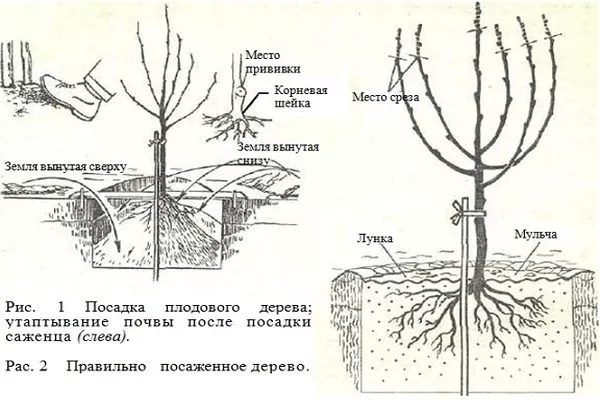
The day before planting, slightly shorten the persimmon seedling's root shoots, trimming its central stem to a height of 80-90 cm. Soak the lower part of the plant in water with Zircon added. The next day, plant, following the step-by-step instructions:
- Form a mound of garden soil and humus (or mature compost) at the bottom of the hole, using 10-20 liters (1-2 buckets). Enrich the soil mixture with nitroammophoska (200 g).
- Drive a stake into the central part of the hole next to the mound to serve as a support for the tree.
- Place the seedling on top of the mound. Spread its roots outward and downward.
- Fill the planting area halfway with garden soil. Firm it with your hands to eliminate any air pockets.
- Water the persimmon tree with sun-warmed water. Use 10 liters per trunk.
- Add the remaining soil to the hole. Make sure the tree's root collar is buried no more than 3 cm deep and the grafting site is raised above the ground.
- Tie the seedling to a stake.
- Form a ridge of soil around the tree's trunk. It should be 5-6 cm high and 1 m in diameter. This will prevent water from spreading when watering.
- Once again, thoroughly moisten the soil beneath the plant. Use 30 liters of water, settled and warmed in the sun, per tree.
- Mulch the tree trunk circle with organic matter (compost, straw, sawdust, non-acidic peat).
When is the best time to plant persimmon seedlings?
You can plant a southern tree in the fall or spring, or, if you purchased a container-grown tree, throughout the growing season. The most appropriate time depends on many factors: the variety, type, and age of the seedling, and the growing region.
Optimal timing for planting persimmons
Gardeners consider the following periods of the year to be the most favorable times for planting heat-loving fruit crops:
- early spring, when the ground has already thawed and warmed up, but the sap flow has not yet begun;
- autumn, 3-4 weeks before frost.
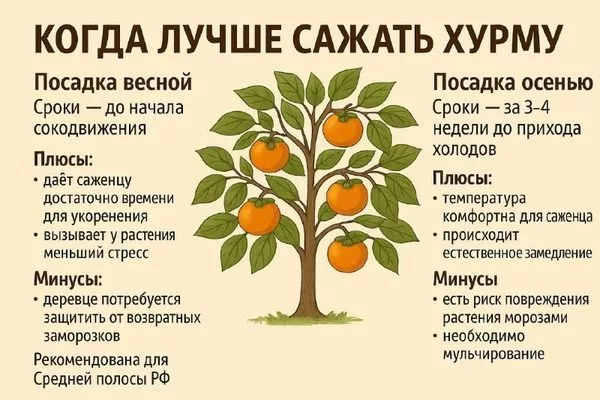
Spring planting gives the persimmon more time to establish roots and causes it less stress. At this time of year, gardeners can more easily control watering, but the tree requires protection from recurring frosts. This method is preferable for temperate climates and regions with colder climates.
During the autumn months, temperatures are more comfortable for the crop planted in the garden. During this time, growth naturally slows, but there is a risk of frost damage to the seedling. Mulching is essential.
Factors influencing planting time
To calculate the most optimal time for planting, consider several important points:
- Age of planting materialOne-year-old bare-root seedlings, which are highly vulnerable to temperature fluctuations and moisture stress, should be planted in their permanent location in the spring. This procedure should be carried out from the third ten days of March until mid-April.
For fall planting, choose a two-year-old persimmon tree. Pay attention to the color of the trunk. It should be brown—an indication that the bark is ripe. If the shoots are light, grayish-yellow, or greenish, the plant will not survive the winter frosts and will die.
Don't purchase planting material from a nursery until October. Make sure to complete the procedure before the end of the first week of November. - Climatic features of the growing regionIn southern regions, characterized by early and hot springs, dry summers, and a long, velvety season, the best option is autumn planting of persimmons. The prolonged warmth will allow the plant to take root and adapt to its new location before winter sets in. Early root regeneration will occur in the spring.
In regions with cooler climates, opt for spring planting. Begin this procedure after the soil has warmed to 14-15°C and the air temperature to 18-22°C. This will ensure the planted tree enjoys favorable conditions that will ensure good root and aerial development.
Step-by-step instructions for spring planting
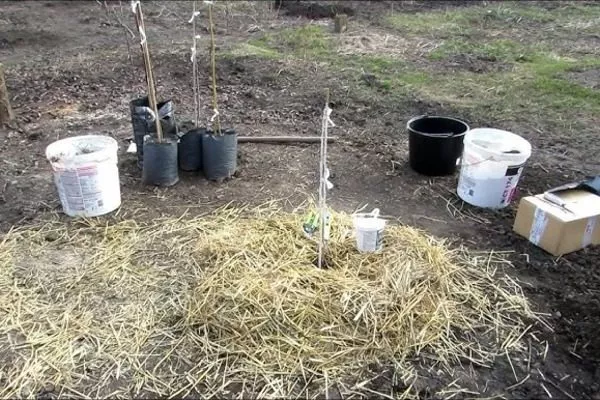
To ensure your persimmon tree successfully takes root in its new location, plant it in the spring, strictly following the instructions described earlier, taking into account the following nuances:
- Before you get started, make sure that the soil in the garden has warmed up to +15⁰С to a depth of 20-25 cm;
- when planting in sandy soil, deepen the root collar by 3-5 cm to protect the persimmon from temperature drops;
- If you plan to grow fruit crops on loam, leave the root collar at the same level as the ground surface (there is no need to bury it);
- don't forget to water the plant generously and mulch the area around the tree trunk;
- Provide the seedling with protection from possible recurrent frosts (build a temporary shelter from special materials).
Autumn planting: features and recommendations
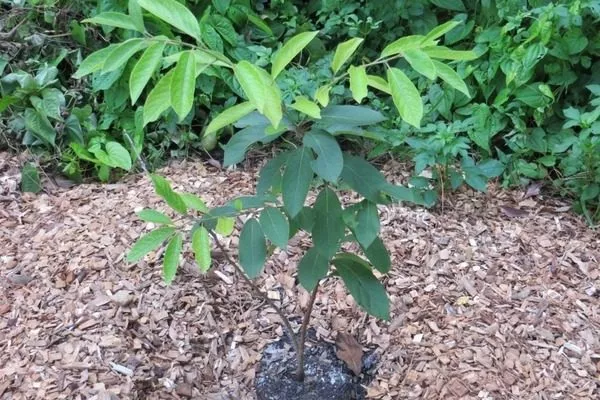
If you live in a mild-winter area, transplant southern plants into your garden in the fall. The optimal time is October. Planting times vary by region:
- second-third decades of October, beginning of November - in the south;
- end of September-beginning of October - for the Middle Belt;
- the first ten days of October - for the Black Earth Region and the Volga Region.
In Siberia and the Urals, persimmons are not grown outdoors. They are cultivated only in heated greenhouses.
Perform fall planting, strictly following the step-by-step procedure described earlier. Add the following steps to the procedure:
- pruning the above-ground part of the plant to 30 cm;
- insulating the root zone (cover the area around the tree trunk with compost or humus, forming a mulch layer at least 15 cm thick);
- construction of additional shelter from spruce branches and agrofibre.
Caring for persimmon immediately after planting
To ensure the trees take root well, begin to grow vigorously and develop properly, and produce a bountiful harvest in the future, provide them with the following care:
- WateringThe crop requires regular irrigation. This is especially necessary for persimmons, which grow in arid climates.
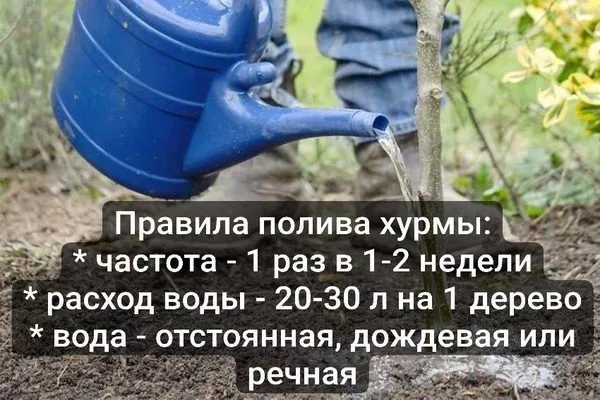
During the first year after planting, water the soil under young trees weekly (at least three times a month). Use 20-30 liters of settled, sun-warmed water at a time. Do not exceed this amount. Damp soil can lead to root rot. In hot weather, water the seedlings frequently—several times a week or every other day.
As the plants mature, gradually reduce the number of waterings to 3-4 times per growing season. Increase the water application rate to 80-100 liters per trunk. Be sure to water the trees during fruiting season and during the hot summer weeks.
Don't forget about the need for autumn moisture-recharging irrigation, which increases the winter hardiness of the crop, and spraying the crown during periods of drought (you can also place open containers of water near the tree trunk to increase air humidity).
- Loosening, weeding and mulchingLoosen the soil under the persimmon tree after rain and watering. Avoid allowing a dense, air-impermeable crust to form on the surface. Combine this procedure with weed removal, which can harbor pests and pathogens.
To retain soil moisture and suppress harmful weed growth, cover the area around the tree trunk with organic matter (5-10 cm of mulch). Avoid placing it directly on the base of the trunk; leave a 5 cm gap from the base. - Crown formationBegin the procedure the following year after planting. Leave the trunk at a height of 50-60 cm. Train the upper part of the tree using a sparsely layered pattern or shape it into a bowl. This technique reduces the persimmon's height, making it easier to care for and harvest. You can find more details on proper persimmon pruning here. Here.
- Top dressingThe best fertilizers for garden trees are organic. Apply them in the spring or fall while tilling the soil. Use humus. The recommended application rate is 8-16 kg (1-2 buckets) per young tree, and twice as much per mature tree. Well-rotted manure and compost are also suitable for feeding persimmons.
This southern plant responds well to the addition of ash to the soil. Use 200 g of dry matter per trunk. Work it into the soil around the trunk.
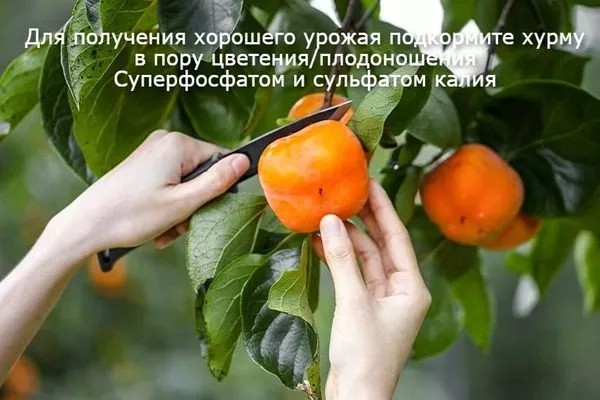
Of the mineral fertilizers, use nitrophoska (40 g/m2). Apply it before budding. During flowering and fruiting, apply a potassium sulfate solution (30 g per 10 l) to the roots and apply dry superphosphate (40-60 g/m2). These substances can also be used for foliar feeding.
Sowing green manure around the tree trunks in the fall provides good results in enriching the soil with nutrients. In the spring, incorporate it into the soil, being careful not to damage the persimmon roots.
- Insulation for the winterSaplings and trees growing in the temperate climate zone require this. In the fall, insulate the area around the trunk with a thick layer of organic matter (at least 15 cm). It's advisable to make a mound of peat at the base of the trunk. Create a shelter using spruce branches, agrofibre, or burlap. Do not use plastic film, as it is not breathable and may cause rot.
During the cold season, pile snow around the persimmon tree to create a high snowdrift. This will provide additional protection from frost.
Common mistakes when planting persimmons
Beginning gardeners often encounter complications when growing this southern fruit crop. These problems stem from mistakes made during planting. The most common ones include:
- Wrong choice of locationIf it's located in the shade, the sun-loving persimmon will grow poorly and produce little fruit. It doesn't thrive in low light conditions. Even light shade reduces the plant's yield.
If you plant a tree in a low-lying area, it will become diseased due to dampness. Close proximity to groundwater can lead to root rot. In such conditions, the seedling will wither and may even die. - Ignoring pre-planting preparationsWhen digging a planting hole, novice gardeners often forget about the need for good drainage. This oversight is especially unforgivable if the soil is heavy and clayey. Growing persimmons in soil that doesn't breathe and doesn't drain well can be stressful. In such conditions, water stagnation in the trunk circle often occurs, leading to root rot.
- Deep root collar penetrationIf it is planted more than 3 cm below ground level, it will begin to rot over time.
The exception is sandy soil, into which, during the autumn procedure, it is necessary to deepen the neck by 5 cm to prevent it from freezing.
On loamy soils, this part of the plant should be at the same level as the soil surface or slightly raised above it.
Planting a persimmon is a task that a gardener must approach responsibly. To ensure the tree thrives, develops properly, and produces abundant fruit, it's important to carefully select a site, carry out all necessary preparatory work, complete the planting process within the allotted timeframe, strictly follow the instructions, and provide quality care.