
Dar Sofiyivka is a unique persimmon variety with characteristics that make it ideal for both garden and commercial cultivation. It was developed in Ukraine in the 1950s by renowned scientist Sofia Vladimirovna Kholodkovskaya, who left her name on the variety.
Description of the variety
Kholodkovskaya combined two persimmon varieties – the Sharp-leaved and the Azerbaijani – resulting in a new, unique variety that immediately won the love of gardeners and lovers of this fruit.
But there is another version of the creation of the Dar Sofiyivka persimmon - it is a modern hybrid, bred in 2012 through open pollination of unknown species.
Varietal characteristics:
- It is distinguished by its dense, cap-like crown, reaching a height of up to 320-350 cm, which makes it especially suitable for growing in areas with limited space.
- Annual growth is about 35-50 cm, which allows for the formation of a harmonious rounded-flattened shape without the need for intensive pruning.
- The crown is dense and multi-branched, creating the appearance of a sphere. Its leaves are large, glossy, and dark green, but turn golden-yellow in autumn. The leaves are oval in shape with pointed tips.
- During the flowering period, which occurs from May 20 to June 10, the plant is adorned with small creamy-white buds, collected in inflorescences, attracting bees and other insects with a delicate aroma.
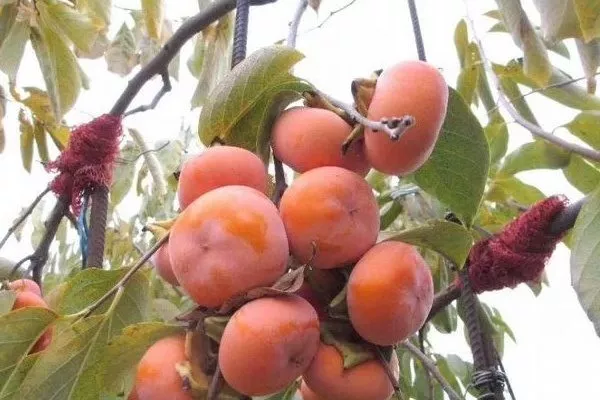
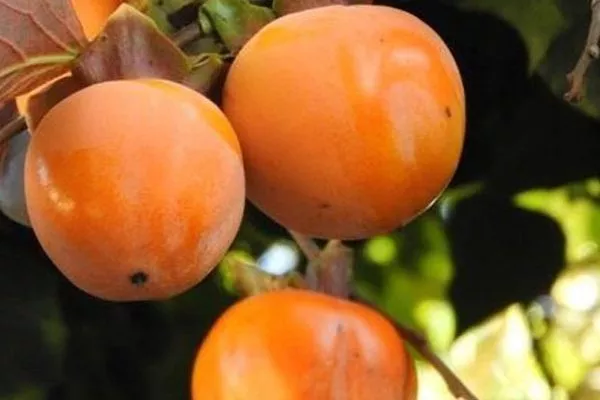
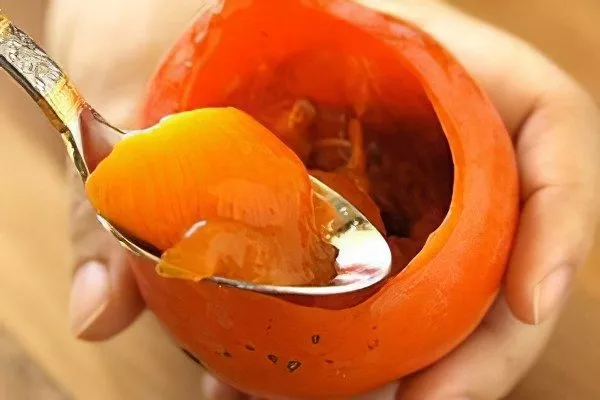
The female flowers are solitary, reaching 2.5-3 cm in diameter, with 3-5 petals, axillary, with broad sepals and a bell-shaped or tubular corolla. They have a yellowish hue. The male flowers are usually gathered in racemes of up to 5, are narrower, and goblet-shaped. They are yellowish-white. - The fruits of this persimmon variety are round-oblate, weighing between 90 and 150 grams, and covered with a smooth, orange-red skin with a waxy coating. The flesh is sweet, with a slight tartness that diminishes as it ripens.
- The taste of ripe persimmon is sweet and aromatic, reminiscent of citrus fruits such as orange or tangerine.
- Persimmons can be eaten fresh, or used to prepare various sweet dishes, such as desserts, jams, and dried fruit products.
Main characteristics
The crop is self-fertile, allowing it to produce fruit without the need for pollination from other plants. Ripening begins in early October and is complete by the end of November, with a shelf life of two to three months.
Other characteristic features:
- The hybrid is adapted to various weather conditions: it can easily withstand short-term droughts and excessive moisture, but long-term saturation of the root system with water can cause fungal infections;
- This crop is highly resistant to diseases and pests, making it easier to care for - fungal infections are rare, making chemical treatment unnecessary (to maintain the health of the tree, it is sufficient to carry out preventive measures once or twice a year);
- The frost resistance of Sofiyivka (as it is commonly called) is up to -28 degrees Celsius, so it can be grown in frost hardiness zones 5 (from -29 to -23 degrees Celsius).
The benefits of persimmon Dar Sofievka
This fruit has a whole range of beneficial properties, making it an essential element of a healthy diet:
- Sofievskaya persimmon is a true source of vitamins and microelements: vitamins A, C, E, B1, B2, potassium, calcium, phosphorus, and magnesium. This helps strengthen the immune system, increase hemoglobin levels, improve vision, and improve overall skin health.
- It is rich in antioxidants, which actively fight destructive free radicals and help reduce the risk of developing cancer.
- Sofiyivka has a beneficial effect on the gastrointestinal tract. Its fiber content helps optimize digestion and prevent constipation, and its anti-inflammatory properties make it a useful treatment for gastritis and ulcerative colitis.

- Persimmon can be a reliable ally for those battling diabetes. Thanks to its low sugar content and optimal glycemic index, it can be included in the diet without posing a health risk.
Growing and care
It's best to choose a planting location that receives ample sunlight but some shade at midday. The soil should be permeable and neutral to slightly acidic.
How to choose seedlings in an online nursery?
When purchasing a plant from a nursery, a visual inspection of the plant is sufficient, but if this is not possible in your area, you will have to purchase the planting material from an online store.
This can be challenging because the buyer doesn't actually see the seedling, but only examines it online. However, experienced gardeners recommend following these tips:
- Check out our selection of seedlings – Each plant species is provided with a detailed description and photographs, allowing you to appreciate the diversity of options available. However, if you find identical characteristics across different varieties, avoid that seller.
- Pay attention to the age of the seedling – Two- and three-year-old plants guarantee a faster harvest, but do not forget that young plants adapt better to new conditions.
- Look at the opinions of others - Reading customer reviews can provide valuable insights into the quality of the strain and its potential results. And most importantly, the seller's honesty and responsibility.
- Please review the delivery terms – The type of seedlings delivered (closed or open root, what type of substrate the roots are in, etc.) is also important. Don't forget about delivery times—the sooner the seedlings arrive, the better the chances of rapid rooting.
Preparing for landing
When choosing a location for planting persimmon, remember that this tree does not tolerate cold winds and cool drafts. Therefore, it is important to provide protection using various structures, such as fences or screens.
Other recommendations:
- When planning the landscape, keep in mind that persimmon requires sufficient space for its crown to expand, so the distance between seedlings should be at least 3.5-4 m;
- This species combines beautifully with low-growing shrubs and conifers, which highlight the sophistication of the foliage and the abundance of fruits;
- Avoid locations where persimmons may suffer from lack of light due to large trees creating shady areas, which will reduce yield;
- the hybrid prefers organically rich, light and loose soils with a high degree of air permeability and a neutral reaction of the environment (pH 6.9-7.0);
- persimmon does not tolerate close proximity to groundwater, which should be at a depth of at least 150-180 cm from the surface of the earth;
- it does not tolerate flooding with rain and melt water, which can deprive the roots of oxygen;
- In lowlands, the hybrid can only be grown in high flowerbeds with a height of 85-90 cm and a diameter of 100 cm.
Peculiarities:
- If the soil is too acidic, it must be neutralized with dolomite flour, adding it to the soil at a rate of 4 kg per 10 square meters.
- To fill the planting holes, use a special mixture of the top fertile soil layer that remains after digging the hole, rotted manure, leaf soil and sand in a ratio of 1:2:2:1.
The landing process
The step-by-step guide to growing persimmons is standard, but there are some nuances:
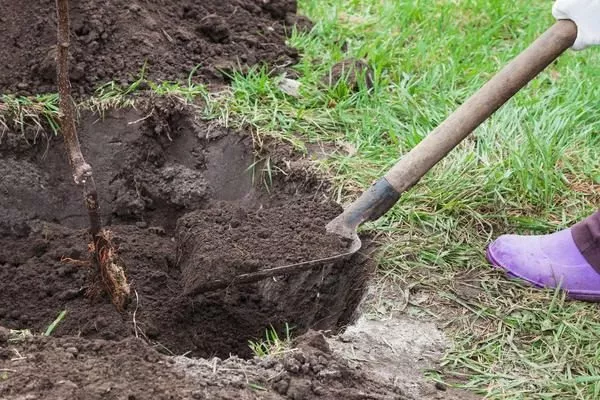
- Prepare planting holes, their depth and diameter should be 60-70 cm, and place them at a distance of 3.5 meters from each other.
- Place a 9-10 cm high drainage layer of fine gravel or broken brick at the base of each hole.
- Drive a 180-200 cm long planting stake into the center of the hole. After planting, tie the seedling to it.
- Fill the holes one-third full with the pre-prepared planting mixture, add 2 tablespoons of potassium sulfate and superphosphate to each, as well as a third of a 10-liter bucket of wood ash, and mix everything thoroughly.
- Place the seedling on top of the planting soil in the hole, carefully spreading out the roots. Continue filling it with the same mixture to the edge of the hole, periodically compacting the soil with your hands to ensure the roots are firmly in contact with the soil and there are no air pockets. After planting, the root collar of the persimmon should be level with the ground.
- Tie the seedling to the planting stake using soft rope in the shape of loose figure eights.
- Provide young trees with water (20-25 liters per tree) and cover the area around the trunk with a 7-8 cm layer of straw. This mulch will prevent weeds from growing and help retain moisture in the soil.
Caring for persimmon after planting
Care measures are not particularly difficult, but pay attention to the varietal requirements.
Watering and fertilizing
Persimmon is a plant that requires a lot of moisture, so it needs frequent and abundant watering:
- During the first month after planting, especially in hot spring weather, water the plants every two days, using 20 liters of water per tree.
- Then, one watering per week in cool weather or two waterings per week in hot summer will be enough.
- A month before harvesting the fruits, watering should be stopped to improve their shelf life.
Persimmon needs only three feedings per season:
- The first one carry out this in April using a urea solution (2 tablespoons per 10 liters of water per tree), after the snow has melted and the top layer of soil has thawed.
- Second This procedure is necessary during budding and subsequent flowering, using potassium-phosphorus preparations or a homemade organomineral fertilizer. To do this, mix 10 liters of water with slurry (at a 1:10 ratio), 2 tablespoons each of phosphate flour and potassium magnesium sulfate, and a liter of wood ash.
The resulting mixture must be thoroughly mixed and applied at a rate of 5 liters per tree. Before applying this solution, water the plants with clean water to avoid burning their roots with the slurry. - The third one Fertilizer is applied in the fall, immediately after harvesting, using a ready-made mineral complex for autumn fertilization of fruit crops, such as Fertika Autumn. See the packaging for dosage.

Pruning and shaping the bush
In the second year after you planted the tree in the spring, begin to form its structure using a sparse-tiered system:
- cut the central trunk to a height of 250 cm;
- shorten the side branches by a third, leaving 3-4 of the most powerful ones;
- Next, form branches of the second, third and fourth levels.
Mature persimmon trees undergo sanitary pruning annually in early spring. At this time, remove damaged, frozen, weak branches, branches growing inward, and branches growing at an angle of less than 45 degrees to the trunk.
Protection from diseases, pests and frost
Persimmons are characterized by good resistance to fungal diseases and rarely suffer from pests. However, to prevent potential problems, take preventative measures in the spring, when green shoots appear on the trees. Treat the plants twice within 3-4 days:
- the first one is against diseases using 1% Bordeaux mixture;
- the second one is from pests, using a solution of the biological product Fitoverm.
If your garden has been attacked by pests or diseases in the summer, repeat these sprays in the fall, after the fruit has been harvested.
Despite its relatively high frost resistance, this persimmon variety requires careful winter protection in two cases: when grown in very harsh conditions and when young. To do this, you need:
- cover the tree trunk circles with dry leaves in a layer of 50-60 cm;
- Place two layers of spruce branches on top, placing them with the needles facing up, to protect the trees from rodents;
- wrap the trunk with burlap or white covering material in three layers, lightly tying it on top with a soft rope (a young tree is covered completely).
Harvesting and storage
Pick persimmons before the first frost of winter. If the fruits are not yet fully ripe, place them in a cool but dry place to ripen. They will be fully ripe in a few days.
For long-term storage of persimmons, various methods can be used:
- peeling, slicing and storing persimmons in the freezer;
- Persimmon can be used to make compote, jam or preserves for the winter.
To store fresh persimmons, choose a cellar or basement where the temperature is maintained at 2°C (37°F). Always stack the persimmons in single layers in wooden crates, carefully sprinkle them with wood shavings, and place them on the top shelf.
Pros and cons
Dar Sofiyivka isn't just a smart choice, it's a real find. This variety impresses not only with its exquisite taste but also possesses a number of attractive characteristics:
No critical flaws were found.
Reviews
Sofiyivka's Gift is a self-fertile variety, simplifying cultivation. Its attractive tree shape and vibrant fruit make it an ideal choice for landscaping. Gardeners praise this hybrid for its frost resistance, excellent yield, and sweet fruit flavor.