
Victoria (Pyrus communis Victoria) is a pear variety popular among Ukrainian gardeners. This early autumn variety is distinguished by its high yield, strong immunity, low maintenance, and excellent harvest quality.
The history of the Victoria pear variety
Scientists developed this variety in Melitopol at the Institute of Irrigated Horticulture of Ukraine. The authors are P. V. Grozditsky, I. N. Boyko, E. A. Avramenko, G. I. Kulikov, and I. N. Maksimova.
Victoria was obtained by crossing Tolstobezhka with the Bere Bosk variety. In 1974, it was submitted for state trials. In 1993, the variety was approved for use in the North Caucasus region (Ossetia).
Initially, it was intended for cultivation in the following climatic zones of Ukraine:
- southern strip;
- steppe;
- forest-steppe.
Description of the Victoria pear tree and fruit
Victoria has many distinctive features that make it easy for an experienced gardener to recognize this variety. Its trees are medium-sized and compact. They possess the following characteristics:
- height: 2 m (under particularly favorable conditions the height reaches 4 m);
- crown: compact, medium-dense, round-pyramidal in shape;
- foliage: rich green, glossy, rounded, with a pointed tip;
- flowers: large, snow-white, saucer-shaped, with a distinct pleasant aroma.
- ✓ The leaves have a characteristic glossy sheen, which distinguishes them from other varieties.
- ✓ The fruits have a unique buttery flavor that is rarely found in other pear varieties.
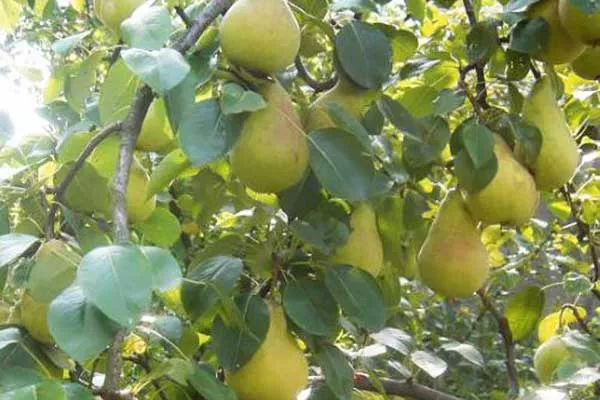
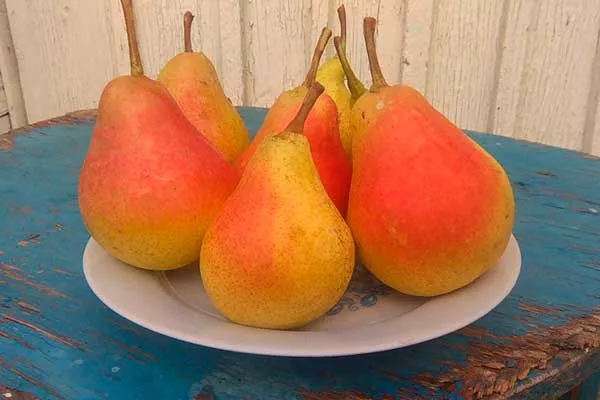
Victoria is a large-fruited pear variety. The fruits of this variety have the following characteristics:
- weight from 180 to 300 g;
- symmetry;
- elongated pear-shaped form;
- covered with a skin of medium thickness, on which there is a rustiness that is barely noticeable to the eye;
- the pulp is white, without granulation.
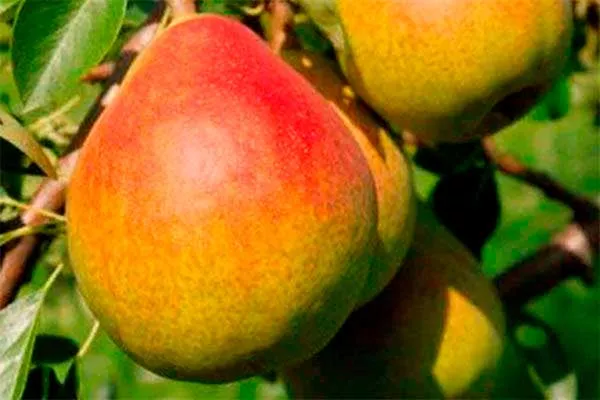
The taste of this pear variety will delight the eater. It has a buttery, sweet, and slightly tart flavor. The flesh is juicy, tender, and aromatic.
The composition of the Victoria pear is as follows:
- sugars (16%);
- pectin (3.5%);
- fiber;
- proteins;
- malic acid;
- citric acid;
- vitamin substances;
- minerals.
The harvest from this variety is versatile. It can be eaten fresh or used to make jelly, jam, marmalade, and compote.
Characteristics
Victoria has excellent characteristics that have earned it the love of not only Ukrainian, but also Russian and Belarusian gardeners.
Pollination of varieties and pollinators
| Name | Ripening period | Disease resistance | Fruit size |
|---|---|---|---|
| Williams red | early | high | large |
| Triumph of Vienna | average | average | average |
| Bere Dumont | late | high | large |
| Nikolai Kruger | average | high | large |
This variety is partially self-fertile, but produces numerous fruits that are completely seedless. Gardeners consider the following pear varieties to be the best pollinators for Victoria:
- Williams red;
- Triumph of Vienna;
- Bere Dumont;
- Nikolai Kruger.
Productivity
Victoria trees begin to bear fruit as early as six years of age (sometimes as early as seven years). Fruiting occurs annually, and fruit set is high. The variety yields up to 200 kg per tree. This yield does not decline over the years, remaining high.
Frost resistance
This variety is characterized by high winter hardiness. Hardiness zones 5-6. Victoria is also drought-resistant, but has average heat tolerance.
Ripening period
Victoria trees bloom late in the spring. This characteristic of the variety protects the flowers from recurrent frosts. The fruits ripen in the last week of August. Gardeners harvest them until mid-September.
Optimal conditions for growing
By providing the Victoria pear seedling with favorable growing conditions, experienced gardeners achieve abundant fruiting on time. To achieve good results, they select a site for the pear tree that meets the following requirements:
- sunny or semi-shaded;
- no drafts;
- located in a garden on an elevated position;
- with light, loose, air- and water-permeable soil (groundwater level is deep);
- with fertile soil (it is desirable to have a small amount of lime in it to obtain the best taste from the fruits).
- ✓ The depth of groundwater should be at least 2.5 meters to prevent rotting of the root system.
- ✓ Soil should have a pH in the range of 6.0-7.0 for optimal nutrient absorption.
Planting and caring for a pear tree
You can plant a seedling purchased from a nursery at your dacha in early spring or fall. In the former case, you'll need to add a growth stimulant and nitrogen fertilizer to the planting hole; in the latter case, you'll need phosphorus or organic fertilizer.
When planting the Victoria pear, take these important points into account:
- the optimal size of the planting hole is 80x80 cm;
- distance between trees - 400 cm;
- The grafting site of the seedling should be 5-7 cm above ground level when planted.
Take care of your pear tree by following these essential procedures:
- WateringBefore the tree reaches fruiting age, water it at least five times per season, using 30-50 liters of water per young plant. Mature fruiting pear trees require watering during flowering, in June (when the fruit sets), and 20 days before the fruit ripens.
Water consumption is the same as for non-fruit-bearing trees. Stop irrigation completely in late July. It will only be necessary to resume it in the spring.
- TrimmingIn the second year after planting, thin out the seedling's crown in the spring, trimming away any frost-damaged parts. Leave any branches bearing fruit. Remove any low-growing shoots entirely.
- Top dressingApply fertilizer for the first time when planting the tree. Choose mineral fertilizers. During the first year, apply nitrogen in mid-May. Repeat the application in June. In the third and fourth years of the tree's life, reduce nitrogen fertilizer application to a minimum to stimulate fruiting.
Feed the pear tree with mineral fertilizers annually and organic fertilizers once every 3 years.
Harvesting and storage
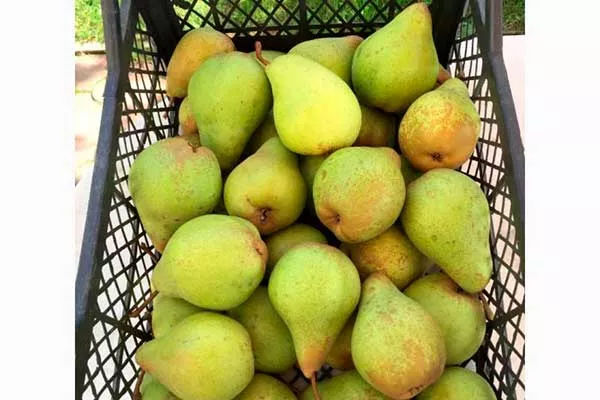
Store ripe Victoria fruits picked at the right time in the cellar. There, they will retain their freshness and marketable appearance for 4 weeks. To extend their shelf life to 12-14 weeks, store them in the refrigerator.
Preparing for winter
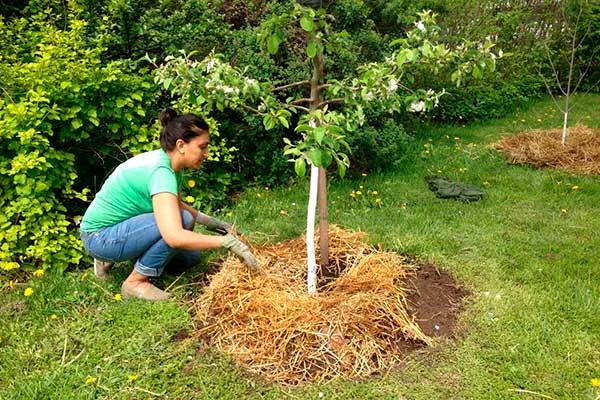
Before the first autumn frosts, protect your Victoria pear seedlings. To do this, cover the root collar with mulch, forming a mound. This will need to be removed in the spring. In winter, it will protect the root collar from freezing. Don't forget to insulate the area around the trunk by covering it with straw or sawdust (at least 15 cm thick).
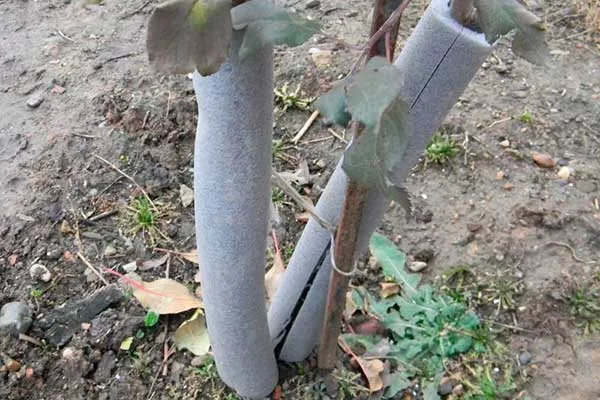
The frost-hardy Victoria pear tree requires no other cover during the winter. However, it's a good idea to protect it from hares. To do this, wrap the trunk with protective material (burlap or spunbond) to a height of 120 cm.
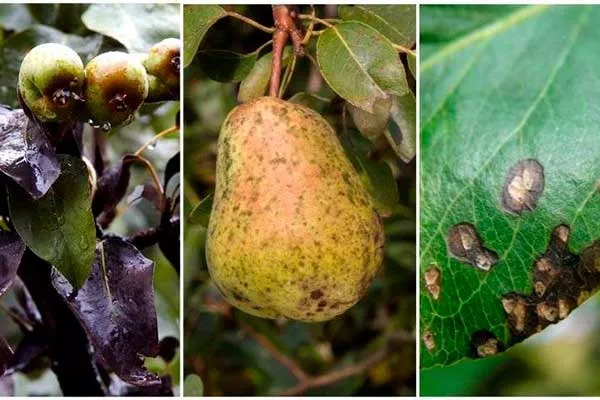
Diseases
The Victoria pear variety boasts strong immunity. It is resistant to viral and fungal diseases, especially scab and brown spot.
Plantations of this variety may be susceptible to the following pear diseases:
- MoniliosThis is a fungal infection. The disease manifests itself as dark spots on the fruit, followed by rotting. Affected fruit do not fall to the ground, but infect neighboring branches. Cut off and burn infected parts of the tree. To combat the disease, use Fitosporin-M or an iodine solution.
- Powdery mildewYou can identify this disease by the gray coating on all parts of the tree. Control it by removing all affected parts of the tree and spraying the crown with Sulfite or Fundazol.
- Black crayfishBlack spots appear on the foliage of a diseased tree, and rot appears on the fruit. A fungus develops on the bark, appearing as a non-uniform thickening. Combat the problem by spraying the pear tree with copper-containing products.
Pests
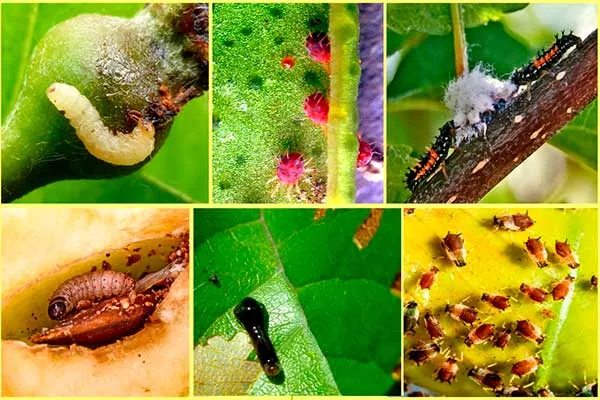
Victoria seedlings are susceptible to a few pests of pear trees:
- Brown fruit miteThe pest's larvae appear in early spring. During their molt, shiny skins remain on the pear tree trunk, which gardeners use to detect the presence of the parasite. Get rid of the mite by treating the planting with Nitrafen.
During the ripening process of the crop, you can use Karbofos or colloidal sulfur against the pest.
- Pear leaf gall midgeThis insect resembles a mosquito with a brown body. Its larvae appear on pear tree foliage. To prevent this problem, treat the trees with Malathion or another insecticide in early spring.
Pros and cons of the variety
The Victoria pear has many advantages, including:
This pear variety has no significant drawbacks. Gardeners list the following as a few drawbacks:
Reviews of the Victoria pear
Victoria is a popular Ukrainian pear variety. It stands out among other varieties due to its high yield, good winter hardiness, and scab resistance. Victoria's harvest is not only abundant but also has excellent commercial qualities.