
If pear tree leaves turn brown and begin to fall prematurely, they're affected by a fungus. Autumn coloring on this fruit tree, which appears in the middle of the summer season, is one of the clear signs of rust. Learn how to diagnose and combat this disease in this article.
Description of the disease
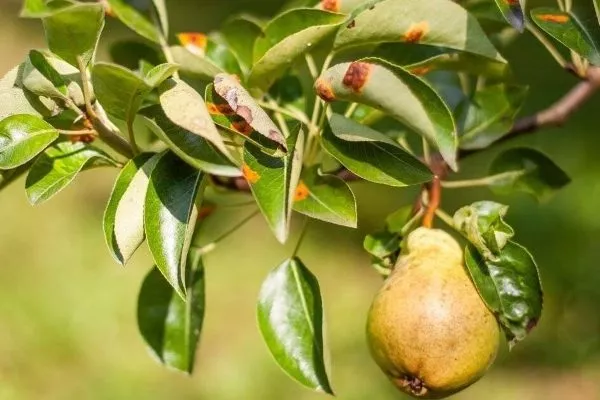
Rust is a common pear disease that damages the foliage. It owes its name to the rusty (yellow-brown with a reddish tint) spots that appear on the leaf blades of affected plants.
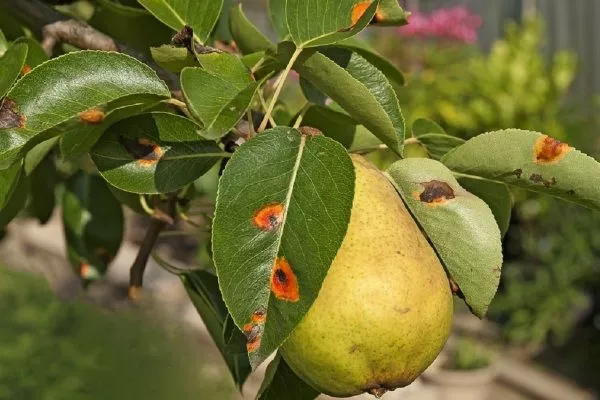
Rust is caused by a fungus belonging to the Pucciniaceae family. This parasite has a biennial life cycle and has two hosts:
- the main one is juniper;
- intermediate - pears.
Gardeners don't grow these two crops in the same plot. It's worth noting that not every juniper species infects pear trees with fungus. The following varieties pose a risk:
- Cossack;
- ordinary;
- high;
- red.
Distribution area
Fruit crops grown in the following areas are susceptible to this fungal disease:
- Krasnodar Krai;
- Stavropol Krai;
- Karachay-Cherkessia;
- Adygea;
- Crimea;
- Ukraine;
- Moldova;
- Georgia.
The frequency of rust occurrence and the extent of damage it causes varies from region to region:
- for the Krasnodar region (its southern part), Ukraine, Moldova and Crimea - once every 2 years with damage to pear plantings from 50% to 100%;
- for the eastern regions of Georgia - once every 3 years with damage from 30% to 50% of plantings;
- for Krasnodar Krai (its central part), Stavropol, Adygea, Karachay-Cherkessia, Georgia (its western regions) - once every 5 years with damage from 15% to 30% of fruit plantings.
Reasons for occurrence
The following factors contribute to the incidence of pear rust:
- closely located juniper plantings;
- rainy weather or overwatering of the garden;
- lack of nutrients in the soil, neglect of fertilizing;
- dense crown of pear tree;
- reduced immunity in fruit trees.
The following weather conditions promote the development of fungus:
- temperature range: from +3 °C to +30 °C (optimal temperature: +18 °C);
- air humidity level is 85%.
Symptoms
The first signs of the disease appear on pear trees in the spring after they have finished blooming. As the rust progresses, the tree's appearance deteriorates. By July, the clinical picture becomes apparent.
Diagnosing a fungal infection of a fruit crop is not difficult based on the following symptoms:
- round spots of reddish color (sometimes with a reddish border) on the outer side of the foliage;
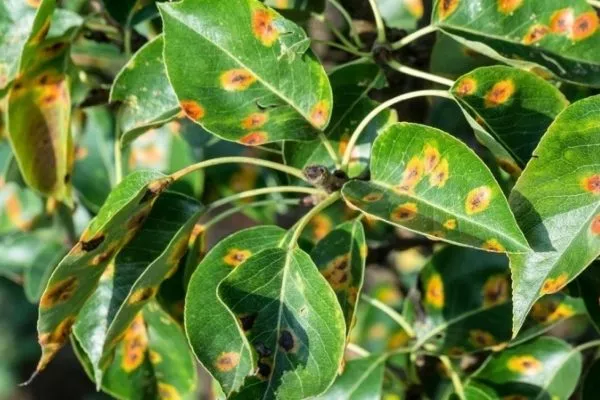
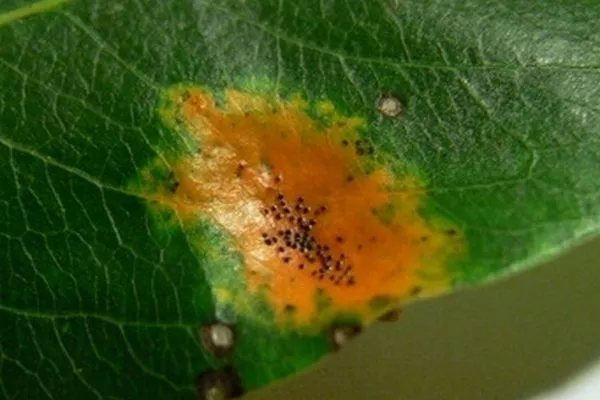
- the presence of black dots on them;
- spindle-shaped growths of pale gray color, located on the back side of the leaf blades;
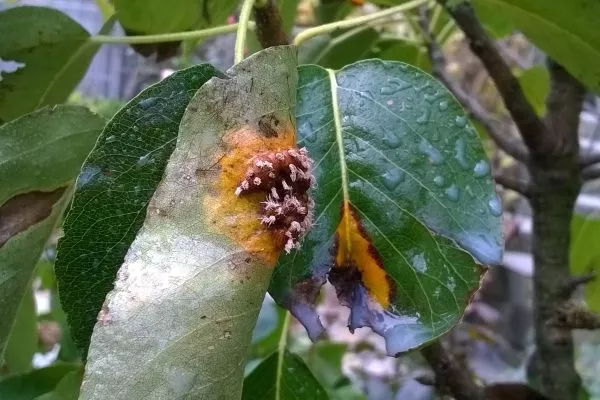
- the appearance of reddish-brown seals and new growths on petioles, shoots, and fruits;
- an increase in the number of spots on the foliage, their growth (the foliage looks rusty and withered);
- premature leaf fall;
- slowing down the growth of young shoots (they will look thickened and short);
- drying out of branches severely damaged by rust;
- shedding of fruits that never had time to ripen.
Excessive leaf spots threaten the plant with oxygen starvation, and early leaf drop can lead to a sharp decline in immunity. A diseased pear tree becomes susceptible to scab and pests, and its frost resistance decreases. A young tree suffering from rust develops poorly, and its chances of surviving the winter are slim.
Stages of the disease
Juniper affected by rust becomes chronically ill. The fungus damages its needles, cones, and shoots. An infected plant is easily identified by swellings, burrs, and wounds. In spring, yellow gelatinous growths containing maturing spores appear on the plant. These spores can be carried by the wind for 40-50 km.
The incidence of fruit tree rust occurs in stages:
- In the second half of April, immediately after the pear blossoms, round spots (0.5 mm in diameter) of a greenish-yellow color appear on its leaf blades. Over time, they increase in size, swell, and darken. The spotting gradually spreads to petioles, shoots, and fruits.
- Massive damage to pear tree foliage by rust in July. The upper surface of the leaf blades is already covered with large spots (up to 15 mm in diameter), characterized by an irregular shape and a brownish-garnet color. Black spots (spermogonia) are present on their surface.
The undersides of the leaf blades also have spots, which are distinguished by their yellow coloring with a greenish tint. - The appearance of aecia on the foliage - light-grey spindle-shaped growths resembling horns. They appear on the underside of leaves in the fall. The horns are located directly on the swollen spots and contain fungal spores.
Spores from the aecia are carried by the wind over long distances, infecting junipers. They germinate in the bark, where mycelium subsequently forms.
Methods of struggle
Pear rust is difficult to treat. Controlling this fungal infection requires a comprehensive approach, including:
- repeated use of fungicides;
- use of folk remedies;
- removal and destruction of affected parts of the plant.
Chemicals
Spraying pear trees against rust with store-bought fungicides requires 3 to 6 applications per season. The number of treatments depends on the product you choose.
For the prevention and treatment of wood from fungal infection, it is applicable Bordeaux mixture (1%) or copper oxychloride (1%)Spray the pear tree with these products on a dry, windless day. The air temperature during the first application in early spring should be above zero.
Treat the tree with these preparations at the following times:
- when the buds on the pear tree have not yet swollen;
- when the first flowers appear on it;
- after flowering;
- 10 days after the third treatment.
Spraying fruit crops will also help combat rust. colloidal sulfurTo obtain a working solution, take 40 g of the preparation and 10 liters of water.
Apply this product 5 times during the season:
- on the eve of leaf opening;
- before pear blossom;
- after it has finished flowering;
- during the period of fruit appearance;
- after the leaves fall (in autumn).
Provides reliable protection against fungus to fruit crops PolyramPrepare a solution using 20 g of the product and 10 liters of water. Mix thoroughly until the fungicide granules are completely dissolved.
Spray the pear with the Poliram solution 4 times:
- when the buds swell;
- at the time of bud formation;
- after flowering has ceased;
- when the fruits on the pear tree reach 40 mm in diameter.
Use to treat pears against rust. SkorThis is a universal fungicide, applicable for other diseases, including scab. Spray the planting with it, dissolving 2 ml in 10 liters of water.
Treat your garden with Skor's solution against rust three times:
- before the leaves bloom;
- on the eve of flowering;
- after the pear tree has blossomed.
The protective effect of the fungicide lasts for 20 days.
Good effect is achieved by using BayletonTo prepare the solution, take 10 g of fungicide and 10 liters of water.
Treat the pear with the prepared liquid 6 times:
- first spraying - when symptoms characteristic of the initial stage of the disease appear;
- subsequent sprayings - once every 14-28 days.
Additionally, watch a video about effective products against rust on pear trees:
Folk remedies
Some homemade remedies, prepared according to folk recipes, can also help combat rust. It's worth using them preventatively, and then using store-bought fungicides at the first signs of the disease.
Among folk remedies, the following have proven themselves to be effective:
- ash infusion (500 g per 10 l, leave for 2 days);
- mullein solution (250 g per 10 l of water, leave for 14 days and dilute with water in a 2:1 ratio before use);
- marigold decoction (500 g per 10 l, leave for half a day);
- soda water (100 g per 10 l), enriched with soap shavings (50 g).
Use each of the above rust-fighting products at least three times. Allow 7 days between applications.
Manual leaf removal
The diseased pear is also shown mechanical treatment, which involves the implementation of the following manipulations:
- manual removal of leaves damaged by rust;
- pruning branches affected by fungus, removing 5-10 cm of healthy tissue (use a tool that has been previously disinfected for this manipulation);
- collecting fallen leaves in the garden.
Burn all prunings and collected plant debris away from your property. Treat cuts on the tree with copper sulfate (5%). Seal each wound with garden pitch. Spray the soil under the pear tree with Bordeaux mixture.
If the tree is severely affected by rust (if it has been infected for several years and has many short, dry branches with cracked bark), mechanical treatment and fungicide application will not help. The pear tree will have to be cut down and burned.
Finally, watch a video from a biologist about when and how to treat rust on pear trees:
Prevention
To make the pears in your garden less susceptible to fungal disease, systematically carry out the following preventative measures:
- Regularly inspect the leaves and branches to avoid missing the first signs of rust;
- pick off the leaves as soon as they develop rusty spots;
- destroy torn leaves and cut branches affected by fungus by burning them;
- Feed the pear tree planting with fertilizers high in potassium and phosphorus to strengthen their immunity;
- do not overuse nitrogen fertilizers;
- do not allow the tree crown to become too dense;
- follow the recommended watering regime for the pear;
- weed and dig up the soil under fruit trees;
- Preventatively spray pears with fungicidal preparations and folk remedies.
Disease-resistant varieties
| Name | Ripening period | Disease resistance | The taste of the fruit |
|---|---|---|---|
| Williams | Summer | Average | Wine-sweet, dessert |
| Chizhovskaya | Summer | High | Sweet and sour, refreshing |
| In memory of Yakovlev | Early autumn | High | Sweet and sour, without astringency |
| Northerner | Late summer | High | Sweet and sour, winey, without astringency |
| Fragrant | Late summer | High | Sweet and sour, pleasant |
| Tikhonovka | Late autumn | High | Sweet and sour |
Not all varieties of this fruit crop are equally susceptible to fungal attack. Some are less susceptible to rust, and their foliage develops rust spots less frequently than others.
- ✓ Genetic resistance to fungal diseases, including rust.
- ✓ High content of natural antioxidants in the leaves, which reduces susceptibility to diseases.
If you don't want to have to fight fungus every year to win your harvest, grow these varieties of pears in your garden:
- WilliamsThis is a summer, early-ripening pear variety with a high yield. The fruits are medium to large (weight ranges from 150 g to 180 g). Their color is waxy yellow with a delicate pink blush. The flavor is wine-sweet, dessert-like.
The variety is characterized by average resistance to frost, drought and rust, but is susceptible to scab and aphids. - Chizhovskaya. This is a mid-season summer pear. The fruits are medium-sized (110-140 g). Their color is yellowish-green with a washed-out pink blush. The taste is sweet and sour, refreshing.
This winter-hardy variety is characterized by low susceptibility to rust, scab, and other pear diseases, as well as pest attacks. - In memory of YakovlevThis is a fast-growing, early-autumn pear variety with a high yield. The fruits are medium-sized (weight 130 g). Their color is golden yellow with an orange blush. The flavor is sweet and sour, without astringency.
This winter-hardy variety is resistant to scab, rust, and septoria leaf spot. It is susceptible to gall mites. Drought tolerance is moderate. - Northerner. This is a late-summer, early-ripening, and high-yielding variety. The fruits are small (average weight 85 g). Their color is yellow-green with a red blush. The flavor is sweet and sour, wine-like, without astringency.
Severyanka is characterized by high winter hardiness, resistance to rust, codling moth, and pear mite attacks. It has average drought tolerance. - Fragrant. This is a late-summer, early-ripening, and high-yielding variety. The fruits are medium-sized (weight 120-140 g). They are green with a brick-red blush. The flavor is sweet and sour, pleasant.
The variety is characterized by average winter hardiness, good resistance to rust, scab, and bacterial infections. - TikhonovkaThis is a high-yielding, late-autumn variety. The fruits are small (average weight 50-70 g). They are green with a yellowish tint. The taste is sweet and sour.
Frost resistance is high. The variety is resistant to rust, scab, powdery mildew, and spotting. It is rarely affected by aphids, codling moths, or weevils.
Which varieties are most susceptible to the disease?
Some pear varieties are susceptible to rust. These include Bere Bosc, Cure, and Dekanka Zimnyaya. Clapp's Favorite, Ilyinka.
Pear rust is most noticeable in midsummer, with browning and leaf fall. Proper use of fungicides will help you combat the disease and save your harvest, while preventative measures will prevent this problem.