
The Rogneda pear is a winter-hardy variety ideal for challenging climates. This pear, with its beautiful name, is very hardy and produces fruit even in rainy and cool summers.
History of origin
The Rogneda variety was developed in 1997 by a group of Russian breeders from the K. A. Timiryazev Russian State Agrarian University – Moscow Agricultural Academy. The Rogneda pear was added to the State Register in 2001. The Tema and Lesnaya Krasavitsa varieties were used in its development. The new variety was zoned for the Central region, but its cultivation area was later expanded.
The appearance of the tree
The Rogneda pear is a medium-sized tree, reaching a height of no more than 4-5 m. Its crown is broadly pyramidal, formed by gently curved, olive-brown shoots.
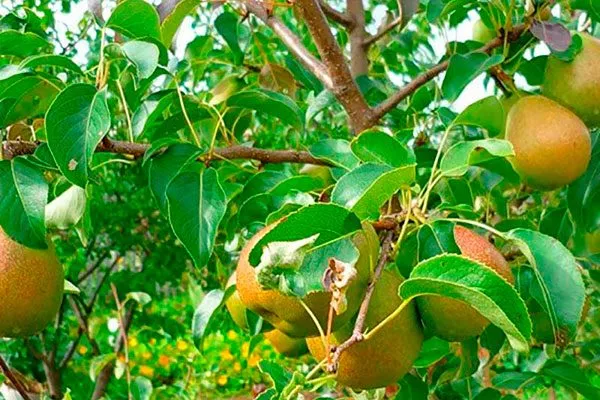
The branches are densely foliated, and the leaves are dark emerald, obovate, and serrated. The tree is characterized by a slow growth rate, resulting in a very compact and neat crown. The flowers are lush, light, and pleasantly fragrant.
Description of fruits
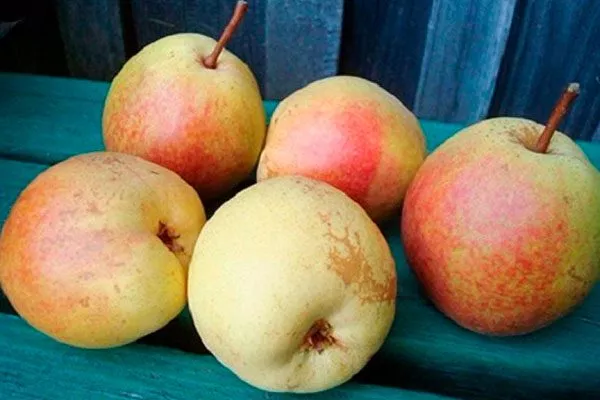
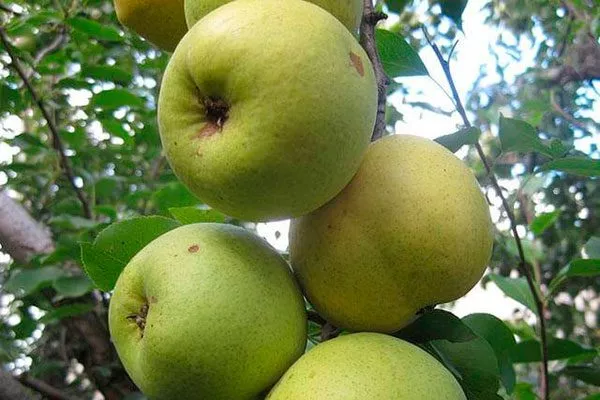
The fruits are round or flattened-round, resembling apples in appearance. Widely diamond-shaped specimens can also be found. The fruit is light yellow in color, sometimes with a scarlet, slightly washed-out blush.
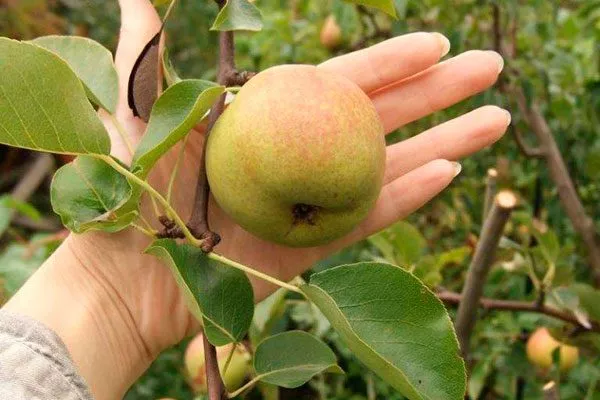
- ✓ The leaves have a characteristic emerald hue and an obovate shape, which helps in identifying the variety.
- ✓ The fruits have a muscat aroma, which is a distinctive feature of the variety.
The white-beige flesh is fine-grained, tender, juicy, and oily, and the skin is smooth and shiny, with numerous subcutaneous spots. The stalk is long and fairly thick. The average fruit weight is about 120-125 g.
Taste qualities
Rogneda's fruits are sweet, with hints of muscat. This variety's excellent flavor profile allows it to be used for a wide variety of purposes. Professional tasters give this variety a 4.2 out of 5.
Chemical composition of fruits:
- dry matter - 13.7%;
- sugar - 7.5%;
- acid - 0.15%.
Self-fertility and pollinators
The variety is self-sterile, so to ensure a good harvest, pollinators—pear trees that bloom at the same time as the Rogneda variety—should be planted nearby. The best pollinators are Vidnaya, Chizhevskaya, and Milada.
Ripening and fruiting
The pear tree begins to bloom in late spring. The variety has a mixed fruiting pattern, with the majority of the fruit forming primarily on young shoots. Rogneda is an early fruiting variety, with the first harvest occurring about four years after planting.
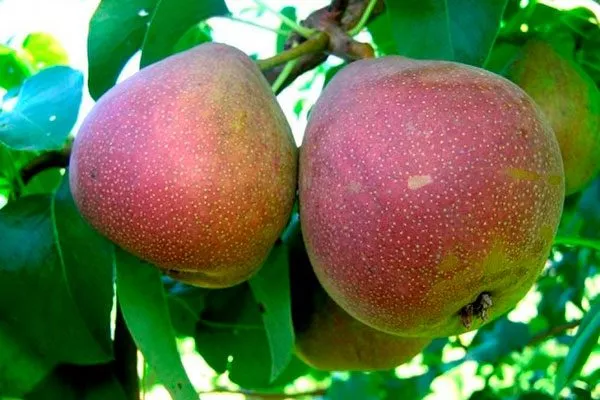
The Rogneda variety is a late-summer variety, with fruits beginning to ripen in the second half of August and reaching peak ripeness in early September. This variety bears fruit in a highly intermittent manner, so some of the ovaries must be removed in June.
If favorable conditions are provided, the tree is capable of bearing fruit for 20-25 years without interruption.
Productivity
The variety boasts excellent yields. A mature tree can produce approximately 50 kg of fruit per season. When grown in large quantities, the average yield of the Rogneda pear is 140 centners per hectare.
Pros and cons
The Rogneda variety is deservedly popular among amateur gardeners and summer residents. It has many advantages that easily outweigh some minor drawbacks. However, before planting this pear, it's best to familiarize yourself with all its pros and cons.
Site requirements
This variety can grow in sun or partial shade. However, it's best to choose a sunny location protected from drafts and strong winds. The optimal distance from buildings and other trees is 3 m and 5 m, respectively.
- ✓ Soil pH should be between 6.0-6.5 for optimal nutrient absorption.
- ✓ The soil organic matter content should be at least 3% to ensure good structure and water retention capacity.
The best soils for growing are loamy and sandy loam. The soil should be light and fertile. The Rogneda pear does not tolerate waterlogging or excessive moisture, nor does it tolerate proximity to groundwater. Excess moisture leads to root rot and eventual death of the tree. The maximum groundwater level is 2-3 meters.
Landing features
For planting, use two-year-old seedlings, which are recommended to be purchased from specialized nurseries. The trees should be healthy, with well-developed roots. The trunk diameter is 1.5 cm.
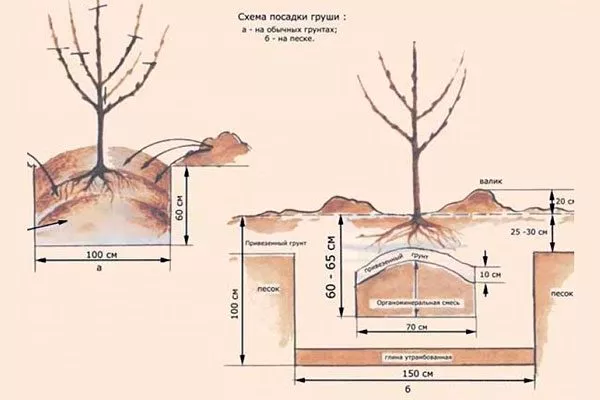
Landing features:
- Planting is recommended in the spring, in late April or early May. In temperate climates, seedlings should be kept away from winter frosts. If the variety is grown in the south, it's best to plant in the fall. Containerized seedlings can be planted at any time, including summer.
- Planting holes are prepared approximately two months before planting, and if planting in the spring, the holes are dug in the fall. The optimal hole width is 80 cm and the depth is 60 cm. The soil removed during digging is mixed with fertilizer. If the soil is clayey, sand is added to the soil mixture.
- Before planting, the roots of the seedling are kept in a solution of Kornevin or another growth stimulant.
- The seedling is planted using standard techniques: placed on a mound of earth and spreading the roots out. The soil is carefully compacted to ensure there are no air gaps between the roots. The root collar should be 5 cm above the ground after planting.
- The planted seedling is watered generously, mulched, and tied to a support. The tree will only become firmly anchored in the ground after two years, and until then, it should be tied to a stake driven into the ground.
Subtleties of care
To harvest half a hundredweight of pears from a tree, it must be well-cared for. This care determines not only the quantity but also the quality of the fruit—their taste, size, and overall presentation.
Subtleties of caring for the Rogneda pear:
- Watering. A lack of moisture negatively impacts the tree's development and fruiting, so it should be avoided. Mature trees are capable of obtaining water on their own due to their very long roots, but young plants require careful watering.
The recommended watering schedule for pear trees is 50 liters. Before wintering, 150 liters of water is needed. The water is poured into trenches dug around the tree's trunk. The furrow depth is 15 cm. After watering, the trench is filled with soil and mulched.
- Top dressing. Fertilization begins in the third year after planting. The tree's yield, fruit size, and flavor largely depend on the quality and timing of fertilization. However, both an excess of fertilizer and a deficiency can negatively impact the tree's health. It's important to fertilize the pear tree correctly, observing the correct dosage:
- In early spring, 10 liters of organic matter and 500 g of urea are added.
- During flowering - complex mineral fertilizer.
- At the stage of crop formation, 500 g of nitrophoska diluted in 10 liters of water is added.
- In autumn, dry superphosphate and potassium sulfate are scattered around the tree trunk circle – 300 g each.
- Trimming. This process affects not only the crown shape but also the tree's health and productivity. At least two types of pruning are performed: sanitary and formative. Mature trees may also require rejuvenation. In the spring, the crown is thinned and adjusted, while all dead and damaged branches are removed.
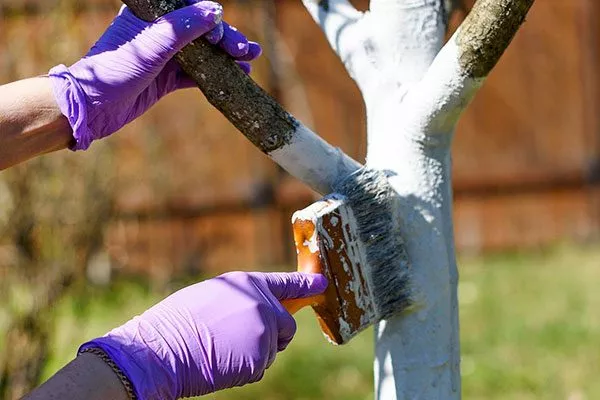
In the fall, pruning is minimal, limited to sanitation measures to avoid stressing the tree before winter. All cuts are disinfected to prevent infection. Garden varnish, for example, can be used. - Whitewash. It's done in early spring, as soon as the snow melts, and in the fall. Lime protects the trunk from burns, infections, and insects. Copper sulfate is often mixed with lime. Trees are whitewashed in sunny weather, after first cleaning the bark with a wire brush. It's not recommended to whitewash young pear trees.
- Loosening. After watering and rain, the tree trunk circles are loosened and weeded, removing weeds.
Preparing for winter
Preparing a pear tree for winter begins immediately after the leaves fall. The area around the tree's trunk is first cleared of fallen leaves and other debris. Then, water the tree to recharge it with moisture and mulch the area around the tree's trunk with a thick layer of humus, peat, or sawdust, approximately 20 cm thick.
The Rogneda variety is frost-hardy, so mature trees tolerate frost well and don't require shelter. However, the trunk should be protected from rodents using standard protective methods—for example, by lining it with spruce branches, burlap, or roofing felt.
Diseases and pests
The Rogneda variety has excellent immunity to the most common pear diseases—scab and fruit rot. However, improper care can leave the tree susceptible to these and other fungal infections.
Most often the variety is affected by:
- Powdery mildew. It attacks the trunk, branches, leaves, and ovaries. A white coating appears on them, which eventually turns rusty. A 10% potassium chloride solution helps combat the problem. After a couple of weeks, spray with a 0.5% urea solution.
- Sooty mold. This disease causes leaves and even fruits to become covered with a black coating. Standard antifungal fungicides can help kill the fungus.
- Rust. It causes rusty spots and growths on leaves and shoots. If left untreated, the rust can also affect the fruit. Copper-containing preparations are used to combat the problem; trees are sprayed with them before flowering. After harvest, the pears are treated with a 1% Bordeaux mixture.
Harvesting and storage
Since the fruit is prone to shedding, it's best to pick it slightly underripe. The fruit is picked carefully, without breaking the stems. Various tools are used for picking, allowing you to reach the pears at a great height.
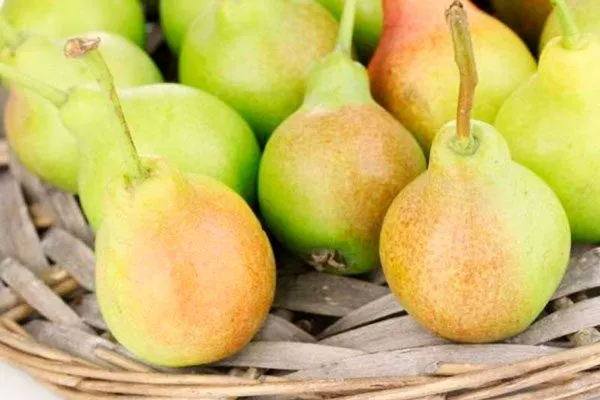
The fruit, placed in boxes, is taken to a cool, dark room. Here, they retain their marketability and flavor for 1-2 months. At room temperature, pears can be stored for 10-20 days.
Application
Thanks to its excellent taste, the Rogneda pear is highly sought after in cooking. Its fruits are not only eaten fresh, but also added to fruit salads, made into purees and juices, and used to make compotes and jams. Thanks to their high sugar content, these pears are suitable for winemaking.
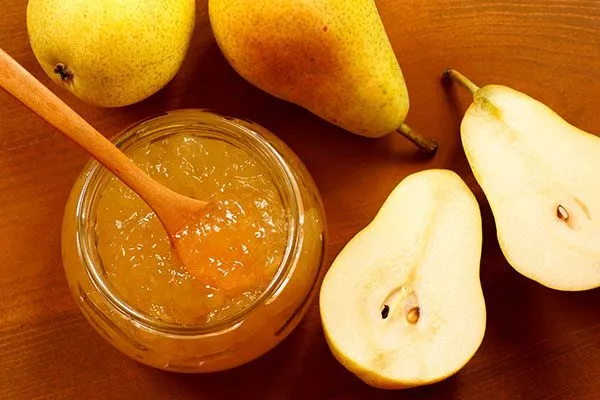
The Rogneda pear is a wonderful variety, almost perfect. It combines all the best qualities of fruit trees, including excellent fruit flavor. This variety is easy to grow and productive, allowing even a novice gardener to harvest beautiful and delicious pears every year.
Thank you so much for the detailed description and planting diagrams. I was planning to plant this variety this year. I also learned some new information about care. There were some things I didn't know, even though my tree has been growing for eight years. Consequently, there were some problems.