
The Yakovlev Autumn pear is part of a popular group of varieties dedicated to the breeder P.N. Yakovlev. It is characterized by high yields but average resistance to pests and fungal diseases. It differs from other varieties in its mixed fruiting and the ability to harvest fruit even from pinches on thin shoots.
History of selection
The variety was developed in the laboratories of the All-Russian Research Institute of Genetics and Selection of Fruit Crops, named after I.V. Michurin. This discovery was made possible by the work of the distinguished specialist P.N. Yakovlev, Michurin's protégé and successor, with the active assistance of S.P. Yakovlev and Z.N. Tsvetaeva.
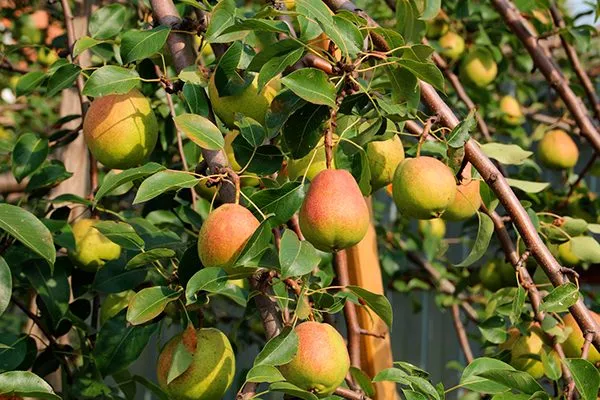
Osennyaya Yakovleva is the result of a cross between the ancient Michurin variety "Doch Blankova" (1906) and "Bergamot Esperen" (Belgium). The Russian "parent" is noted for its high growth rates and abundant fruiting, which have been passed on to its descendant. Information about the foreign "ancestor" is not publicly available.
The Osennyaya Yakovleva pear has been tested at the state level since 1949, and by 1974 it was included in the State Register of the Russian Federation for the Central Black Earth and Lower Volga regions.
Description of the Yakovleva Autumn pear with photos
The variety served as the basis for the creation of a number of new cultivated plants, including the Debutantka pear, as well as other elite varieties. In the development of new varieties, the Osennyaya Yakovleva serves as a source of high-quality fruit.
Tree
The plant is a very tall pear tree, reaching 12-15 m in height. However, with annual formative pruning, the shoots can be kept under control, preventing them from growing more than 7-10 m.
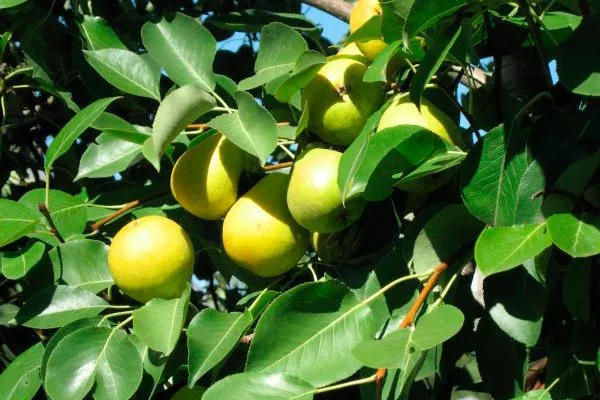
Characteristic features of the tree:
- crown shape – round and wide pyramidal type with weakly dense branches;
- shoots – They are distinguished by their considerable thickness and width, and their distinctive arching, which is why the tree is considered spreading and drooping. Despite this, the branches can support fruit without reaching the ground;
- foliage – strong;
- type of fusion of skeletal shoots – powerful;
- shoot formation – rapid;
- bark color – with a brownish tint;
- surface of stems – has a small number of lenticels;
- foliage – classic green, slightly curved, with short-pointed serrated serrations, with a wide, sharp end and a wedge-shaped base;
- petiole – long and strong;
- shape of stipules – subulate.
- ✓ The leaves have a specific curved shape with short, pointed, serrated serrations.
- ✓ The fruits are characterized by an irregular, wide pear-shaped form with a ribbed, bumpy surface.
Fruit
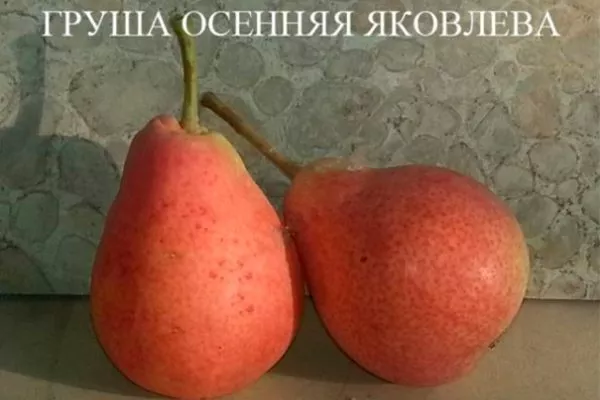
The fruits of the Autumn Yakovlev variety are more medium-sized than large – their weight varies from 130 to 250 g, which is influenced by many factors – from climatic and weather conditions to strict adherence to agricultural requirements.
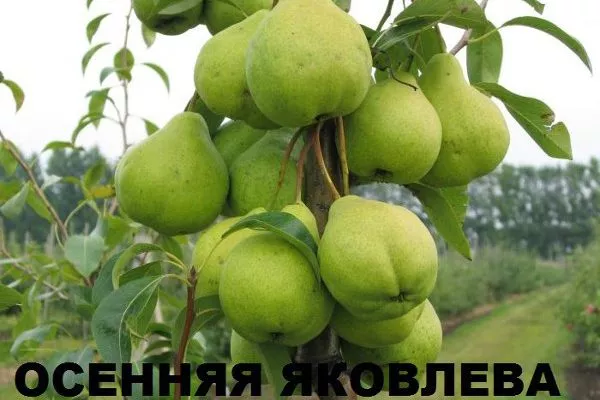
Appearance of pears:
- form - wide pear-shaped, but irregular, and sometimes diamond-shaped round;
- surface – ribbed-lumpy;
- skin color when not fully ripe – green, but with a reddish blush on one side;
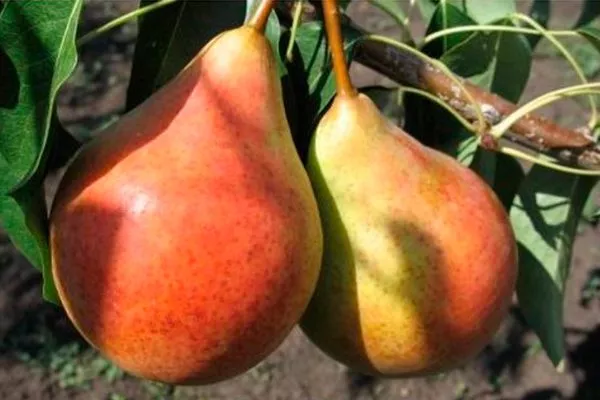
- the shade of the skin at technical ripeness – yellow-green with a carmine blush;
- skin – dense, has large brown inclusions;
- peduncle – moderately thick and long, but always straight;
- funnel – no rust, wide;
- saucer – with a shallow depth, but considerable width;
- cup – open;
- heart – broadly oval;
- bones – large, egg-shaped, light brown;
- seminal chambers – closed type;
- pulp – dense and oily, no graininess;
- pulp texture – juicy and tender, melts in your mouth.
Characteristics of the variety
To know in advance how to properly grow a pear variety, carefully familiarize yourself with its main characteristics.
Taste qualities
The sweet, muscat flavor earned the variety a 4.9 rating in the tasting evaluation. The fruits of this pear tree contain a variety of beneficial substances: organic acids, pectin, tannins, enzymes, natural sugars, and phytoncides, as well as a valuable set of minerals—phosphorus, calcium, cobalt, iron, silicon, potassium, and copper.
The composition of Osennyaya Yakovleva differs: sugar content is 8-9%, acidity fluctuates between 0.07-0.08%, the content of ascorbic acid is 11-12 mg per 100 g of product, catechins - 38-38.8 mg per 100 g.
Ripening time
The pear harvest begins in the second half of summer. It is considered an autumn variety, as the fruit ripens in mid- to late autumn.
Productivity
Fruiting begins in the fifth year of the tree's life, but it's not uncommon for fruit to appear later. A mature tree can yield 33-40 kg of fruit, highlighting its high productivity.
Winter hardiness
Despite the wide range of pear varieties, Osennyaya Yakovleva stands out for its excellent winter hardiness. The cultivar's creators claim that the trees can withstand frosts down to -32-35 degrees Celsius, provided they are properly prepared for the winter.
Pollinators of the Yakovlev Autumn pear
No information on the pollination requirement for this fruit tree species has been found in reputable sources. However, thanks to the knowledge accumulated by gardening enthusiasts, the Osennyaya Yakovleva variety is considered partially capable of self-fertilization.
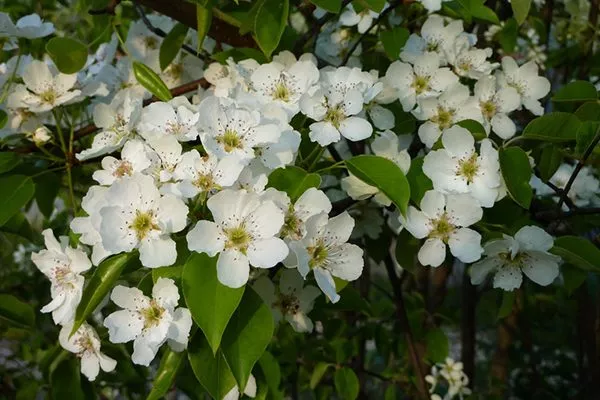
To ensure high yields, it is recommended to cultivate varieties with similar flowering and ripening periods in close proximity. Among the most effective pollinators, the Avgustovskaya and Lada pear varieties are considered the most effective.
The distance between pear trees for mutual pollination typically ranges from 50 to 65 meters. The likelihood of achieving adequate pollination remains high, as late-summer and late-autumn fruiting varieties can be located in adjacent areas.
Cultivation areas
The conditions of the Central Black Earth Region and the Central Belt are suitable for cultivating this pear variety. These trees can sometimes be found in Siberia. They grow in the Moscow, Yaroslavl, and Ryazan regions, and are also found in Belarus, Ukraine, Moldova, Kazakhstan, and Estonia.
Resistance to diseases and pests
This fruit variety has a moderate resistance to fungal infections and pest attacks. Gardeners recommend preventative treatments to prevent diseases. Scab is particularly dangerous. Fruit infected with scab should be either burned or buried, and the leaves can be composted and covered with soil.
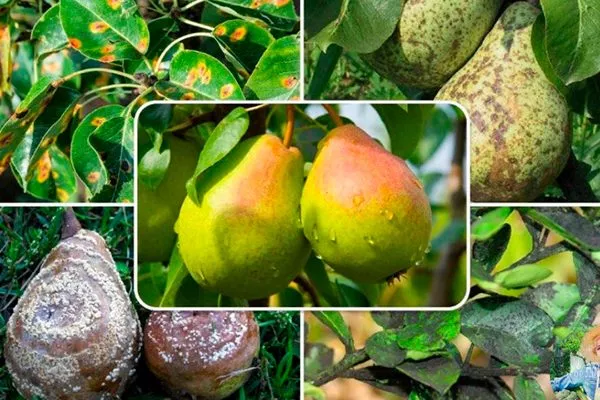
Basic preventative measures against fungi and insect pests include:
- cleaning and disposal of fallen leaves and cut branches by burning;
- deep autumn digging of the tree trunk circle;
- timely removal of weeds, mulching the soil around the trunks;
- cleaning and treating any damage to the bark with special agents;
- regular thinning of the crown to ensure access of light and air;
- liming of trunks and bases of lower branches with the addition of copper sulfate;
- In autumn it is recommended to clear the trunks of damaged wood;
- preventive spraying with fungicides;
- A mustard solution is used against scab: dilute 55-75 g of powder in 10 liters of water and carefully spray the ground at the base of the trees.
To prevent pear scab infection, it is recommended to use high-quality planting material, including seedlings and cuttings from reputable nurseries.
Advantages and disadvantages
Landing rules
Pear seedlings of this variety are suitable for planting in both spring and fall. The optimal time for fall planting is the last days of October or the first days of November, when conditions favor root strengthening before the frosts.
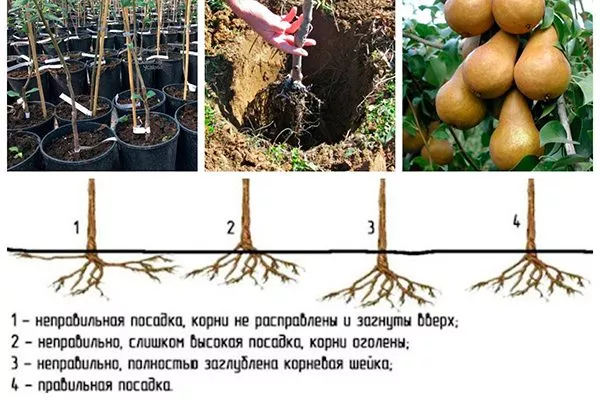
As long as the soil temperature remains above 4°C (4°F), the roots continue to grow. However, there's a risk that if planted too late, the plants could become over-chilled. When spring arrives, planting begins well before the plant emerges from dormancy—usually between March and April.
Individual planting requirements of the variety:
- For high-quality growth, pears should be spaced 4-5 m apart within a row and 2-3 m between rows if the seedlings are grafted onto seed rootstocks.
- The soil is prepared in advance by digging a hole 12-16 days before planting.
- The hole size should be 25-35 cm deeper and 35-45 cm wider than the root ball.
- The topsoil is separated from the subsoil so that they can be used separately. Fertile soil is placed at the bottom of the hole to ensure good root establishment. If the soil is poor, a mixture of peat and humus is added to enrich it.
- After the pear roots are placed evenly and without bends in the hole, the seedling is carefully placed at the correct depth - almost 14-16 cm above ground level, and covered with soil from the second pile.
Care Features
Immediately after planting, the tree is watered: 5-8 liters of water per plant is sufficient. A protective soil mound is formed around the trunk in the fall and leveled in March. In the spring, it is recommended to place at least 10 kg of manure around the trunk, but ensure that it does not touch the tree itself.
Further care is as follows:
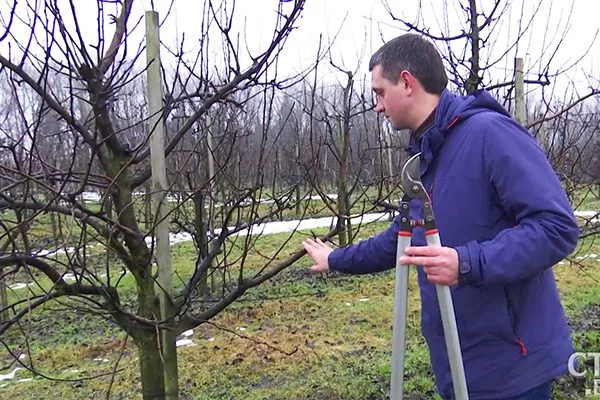
- In March, crown maintenance becomes essential: dead branches need to be trimmed and the remaining ones shaped more compactly. This is done to control the rate of plant growth and bark formation. Regulating the crown's volume stimulates the formation of fruiting branches and encourages the emergence of new shoots.
During the final pruning stage, attention is focused on branches bearing last year's buds, recognizable by their evergreen fruiting growths. Formative pruning is aimed at preventing excessive foliage compaction. - During the summer season, especially during hot periods, plants should be provided with sufficient watering so that the soil around them does not become covered with a dry crust.
- With the onset of autumn, the trunks are coated with a protective white lime, which not only contains beneficial elements for the pear tree but also serves as a barrier against various diseases. Exposed areas of the trunk are dipped in a protective solution of red iron oxide.
- In the spring, a series of treatments is necessary. The first spraying occurs during the period of bud awakening and blooming, which helps eliminate fungi and insect pests.
The next treatment is carried out after the appearance of flower buds, and the use of insecticides and fungicides such as Fury, Strobi and Inta-Vir is considered the most effective. - In May, trees are fertilized: the most valuable additive for pears is urea, although nitrate is sometimes used. Micronutrients should also be considered: copper sulfate and an aqueous solution of boric acid have a beneficial effect on the plant.
For older trees, root balling is used, followed by weed removal and nitrogen fertilizer application to the tree trunk area. This process positively impacts the soil composition, helping protect it from drying out due to grass growth.
Collection and storage
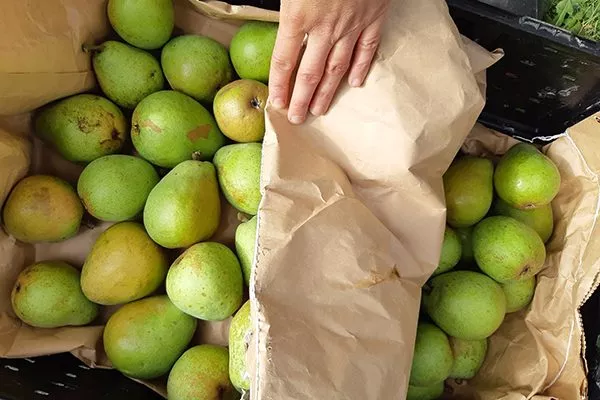
To ensure the harvest retains its flavor and marketability, the fruits are best harvested in early autumn, when they are still slightly unripe. At this stage, they can be kept fresh for up to 75 days, during which time they will fully ripen and acquire a golden color.
Gardener reviews of the Yakovleva Autumn pear
The Yakovleva Autumn pear is an excellent variety for both commercial and home cultivation. It is versatile, used for making jams and preserves, compotes and juices, freezing, and drying. It is especially important that the young shoots already have the potential for high-yielding fruiting. Even small stems of this pear variety can produce a decent yield.