
The Original pear has been popular among gardeners for many years. This variety is in demand throughout the country and thrives in all regions due to its drought and frost resistance. With proper care, the crop thrives, its immunity is strengthened, and yields are higher.
Creators of the variety
It was developed in the Saratov region by domestic breeders. Two popular varieties, Rumyanaya Berkut and Lyubimitsa Yakovleva, were used in its development. It was introduced into cultivation in 1994.
The appearance of the tree
This medium-sized plant has a spreading, rounded crown and is characterized by medium foliage. Other distinctive features include:
- The branches and trunk are covered with smooth bark, colored gray.
- The shoots are of medium length, straight, grey-blue and slightly pubescent.
- The branches are covered with oblong-elliptical leaves of medium size.
- The leaves have a shiny surface, pointed tips and a finely serrated edge, are colored green, and the vein is light green.
Fruits and their taste characteristics
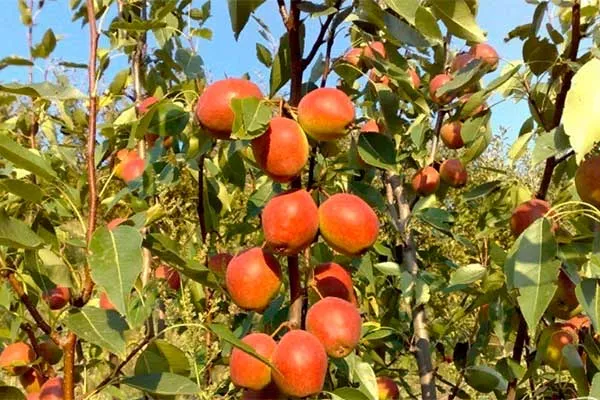
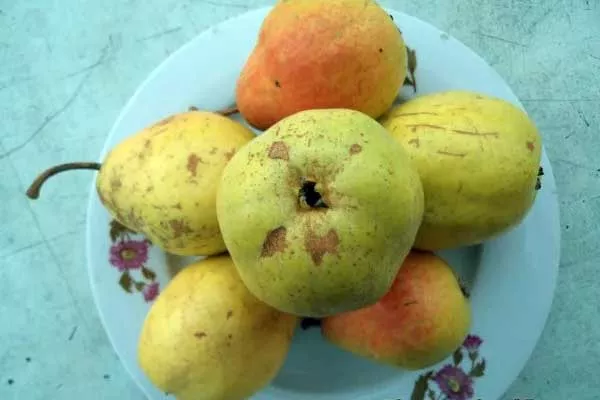
They weigh an average of 120-140 g. They are uniform, elongated pear-shaped, with characteristic constrictions around the perimeter, 1 to 1.5 cm from the calyx and stalk. The skin is smooth, with a yellow base color and a dark red blush present over the entire surface.
Ripening time and early fruiting
This autumn variety boasts a pleasing annual harvest. It begins bearing fruit 4-5 years after planting.
Application
The fruits are used in a variety of forms. They are suitable for a wide range of consumption: both fresh and processed. They can be used to make preserves, compotes, juice, dried fruit, marmalade, or wine. This variety is widely used in both commercial and home gardening.
Care and cultivation
It's important to pay special attention to proper planting and subsequent care. Follow these recommendations:
- Selection of location and soil. Choose a well-lit location with fertile, well-drained soil where water does not stagnate.
- Preparing the soil. Before planting your pear tree, prepare the soil by enriching it with humus or compost. This will ensure good nutrition and moisture for the roots.
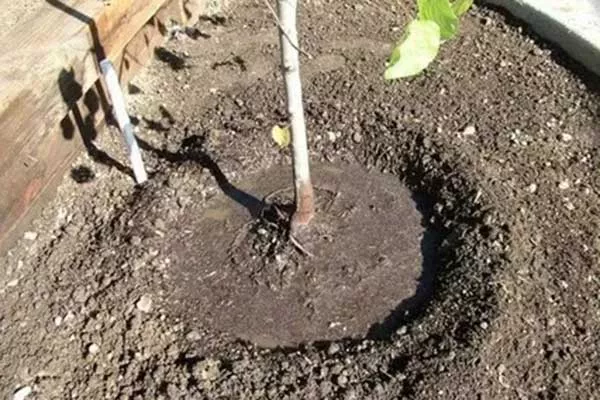
- Planting a plant. Dig a hole measuring 60 x 60 x 60 cm. Form a mound of earth in the center of the hole and place the seedling on it, carefully spreading the roots. Fill the hole with soil and gently compact it. The grafting site should be slightly above ground level.
- Regular watering. Water young seedlings throughout the growing season. Avoid allowing the water to dry out or standing water near the roots.
- Top dressing. For good development and growth, apply fertilizer. Pear trees respond well to mineral and organic compounds.
- Crown formation. Remove excess shoots to maintain the rounded shape of the crown. If necessary, tie shoots to prevent them from breaking under the weight of fruit or in gusts of wind.
The crop is characterized by resistance to diseases and pests, but with improper care, the gardener may encounter some problems:
| Disease/Pest | Symptoms | Methods of control |
| Spider mite | A thin web on the leaves, yellowing and curvature, later – falling off. | Treat the garden with acaricides (Furia, Nissorun) during mite activity. Apply several treatments at 10-14 day intervals. |
| Pear moth | The appearance of nests of moth-like larvae on leaves and fruits, deformation and curvature of fruits. | Use of insecticides (Karbofos, Fosba). Treatments are carried out during the period of larval activity. |
| Black spot | The appearance of round, black spots on leaves and fruits, decreasing yield. | Use copper-based fungicides (Oxyhom, Hom, Medicus) during the growing season. Regular treatments at 10-14 day intervals. |
| Powdery mildew | Whitish spots appear on leaves and stems, which can spread throughout the foliage. The leaves become brittle and dry out. | Removal of plant debris and weeds. Treatment with colloidal sulfur solution. Application of fungicides (Topaz or Oxychom). |
| Late blight | Leaves turn yellow and fall off. Brown spots appear on the roots. | Treatment of plants with copper-containing preparations. |
| Firefly | Reddish spots form on the leaves, which eventually expand and dry out. The disease spreads more frequently during rainy seasons. | Removal of affected plants. Treatment with fungicides (Bordeaux mixture). |
| Alternaria | Round brown spots with a yellow border appear on the leaves. The foliage turns yellow and falls off. | Remove affected leaves. Treat with fungicides (Fundazol or Ridomil). |
When to harvest and how to store?
Harvest the fruit towards the end of the season, when it reaches harvesting maturity. It's important not to miss the harvesting moment. Gradually, the fruit begins to change color as it ripens on the tree.
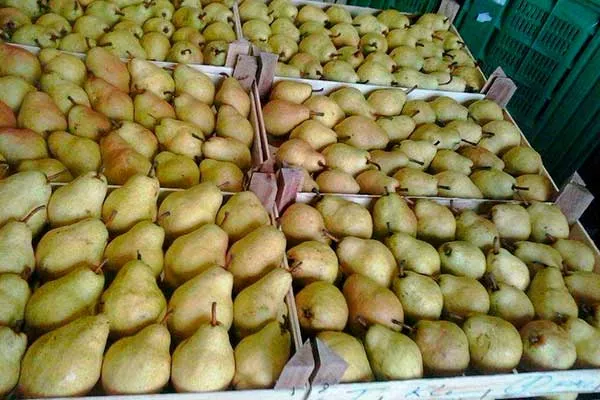
To determine if the fruit is ready to harvest, take 2-3 fruits and cut them open to check the condition of the seeds. If the large, healthy seeds have already begun to brown, this indicates they are ready to harvest.
- ✓ The fruits begin to emit a characteristic sweet aroma when fully ripe.
- ✓ The skin of the fruit becomes slightly soft when pressed at the stalk.
Follow certain rules:
- Usually, fruits ready for picking are easily separated from the branch.
- If the fruit does not separate, wait another 2-3 days and repeat the check.
- Leave fruits that are difficult to pick on the branch to ripen further.
Reviews of the variety
The Original pear has excellent flavor and high yields. The tree is frost-resistant and rarely susceptible to disease. The fruit is juicy and sweet, and stores well under certain conditions. With proper care, it can boost immunity and ensure a good harvest.