
To ensure proper growth and high yields, pear trees need to be pruned in a timely manner. Let's learn about the different types of pruning, how to shape the crown, and how to care for the pear tree after this pruning.
The best time to prune a pear tree
Experienced fruit tree growers recommend pruning in early spring. Pear trees can be pruned twice a year: in early spring and fall.
In spring, not only the crown is shaped but also branches damaged by frost are removed. In the pre-winter period, pruning and rejuvenation of the pear tree are also permitted. However, this is recommended only for winter-hardy varieties, as pruning significantly weakens the tree and reduces its frost resistance.
Also, in the fall, the pear tree's defenses weaken, while fungal spores begin to actively spread. Therefore, pruning pears is risky. But every coin has two sides.
Benefits of autumn pruning:
- more predictable weather conditions (in spring it is easy to prune a tree too late or too early);
- after heavy pruning in the spring (if this was required), the pear yield decreases, but not in the fall;
- The tree recovers more easily because the plant does not have to divide its energy between healing wounds and forming fruit.
Deadlines
To ensure that pruning benefits the tree, it's important to time the procedure appropriately. Delaying or rushing pruning can cause serious damage to the tree, leading to disease and even death.
When is it recommended to prune a pear tree:
- In the spring. Pruning is done before the sap begins to flow. Ideally, leave just a few days between the procedure and the sap flow. Once the sap begins to flow, the tree's immune system will immediately activate, preventing the development of pathogens.
- In autumn. The main signal to begin the procedure is leaf fall. Another requirement is above-zero air temperatures. If the thermometer drops below -5°C, no further pruning is necessary.
There are no exact calendar dates for pruning. Furthermore, they depend on the region and current weather conditions. In temperate climates, fall pruning is completed by the second ten days of October, while in spring, work begins in late March.
What types of pruning are there?
Pear tree pruning is performed based on the tree's age and intended goals. Depending on these factors, several types of pruning are distinguished:
- Sanitary. Pruning dried, damaged, diseased, and frozen branches. Recommended time: any time.
- Thinning. Since pear trees produce a lot of shoots, excess shoots are removed to ensure adequate air circulation within the crown. Branches growing inward, suckers, and crossing shoots are pruned.
- Formative. The crown is formed in the first years of a tree's life. This has a positive effect on its longevity and fruiting.
- Stimulating. Its essence lies in shortening shoots. The goal is to limit branch growth. The result is stimulation of lateral shoot growth.
- Rejuvenating. Extends the fruiting period of the tree and increases the yield.
- ✓ For sanitary pruning, the critical diameter of branches that can be removed without harming the tree is no more than 5 cm.
- ✓ When performing formative pruning, the angle at which branches depart from the trunk should be at least 45 degrees to prevent them from breaking under the weight of the crop.
General rules for pear pruning by season
Depending on the time of year pruning is performed, certain rules must be followed. Furthermore, a specific type of pruning is recommended for each season.
Spring
Before the buds swell and sap begins to flow, begin pruning. Regardless of the type of pruning performed and the tree's age, it's important to follow certain guidelines. This will prevent harm to the pear tree and ensure the procedure is beneficial.
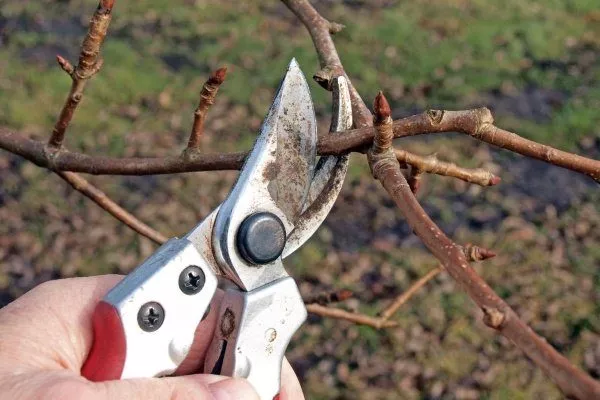
Trim thin branches with sharp pruning shears, and thick branches with a hacksaw. All blades should be disinfected. Use alcohol-based disinfectants.
When pruning, follow these rules:
- Start by thinning the crown to allow light and air to reach all fruiting branches.
- After thinning, if necessary, shorten the central trunk by 1/4 to form a cup-shaped crown.
- Disinfect the cuts.
- Remove shoots growing vertically, as well as branches pointing downwards – they are unproductive.
See also a video on pruning pear trees in spring:
Autumn
Autumn pruning is recommended for early and mid-season pears.
Rules for autumn pruning:
- Prune your pear tree sparingly in the fall, otherwise the tree will spend too much energy on recovery, which is completely unnecessary before winter. Furthermore, the tree will produce too many vertical shoots.
- It is recommended to remove branches in stages – a little at a time every year.
- Start pruning with shoots that grow at a 90-degree angle to the trunk. Then move on to those growing vertically.
- After completing the work, disinfect the cuts.
When pruning branches, focus on the ring-shaped ridges on the bark—they're located between the trunk and the base of the branches. Cut directly along the ridge, as it contains tissue that accelerates healing.
In addition to the above, watch the following video:
Summer
In summer, pear trees are only pinched. This procedure is also called pinching. You can remove the shoot tips with your fingers or a cutting tool.
Pinching takes much more time than pruning, but it's not worth skipping. After pinching, the tree actively recharges, as it uses nutrients more efficiently and evenly.
In summer, you can prune a pear tree if it has developed numerous young shoots that are thickening the crown. The tree's response may depend on the timing of the pruning:
- June. It delays shoot growth. This causes axillary buds to produce summer shoots prematurely. Leaf buds transform into fruit buds. Pinching in June negatively impacts the tree's growth and complicates its wintering.
- July-August. At this time, the shoots finish growing. Pinching enhances the development of axillary buds.
The video below explains how to prune a pear tree in the summer:
Pruning based on age and other factors
Pear trees are pruned annually, according to their age and other characteristics. There is no single pruning scheme for every situation; each tree requires an individual approach.
After landing
Pear trees are characterized by large annual growth and a small number of skeletal branches. They primarily form small ring-shaped branches and short spear-shaped branches. Another characteristic of pear trees is the accelerated growth of the central conductor. This growth must be redirected to the lower buds, otherwise the pear will grow too tall.
Nurseries typically sell two-year-old seedlings consisting of a main stem and 5-6 lateral branches. Therefore, begin formative pruning of the young tree's crown in its first year:
- Shorten the trunk by 50-60 cm from the ground level to stimulate the growth of lateral branches.
- Shorten the side branches above the buds by 10-15 cm.

- Pinch off the buds located near the ground so the seedling doesn't waste energy growing lower shoots. Besides, you'll have to remove these shoots later anyway.
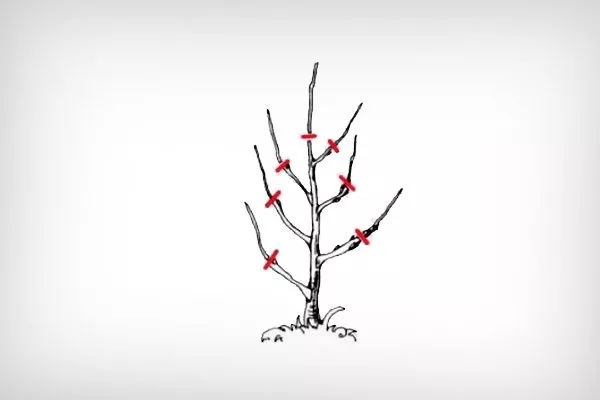
Pruning the seedling helps the tree establish itself. Its roots are still very weak, and if the buds begin to develop rapidly, they won't be able to provide the young pear with the necessary nutrition.
If a seedling is planted and pruned in spring, it does not require pruning in autumn.
Two-year-old pear tree
In the second year, crown formation continues. A two-year-old tree has lateral branches; three shoots should be selected and the rest pruned.
Rules for pruning a two-year-old tree:
- Achieve an even distribution of branches around the trunk.
- The optimal angle between the trunk and branches is 120 degrees.
- The vertical distances between branches are from 10 to 22 cm.
- Once you have selected the desired branches, trim all the rest:
- cut off branches that are lower than the lowest selected branch;
- branches that will be skeletal on the 1st tier, cut into a third;
- shorten the central trunk so that 80-90 cm remains from the ground to the farthest branch of the 1st tier.
Three-year-old
A three-year-old pear tree is pruned in much the same way as a two-year-old tree. The crown continues to be shaped.
Pruning a three-year-old pear tree:
- Your task is to organize the second tier. There should be about 70 cm between the first and second tiers.
- For the second tier, select three branches growing at a steep angle from the trunk. Shorten them by a third. Cut the branches of the first tier by the same amount.
- Cut the main conductor, stepping back 40-50 cm from the location of the farthest branch in the second tier.
- Cut back all other branches growing from the trunk. Remove any excess, competing shoots from them, leaving only one—the dominant one.
Four-year-old pear tree
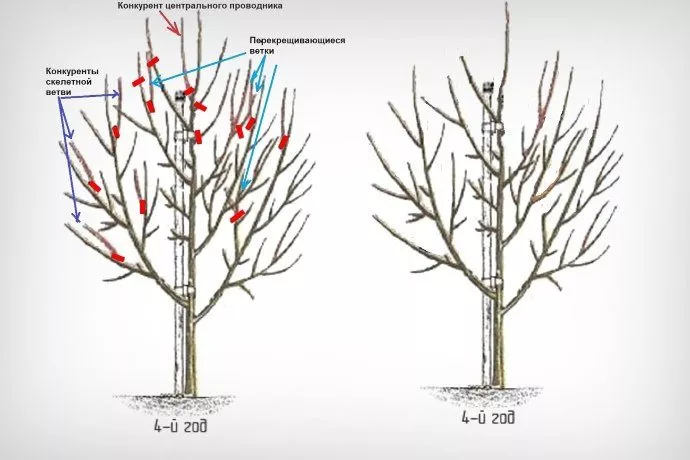
In the tree's fourth year, a similar third tier is established. This time, the distance between the second and third tiers is approximately 40-50 cm.
Two branches directed in opposite directions will be sufficient; any excess is cut off. The trunk is shortened to encourage growth to the lateral branch.
Five-year-old
By the fifth year, gardeners have completed crown formation. If pruning has been carried out correctly over the past four years, the pear tree should be approximately 4 meters tall and have three tiers.
Adult pear tree
It's best to prune a tree that's over 5-6 years old in the spring. Start with sanitary pruning. The subsequent pruning procedure for a mature pear tree is as follows:
- Clean the barrel. After sanitary pruning, move on to trunk cleaning. This involves removing the numerous shoots growing from the central trunk.
- Remove competitors. Pear trees often develop competing shoots that grow parallel to the trunk. Prune them off. The tree should have only one dominant trunk.
- Limit upward growth. Pear trees have a characteristic tendency to grow upward throughout their lifespan. Upper branches that extend upward should be pruned.
- Perform crown lightening. Remove all branches growing vertically upward, downward, or crossing. Another task when thinning is pruning suckers. Reduce the annual growth by three buds.
Old
Old pear trees benefit from rejuvenation. This isn't done in a year or two—it takes several years to properly rejuvenate the tree without harming its health. When an old skeletal branch is removed, a new one is grown to replace it.
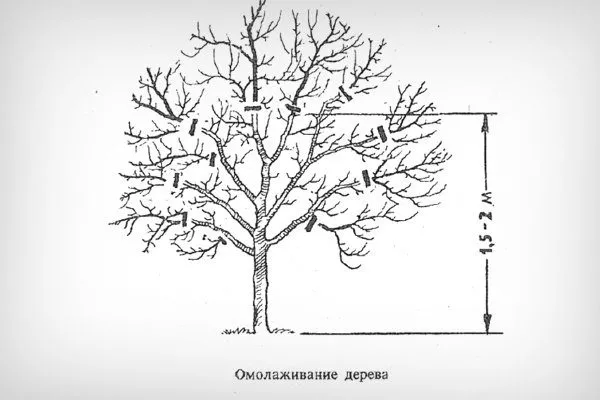
The maximum proportion of branches removed at one time is 1/3 of the total mass.
Trees in a neglected state may also require rejuvenation. Even with an abundance of green foliage, they produce little fruit. Reviving old trees is difficult, but possible. To prevent damage from stress caused by heavy pruning, three prunings are performed at intervals of one to two years.
How to rejuvenate an old pear:
- Form two tiers on the tree, leaving a 1-meter gap between them. Cut off the trunk where the topmost branch originates.
- Leave 5 to 7 strong branches on each tier. Cut the rest off at the trunk.
- Clear each skeletal branch of excess shoots, trim away suckers and crossing branches. Cut all shoots off the trunk.
To rejuvenate an old tree, gardeners often simply cut it down by half or at a height of 1.5 meters from the ground. The following year, the resulting shoots are used to form a new tree with a regular or bowl-shaped crown.
Columnar pear
Columnar pear pruning is done primarily for decorative purposes. Only the side branches are trimmed to maintain the tree's compact form. The trunk is left untouched.
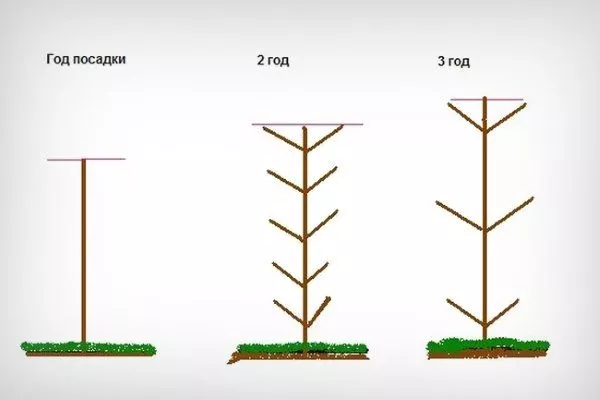
To maintain columnar pears in normal condition, annual sanitary pruning is sufficient, during which broken and dried branches in the interior of the crown are removed.
Dwarf
These pears are especially often grown in areas with harsh climates. They are covered for the winter to protect them from frost.
How to shape a dwarf pear tree:
- Immediately after planting, cut the tree to a height of 40-50 cm from the ground.
- In the 2nd year, cut the lateral branches (usually 4-5 of them) by a third.
- Prune the trunk by 15-20 cm.
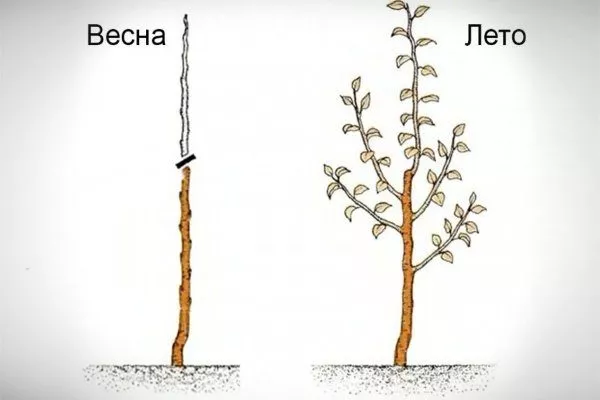
In subsequent years, shorten the growth by a third. The height of a dwarf pear tree should be 1.5-2 m.
Large pear
A tree that's too tall and spreading can create significant problems in a yard. If it's taller than 3 meters, caring for it becomes more difficult.
An overgrown pear tree should be reduced in height by 1.5-2 meters. Then, all dead and old branches are removed. Further steps depend on the tree's age and condition.
Crown formation
This is done over several seasons. The pruning pattern depends on the desired crown shape.
People with extensive experience in gardening claim that the most practical crown shapes for a pear tree are cup-shaped and spindle-shaped.
Sparsely tiered form
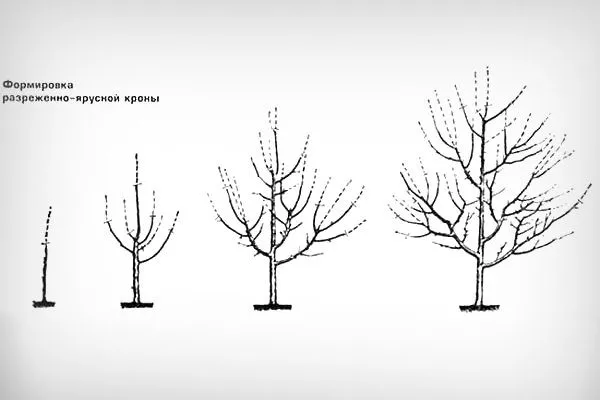
This is the simplest option. The tree takes on the most natural shape possible. The branches are arranged in tiers of 2-3 branches.
How to form a sparse-tiered crown:
- Select a section of the trunk that will be the standard – approximately 50 cm.
- Measure 40 cm from the trunk – this will be the skeletal branches of the first tier. The central conductor is trimmed off. It is cut above a strong bud – this will give rise to a shoot that will continue the trunk.
- The main branch should be 20 cm higher than the side branches.
- After a year, clear the trunk of shoots. Then begin forming the tiers according to the scheme described above.
- Form one tier each year. Leave three branches on the first tier, and prune the rest to slow their growth and increase yield.
Improved tiered
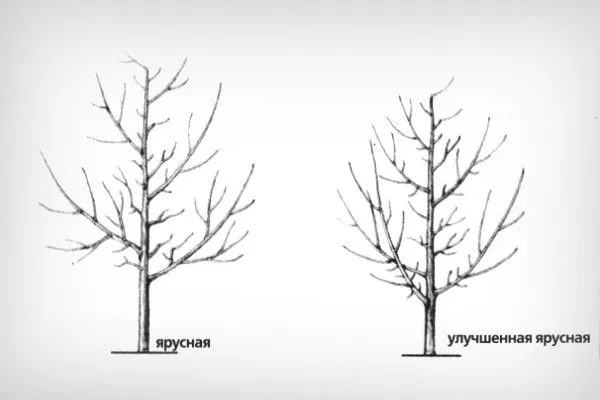
This is an improved version of the previous crown formation scheme, in which additional skeletal branches are left. Thus, in the first tier, instead of three, four branches are left, and for the second tier, about six buds are left.
Recommended scheme:
- on the first tier - 4 branches;
- on the next one - 2-3 branches;
- The third tier is missing, instead there are 2 separate branches.
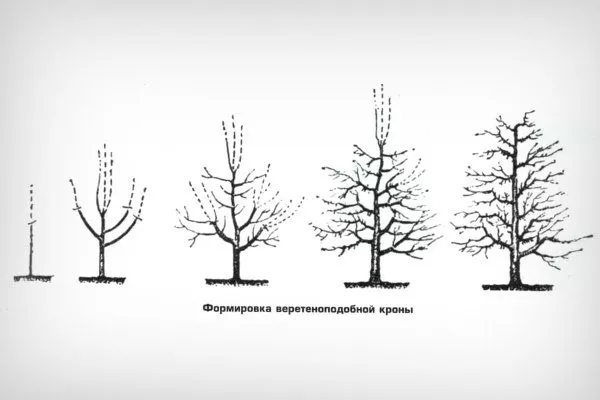
Spindle-shaped crown
This pattern is favored by professional gardeners. Spindle-shaped pears bear fruit earlier, have high yields, and benefit from good ventilation and light on the fruiting branches.
The main feature of this design is the numerous semi-skeletal branches. They are tied to a horizontal position. The branches are then arranged in a spiral, spaced 2-3 times apart.
The downside of this design is that the lower branches droop, making it difficult to care for the trunk circle and the rootstock.
Cup-shaped
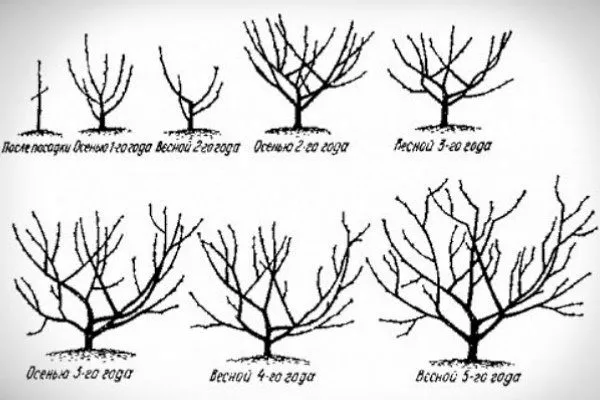
Another name for the crown is vase-shaped. This design involves pruning without selecting leading branches (skeletal branches are arranged in a single tier). The leader is pruned in the first year of planting, leaving 3-4 branches to form the framework.
Semi-flat shape
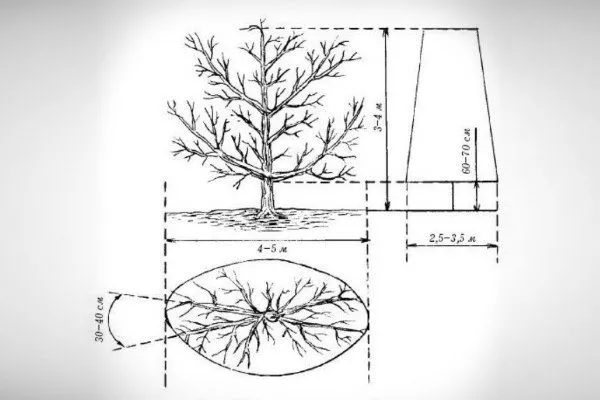
This option is good for small plots. It features 4-6 branches arranged at a 50° angle to the trunk. The bottom row has two branches growing in a mirror image.
In the second and subsequent tiers, only two branches are left. For a vigorous tree, the ideal distance between tiers is 1 m; for a medium-sized tree, 0.8 m.
General questions about pear pruning
Pruning is considered the most difficult and challenging task when growing fruit trees. Beginners often find themselves at a loss when attempting to prune their trees themselves. Let's look at some questions that inexperienced gardeners may have:
- Can you trim the top of a pear tree?The central conductor is pruned only in young seedlings and only once a year, otherwise the tree will become too tall.
- Do the water sprouts need to be trimmed?These are competitors to the leaders and must be ruthlessly eliminated. They bear no fruit and only serve to clutter the space.
But there are cases when water sprouts are used to form full-fledged fruiting shoots. To do this, the shoots are trained horizontally by cutting them to an outer bud or bending them back with a rope. - Pruning to a replacement branch: why and how is it done? This pruning method allows you to form a fruiting unit, which consists of one or more fruiting branches and a replacement branch. This is usually done no earlier than the fourth year of growth.
The process involves pruning shoots with flower buds for fruiting. One-third or one-quarter of the shoot's length is removed. All other shoots are left to grow, preserving two to three buds. - How to prune a frozen pear tree?Pruning is carried out taking into account the damage incurred. If the crown of a one-year-old tree planted in the shade is damaged, it must be shortened by a third of its length. However, this procedure is recommended for all young trees that have survived the winter.
After winter, branches are removed from mature trees (either completely or down to healthy wood), depending on the severity of the damage. Affected areas are easily identified by their dark color (where the bark is frozen, it turns black or dark brown). - How to cut down a thick branch? Pruning is done in stages. This approach is convenient for the gardener and does not damage the pear tree. When performing this type of pruning, it is important not to harm the tree; its visual appeal is sacrificed.
It's necessary to wait for the dormant buds to awaken for new shoots to emerge. Once the "stump" has grown a few branches, you can begin shaping the crown.
Peculiarities of pear pruning in different regions, including Siberia
In harsh climates, especially in the Ural and Siberian regions, pear trees are pruned to form a bush. This type of tree is easier to protect from frost during the winter. Its trunk is only 10-15 cm (but no more than 30 cm), and the placement of the skeletal branches is random.
When shaping the crown of a young tree, skeletal branches are moderately pruned and semi-skeletal branches are thinned. In the fifth year, the central conductor is pruned to the level of the upper branches. The height of the bush is 2-2.5 m. This is sufficient for normal growth and fruiting.
In areas with cold winters, a creeping crown shape is used:
- The seedlings are planted at a 45-degree angle, with their tops facing south.
- Over three years, a tree is formed with 2-4 skeletal branches, approximately 1 m long. Then, a pair of vertical shoots are left on each branch, and all the others are removed.
A different approach to pruning is observed in regions with warm climates. For example, in Crimea, where the climate is particularly favorable for fruit trees. Here, pears can be pruned almost year-round, and frost damage is virtually nonexistent or extremely rare.
How to care for pears after pruning?
Pear trees generally tolerate pruning well, especially if the gardener has followed the rules described above and disinfected tools and cuttings. It's important to prevent infection from entering the exposed cuts during pruning.
After pruning, even minor ones, the tree weakens because it has to expend energy on recovery, healing the wounds caused by saws and hacksaws. During this period, timely watering and good nutrition are especially important.
How to care for a pear tree after pruning:
- Processing of cuts. To prevent infection from entering open wounds, they are sealed with a protective compound. Gardeners believe the best sealant for pear tree cuts is a natural oil paint with drying oil. A special garden paste is also considered a good option.
Large cuts (more than 1 cm in diameter) must be treated. Small wounds usually heal easily and quickly, without any consequences for the tree. - WateringThe tree is watered at least three times per season: before bud break, after flowering, and after harvest. The recommended watering interval is 5 to 20 buckets, depending on the tree's age.
- Top dressing. During the season the tree is fertilized 5 times:
- Before flowering. Add 30 grams of ammonium nitrate or the same amount of urea. Simply scatter it around the tree trunk and rake it into the soil.
- At the beginning of flowering. Water with urea. Make a solution of 100 g per bucket of water.
- After the inflorescences fall. Add a solution of nitroammophoska - 50 g per 10 l of water.
- Before the fruits ripen. In June, foliar feeding is performed. The tree is sprayed with a solution of potassium sulfate – 5 g per 1 liter of water. In July, the pear tree is sprayed again, but this time with magnesium sulfate – 100 g per 5 liters of water.
- After harvesting. Wood ash is added to the soil before winter – 200 g per 1 sq. m.
Pear tree pruning is a necessary agricultural practice, without which one cannot expect high yields. Proper crown shaping makes the tree easier to harvest, prevents frost damage, and keeps it looking beautiful and well-groomed.