
The Medovaya pear is an excellent choice for anyone who appreciates the quality and flavor of fresh fruit. It features mixed fruiting (ovaries form not only on the fruit stems, but also on the ring-shaped stems), decent frost resistance, robustness, and other attributes.
History of origin and zoning
The Medovaya pear variety was developed by Russian scientists at the Crimean Breeding Station back in 1962. It was pollinated by the French Bore Bosc variety. The originators of this new variety were three scientists, who, after extensive testing, presented their creation to the public just three decades later.
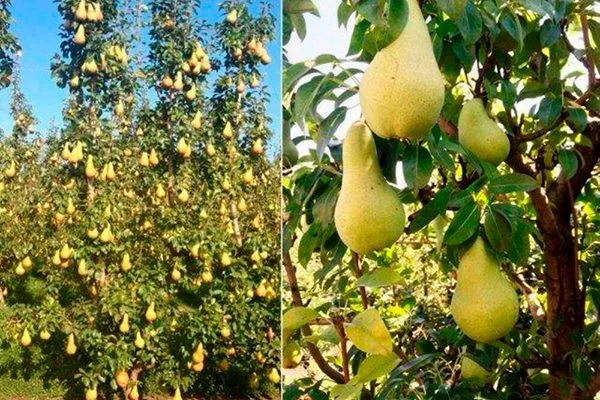
Based on the results of extensive research, the variety was zoned for the North Caucasus region, successfully spreading to central Russia, as well as Ukraine and Belarus. The pear was officially named Crimean Honey.
Detailed description of the variety
This pear is easy to recognize by its external characteristics, but it's important to familiarize yourself with other characteristics in advance—whether additional pollination is required, how resistant the variety is to adverse factors, etc.
- ✓ The fruits have a honey aroma and taste, which is due to the sugar content of more than 10%.
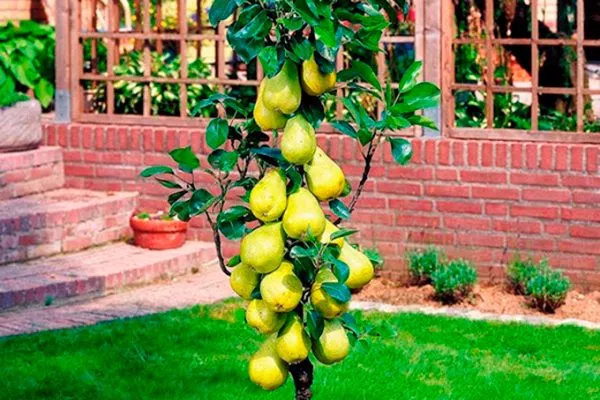
- ✓ The tree has a columnar trunk and an inverse pyramidal crown, which is rare among other pear varieties.
Fruit tree: features
The trees of this pear are medium-sized, reaching 170-200 cm. Other characteristics:
- trunk type: columnar;
- crown shape: inverse pyramidal;
- number of shoots: small;
- foliage: insignificant;
- peduncles: shortened, strong.
Characteristics of fruits
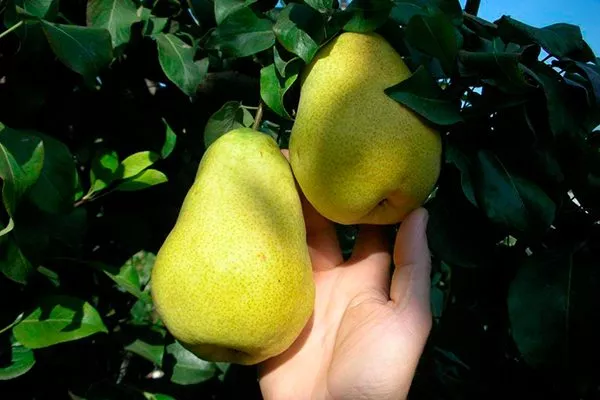
The fruit is large in size, weighing 320-350 g. Particularly large specimens reach a weight of up to 500 g. Other characteristic features:
- the shape is shortened, pear-shaped, asymmetrical;
- there are bumps all over the surface;
- the peduncle is silvery;
- the skin is loose;
- it is densely covered with darkish dots;
- the color scheme is yellowish-green, with orange inclusions;
- the peduncle is medium-sized, curved;
- the fruits are held firmly on it and do not fall off prematurely;
- the taste qualities are high - based on the tasting assessment established by experts, it varies from 4.5 to 5 points;
- the taste is mostly sweet, as it contains at least 9-10% sugar;
- the aftertaste is honey-like, as is the aroma;
- the color of the fruit pulp is creamy;
- the structure of the pear is soft and buttery;
- the amount of juice is abundant;
- the shelf life of fruits in a marketable condition and freshness is just over 3 months;
- They are used for fresh consumption, for making desserts, compotes, jams, and confiture.
Subspecies of the proposed variety
| Name | Ripening period | Fruit weight (g) | Fruit color |
|---|---|---|---|
| G-1 | winter | 250 | bright yellow |
| G-2 | mid-autumn | 200 | brown blush |
| G-3 | the first days of autumn | 400 | bright yellow |
| G-4 | autumn | 300 | not specified |
| G-5 | summer | 250 | not specified |
Research on the Medovaya pear variety has been ongoing for many years. During this time, five subvarieties have been developed. All are distinguished by their early ripening and certain characteristics in terms of taste, shape, and color:
- G-1 - The latest (winter) subspecies of all Honey pears. Its fruits ripen with the arrival of frost, are bright yellow, weigh up to 250 g, and have a slightly bumpy surface.
- Pears of the G-2 subspecies – They ripen in mid-autumn and rarely weigh more than 200 g. A brown blush can be seen on the surface of these fruits, and a special aroma and sweetness can be felt in the taste.
- Subspecies G-3 – is a classic, bright yellow pear weighing up to 400 g, which ripens with the arrival of the first days of autumn.
- G-4 – autumn variety, medium-sized fruits (weighing up to 300 g).
- G-5 – The earliest-ripening subspecies, its fruits ripen in summer. They weigh only 250 g, but have an excellent, sweet, and aromatic flavor.
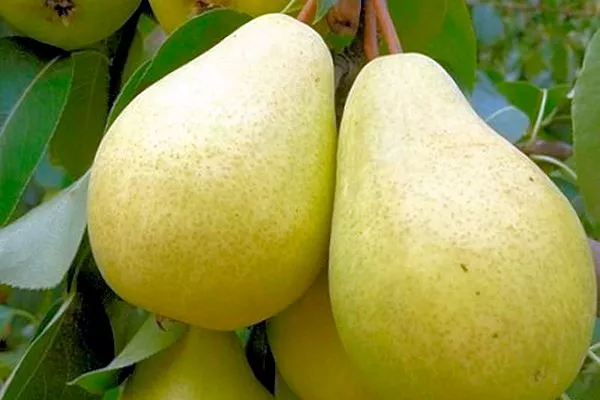
Thus, a single variety name conceals as many as five different subspecies, each with its own characteristics. When purchasing a seedling, it's worth clarifying which subspecies a particular fruit tree belongs to.
Microelement composition of pears and their benefits
The flavor of Medovykh pears is largely determined by their micronutrient composition. Their particularly sweet taste is due to their high sugar content, exceeding 10%, while other pear varieties contain only 6-7%.
Purpose of fruits
Honey pears are so delicious that they are usually eaten quickly, without waiting for processing. However, if needed, they can be used to make juice or jam. The sweet fruit is also suitable for baby food. Experienced gardeners recommend adding less sugar when making jam due to the fruit's intense sweetness. The harvest of this variety travels well.
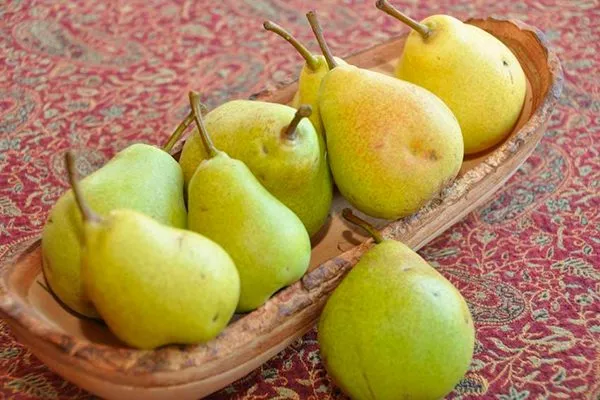
A key advantage of this variety is its long-term shelf life. Fresh fruit can be successfully stored for up to three months at temperatures ranging from 0 to 50 degrees Celsius.
Resistance to frost and drought
The plant is highly resistant to low temperatures and can withstand temperatures as low as -30-40°C without preparation. During the early stages of tree development, covering or mulching is recommended to help the young plant tolerate frosts more easily and prevent disease.
The Medovaya pear has average drought tolerance. For optimal growth, the tree requires only a few waterings per month. However, without this, the fruit will develop unevenly and become smaller.
Flowering and fruiting
The Medovaya pear tree bears fruit regularly. Every year, starting at 4-5 years of age, it produces a large quantity of ripe, high-quality fruit. Weather conditions in the region in spring may have little impact on the tree's yield.
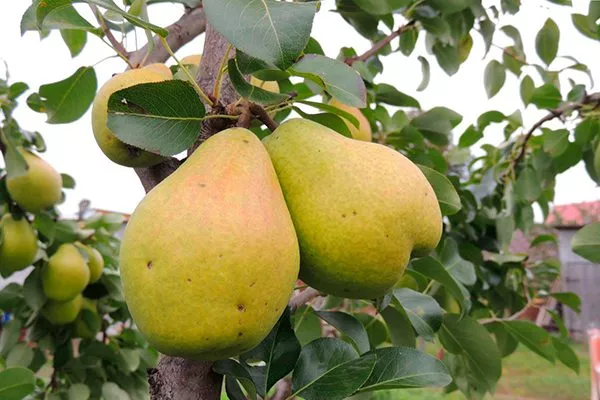
The Medovaya pear tree blooms in May. It is always abundant and long-lasting. The pear flowers are simple, gathered in clusters of 2-5. Ripe fruits are held firmly on short stalks and require hand picking.
Lifespan
Dwarf trees have a long lifespan. The Honey Pear is no exception. With proper care and the necessary conditions, it can live from 40 to 70 years. However, it is possible for it to live for centuries.
Self-fertility and pollinators
The variety is limitedly self-fertile, so for a good harvest it requires pollinating trees such as Chudesnitsa, Tavricheskaya, Bere Bosk and Bere Ardanpon.
Ripening period and yield
Honey pear is considered a late-autumn crop. It begins bearing fruit around September 10th. The exact timing depends on the weather and agricultural practices. The first fruits can be obtained 3-5 years after planting.
Pears should not drop fruit; their yield is 30-35 kg per tree. To achieve these results, strict agricultural practices must be followed.
Resistance of the variety to diseases
The Medovy variety exhibits high resistance to only two common diseases: moniliosis and clasterosporium. No resistance to other diseases has been observed, so preventative treatments are recommended when growing this variety.
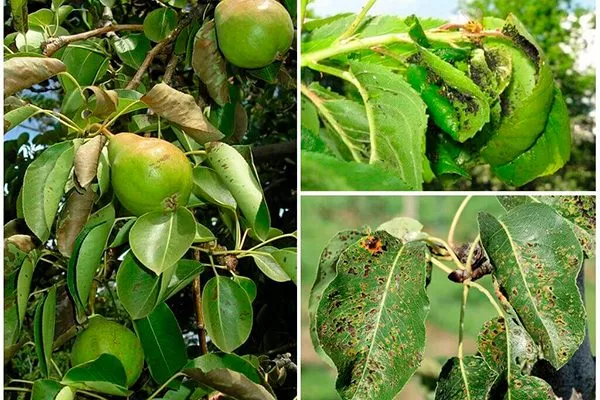
What is dangerous:
- Scab - Covers fruit tree leaves with dark spots that enlarge over time. Velvety, olive-colored spots appear on the fruit. To prevent the disease, plants should be sprayed with Bordeaux mixture in the spring before bud break. Affected areas of the tree should be removed and burned.
- Rust - It appears as orange or red spots on the leaf surface. To prevent this disease, you can use the product Skor. Antifungal compounds applied to the soil around the trunk during tillage are also effective.
- Fruit rot – It manifests itself as characteristic spots on the surface of fruits. The drug Dnok is recommended for treatment of this disease.
In addition to diseases, various pests, such as aphids and mites, pose a threat to Honey trees. Information on insect control methods can be found in the video:
Growing specifics and agricultural recommendations
It's recommended to plant honey pears in the fall in a sunny location. Pollinator seedlings should be placed 3 meters away from the seedling. Follow other important planting and care guidelines:
- The soil on the site should be predominantly sandy, with a neutral or alkaline acidity level.
- The plant should be watered once a week, starting with 8-12 liters of water per seedling. Once fruit appears, watering should be continued only before and after flowering, using 15 to 22 liters of water per tree.
- In early spring, it is recommended to apply nitrogen-containing fertilizers. Phosphorus-potassium mineral complexes are necessary before and after flowering. Before winter, it is recommended to apply wood ash.
- In autumn, after clearing the area around the tree trunk from fallen leaves, you can carry out moisture-recharging irrigation.
- Mulching is done with humus up to 25 cm high.
- In acidic soil, it is recommended to fertilize the pear tree with calcium by sprinkling a couple of glasses of crushed charcoal per square meter at the end of summer.
- When pruning, leave 8 to 12 main branches aligned along the tier. Lower branches should be angled at 50 degrees, and all other branches at 70 degrees. The central branches are shortened by 45-70 cm at the beginning of each growing season, removing excess growth and vertical shoots on the ring.
- ✓ The soil acidity level should be strictly neutral or alkaline; use a pH meter for accurate determination.
- ✓ The distance between seedlings and pollinators should not exceed 3 meters for effective cross-pollination.
Preparing for winter
The honey pear is relatively winter-hardy. Unofficial sources report that the tree itself can survive temperatures as low as -25°C. However, lower temperatures are possible, so it's necessary to cover and protect young seedlings.
To prepare young pear trees for frost, water them regularly and thoroughly, whitewash the trunk and cover it with burlap, and, if possible, wrap the crown of the young pear tree in a breathable material. Following these guidelines will help you grow a healthy and fruitful pear tree, protected from severe frosts.
The pear tree trunk can be covered with spunbond, agrofibre, or simple cardboard. Additionally, wrapped spruce branches will help retain heat and protect against mice. Every spring, the crown should be inspected, removing any thickening branches, diseased, or dried-out shoots.
Tips for harvesting and storing crops
Although this is a late-season variety, the fruits can ripen as early as late August. Since they don't fall off, they must be picked manually, carefully plucked from the tree and preserving the stems. Please note the following harvesting and storage precautions:
- It is not recommended to pick pears that have not reached technical ripeness: once removed from the tree, the fruit will not ripen during storage and will not develop its characteristic aroma and flavor. Ripeness can be determined visually or by taste: the stem of a ripe pear separates easily, the flesh is a pleasant beige color, and is tender but firm to the taste.
- It is better to store harvested fruits in the refrigerator at a temperature of +1 degree or in a dry basement/cellar at a temperature not exceeding +4 degrees.
- When storing, do not wash or wipe the fruit to preserve the waxy coating that protects it from spoilage.
- It is better to wrap fruits in paper and place them in a single layer on shelves or in boxes.
Methods of reproduction
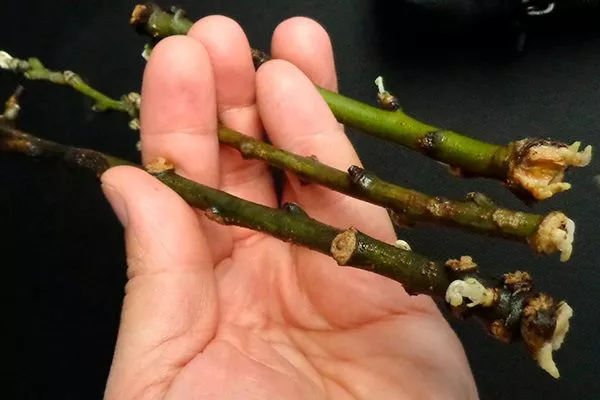
The Medovaya pear is propagated in a variety of ways: by cuttings, layering, seeds, and root suckers. Most often, gardeners use cuttings. To do this, a healthy shoot with 4-5 leaves and a couple of internodes is cut off. This cutting is prepared and placed in a warm location. After rooting, the cutting is planted in a container until it acclimates, and then transplanted into the open ground.
Advantages and disadvantages
By analyzing the Medovaya pear variety's description, photos, and reviews, you can objectively assess its strengths and weaknesses. Gardeners note the following positive aspects of this variety:
Disadvantages include uneven fruit size ripening and the need for preventative treatment against certain diseases. High yields can also reduce the tree's frost resistance.
Gardeners' reviews of the Medovaya pear variety
The Medovaya Krymskaya pear is a wonderful addition to your garden. It has a unique honey-like flavor and aroma, making it especially appealing to lovers of sweet fruits. Thanks to its resistance to diseases and pests, it's easy to grow and requires little maintenance.