
The Lada pear is a winter-hardy domestic variety with medium-sized, sweet-and-tart fruits. It has become established in many regions of the country and is prized by gardeners for its hardiness and productivity. This early-summer variety is often confused with the autumn pear with a similar name, the Amur Lada, so we emphasize that this article will focus specifically on the early Lada.
The history of the early ripening variety Lada
The variety was developed at the K. A. Timiryazev Moscow Agricultural Academy by scientists S. T. Chizhov and S. P. Potapov in 1979. It was registered in the State Register in 1993 and recommended for cultivation in central Russia. The Lada variety is especially popular in the Moscow region.
The Lada pear was created by crossing the Far Eastern Olga variety and the Belgian Lesnaya Krasavitsa variety. From the former, it inherited frost and disease resistance, while the latter imparted excellent fruit flavor. This delicious pear, equally suitable for eating and processing, is especially prized by gardeners in the central and eastern Siberian regions.
Description of the tree
The Lada pear tree is a medium-sized, standard tree, reaching a height of 5-6 m. The crown diameter varies depending on the tree's layer: 3-4 m on the lower layer, and 1-1.5 m on the upper layer. Young pears have a funnel-shaped crown. When the tree begins bearing fruit, the crown becomes pyramidal.
The branches grow densely, with medium foliage. The bark of the trunk is dark gray, with gray on the skeletal branches. The shoots are long and not very thick, with short internodes, slightly curved.
- ✓ Mixed fruiting type: ovaries are formed on all types of fruiting branches.
- ✓ Partial self-fertility: to increase yield, planting pollinators is recommended.
The Lada variety has a mixed fruiting pattern—ovaries form on all types of fruiting branches. The flowers are white, gathered in corymbose clusters of 5-7. The leaves are smooth, elongated-oval, with serrated edges.
Description of fruits
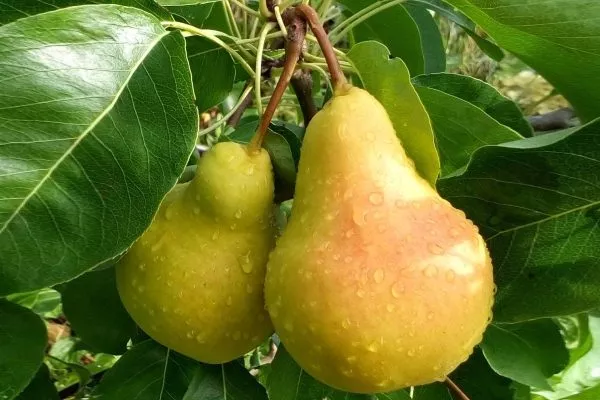
The Lada pear produces small, non-funneled fruits with small tubercles on a shallow, narrow saucer. The peduncle is thick, slightly curved, and has a swelling and slight rusting at the point of attachment.
Fruit characteristics:
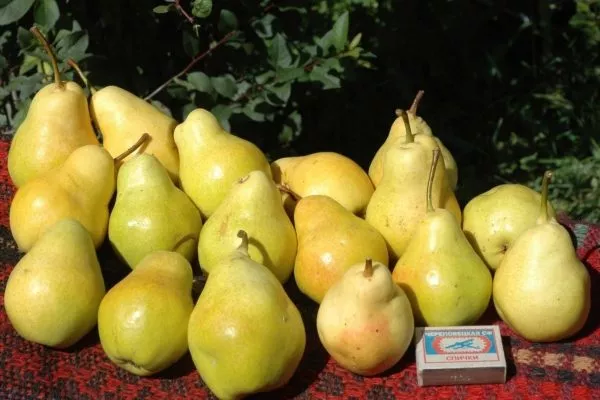
- color - light yellow, with a slight blush;
- shape - broadly pear-shaped or broadly ribbed;
- the skin is smooth and thin, with small dots underneath;
- the pulp is white-yellow, with a dense, fine-grained consistency;
- seeds are dark brown, small, up to 5 pieces.
Commercial and consumer qualities of fruits
Lada fruits are not only beautiful to look at but also boast excellent nutritional qualities. They have juicy, aromatic flesh with a pleasant sweet flavor. The taste also has a slight tartness.
Consumers note that Lada pears can have a somewhat bland taste. This is apparently due to eating overripe pears, which become starchy over time.
Biochemical composition of fruits:
- dry matter - 15.7%;
- the ratio of sugars and acids is 30.3-33.3 (depending on the rootstock);
- sugar - 7.2%;
- acids - 0.27%;
- arbutin - 1.1-1.2 g per 100 g;
- P-active substances - 92 mg per 100 g.
The fruits are very sugary, attracting wasps and other insects. They break when they fall from the tree, and are easily damaged if picked carelessly.
Characteristics
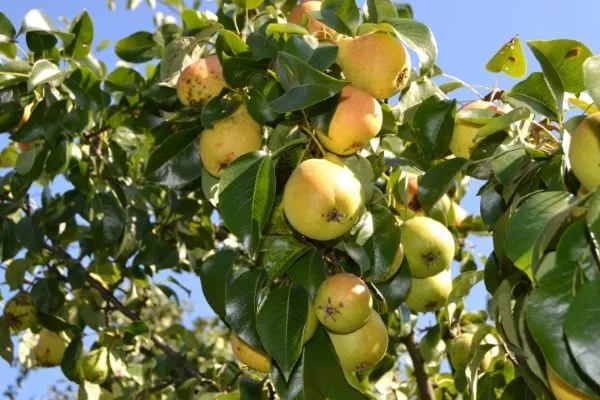
The Lada pear is an early summer variety. The fruit begins to ripen between August 10th and 15th. The tree bears fruit regularly, and once ripe, its fruit remains on the branches for a long time.
Before planting the Lada variety in your garden, familiarize yourself with its growing characteristics—it may not be suitable for you for a number of reasons.
Main characteristics of the Lada variety:
- Frost resistance is average; a mature tree can withstand frosts down to -30°C.
- Early fruiting - fruiting begins 3-4 years after planting.
- Self-fertility is partial.
- The yield is high, about 50 kg from one tree.
- Drought resistance is low; during drought, it requires frequent watering.
- Tasting score: 4.4.
- Purpose: for food and processing.
- Transportability is low.
- Keeping quality is low.
Advantages and disadvantages
The Lada pear has far more advantages than disadvantages. However, to make a final decision and fully evaluate the variety, it's worth comparing all its pros and cons:
The best pollinators
| Name | Disease resistance | Ripening period | Fruit size |
|---|---|---|---|
| Chizhovskaya | High | August | Average |
| Rogneda | Average | September | Large |
| Space | High | July | Small |
| Northerner | Low | August | Average |
To achieve maximum yield, it's recommended to plant pollinator varieties near the Lada pear. These are selected based on their flowering times—they should be similar to those of the Lada.
Best pear pollinators:
- Chizhovskaya;
- Rogneda;
- Space;
- Northerner.
The distance between trees should be no more than 40-50 m so that bees can successfully work on cross-pollination of pears.
Landing
To ensure a pear tree develops quickly and properly, avoids disease, and produces good fruit, it's important to plant it correctly. The tree's future also depends largely on the quality of the planting material and the location.
- ✓ The seedling planting depth should be such that the root collar is 5-7 cm above ground level.
- ✓ The distance between trees should be at least 4-5 meters to ensure sufficient space for the growth of the root system and crown.
Deadlines
In southern latitudes, fall planting is preferable. Winters here are mild, so the seedlings have a good chance of surviving the winter. Planted approximately 3-4 weeks before the cold weather sets in, these pears have time to establish themselves safely, and they begin to grow vigorously in the spring.
Pears planted in the fall are stronger and more seasoned. However, in regions with harsh winters, gardeners often choose spring planting, as young seedlings have a much harder time surviving their first winter. In the spring, planting occurs before the sap begins to flow.
Selecting a seedling
It's recommended to buy seedlings in the fall, when there's a wide selection of planting material on the market. They should be purchased from trusted suppliers—specialized nurseries. For spring planting, you can also buy seedlings in the fall and then plant them in the garden or basement.
How to choose a good seedling:
- roots - well developed, with many thin roots, about 30 cm long, without dry or broken ends;
- trunk - even, with smooth bark, without cracks, wounds and damage;
- age — 1-2 years.
Choosing a location
Before purchasing seedlings, choose a planting site. It's recommended to prepare the planting hole well in advance.
Recommendations for choosing a landing site:
- good lighting - during the growing season, the tree should be illuminated for at least 10 hours;
- southern or southwestern part of the garden;
- protection from prevailing winds;
- no drafts;
- the maximum groundwater level is 2 m to the surface.
At midday, it is recommended to shade the seedlings so that the shoots and leaves do not dry out.
Lada is undemanding regarding soil, but prefers loose and fertile chernozem, loam, or chestnut soils. Neutral pH is recommended. Sand and peat are added to heavy clay soils, while clay is added to sandy soils.
Preparing the planting hole
Planting holes are prepared in advance. For spring planting, start in the fall; for fall planting, dig 80-90 days in advance. The holes are dug in a 4x5 m pattern.
How to prepare the landing site:
- Clear the area of debris and perennial grass roots. Dig over the soil, adding organic matter at a rate of 6-8 kg per square meter.
- Dig a hole 1 m in diameter and 0.7 m deep. Set aside the top fertile soil layer (20-30 cm thick). You'll need it to prepare the soil mixture.
- If the soil is heavy and clayey, place a 10-15 cm thick drainage layer at the bottom. Use expanded clay, crushed stone, or broken brick. If the soil is sandy, place a layer of clay at the bottom to retain water.
- To prepare the pit fill, mix the excavated soil (fertile) with 10 kg of well-rotted manure or humus. Add 200 g of ammophoska, 700 g of dolomite flour, and 600 g of wood ash.
- Mix all ingredients thoroughly and pour the resulting soil mixture into the hole, filling it to the top.
- Pour 20 liters of water into the filled pit.
- Cover the hole with covering material - roofing felt or a sheet of slate - to prevent rain from washing away the nutrients.
Step-by-step landing
Planting is best done on a cloudy, windless day. Before planting, soak the seedling for several hours in water, or better yet, in a solution of a root stimulant such as Epin, Kornevin, or Heteroauxin. Before planting, dip the roots in a mixture of clay, manure, and water.
Prepare a support in advance to tie the seedling to. It should be driven in before filling the hole. You can use a wooden stake or a plastic or metal pipe. The length of the stake should be such that, once installed, it is 1.5 times the height of the tree. A typical height for a stake or pipe is 100-110 cm.
Planting order:
- Open the hole and remove some of the soil mixture. This should be enough to allow the seedling's root system to fit freely into the space, with its root collar 5-7 cm above ground level.
- Step back 10-15 cm from the center of the hole and drive the prepared support into the ground.
- From the remaining soil mixture in the hole, form a mound on which to place the seedling and spread its roots along the slopes.
- Fill the hole with the remaining soil mixture. Add the soil gradually, compacting each layer thoroughly to ensure there are no air pockets between the roots. Pay attention to the root collar—it shouldn't be buried deep in the soil.
- Tie the tree to the support. Use a soft but strong material to avoid damaging the bark or squeezing the trunk. Twine, for example, is suitable, but wire is prohibited.
- Form a circle around the tree trunk to prevent water from leaking out during watering.
- Water the seedling generously. You'll need approximately 30-40 liters of warm, settled water. It's important that the entire soil filling the planting hole is soaked. This will ensure good root contact and the removal of air pockets, which always form when filling the hole, even if compacted.
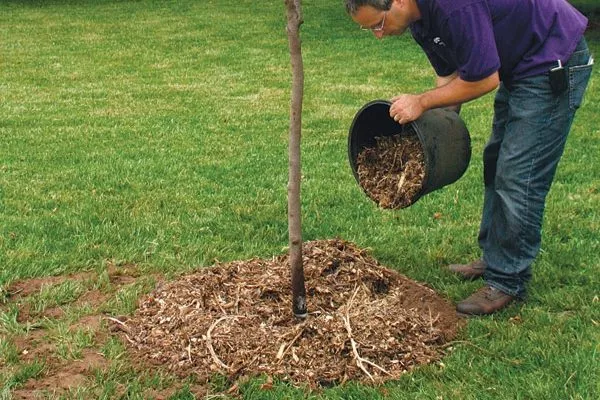
- Mulch the tree trunk circle with compost, freshly cut grass, straw, etc.
- Cut the seedling to 60-80 cm, and shorten the side shoots by 50%.
Also watch a video about planting a pear tree:
Further care
The Lada variety is undemanding and requires standard care. Regular watering, pruning, and fertilizing are essential to maintaining fruiting and the tree's health.
Watering
Pears don't tolerate stagnant water, but they do require regular watering. They are not drought-tolerant. The Lada variety requires an average of 5-6 waterings per season. Mature trees require infrequent but generous watering. Young trees require more frequent watering because their root system is not yet fully developed.
Pear trees are usually watered during the following periods:
- before flowering;
- after flowering;
- at the stage of fruit formation and shoot growth;
- half a month before the fruits ripen;
- after harvest;
- In autumn, moisture-recharging irrigation is carried out.
The recommended watering rate is 30 liters per square meter of the tree trunk circle. Young trees are watered weekly, with 10 liters applied morning and evening. The best method is to sprinkle the soil under the tree's crown. This ensures even absorption of the moisture and prevents root erosion.
The second watering option is to use grooves dug around the perimeter of the tree's crown. The recommended depth is 20-25 cm.
Soil care
Loosen and weed the tree trunk regularly—ideally after every watering and heavy rain. Loosening the soil prevents crust formation and allows air to reach the roots.
The area under the pear tree's crown should be kept perfectly clean. Even annual flowers are not recommended here. However, mulching it with peat, sawdust, freshly cut grass, straw, and other loose organic matter is beneficial. Mulch not only prevents rapid water evaporation but also weed growth.
Top dressing
The fertilizer placed in the hole lasts for the first two years of the tree's life. Therefore, fertilizing usually begins in the third year after planting. Fertilizing rates are increased once the tree begins to bear fruit.
Table 1. How, when and what to feed the Lada pear:
| Fertilizer | Timing and frequency of contributions | How to contribute |
| Dry organic matter - peat, compost, humus. | In spring and autumn, every 3-4 years. | 5-6 kg per 1 sq. m. Spread evenly and dig up. |
| Liquid organics - solutions of mullein and chicken manure. | At the stage of ovary formation and fruit growth - 2-3 times at intervals of 2-3 weeks. | An infusion is prepared from 2 liters of mullein and 1 liter of bird droppings (or 5 kg of fresh grass). Add 10 liters of water and let steep for a week. Then dilute with water 1:10 and water the area at a rate of 10 liters of solution per square meter. |
| Nitrogen mineral fertilizers – urea, nitroammophoska, ammonium nitrate, etc. | Every spring. | 20-30 g per 1 sq. m area. Spread and dig up evenly. |
| Phosphorus - superphosphate, superagro. | Every autumn (at the end of November). | 30-40 g per 1 square meter of tree trunk area. Spread and dig in. |
| Potassium - potassium sulfate, potassium monophosphate. | Every spring (at the end of May). | When watering, add 10-20 g of fertilizer for every 10 liters. The norm is 10 liters per 1 square meter. |
| Complex mineral fertilizers (according to instructions). | According to the instructions.
| |
Trimming
Regular pruning helps maintain a neat crown, promotes high yields, simplifies tree maintenance, and reduces the risk of pear diseasesThere are several types of pruning, each with its own purpose and timing.
Formative pruning is performed only in the spring, as heavy pruning is contraindicated before winter. During this period, the pear tree must prepare for winter and needs strength to survive it. For the Lada variety, with its pyramidal crown, a sparse, tiered, and bowl-shaped form is recommended.
Scheme of formation of a sparse-tiered crown:
- In the second year after planting, all but two or three branches are pruned to the ring. Branches are left at different levels, spaced 15-20 cm apart. The branches should point in different directions.
These will be the skeletal branches of the first tier. They are pruned by 30-40%. The central conductor is also shortened slightly, so that the cut is located 20-30 cm above the last branch. - One to two years after the first tier is established, the second tier is formed in the same manner. By this time, second-order branches will have grown on the first-tier branches. Only two branches are left on each skeletal branch. These are pruned back by 50%. Any excess branches are trimmed back to the ring.
- After another 1-2 years, they begin to form the third tier according to the scheme described above.
The formation process is completed by pruning the central conductor at the base of the upper branch. The entire process takes 4 to 6 years.
In addition to formative pruning, other types of pruning are also carried out on pear trees:
- Regulatory. It's aimed at preventing the crown from becoming too dense. It's carried out early in the spring. Lada trees become dense quickly, so they need to be thinned annually. However, it's important not to overdo it, as excessive thinning can reduce the yield.
- Supportive. This pruning helps maintain the tree's yield at the proper level. The pinching method is used: young shoots are shortened by 10-15 cm. Pruning encourages branching and an increase in the number of fruit buds. Pinching is best done in early summer.
- Sanitary. It's carried out in early spring and fall. It involves removing dry, diseased, broken, and frozen branches.
Cuts are made "on the ring"; knots and stumps are prohibited, as they can harbor fungi and insect pests.
We also suggest watching a video on pear tree pruning:
Preparing for winter
Lada is a winter-hardy variety; even seedlings can survive winters in temperate climates without any protection. However, in regions with extreme winter temperatures, it is recommended to cover the tree trunks with a thick layer of peat—at least 30 cm.
In anticipation of winter, the tree's trunk and skeletal branches are coated with a whitewash solution. It is prepared from slaked lime (300 g), office glue or PVA glue (2 tablespoons), water (2 l), and copper/iron sulfate (1-2 tablespoons).
Diseases and pests
The Lada pear is resistant to fire blight and scab, but it can be vulnerable to other diseases. Modern fungicides help control fungi and pathogenic bacteria, and insecticides combat insect pests.
Table 2. Diseases and pests of the Lada pear, measures to control them:
| Diseases/pests | Signs of defeat | How to fight? |
| Fruit rot | Brown spots and round grey pads with rot appear on the fruits. | Treatment with 1% Bordeaux mixture, in early spring - with lime solution (2 kg per 10 l of water). |
| Powdery mildew | The appearance of a whitish coating, shedding of ovaries, flowers, and leaves. | Spray before bud break with 10% potassium chloride, 7% urea, and 0.5% potassium salt. Repeat the treatment after harvest. |
| Cytosporosis | Dark spots appear on the bark, which, as they grow, acquire a red-brown hue. | Spray with Hom (40 g per 10 l, 4 l per tree) before flowering, after flowering - with Oxyhom (20 g per 10 l of water, 3 l per tree). |
| Rust | Red and orange swellings appear on the leaves. | Treatment with copper oxychloride (80 g per 10 l of water, 4 l per tree), after harvesting - with 1% Bordeaux mixture. |
| Pear mite | Blisters appear on the leaves and they fall off prematurely. | Treatment with colloidal sulfur (100 g per 10 l of water, 3 l per tree). |
| Ringed silkworm | The appearance of egg-laying eggs on the shoots. | Spraying before the leaves open with Entobacterin (5 g per 10 l of water, 3 l per tree). |
| Goldtail | The appearance of nests of 5-6 leaves. | Spraying with Decis (1 g per 10 l of water, consumption 3-4 l). |
Harvesting and storage
Lada pears reach technical (harvestable) maturity in early to late August. Once ripe, they hang on the branches for a long time without falling off. Ripe pears are collected in baskets, buckets, or directly into boxes to avoid moving the harvest.
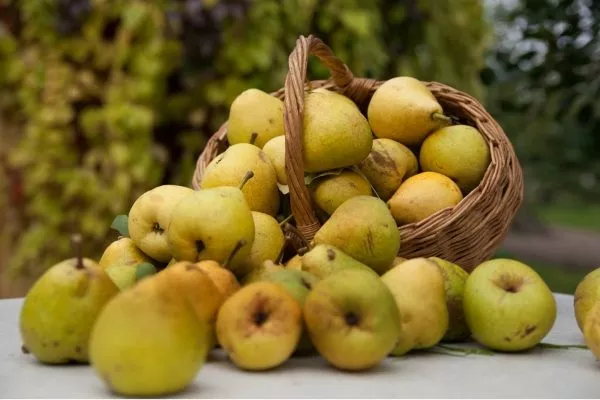
For harvesting, it is recommended to use stepladders and fruit pickers to reach the fruits hanging on the upper branches.
Harvested pears can be stored for about two months under favorable conditions. They retain their flavor and marketability for the longest time at temperatures of +1 to +4°C and 90% humidity. It is recommended to store the fruit in plastic or wooden crates. Most of the harvest is stored in a basement/cellar, while some can be refrigerated.
Gardeners' reviews of the Lada pear
The Lada pear, with its many advantages, is an excellent choice for regions with harsh winters. This winter-hardy variety is equally good fresh and canned, and its high and consistent yield ensures a reliable supply of fresh pears and preserves for your family.