
The Krasnobokaya pear is a relatively new variety, but has already gained popularity among both novice and experienced gardeners. This cultivar boasts numerous characteristics, including drought and frost tolerance, resistance to pests, and resistance to disease. Proper care is essential for its full development.
History of selection
It was developed at the Federal State Budgetary Scientific Institution by the Federal Agrarian Research Center of the Ural Branch of the Russian Academy of Sciences. It was created with the participation of breeders E. A. Falkenberg, M. A. Mazunin, and V. I. Putyatin.
Breeding work began in the 1970s, but the variety was only included in the State Register in 2002. The parents are the Nezhnost and Zheltoplodnaya pears.
Description of the Krasnobokaya pear with photos
The plant's appearance is virtually indistinguishable from other varieties. However, its presentable appearance and large fruit size immediately attract attention.
Tree
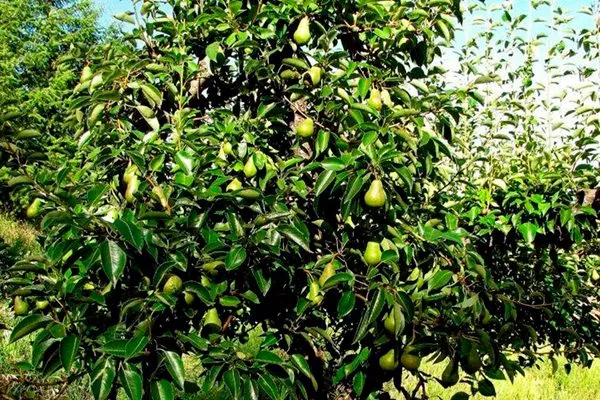
It's a medium-sized plant, reaching a height of up to 4 m. Its growth rate is fast, but slows after fruiting begins. Other distinctive qualities:
- The crown is sparse and has a rounded shape.
- The branches have a curved shape, extending from the trunk at a right angle, with slightly upward-curved ends.
- The bark is peeling and colored in brown shades.
- The shoots are thick, with many lenticels, and large pubescent buds.
- The leaves are large, corrugated, and have helically twisted, wrinkled tips. The leaf blade is curved and has a wavy edge.
- The flowers are large, cup-shaped, with oval petals of a pink hue.
Fruit
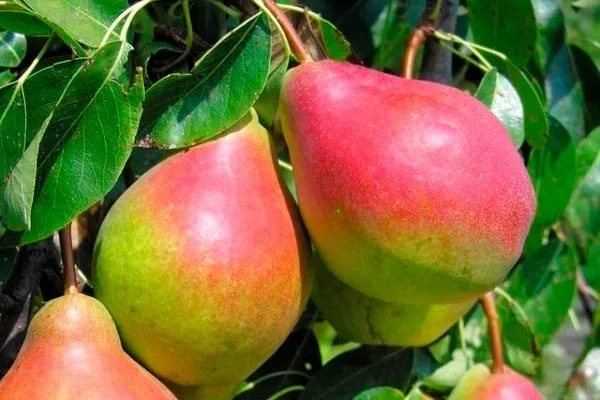
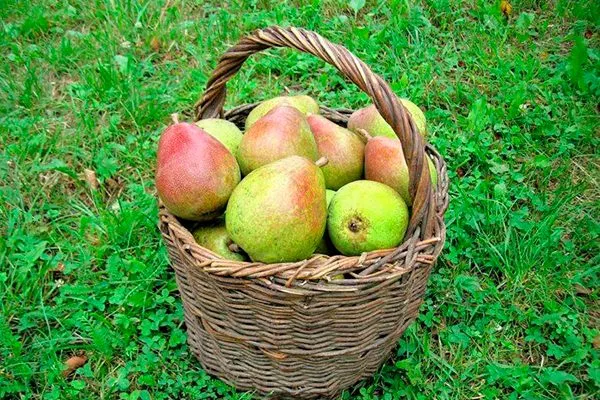
Characterized by large, symmetrical, pear-shaped fruits, their weight varies from 150 to 180 g. Detailed characteristics are listed below:
- At first the peel is light green in colour, but gradually it turns greenish-yellow.
- Where the sun shines more, the skin develops a crimson "blush", hence the name.
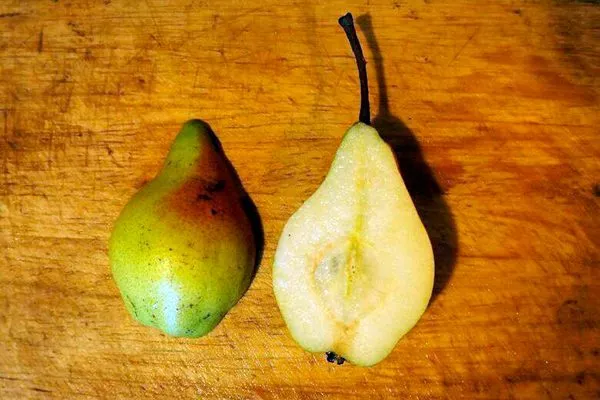
- The flesh is tender, with a grainy texture and an oily consistency, ranging from white to yellowish-cream in color.
The taste qualities are high and can compete with hybrids grown in more southern regions.
Characteristics of the Krasnobokaya pear
In addition to its excellent taste, it has a number of other characteristics. These should be considered before planting a seedling in your garden.
Tasting evaluation of the Krasnobokaya pear
It has a pleasant flavor that rivals other varieties and hybrids that are more sensitive to the climate in the growing region. Its flesh is distinctly sweet, with a slight tartness that provides balance and prevents a feeling of blandness. It has a subtle tartness.
Ripening time
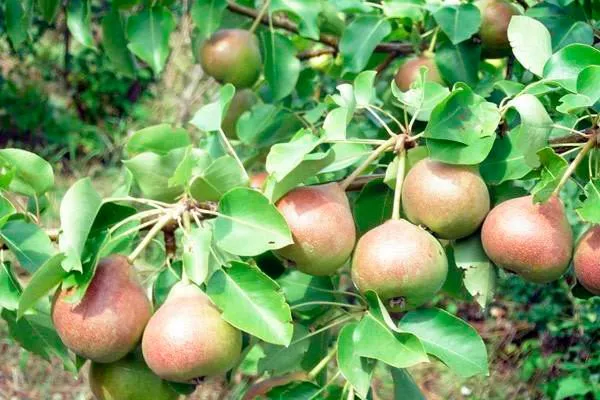
This is a late-autumn variety. Harvest occurs in the last ten days of September. The fruits are usually picked slightly unripe. This is to prevent them from falling off too quickly during the ripening period, rather than allowing them to ripen gradually through December or January, as is typically done with winter varieties.
Fruiting and yield
It begins bearing fruit approximately 5-7 years after planting in open ground. It has no "resting" seasons and produces fruit annually. On average, a mature tree over 10 years old yields 30 to 40 kg of fruit. The yield demonstrated during official variety trials was 105 centners per hectare.
Resistance to adverse factors
It has good resistance to adverse weather conditions, making it suitable for the unstable climate typical of the Urals. This property allows it to successfully produce crops even in variable weather conditions.
Frost resistance of Krasnobokaya pear
It is characterized by cold resistance ranging from -30 to -35°C. During the development process, the seedlings were exposed to frosts below -45°C and survived successfully, suffering only minor damage and quickly recovering.
Pollinators of the Krasnobokaya pear
| Name | Disease resistance | Ripening period | Frost resistance |
|---|---|---|---|
| Red-sided pear | High | Late autumn | Up to -35°C |
| Northerner | Average | Early autumn | Up to -30°C |
| Myth | High | Mid-autumn | Up to -32°C |
| Drooping | Average | Late autumn | Up to -34°C |
It's not officially self-sterile, but without pollinators, yields will be extremely modest. To ensure pollination, choose neighboring plants based on their overlapping flowering periods and their ability to survive in the local climate.
Common pollinators for this variety include the following cultivars: Severyanka, Mif, and Povislaya. Plant at least 3-4 plants per plot. The maximum distance between them should be no more than 10 meters, otherwise successful pollination is not guaranteed.
Growing regions
Krasnobokaya was recognized as the most suitable for cultivation in the Urals, but experiments and gardening experience have shown that its adaptability allows for a significantly wider growing area. It is suitable for cultivation in Siberia and the Far East, as well as in regions with a milder, temperate climate.
This variety has also attracted interest abroad. It has quickly and successfully "migrated" to Belarus, Kazakhstan, and Ukraine. It is also found in the Baltic regions.
Disease resistance
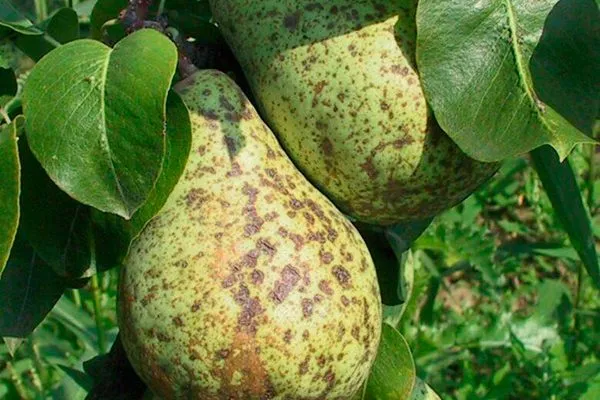
It exhibits good resistance to diseases and pests. It is extremely rarely attacked by scab and gall mites. Gardeners rarely report cases of powdery mildew or cytosporosis.
Advantages and disadvantages
In addition to its adaptability to cool regions, it has a number of other positive qualities. Advantages of the crop:
Among the disadvantages, gardeners note fine-grained pulp, the presence of tart notes in the taste, reduced shelf life if harvested late, and a tendency to crumble after fully ripening on the tree.
Planting the Krasnobokaya pear tree
Start planting in the spring, in the second half of May or even early June. This is because it allows time for the soil to warm up sufficiently and the likelihood of recurrent frosts is minimal.
- ✓ The age of the seedling should not exceed 2 years for better survival.
- ✓ The root system must be well developed, without signs of rot or damage.
When choosing a landing site, consider several criteria:
- Good lighting and no dense shadows (at least 3 m distance from any obstacle).
- Availability of protection from sharp gusts of wind and cold drafts.
- The depth of groundwater is 1 m or more below ground level.
- Fertile and loose substrate: chernozem, forest sierozem, sandy loam or loam.
Planting a seedling follows a standard process. The recommended planting hole size is 70-80 cm in depth and diameter. It's important to orient the seedling's roots correctly, directing them downward to prevent them from bending or sinking too deeply into the soil. The root collar should be 5-6 cm above the soil surface.
Caring for the Krasnobokaya pear
Caring for a tree ensures its proper survival and development. It requires certain care measures. Follow these recommendations:
- During the first year of planting, provide abundant watering every 10 days if there is no rain, using 10 liters of water per tree.
- Water adult plants 3 times per season: before flowering, after flowering, and at the end of October.
- Provide additional watering during periods of extreme heat and drought, based on the condition of the soil in the trunk circle area.
- Fertilize several times a year. In the spring, use organic or nitrogen-based fertilizers, and during flowering, use complex fertilizers. In the fall, apply a phosphorus-potassium fertilizer.
Collection and storage
Fruit is picked from the trees when unripe in the last ten days of September or early October. Delaying harvesting is undesirable, as ripe fruit quickly falls to the ground, which negatively impacts their storage quality.
- ✓ Easy separation of the fruit from the branch with a slight twist.
- ✓ The appearance of a characteristic blush on the skin, corresponding to the variety.
The shelf life is limited to a maximum of three months. Under unfavorable conditions, this period may be reduced to 20-30 days. Store the harvest in any container that provides ventilation. Store in a dark, well-ventilated area at a temperature of 5-7°C.
Preparing for winter
Winter preparation includes fertilizing with phosphorus-potassium fertilizers, generous watering, and mulching the trunk area. The need for shelter is determined by weather conditions. Insulate the trunk and root zone of young trees.
Gardeners' reviews of the Krasnobokaya pear
The Krasnobokaya pear is a high-yielding and easy-to-grow variety, ideal for growing in the Ural region. It is the choice of gardeners across the country. Certain factors must be taken into account, including proper care, as this determines the plant's immunity and future harvest.