
Pear mites are a common occurrence and quite dangerous for the tree. These are small parasitic insects called gall mites (commonly known as galls). When the pest infects a pear tree, it begins actively sucking sap from the leaves, allowing it to rapidly reproduce and spread throughout the tree, eventually infecting other fruit trees.
Description of the pear gall mite
The gall mite is a sucking insect found on pear, apple, quince, rowan, and hawthorn trees. Its body size is microscopic—0.20 to 0.24 mm—making it difficult to spot on leaves.
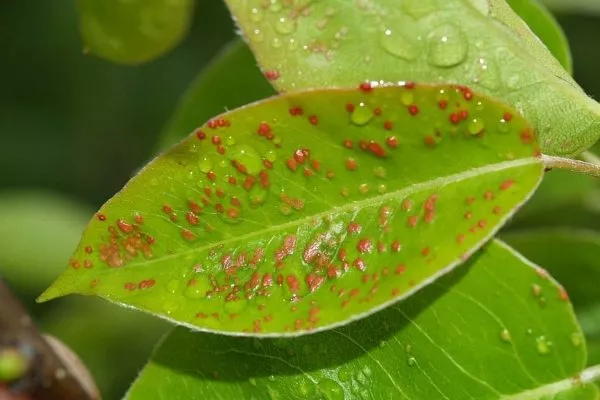
Morphology
The insect has an elongated, worm-like body with two pairs of legs and a piercing-sucking mouthpart. When examined under a microscope, it resembles a worm. Other morphological features include:
- the trunk is sharp, used for piercing the structure of leaves and then sucking out the juice;
- setae are located on the opisthosoma in a quantity of 6 to 7 pairs - genital, caudal, lateral, ventral and accessory;
- the oral cavity has a rostrum, pedipalps and needle-shaped chelicerae;
- the paws consist of a feathery empodium and an unpaired claw;
- the shield is triangular, the genital opening is transverse;
- The number of rings and microscopic tubercles on the abdomen varies from 70 to 80 pieces.
Tick females are divided into 2 types:
- protogynous (or summer) – necessary for reproduction during favorable periods;
- deutogynous (or winter) - needed for survival in the cold season.
Development
Deutogynous females spend the winter in the buds in a state of hibernation, so they do not reproduce or feed. When warm weather arrives, they awaken and immediately begin feeding in the tree gall itself, transforming into a protogynous female, which allows them to lay eggs. This occurs in March-April.
The eggs hatch into light green adults. The larvae undergo active development over the course of 20 days (in summer, this takes only a week), eventually turning dark brown.
What happens next:
- galls crack due to drying out;
- mites crawl out and spread throughout the plant;
- They begin to lay eggs again, resulting in a new generation by July.
In total, up to 3 generations appear per season.
How fertilization occurs:
- males leave their spermatophores on vegetation;
- the female, moving along the tree, captures particles;
- After this, they are crushed and directed into the spermatozoa through the genital valve.
A distinctive feature of gall mites is that they lay both unfertilized and fertilized eggs. The former hatch into males, the latter into females. A single clutch contains approximately 20 adults.
Geographic distribution
The habitat of gall mites extends to such countries as Armenia, Azerbaijan, Georgia, Central and Asia Minor, Kazakhstan, Western Europe, North America, Australia, South and North Africa, Ukraine, and Russia.
Harmfulness
Pear gall mites are considered dangerous insects because the risk of infestation persists throughout the growing season. Therefore, trees must be protected on a continuous basis.
Unpleasant consequences of pest infestation:
- the growth and development of young shoots is inhibited;
- the entire green mass of the tree, ovaries, buds, flowers are destroyed, due to which photosynthesis is absent, and accordingly, the fruits become gnarled, grow small or do not form at all;
- Due to the punctures left by mites, infection occurs quickly – the plant gets sick, and its immunity weakens.
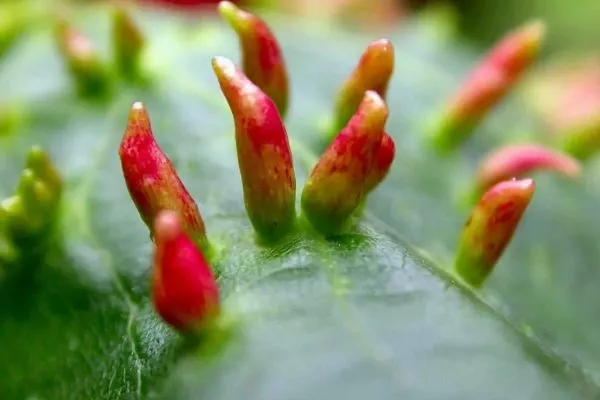
Signs of spider mites on pear trees
At the initial stage of infestation, gall mites are impossible to spot because they are too small, so all symptoms are limited to changes on the tree. How to recognize a pear pest infestation:
- formation of tiny holes on leaves, especially young ones;
- next – the formation of light green spots of small dimensions (about 3 mm) on the back side of the leaves, mostly along the vein line;
- then the plaques become dirty brown and increase in size so that they cover almost the entire leaf blade;
- then the plaques transform into convex growths, become brownish in color, and the plate appears extremely deformed, after which it crumbles.
As the mites multiply and grow, they infest increasingly larger areas of green foliage. The main causes of infestation are:
- lack of crown pruning, causing the crown to become too dense;
- excessive amounts of phosphorus-based fertilizers;
- transfer of insects from one crop to another;
- failure to comply with agricultural regulations.
Pest populations are also affected by pesticides, particularly growth stimulants.
How to destroy gall mites?
Gall mite control is essential, beginning in early spring and continuing through late fall. The first treatment is carried out before bud break, the second during bud break, the third after flowering, and then as needed.
Folk remedies
Folk remedies for gall mite control are considered effective, but not as effective as chemical treatments. However, these methods are considered completely safe, but their effectiveness is shorter-lived.
What can be used and in what dosages:
- Hot pepper decoction. A very popular remedy used for spraying affected foliage. How to prepare it correctly:
- Grind 1 kg of chili pepper in a meat grinder or with a knife;
- add the product to 10 liters of water;
- put on fire and cook at a slow boil for 2 hours;
- let it cool naturally;
- strain.
- Calendula decoction. The marigold solution is sprayed onto the greenery. The process for preparing it is simple:
- take 10 liters of water;
- add 1 kg of fresh flowers or 600 g of dried flowers;
- put it on the fire;
- boil for about 10-15 minutes;
- cover with a lid and leave to infuse for 5 days;
- strain.

- Infusion of potato tops. Spraying the leaves is done in the same way as in the previous case. How to prepare and use correctly:
- pick the potato tops and chop them or grind them in a meat grinder;
- Mix 1 kg of tops with 10 liters of warm water;
- leave to infuse for 4-5 hours;
- Pour in about 200 ml of liquid laundry soap after straining the infusion.
- Dandelion tincture. To prepare, take 1 kg of dandelion leaves and 3 liters of water. Then proceed as follows:
- mix both components;
- leave to infuse for 3 days;
- strain;
- pour in 50 ml of brown liquid laundry soap;
- mix thoroughly;
- Spray the pear or other fruit tree.
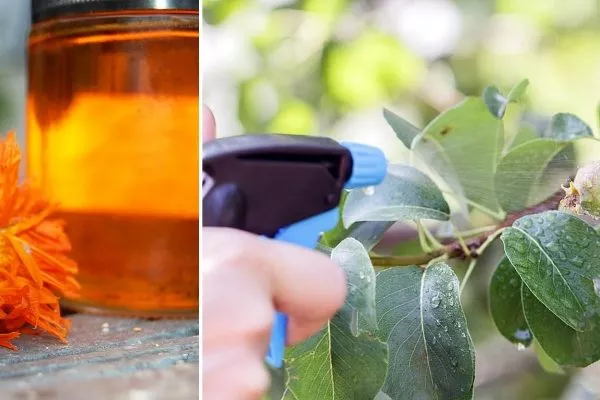
- ✓ The ambient temperature must be at least +15°C for the hot pepper decoction to be effective.
- ✓ Spraying with an infusion of potato tops should be done in the evening to avoid leaf burns.
Treat trees with natural remedies either early in the morning or late in the evening. The weather should be dry and windless. Repeat the treatment every 5 days.
Biopreparations
These are biologically derived products that, unlike chemical ones, are considered more gentle on trees and humans. Despite these advantages, biological products are not as potent as insecticides.
The best products for treating pear trees against gall mites:
- Vertimek. It is considered an insecticidal acaricidal drug, exerting contact and intestinal action, as its main active ingredients are the metabolites of various fungi (avermectins). Best used in hot, dry weather.
The product is considered harmless, so pears can be picked from the tree as early as four days after spraying. It is essential to treat the leaves on both sides, as the liquid does not penetrate the leaf blade, but only remains on the surface.
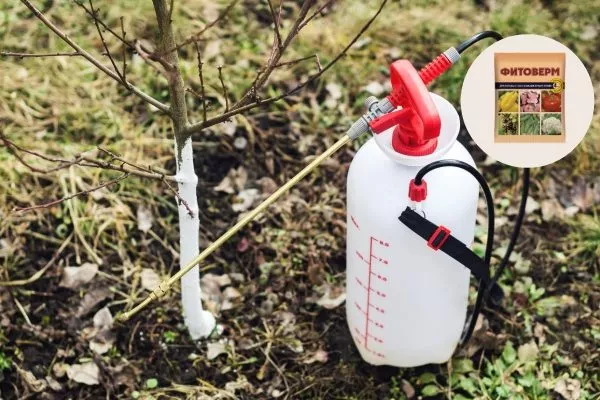
For 10 liters of water, only 1 ml of Vertimek is required, which is enough to treat 100 square meters. - Fitoverm. Based on avermectin, it's considered a broad-spectrum biological insecticide. As with the previous method, it's more effective on hot days. It's excellent for preventative spraying, so it's recommended to apply it before bud break and after flowering.
Dilute 15 ml of the product in 10 liters of water. For young trees, use 3-4 liters of solution; for mature trees, use up to 8 liters of solution.
- Colloidal sulfur. It's a mildly toxic pesticide. You'll need 5 to 10 grams of powder per 10 liters of water (less for prevention, more for control). The thermometer should be at least 20 degrees Celsius.
Chemicals
Chemical treatments combat gall mites quickly and effectively, making them increasingly popular. However, they have a significant drawback: toxicity to humans, insects, and plants. Mandatory conditions under which chemicals should not be used include:
- during flowering;
- if there is an apiary with bees nearby;
- a month before the fruits ripen.
What medications are used and how:
- Karbofos. This organophosphorus insecticide and acaricide has contact and stomach action. It contains malathion, which paralyzes the pest, causing its death.
It is produced in powder form, suspension, or ready-to-use solution. Most often, gardeners purchase the emulsion form. 5 ml of the medicinal solution is required per 10 liters of water. The application rate is 2 to 5 liters per square meter of pear tree crown. Therefore, for preventative purposes, the required amount of solution is half that for medicinal purposes. - Actellic. It is an acaricide with contact action and fungicidal properties. It can be used no more than twice per growing season. It is used for both prevention and treatment.
For 10 liters of water, use 20 or 40 ml of the solution, depending on the intended use. One tree requires 2 to 5 liters of the prepared solution. - Fufanon. The product is based on malathion and is sold as a concentrated liquid. For 9 liters of water, you'll need 12 ml of the product. For one seedling, you'll need 2 liters of solution; for a mature pear or apple tree, 5 liters.
- Karate Zeon. A very powerful insecticide with a broad spectrum of action, capable of killing not only insects but also their eggs. The active ingredients are pyrethroids.
To prepare a working solution for prevention, mix 10 liters of water and 4 ml of concentrate; for treatment, mix 10 liters of water and 8 ml of the product. - Apollo. A contact pesticide. As with the previous product, it's based on pyrethroids, so it's also considered potent. Its special feature is its selective action: it kills pests but has no effect on beneficial insects, so it's approved for use near apiaries.
For 10 liters of water you need 4 ml of concentrate.
Agrotechnical methods and prevention
To prevent and control the invasion of tick-borne pests, it is important to adhere to all agricultural practices, and in a comprehensive manner.
Please pay attention to the following nuances:
- In summer, fertilize your pear tree with minerals—they prevent the spread of spider mites. This happens by saturating the tree's structure with nutrients, which reduces the amount of sap in the leaves. As a result, the pest abandons the plant due to lack of nutrition.
- Sanitary cleaning and treatment is a mandatory procedure, since removing old bark disturbs pest nests, and whitewashing prevents insects from climbing onto the crown.
- Buy cuttings from nurseries – they undergo preventative treatment, so the seedlings will be free of eggs and mites.
- Remove fallen fruit and leaves from the area promptly - they may contain pests that will move to the pear tree or come back to life in the spring.
- Always dig around the tree trunk in the fall and spring. Additionally, sprinkle wood ash into the area. This prevents the spread of insects.
- Loosen the soil after each watering.
- Avoid overdosing on fertilizer. This weakens the tree's immunity, leaving it vulnerable to pests. This is especially true for phosphorus, which triggers the rapid development and spread of gall mites.
- Avoid dense plantings – if the branches of nearby trees touch each other, this opens a path for insects to move to a new plant, which can damage the entire garden.
- Use trapping belts to prevent ticks from moving through trees.
Gardeners have developed a preventative spray for crowns against spider mites. This should be done in early fall.
What you will need:
- water – 10 l;
- urea – 100 g;
- copper sulfate – 5 g;
- boric acid – 3 g;
- potassium permanganate – 3 g.
Which pear varieties are resistant and susceptible to pest damage?
| Name | Disease resistance | Ripening period | Fruit size |
|---|---|---|---|
| August dew | High | Early | Average |
| Sorceress | Average | Average | Large |
| Fragrant | High | Late | Average |
| In memory of Yakovlev | High | Average | Large |
| Northerner | Average | Early | Small |
| Beauty | High | Average | Large |
| Chizhevskaya | Average | Late | Average |
| Tikhonovka | High | Early | Small |
| Red-sided | Average | Average | Large |
| Fairytale | High | Late | Large |
| Rainbow | Average | Early | Average |
| Myth | High | Average | Large |
| Yellow-fruited | Average | Late | Average |
| Larinskaya | High | Early | Small |
| Dekabrinka | Average | Late | Large |
For novice gardeners, it's easiest to purchase varieties that are resistant to gall midges. This group includes the following pears:
- August dew.
- Sorceress.
- Fragrant.
- In memory of Yakovlev.
- Northerner.
- Beauty.
- Chizhevskaya.
- Tikhonovka.
- Red-sided.
- Fairytale.
- Rainbow.
- Myth.
- Yellow-fruited.
- Larinskaya.
- Dekabrinka.
All other pear varieties are considered unstable to gall mite.
Pest Control Reviews
When spider mites appear on a pear tree, immediate pest control measures are essential. Preventative measures and proper agricultural practices are also essential to avoid an infestation of this dangerous insect.
A great, comprehensive article, written with knowledge of agricultural technology. Thank you for the wide selection of effective products and folk remedies. This problem often arises at our dacha. I'd be interested in trying the pepper infusion. I don't think it will affect the taste of the pears, but I think it will definitely kill the mites.