
The Karamelnaya pear is named for its well-known caramel flavor, as the fruit's flesh also has these notes, making it a unique characteristic of the variety. The cultivar was developed at the Timiryazev Academy of Agriculture in Moscow, and is therefore zoned for the Moscow region and central Russia. It is characterized by its low maintenance, stable yields, and moisture-loving nature.
Description of the Caramel pear
The tree is considered medium-sized, growing to a height of 3-4 meters. The crown is pyramidal or conical in shape, with medium foliage. This variety produces mixed fruit.
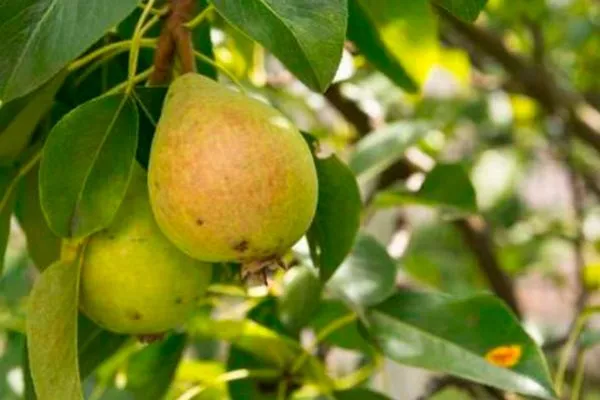
Brief description of fruits and taste qualities:
- dimensions – small, the weight of one fruit is maximum 110 g;
- form - pear-shaped, regular;
- skin – refined and smooth;
- peel color – light yellow, but with a blush;
- pulp shade – cream;
- subcutaneous inclusions – in small quantities, not strongly expressed;
- pulp – juicy, fine-grained type with medium density;
- taste - sweet;
- aroma – not very rich;
- presentation – at a high level.
Main characteristics
| Name | Disease resistance | Shelf life of fruits | Watering requirements |
|---|---|---|---|
| Caramel Pear | High | Up to 2 months | High |
| Academic Pear | Average | Up to 1 month | Average |
| Pear Otradnenskaya | High | Up to 1.5 months | Average |
| Chizhovskaya pear | High | Up to 2 months | Low |
| Space Pear | Average | Up to 1 month | High |
| Pear Rogneda | High | Up to 1.5 months | Average |
| Lada pear | Average | Up to 1 month | Low |
The caramel pear is considered partially self-fertile, so it requires donor plants. Any pear variety that blooms at the same time can be used as pollinators. For example, the Akademicheskaya, Otradnenskaya, Chizhovskaya, Kosmicheskaya, Rogneda, or Lada pears.
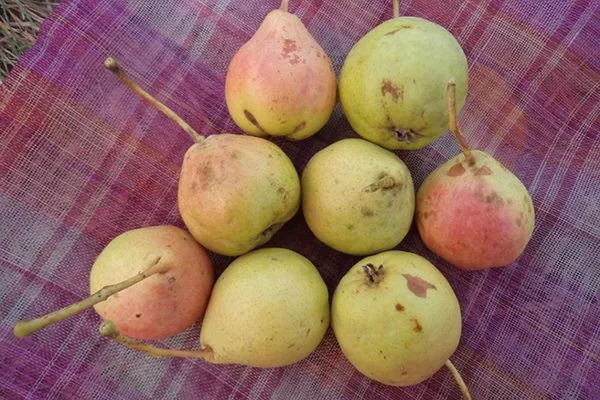
Main characteristics:
| Productivity | At a high level, one plant can yield 45 to 50 kg or more. |
| Precocity | The fruiting period begins early – already in the third year after planting the seedling. |
| Ripening period | From the end of June to the beginning of August. |
| Purpose | Universal – the fruits are used for eating in their natural form, making jam, juice and compote, freezing and drying. |
| Shelf life | At room temperature up to 12 days, in a cellar/basement up to 2 months. |
| Resistance to diseases and pests | At a high level, therefore, under favorable growing conditions and compliance with agricultural practices, preventive spraying is not carried out. |
| Soil type | Drained, loose soil – loam, chernozem, sandy loam. The soil should be neutral or slightly acidic. |
Landing rules
This sun-loving pear variety is best planted on a southwest-facing side. For spring sowing, it's best to plant before the sap begins to bloom, and the hole should be prepared in the fall.
- ✓ The depth of groundwater should be at least 2.5 m to prevent rotting of the root system.
- ✓ The optimal soil pH for the Karamelnaya pear is 6.0-6.5; if it deviates, it must be adjusted with lime or sulfur.
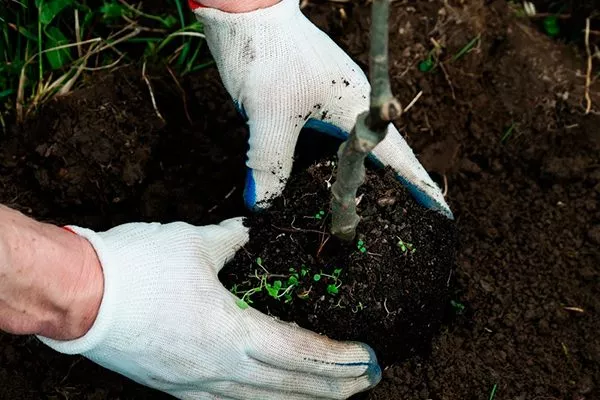
Agronomists recommend autumn for planting young trees, as this allows this type to become more resistant to cold, diseases, and pests, and also to take root more quickly.
Other features:
- When choosing a young seedling, pay attention to its age—one or two years. Be sure to inspect the grafting to ensure it is properly grafted, the aboveground portion should be free of defects, and the roots should be strong with a clean, light-colored cut.
- The seedling's roots should be soaked for 24 hours in water or a stimulating solution, such as Kornevin. Before planting, the lateral roots should be trimmed back by 10-13 centimeters. If there are leaves, they should be removed, and small branches near the trunk should be shortened.
- A young tree should be at least 75-80 centimeters high.
- Planting in a permanent location involves preparing a 70x70 cm hole and a pre-prepared soil mixture. The topsoil should be mixed with approximately 9-10 kg of humus or compost, 80-90 g of nitrophoska, 100-130 g of fly ash, 55-60 g of superphosphate, and 25-35 g of potassium salt.
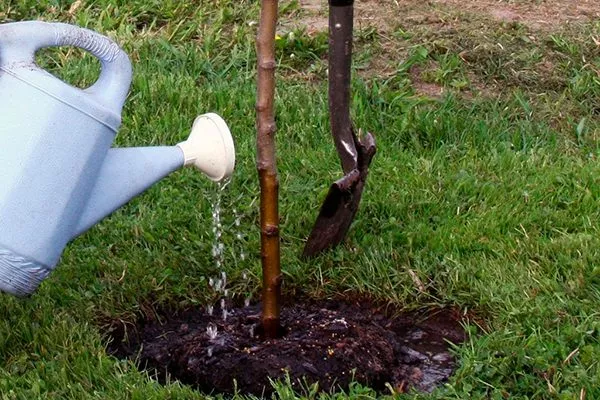
- After placing the seedling in the planting hole, water it with approximately 9-10 liters of settled water. Once the water has been absorbed, add the remaining soil, compact it, and water again—this time with 20 liters of water. This watering method is typical for a small number of pear trees.
- It is necessary to mulch the soil around the plant after watering and periodically remove weeds around the seedling.
Care methods
Growth regulation and care take time throughout the year: it is important to maintain loose soil, apply fertilizers in a timely manner, and regularly prune and carry out preliminary treatments to prevent diseases.
Peculiarities:
- After planting, water once a week. This variety requires adequate moisture—10 to 20 liters per tree. In subsequent years, you can increase the amount of water, while reducing the frequency to once or twice a month.
- Create a shallow trench around the trunk to retain moisture. For full watering of mature trees, it is recommended to use artificial rain.
- After watering, do not forget to loosen the soil for additional aeration.
- Fertilization should be regular. Fertilizing tips:
- This variety does not require much nitrogen, so it should be introduced in limited quantities over the course of 2-3 years;
- organic matter is added once every three years, taking into account the soil type;
- mineral fertilizers are required annually;
- with the onset of cold weather, mineral complexes are added to the soil along with organic matter;
- Charcoal can be additionally used in the amount of 250-350 g for each plant, in combination with loosening the trunk area;
- Any fertilizers should be applied carefully, without damaging the root system, and can be combined with watering.
- Pruning is a key element in the growth and development of this variety. It's best to do this in the spring. The tree tolerates pruning well, provided temperatures don't drop below -7-8 degrees Celsius. Selectively leave only the main branches on the tree, cutting off the remaining stems. Do not apply fertilizer during this period.
- Before the onset of frost, autumn pruning is carried out to remove wilted branches. Crown pruning is not practiced in winter.
Preparing for winter
This variety is cold-resistant, but requires protective cover, especially for young specimens. Overwintering recommendations:
- It is necessary to protect the trunk using burlap, cardboard or any alternative material.
- It is necessary to treat the trunk from rodents in advance, using, for example, dust or birch tar.
- Using straw in combination with herbs (wormwood, comfrey) will provide insulation and protect against mice.
- The edge of the covering material is secured in the ground to a height of 3-5 cm after the entire tree is covered.
These simple steps will help protect the plant from frost until the growing season begins.
Diseases and pests
If cultivation rules are violated, the risk of such problems increases:
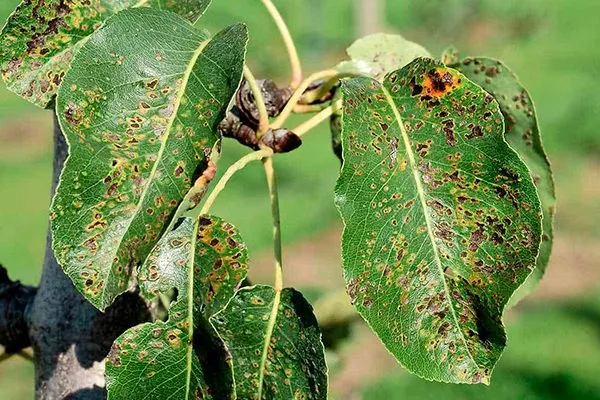
- Fruit rot. The disease manifests as black spots on the fruit, gradually spreading throughout the tree. Control methods: Infected fruit are removed and destroyed by treating the tree with Bordeaux mixture or copper sulfate.
- Trunk rot. This disease is dangerous for weakened and aged trees. The bark turns dark red. The caramel bark begins to dry out. Control methods: remove infected areas with a knife, treat with copper sulfate and garden pitch.
- Mosaic disease. This is a serious disease. Leaves turn pale and spots appear. Control measures include cutting down the tree, uprooting the roots, and burning them to prevent infection of other crops.
When to harvest and how to store it?
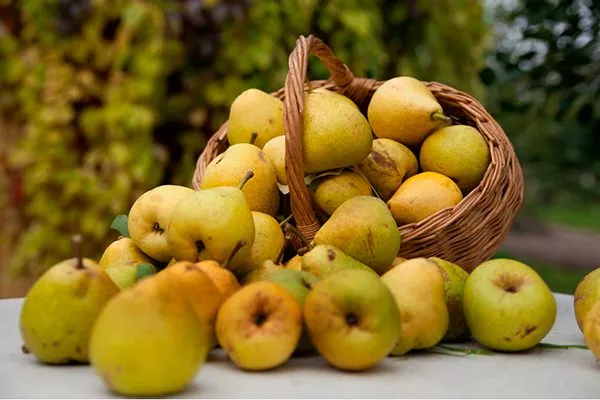
Fruit harvesting begins in early autumn. Carefully picked fruits are placed in boxes, layered with paper. They are stored in a cool, dark place for up to two months, periodically checking for signs of rot.
Gardeners' reviews of the variety
The Karamelnaya pear easily survives Moscow winters and quickly adapts to other climates. It is characterized by excellent flavor and resistance to all adverse factors. With proper agricultural practices, it can achieve consistently high yields every year.