
The Cathedral pear is a member of the Rosaceae family, with corymbose inflorescences. It is an early-fruiting table variety that ripens in summer and produces fruit regularly. Pollination is by wind and insects. The tree is quite winter-hardy, making it easy to grow in the central part of the Russian Far East.
History of selection and zoning
The Kafedralnaya variety was developed relatively recently, in 1989, at the Timiryazev Moscow Academy of Agriculture. Authorship is attributed to four breeders and scientists: M. V. Kachalkin, V. I. Susov, S. P. Potapov, and S. T. Chizhov. Hybrid seedlings were used to create the variety, which in turn were taken from the following varieties:
- Duchess Thigh;
- Tema;
- Forest beauty.
A few years later, in 2001, the Cathedral was included in the State Register and zoned for the Central part of Russia.
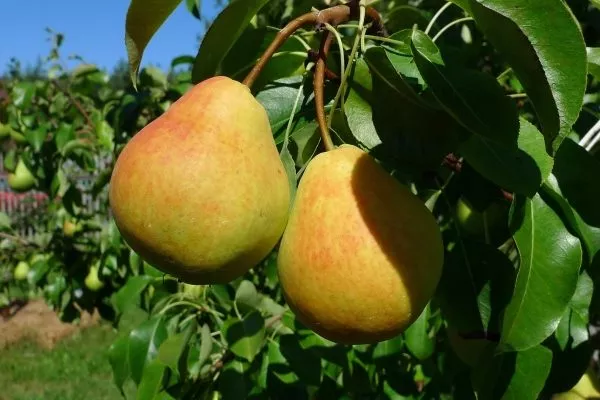
Description of the Cathedral pear variety
The Cathedral pear has a unique feature: its crown never becomes dense, as there are no downward-growing shoots. This quality eliminates the need for constant crown shaping. This is achieved through a balanced distribution of growth elements throughout the plant body.
Tree characteristics and annual growth
The average height of the Cathedral cultivar ranges from 3 to 4 meters. Shorter or taller specimens can be found, depending on growing conditions. The crown is conical.
Other characteristics:
- bark - smooth and grey, without roughness, brown with a red tint when young;
- branches - ends slightly curved upwards, sparse, ringed;
- leaves are large in the south, smaller in the north, but the other parameters are the same:
- shape – oval;
- surface – smooth;
- color – rich;
- tip - pointed type;
- edges are serrated.
- kidneys - cone-shaped;
- flowers – large, cup-shaped, snow-white;
- crown – conical, regular;
- central conductor - clearly defined.
- ✓ No need for crown formation due to the natural balance of growth elements.
- ✓ Two-type root system provides stability and effective nutrition.
Branching of the root system
The Cathedral pear's root system is quite complex. Unlike other fruit tree varieties, it is considered to have two types:
- Deep roots. They develop rapidly, growing deep into the earth. There, the root acts as an anchor, firmly holding the thick tree in a stable position.
As the plant grows, secondary, suction-type roots form on the main shoot. This root system is considered very powerful. - Superficial processes. These areas of the root system are responsible for the absorption of nutrients, oxygen, and water from the soil, so their maximum depth is 10-12 cm. However, the roots extend laterally up to 4 m (at maturity).
The close proximity of the shoots forces the gardener to loosen and weed the soil very carefully so as not to damage the roots, which could weaken the tree.
Description of fruits
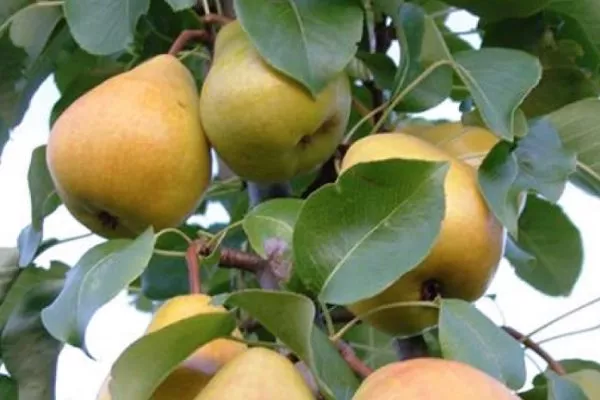
The Cathedral pear's shape is very regular and even (pear-shaped), making it a highly commercial fruit. Other characteristics of the variety include:
- Surface. The fruit's skin is bumpy, yet smooth and very tender. It feels slightly oily and has a glossy appearance.
- Size and weight. The fruits are considered small, as their weight varies from 90 to 130 g.
- Caloric content. Cathedral pears are considered dietary, containing only 50 kcal per 100 g. If consumed unripe, the calorie content is only 40 kcal. They contain 16% dry matter, about 8% sugar, and 0.3% acid.
- Color. When unripe, it's yellow-green; when ripe, it's a lighter yellow. It has a reddish-pink blush.
- Inclusions. These are multiple subcutaneous dots that have grayish or greenish hues. They are faint, almost invisible.
- Peduncle. Its length is universal, medium, and its shape is slightly curved, which creates additional convenience when harvesting.
- Taste and aroma. The fruit has a medium aroma, but a distinct flavor. It's sweet with a slightly tart aftertaste. It's considered a dessert pear.
- Pulp. The hue is white, the texture is buttery, and the texture is juicy and fine-grained. It has a slight density when biting into the flesh.
- Application. Cathedral pears are ideal for making juices, compotes, and purees due to their juiciness and sweetness. Pears are processed into marmalade, preserves, marmalade, and jam. The fruit is also suitable for drying.
Other characteristics of the variety
For a gardener, agronomic performance indicators are much more important than taste and appearance indicators. This will allow you to accurately determine the necessary measures:
- Drought and cold resistance. The tree can withstand temperatures as low as -30°C, so in southern Russia it doesn't even require shelter. This applies to mature plants; young trees (up to 7 years old) should be protected from recurrent frosts and winter cold, as their root systems and trunks are not yet fully developed.
The variety has difficulty tolerating excessively dry summers; it is important to add water in a timely manner and strictly monitor this process. - Immunity to diseases and pests. The tree's resistance to disease was taken into account when developing the cultivar. Therefore, the "Kafedra" variety is extremely rarely affected by powdery mildew, sooty mold, and rust. Despite this, it is susceptible to green aphids and leafhoppers.
- Fruiting. The first small harvest is harvested from the tree at the age of 3 to 4 years. Fruiting is considered very early for the pear tree. Moreover, during the first years, the fruits can grow either singly or in clusters.
Avoid overloading the tree with too many fruits during its 5-6th year. To avoid this, remove the ovaries, leaving no more than two on each branch. - Self-fertility. It's at a high level. The pear tree thrives on pollen carried by bees. Despite this, agronomists believe that additional pollination is needed for the Cathedral variety to improve its yield. To achieve this, pear varieties such as Pamyat Zhiglova, Chizhovskaya, Lada, Rogneda, Sapphire, and Prosto Maria are planted nearby.
- Bloom. Depending on the region, flowering begins from May 1 to 20.
- Ripening periods. This is a summer pear, the fruit of which is ready to eat as early as the first of August in the South and after the 15th in other regions. In Siberia and the Urals, the ripening period shifts slightly until early September.
- Productivity. The variety is considered productive: gardeners harvest from 180 to 250 kg of fruit from one mature tree.
- Life expectancy. The cathedral pear bears fruit for about 45-50 years, and the tree remains viable for 2 centuries, but no longer produces fruit.
- Increase. Every year, shoots grow by a maximum of 40 cm for 8-10 years, after which development stops.
Advantages and disadvantages
The variety is characterized by certain advantages and disadvantages:
Methods of reproduction
The Cathedral pear is most often propagated by root suckering and cuttings. These are the most optimal methods for obtaining healthy seedlings, both in terms of simplicity and speed. Cleft grafting or bark grafting are also possible, but this is a laborious process.
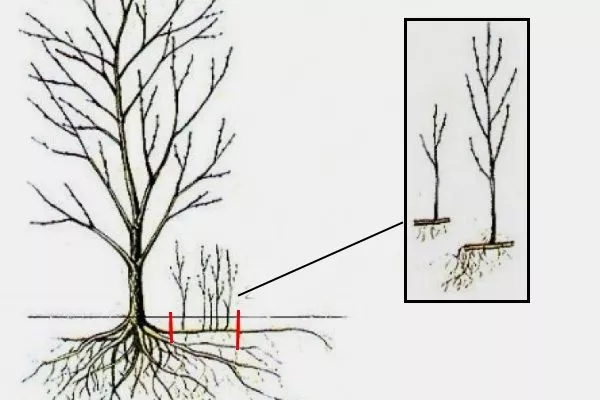
Undergrowth
This is the simplest method for trees that are not grafted. The procedure is performed in the fall or spring. In both cases, the seedlings need to be placed in a greenhouse for several months after being planted in a pot with potting soil.
The principle of the procedure:
- Select a healthy shoot.
- Dig it up from all sides with a shovel.
- Use a shovel to cut the main root off the parent plant. Cut off any other root suckers as well.

- Remove from the soil.
- Soak in any root growth activator.
- Plant in a pot in the standard way.
Cuttings
Another simple method. To use it, you'll need a strong, mature, and completely healthy tree. The process is as follows:
- Take a one-year-old shoot without visible damage.
- Treat garden tools with antiseptic.
- Cut the branch at a 45 degree angle.
- Place the bottom side down into the growth stimulator.
- Keep the root growth site in water at room temperature for 2-3 days.
- Plant in open ground.
- Cover with plastic wrap for 3 months, then uncover. Periodically during this time, open the plastic wrap to allow the plant to ventilate.
Graft
It is important to carry out the procedure only at the beginning of spring in order to obtain a full-fledged shoot during the warm season.
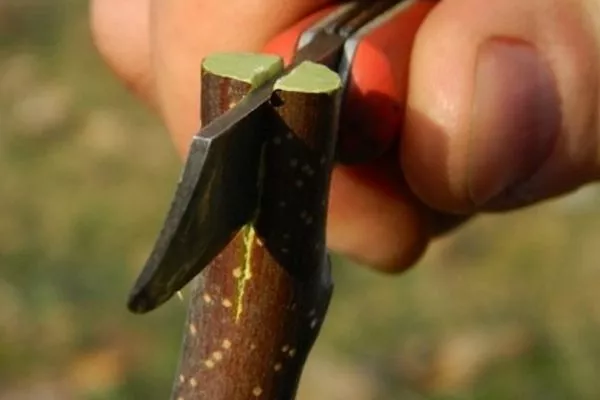
How to cleft graft:
- Cut the selected rootstock to a stump. Use a sharp knife to create a 5 cm deep split. Keep in mind that the bark must be cut beforehand, otherwise it will tear.
- Make wedge-shaped cuts on the cuttings and insert them into the cleft to align the cambium.
- Cover the grafting area with garden pitch.
- Wrap the split area with electrical tape.
- Wrap with PVC film.
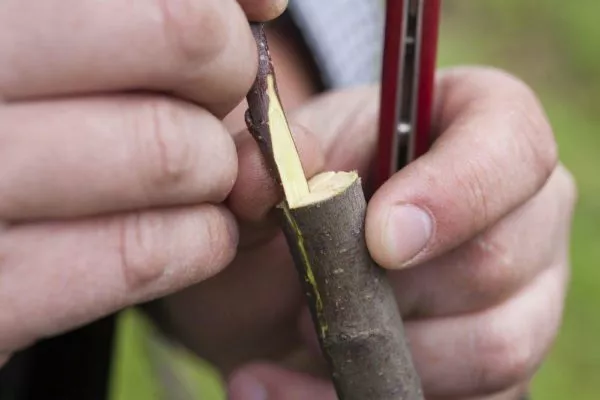
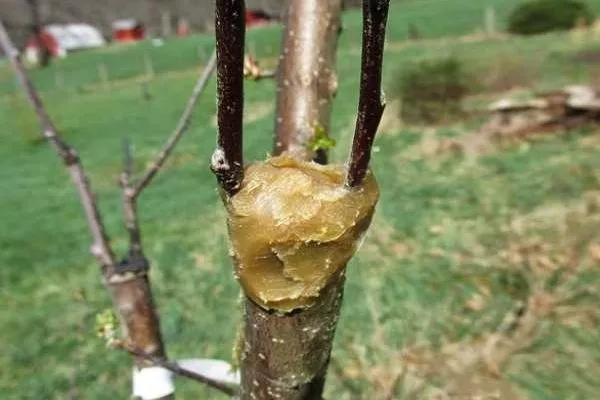
How to graft by bark:
- Bring the cuttings into the house 24 hours before the procedure.
- Before grafting, soak the bottom side in a growth stimulator.
- Cut off the top of the trunk from the rootstock tree.
- Clean the cut areas with a knife.
- Cut the bark on the rootstock so that the top layer is separated.
- On the cutting that will be grafted, make an even cut at the top and at the bottom at an angle of 25 degrees.
- Pull back the bark on the rootstock. Insert the scion and press it firmly against the tree.
- Apply garden pitch to the wounds.
- Wrap the area with electrical tape.
- Cover with plastic wrap.
Features that are important to know:
- the cutting takes root on the rootstock on the 14-17th day - during this period it is important to remove the plastic cover;
- If the grafted shoot falls, it means there is no survival rate – the procedure will have to be repeated;
- the cuttings must have at least 3 eyes;
- Carry out the procedure very quickly, as the wood surface is subject to rapid oxidation and drying.
Planting the Cathedral pear tree
The variety isn't particularly demanding when it comes to planting. However, it's important to follow certain rules and requirements specific to the Cathedral pear.
Deadlines
This variety is renowned for its good frost resistance, so it's recommended to plant it in the fall. Experienced gardeners claim this will further enhance the plant's cold tolerance. In this case, it's important to take the time to plant and check the upcoming weather forecast in advance. The first frost should be one to six weeks away.
In northern regions, planting pear trees in the fall is not advisable—the young plants won't survive such severe winter frosts. For spring planting, aim for the period from mid-April to early May, depending on climatic conditions.
Selecting a seedling and preparing it
The maximum age for a Cathedral pear cutting is 3 years. The plant should be 1.2-1.5 m tall, with 3 to 5 branches and a trunk 50 cm. When purchasing, pay attention to the tree's condition—it should be healthy, not dry, and free of disease and pests.
Prepare cuttings properly before planting if they have an open root system:
- Cut off all damaged elements from the above-ground part and the root.
- Trim the roots if they are longer than 30 cm.
- Disinfect the cut areas with a weak solution of potassium permanganate or copper sulfate.
- Soak the seedling in water for 24 hours.
- Now dip them into the root growth stimulator.
- Near the planting hole, dip the roots into the clay mixture.
A place in the garden
Any fruit tree requires specific soil conditions, and the Cathedral Pear is no exception. Consider the following:
- the soil must be very fertile and loose, the best type is black soil, sandy loam;
- the groundwater level is high – about 2.5 m from the earth’s surface;
- drafts are excluded, but the trees must also be ventilated;
- The lighting is good, so you shouldn't choose places under tall trees or near buildings.
- ✓ Soil pH should be between 6.0-6.5 for optimal nutrient absorption.
- ✓ The distance to the nearest buildings or other trees must be at least 5 meters to ensure sufficient ventilation and lighting.
Distance between trees
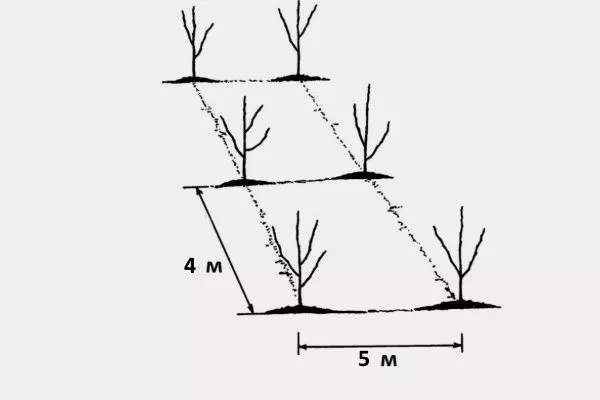
It's important to maintain precise spacing when planting. If you plant trees closer than the required distance, they will compete for nutrients, water, and oxygen. This will result in energy being spent on competing rather than on growth and development. Planting them further apart won't cause any harm, but the pears will take up too much space.
Optimal indicators:
- between trees – 4 m;
- between rows – 5 m.
Planting a tree step by step
Before planting, a hole is first prepared. The following conditions apply:
- when planting in autumn, work is carried out 2-3 weeks in advance;
- in spring – in autumn.
How to proceed:
- Dig up the entire garden area.
- Rake the soil evenly. A smooth surface makes it easier to mark out the planting pattern.
- Dig holes 70x70 cm deep for a one-year-old cutting. If the seedling is two years old, increase the dimensions by 10 cm (80x80 cm), and so on. When digging, discard the top layer of soil (approximately 20 cm) into a separate pile.
- Add 20 kg of humus, 100 g of urea, 150 g of ammonium sulfate, 900-1000 g of superphosphate to the discarded top soil.
- Mix thoroughly and pour into the hole. Cover with any waterproof material (film, etc.).
- When it's time to plant, remove the covering and drive a stake almost into the center of the hole.
- Place a seedling nearby, spreading the roots to the sides.
- Fill with the remaining soil from the hole so that the grafting site is located 6 cm above the surface of the area.
- Compact the tree trunk circle.
- Create a mound around the area to prevent water from leaking out of the area.
- Water generously – 15 liters of water per seedling.
- Mulch the tree trunk circle with spruce branches, humus, sawdust or peat.
This video explains everything about planting a pear tree:
Caring for the Cathedral Pear
To ensure that a pear tree produces fruit according to its varietal characteristics, it's necessary to adhere to agronomic requirements, which consist of a small set of measures. These include soil moisture, fertilizing, and pruning.
Watering
A mature Cathedral tree can easily withstand dry summers, but in this case, the fruit will be small and not as juicy as described in the variety description. Carefully monitor the frequency, quality, and quantity of watering.
Rules:
- the amount of water added under a tree up to 10 years old is 20-30 l, from 10 to 20 years old – 30-50 l, from 20 years and further – about 60 l;
- frequency – twice a month, if the summer is very hot, then every week;
- irrigation type – sprinkling;
- time of moisturizing: half the dose in the early morning, the second part after sunset;
- quality – settled and warm enough;
- watering stops completely immediately after harvesting;
- Before wintering, about 100 liters are added to the soil, which is called a moisture charge.
When and what to fertilize with – fertilizer application schedule
There's a standard fertilizing schedule for the Cathedral pear, but gardeners should consider the tree's condition. If it's producing well and disease-free, it's acceptable to reduce the recommended dosage. If, conversely, yield has declined, the dosage can be increased slightly.
How to apply fertilizer:
- The first fertilization is carried out immediately after removing the covering, but always before budding begins. The purpose of fertilization is to promote the development of green mass, shoots, and fruit buds. What to apply: 80-120 g of urea dissolved in 5 liters of water per tree, watering the root zone.
- The second time is after the tree has finished flowering. Now you'll need 1 kg of chicken manure and freshly cut grass (two 10-liter buckets of already chopped weeds). Mix everything together and pour 10 liters of warm water over it. Let it steep for about 7-8 days, then combine 1 liter of the infusion with 10 liters of water and apply it to the roots. The recommended dose for one tree is 20-25 liters.
- After July 10, nitrogen-containing preparations are used to strengthen the immune system and promote bark and fruit development. For one tree and 10 liters of water, the following is additionally required:
- 5 g copper;
- 100 g potassium salt;
- 20 g of boron.
- In the fall, to prepare for winter, potassium and phosphorus fertilizers are required. What to apply per square meter:
- Superphosphate – 2 tbsp., potassium chloride – 1 tbsp., water – 10 l;
- When digging, add 200 g of wood ash to a depth of 10-12 cm.
Whitewash
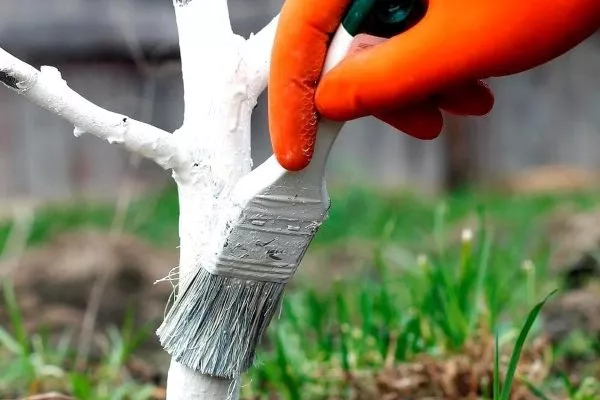
This is a mandatory measure that protects the tree not only from rodents and pests, but also from sunburn and frostbite. Therefore, it is recommended to whitewash the trunk and lower branches 2-4 times a year. How to make a working solution:
- take 10 liters of water;
- stir 1 kg of clay into it;
- add 2 kg of lime;
- add another 5-6 liters of water.
Soil care
The tree trunk area also requires appropriate care. It must be kept completely clean, as weeds can spread infections and pests. Here's what to do during the growing season:
- destroy weeds by weeding or pulling them out by hand (be sure to include the root system);
- mulch – after watering;
- loosen the soil – helps saturate the roots with oxygen;
- remove fallen leaves and fruits.
Trimming
The most important pruning should be done in the spring, before the sap starts to flow. This sanitary procedure helps form a proper crown during the first 3-4 years of the tree's life. This also helps protect the plants from further damage. diseases, as normal ventilation is ensured.
Follow the basic requirements:
- always leave only the strongest branches, all weakened ones must be removed;
- You cannot leave branches whose ends touch the ground surface, as this increases the risk of infection and pest infestation;
- pruning is carried out exclusively on the ring, therefore leaving stumps is prohibited;
- the maximum number of shoots removed is 12-15 per procedure;
- The first pruning is carried out in the second year after planting the seedling.
The Cathedral pear tree only requires sanitary pruning once a year. However, gardeners also recommend doing this in the fall, just before wintering, as many branches break during the growing season, become infested with insects, and so on.
Once a year or two, shape the crown using thinning methods – cut off incorrectly directed branches and those shoots that are too dense for the tree.
Rejuvenation
Rejuvenation pruning is necessary for trees that have begun to bear fruit less efficiently, are producing smaller fruits, or are frequently susceptible to disease. This most often occurs after 10 years of age.
How to do it for this variety:
- cut all branches from the central trunk;
- leave only the 4 strongest branches on the main shoot.
Harvesting and processing pears
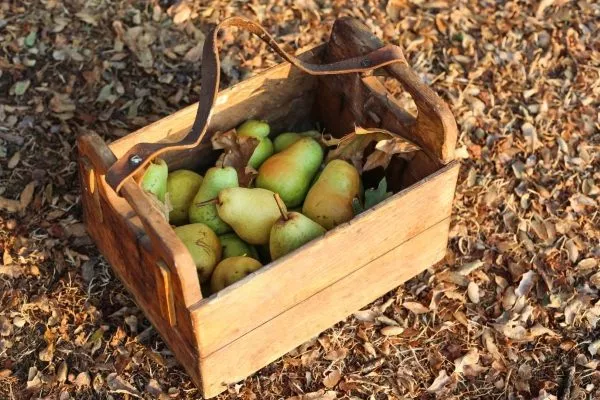
Harvesting must be done correctly and in a timely manner. If the fruit is to be stored, pick it when it's unripe. If it's to be eaten within three days or used to make jam, juice, and other items, wait until it's technically ripe, which is determined by the color of the skin.
Rules:
- start harvesting from the upper tiers - the pears there will ripen faster than those below, since they are completely open to the sun's rays;
- the same applies to the side pears;
- Use a stepladder to ensure your safety;
- do not climb the tree - branches break and sap flow is disrupted due to the load;
- When picking for storage or selling directly from the tree, place the fruit in boxes - pear fruits do not tolerate frequent moving from place to place;
- If the tree contains healthy and slightly rotten or simply too soft fruits, place them in different baskets;
- Do not pull the stalk, but twist it from the branch.
Shelter for the winter
The Cathedral tree can withstand temperatures down to -30 degrees Celsius, so if winter temperatures aren't expected to reach those temperatures, there's no need to cover the tree. Otherwise, covering the tree is mandatory. Here's how to do it correctly:
- A month before covering, do a moisture recharge, then add fertilizer and loosen the soil.
- Apply mulch around the tree trunk. Apply a layer of at least 20-21 cm. Moss, peat, straw, and hay are all good choices, but humus is best, as it provides additional heat and maintains the desired temperature.
- Whitewash the trunk and lower branches with lime.
- Wrap the trunk with burlap. If you don't have burlap, use thickened paper instead. If the winter is particularly harsh, add additional insulation with plastic film or cover it with spruce branches.
- Secure the structure with twine.
Diseases of the Cathedral pear and their control
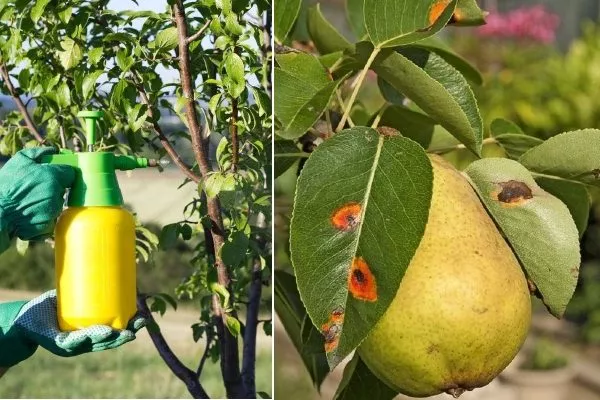
Cathedral pear is not susceptible to all diseases and pests. The most dangerous ones are:
- Powdery mildew. When infected, a whitish coating appears not only on the fruit but also on the ovaries. If you press on this area, it will sag.
As the disease progresses, the fruit hardens and darkens, causing black spots to form on the surface. The leaf blades also turn black, dry out, and curl up.
For treatment take:- 80 g colloidal sulfur, 10 l water;
- 2 ml of Topaz or Skor and the same amount of water.
- Sooty mold. The disease is similar to scab. Its symptoms include a black coating, similar spots, and stunted tree and fruit development. Treatment (all ingredients are calculated per 10 liters of water):
- laundry soap – 150 g, copper sulfate – 5 g;
- Hom – 40 g.
- Rust. The leaves become rusty, and black spots form on the surface. For treatment, use Skor – 2 ml per 10 liters of water, Gamair – 10 tablets per 10 liters of water.
- Green aphid. A green coating is visible on the surface of the leaves. To control them, use the following (per 10 liters of water):
- Bordeaux mixture (copper sulfate - 300 g, lime - 400 g);
- Karbofos – 30 g.
- Copperhead. The buds are affected first, then the flower buds. To control the disease, use one of the following (per 10 liters of water):
- Kemifos – 10 ml;
- Karbofos – 90 g;
- Decis – 2 ml.
Reviews of the Cathedral pear
The Cathedral pear is easy to care for, and its variety allows for multiple propagation methods. Its yield is high, but to achieve this, it's important to follow planting guidelines and agricultural practices.