
'Starkrimson' is considered one of the most well-known and easy-to-care-for pear varieties. The tree and its fruit are distinguished by their beauty, stunning flavor, and aroma. The result is a harmonious combination of all these wonderful qualities in a single tree.
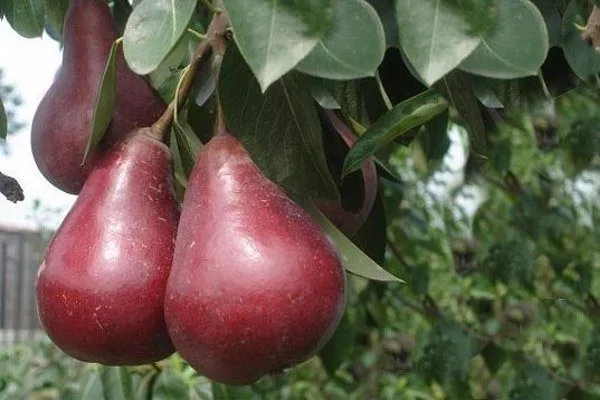
Ripe Starkrimson pears
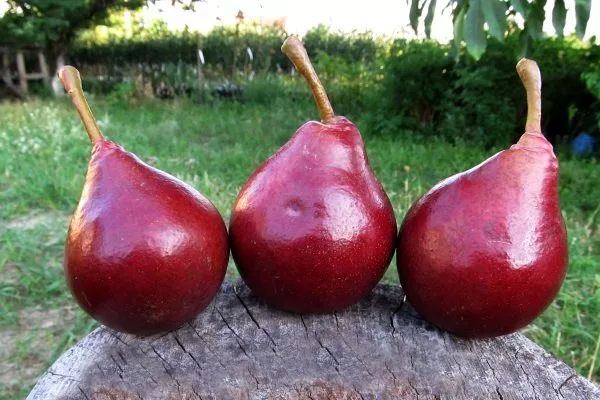
The skin of the Starkrimson pear changes color as the fruit ripens.
History of selection
The history of the Starkrimson pear began in 1939 in Michigan, USA. To develop this variety, scientists used the "Clappa's Favorite" cultivar to create a new variety of common pear, which they later named Starkrimson. It differs from its parent in that it produces beautiful red fruits. In 1956, Stark Brothers Nursery patented this variety. Another name for this pear is Red Favorite.
Description of the Starcrimson variety
This pear variety is considered tall, reaching 4 to 5 meters. The tree's crown is dense and spreading, pyramidal in shape, with narrow, dark green leaves that can sometimes have a burgundy tint. The leaves range from 3 to 10 cm in length, with a pointed tip. Flowering is mid-late.
The fruits of this tree are characterized as follows:
- the fruit can weigh from 180 to 200 grams, but the weight of some pears is much greater and can reach up to three hundred grams;
- in shape it can be either pear-shaped or round-elongated;
- ripe fruit is red in color, unripe fruit is yellow;
- The pear's flesh is juicy white, very soft and sweet, and the description "melt in your mouth" perfectly fits it.
- the taste of the fruit is sweetish-sour;
- The aroma is very delicate and pleasant, with nutmeg notes. With such flavor characteristics, Starkrimson is often used and highly prized in cooking. It is added to desserts and dietary dishes, as well as to preserves, jellies, and marmalades. This pear is also used to make compotes and liqueurs.
The subtleties of pollination
The pear tree cannot pollinate itself, so other pear varieties (called pollinators) are used for this purpose and should be planted next to the Starkrimson. These varieties include:
- Take the bosk;
- Williams;
- Panna;
- Dessert;
- Conference;
- Winter decanter;
- Forest beauty;
- Take Ligel.
Fruiting and ripening period
To determine the fruiting period, it's important to consider the rootstock used. Quince is considered the best rootstock—with it, 'Starkrimson' begins bearing fruit as early as 4-5 years after planting. Using wild pear extends this period to 7 years.
Pears begin ripening from mid-July to early August. The timing is influenced by weather and climate conditions in the regions where the trees grow. The harvest should be started approximately 10-14 days before full ripening, while the fruit is still yellow. Picking begins with the lower branches and gradually progresses to the upper ones.
High fertility begins at 7-10 years of age, but peak yields are reached between 12 and 16 years of age—up to 35 kg per tree. Starkrimson continues to produce abundant and consistent yields even into adulthood.
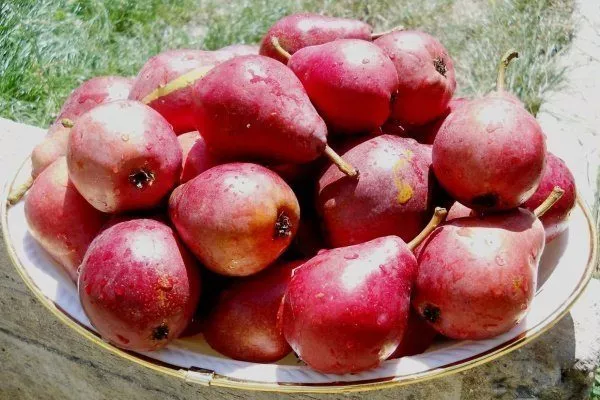
Advantages and disadvantages of the Starkrimson pear
All plant varieties have their positive and negative aspects, and Starcrimson is no exception. The variety's advantages include:
- tasty, healthy and beautiful fruits;
- high drought and frost resistance;
- simplicity and unpretentiousness in planting and care;
- decorativeness;
- high level of productivity;
- resistance to pests and parasites.
The disadvantages of Starcrimson are as follows:
- large tree growth;
- poor transport and storage tolerance;
- shedding of overripe fruits;
- begins to bear fruit at least 4 years after the tree is planted.
Preparing for landing
Starcrimson prefers loose, moist, clayey soil, so before planting, find a location protected from sun and wind. You should also prepare the soil for the upcoming planting and mulch the soil—applying organic and inorganic fertilizers around the tree trunk will help control weeds. You can also insulate the underside of the tree by covering it with a special material.
- ✓ The optimal soil pH should be in the range of 6.0-6.5 to ensure better absorption of nutrients.
- ✓ The depth of groundwater should not exceed 2 meters to avoid rotting of the root system.
Carry out work in a timely manner, then the tree will spend its energy on forming a crop, and not fighting parasites or droughts.
Decide on a timeframe. Planting times vary depending on the region of the country you live in. In southern and northern regions, spring is considered optimal. Trees planted in the spring have time to strengthen and gain strength over the summer, ensuring they can survive the coming winter without problems. However, some gardeners choose to plant in the fall.
If planting occurs in spring, it is best to do so between April 20 and 30, and in autumn – no later than mid-October.
Prepare the site. Gardeners recommend doing all work in the fall, even if you end up planting the tree in the spring, because the soil in the tree holes will settle and you won't have to worry about it settling later.
Subsidence is detrimental to trees. When the root collar closes, it can lead to the tree's death. Therefore, when digging a hole, it's important to choose the optimal depth (45-55 cm) and width (100 cm).
Step-by-step planting instructions
Let's consider the simplest method of planting a pear tree, among all existing ones:
- Prepare the seedling by trimming all thick and strong roots by 10-12 cm and the top. The planting material should look like a stick, free of branches and leaves, about 75-85 cm tall. Before planting, place the seedling in a bucket of water for an hour.
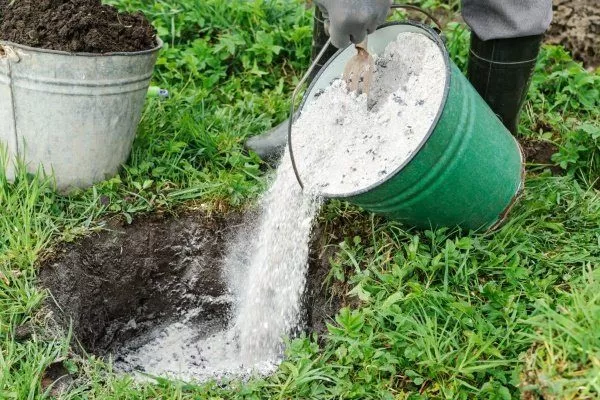
- Mix equal parts soil from the hole with ash and water until it reaches a thick, creamy consistency. Soak the seedling's roots in this mixture.
- Loosen the soil and place 10 raw eggs in it, then fill it with a diluted mixture of soil and ash, and sprinkle dry soil on top. Then plant the pear seedling.
- Fill the hole with the remaining soil and place 10 more eggs around the perimeter—they will provide nutrition for the root system. After completing all these steps, mulch the circle of soil around the table with pine needles, compost, peat, and sawdust.
Watering and fertilization
The watering guidelines for "Starkrimson" are as follows: apply up to 30 liters of water per square meter under a mature tree. After watering, thoroughly loosen the soil around the planting area, but not too deeply. The tree will not need watering if there was heavy rainfall the day before.
To ensure fruit production, the tree also needs to be thoroughly fertilized. Experienced gardeners use a well-balanced system for this: mixing organic and inorganic fertilizers—potassium, phosphate, nitrogen, and saltpeter (used during flowering). To speed up fruiting, use phosphorus mixed with ash.
Certain types of fertilizers are used depending on the time of year:
- If the tree is planted in the spring, it should be fertilized for the first time in the second year. If planted in the fall, the fertilization process occurs the following spring. In the spring, apply nitrogen fertilizer to improve the quality and quantity of blossoms and fruits.
- In the fall, the tree needs to be fertilized to replenish nutrients and prepare it for the cold weather. Fertilizer is applied to the area around the trunk.
- Use fertilizers containing phosphorus and calcium during the summer feeding period to ensure the tree looks good.
| Fertilizer type | Impact on yield | Period of contribution |
|---|---|---|
| Nitrogen | Increases the number of inflorescences | Spring |
| Phosphorus | Improves fruit quality | Summer |
| Potassium | Increases resistance to diseases | Autumn |
Drought resistance and winter hardiness
It's okay if a gardener can't water the tree regularly—Starcrimson is drought-resistant, so it can easily tolerate periods without water. However, if you can water it frequently, it will reward you with a more bountiful harvest. This tree can also cope well with colder seasons.
Tree pruning
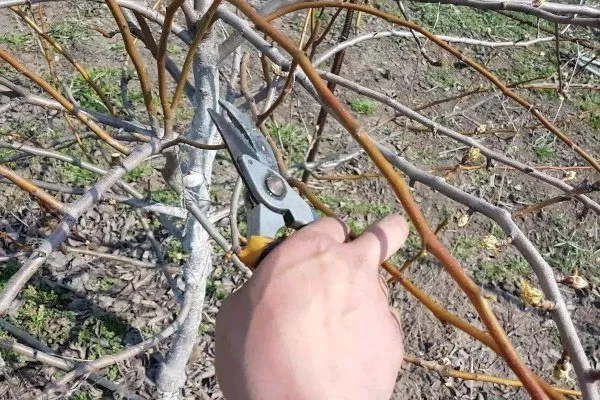
Pruning is necessary to shape and thin out a tree's crown. Regular pruning prevents the tree from wasting all its energy on young branches, delivering all its juices and nutrients to the fruit, which has a positive effect on both the quality and quantity of the harvest.
Timely spring pruning will ensure a good fall harvest. Spring pruning follows this pattern:
- The tree crown is thinned out so that the sun's rays can warm the trunk and fruit-bearing branches without interference.
- The trunk is shortened by about 1/4 so that the tree does not grow upward.
- All cuts are treated with a special agent.
Seedlings are pruned from the first year of life, and in the second year, care is taken to ensure that the height does not exceed 50 cm. Branches are trimmed using pruning shears or a garden saw.
There are two methods of pruning a tree:
- The first method involves pruning branches that have too many fruits growing on them, which ultimately threatens to cause the branches to break off;
- With the second method, all incorrectly growing branches are cut off to the very base, and those branches that do not grow horizontally to the ground are considered incorrect.
Work begins when warm weather sets in.
Summer pruning involves pinching young shoots (using fingernails to pinch off unwanted shoots at the top) – this removes the entire top down to the hardened area, preventing the shoots from growing longer. This process begins in June and continues throughout the season, as branch growth is only halted, not completely stopped.
The autumn pruning period begins in late August and continues until mid-September. The autumn pruning process follows this pattern:
- Remove all diseased and dead branches, as they may break and damage healthy branches.
- Get rid of branches that grow at a 90 degree angle.
- Remove only partial remaining incorrectly growing plants (select only those branches that will interfere with fruit-bearing branches).
- Don't leave stumps when removing a branch completely. Cut the branch at its base.
- Burn pruned branches to kill pathogenic bacteria.
Diseases and pests
Even though pears are disease-resistant, they can still be attacked by certain types of pests. These include:
- diurnal butterflies;
- bedbugs;
- apple blossom weevil;
- gall mite;
- codling moths;
- itching;
- pear mite;
Starcrimson can also become infected with scab. Symptoms include:
- the appearance of dark green spots, which over time change their color to brown;
- the leaves turn yellow and fall off.
The fungus infects the bark, stems, petioles, and flowers. To eliminate this disease, remove and destroy any damaged fruit.
Fruit rot is a disease that manifests itself through the appearance of dark spots that later turn brown, and the fruit changes color to a lighter one, after which the tree begins to dry out.
Use Fufanon, BI-58, Karbofos, and Nitrafen to control pests and parasites. For prevention, use Bordeaux mixture during bud formation, and copper-containing preparations during active shoot growth. To protect the tree and its root system, use calcium-containing fertilizers. Apply before and after flowering.
Transportability and storage
'Starkrimson' doesn't transport well. Unripe fruits can last up to a month, while ripe ones, even under the best conditions, only last a week. Because of this, this variety is not recommended for commercial sale; it's best suited for the needs of the home gardener and their family.
To keep pears in the best possible condition, store them in a cool, ventilated place on dry sawdust.
Starcrimson is considered a popular pear variety, which has proven itself with its characteristics and delicious, attractive fruit. Many gardeners appreciate all the advantages of this variety, as well as its decorative qualities. Planting this pear variety requires no special knowledge, so even a beginner can handle it.