
The Chinese pear is a relatively new fruit to the Russian market, attracting consumers with its pleasant taste and unusual shape. The round, sweet, and crunchy fruits are not cheap. But it turns out you can grow these exotic fruits yourself—hybrids of this variety can bear fruit in temperate climates.
Description of Chinese pear
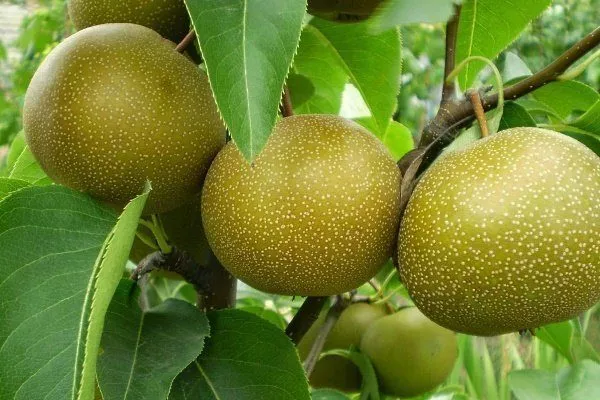
The Chinese pear has many names—sellers often call it Japanese, sand, Taiwanese, or Neshi. It is known for certain that this variety was developed from the Yamanashi, a wild pear. The fruits of this ancestor, although large, were very sour and hard. Breeders, taking the Yamanashi's high adaptability and frost resistance, imbued them into a new variety—the Neshi.
The Chinese pear, compared to its wild ancestor, boasts superior flavor. Today, the Nashi is popular not only among gardeners in China and Japan; this variety is grown in many countries. The key to growing it is a suitable climate.
In Russia, favorable conditions for the Nashi pear are found only in the south. However, its hybrids, which are more frost-resistant, can bear fruit in the temperate zone. For example, a hybrid of the Chinese and Far Eastern pears can withstand temperatures down to -35°C.
The flavor of nashi pears is considered unique. These pears are excellent for culinary purposes. They are used to make desserts, preserves, and are added to salads and baked goods.
Tree and fruits
Many varieties have been developed from the wild pear, inheriting its frost resistance. While each variety has many differences, it shares a number of common characteristics:
- Great height of the tree. Subspecies of Chinese pear reach heights of 4-10 meters. Trees of the classic variety are tall. However, hybrids—the ones grown in Russia—are much shorter.
- Self-fertility. Almost all Nashi subspecies are self-fertile and do not require pollinators. The lack of pollinating pears does not affect yield. However, it does affect the appearance of the fruit—without pollinators, they are smaller and uneven.
- Frost resistance. There are hybrids that can withstand low temperatures, while others can only survive the winter if they are insulated – wrapped in straw or surrounded by spruce branches.
- Life timeA tree lives for about half a century. The lifespan of grafted trees is influenced by the rootstock: with dwarf rootstocks, a tree lives up to 20 years, while with vigorous rootstocks, it lives 50 years.
- Productivity. While the tree isn't bearing fruit, it grows rapidly upward. Once the fruit appears, growth slows, and the yield gradually increases. By the fifth year, the tree produces up to 80 kg of fruit, and by the 30th, up to 2 centners. Yields of up to 0.5 tons per tree have been recorded.
- Disease resistance. All varieties are highly resistant to scab, rot, parasites, and infections.
- Fruiting cyclicity. The tree is harvested annually. If pruning is improper, the plant loses vigor and productivity.
The nashi fruit has an unusual shape, appearing like a cross between an apple and a pear. Characteristics of the Chinese pear:
- The juicy and fragrant flesh has a magnificent flavor, combining sweetness and acidity. The aftertaste reveals spicy notes.
- The fruits have thin skin.
- Unripe nashi are sour and inedible. They are even dangerous to the body, as they contain high levels of organic acids.
- The color, depending on the variety, ranges from pale green to bronze.
- Average size – 4 cm in diameter.
- Weight – 120-300 g.
- Versatility – the fruit is delicious fresh and processed.
In stores, nashi are usually sold in paper bags—they're used to keep the unripe fruit ripe. They're stored at room temperature, and once ripened, in the refrigerator.
Neshi fruits should not be eaten on an empty stomach. They are also not recommended to be combined with meat or dairy dishes.
Composition and caloric content
Nashi fruits have a typical calorie content for pears – 42 kcal per 100 g. These fruits do not contain starchy carbohydrates, making them suitable for dietary use. It is recommended to eat one Nashi fruit three times a day.
100 g of fresh nashi fruit contains:
- water – 45 g;
- dietary fiber – 2 g;
- ash – 0.2 g;
- vitamins and minerals.
Chinese pears are rich in zinc, selenium, calcium, manganese, copper, and magnesium. They are especially rich in phosphorus and potassium. In fact, this fruit contains five times more potassium than all other micronutrients combined. They are also rich in choline and vitamins C and K.
Advantages and disadvantages of the variety
European pear varieties are undoubtedly tastier, juicier, and more beautiful than their Chinese counterparts. But the latter have many advantages that are important for our climate:
- resistance to weather disasters;
- high immunity;
- unpretentiousness to care and growing conditions;
- high and stable yields;
- frost resistance is much higher than that of European varieties;
- demand in cooking - hard varieties are good in salads, sauces and side dishes, they are stewed, baked, canned;
- high capacity for vegetative reproduction.
Disadvantages of the variety:
- not keeping well enough;
- The skin of ripe pears is easily damaged.
Varieties of the variety
Breeders have developed dozens of varieties of Chinese pear. The most winter-hardy and undemanding varieties are grown in Russia. Gardeners choose Nashi varieties, which are undemanding to soil conditions, easily survive harsh winters, and are resistant to drought and pests. Let's take a closer look at the varieties most popular with Russian gardeners.
For more information on popular pear varieties in our region, please visit here.
| Name | Frost resistance | Ripening period | Fruit weight |
|---|---|---|---|
| Scythe | High | Summer | 130-160 g |
| Hosu | High | Autumn | 150-200 g |
| Olympic | High | Autumn | 160-200 g |
| Morning freshness | Average | Summer | 100-150 g |
| Crystal | High | Autumn | 160-220 g |
Scythe
Kosui is a summer variety that bears fruit in the second half of July. Advantages of the Kosui variety:
- frost-resistant;
- resistant to diseases and pests;
- early maturity – ripens earlier than all other Chinese varieties.
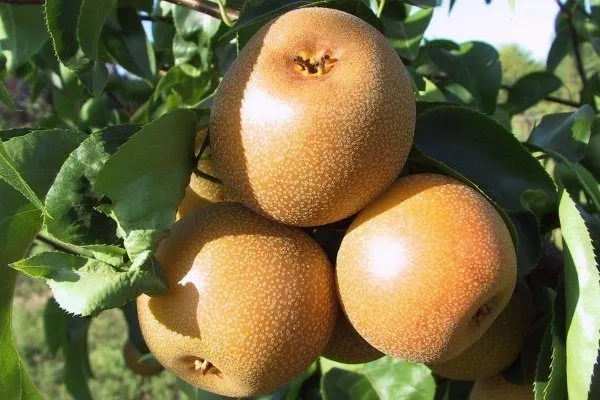
The fruits are medium-sized, weighing up to 160 g. The color is a rich bronze. The flesh is juicy—an ideal summer fruit.
Hosu
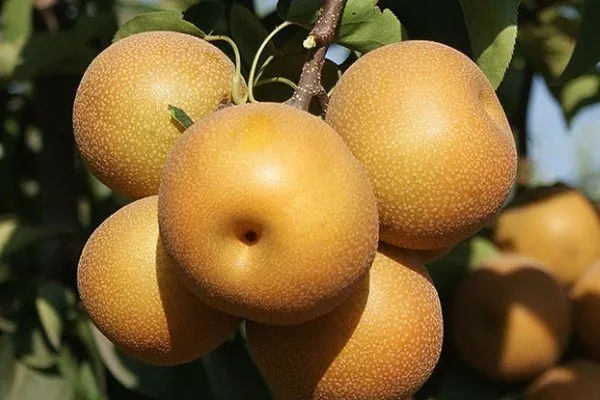
Hosui is a self-pollinating variety, but the presence of other Chinese pear varieties nearby increases yield. The tree begins to bear fruit in its second or third year of planting. Although considered a fall-bearing variety, harvesting begins in the second half of August. The fruits ripen unevenly, so harvesting is done in several stages. The harvest ends in mid-September.
Advantages of the Hosu variety:
- pest resistance;
- frost resistance;
- large-fruited;
- early maturity – pears appear in the 2-3 year after planting;
- Excellent taste, juicy and sweet pulp, contains up to 12% sugar.
The fruits weigh 160-200 g, but can reach 300 g. The color is a rich bronze-brown. The flesh is dense—cutting the fruit with a knife requires some force.
Olympic
Olimpic is an autumn variety with excellent characteristics. Its advantages:
- early maturity – the tree bears fruit already in the 2nd year of planting;
- pest resistance;
- frost resistance;
- not afraid of diseases, including scab and powdery mildew;
- quickly adapts to climate and soil;
- Excellent taste characteristics, pleasant fruity aroma.
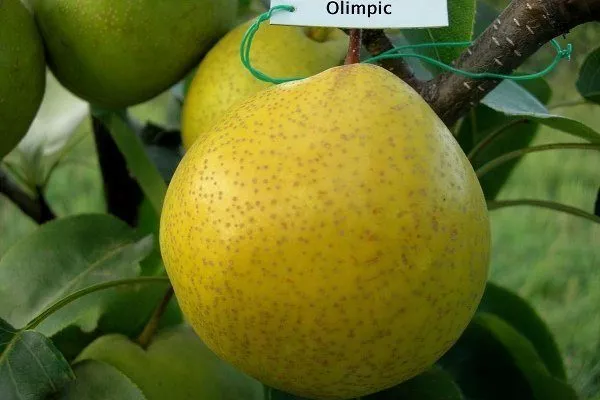
The Olympic pear is also known as the Big Korean Pear or the Korean Giant. The fruits are round and a pleasant golden hue. The entire surface is covered with fine gray speckles. Each fruit weighs 160-200 g. The flavor is unique, tartly sweet, and the flesh is juicy. These pears are delicious fresh, but they also make excellent storage pears, as they keep well. Harvest is in September.
Morning freshness
This summer variety is popular in Russia's temperate latitudes. It is partially self-fertile; to increase yield, it is recommended to plant nearby Chinese pear varieties such as Bronze, Eastern Golden, and Kieffer.
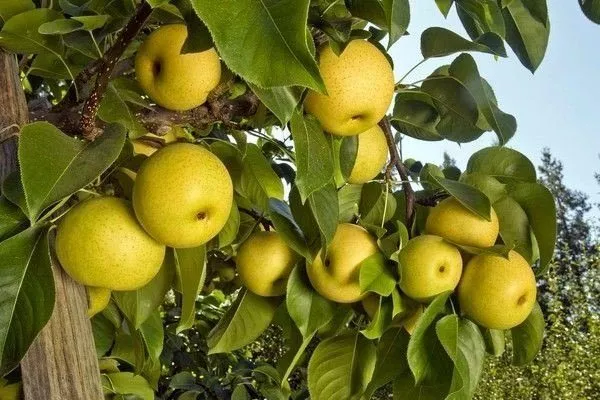
The variety tolerates frost well and has strong immunity to bacterial and fungal diseases. The fruits are small, weighing 100-150 g, with bright green skin covered with gray speckles.
Crystal
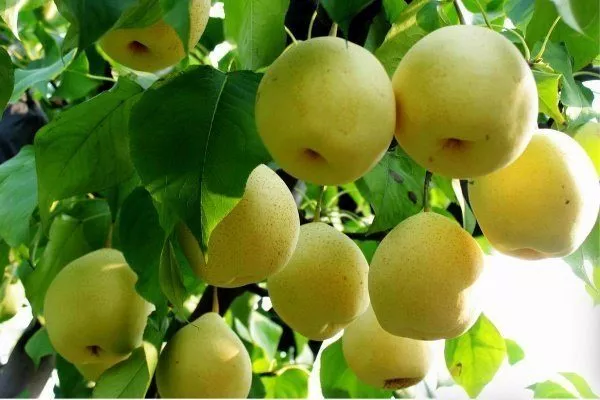
An early-bearing autumn variety. The tree produces high yields as early as 2-3 years. It is resistant to fungal infections. Fruits weigh 160-220 g and are light yellow. A distinctive feature is their low calorie content. They have juicy yet firm flesh and a delicate, fruity flavor.
Comparison table of popular Nashi varieties
| Variety | Fruiting begins | Average fruit weight, g | Harvest time | Shelf life |
| Scythe | for 2 years | 130-160 | second half of July – beginning of August | until September |
| Hosu | for 2-3 years | 150-200 | mid-August – second ten days of September | until November-December |
| Olympic | for 2 years | 160-200 | mid-September | until January |
| Morning freshness | in 3-4 years | 100-150 | mid-August | 2-3 weeks |
| Crystal | for the 3rd year | 160 | September | until December |
Landing features
Caring for Chinese pears isn't much different from caring for European varieties. The difference in cultivation techniques is due to the hybrid's shape—for example, columnar varieties require more fertilizing and watering. These varieties have a less developed root system, with roots located closer to the surface than those of standard pears.
Timing, location and climate
In the middle zone, Nashi are planted in two ways:
- Seedlings. Trees planted this way have a longer lifespan.
- By vaccination. The advantage of scions is early fruiting. But given the early fruiting of all "Chinese" varieties, this advantage is not taken into account.
Soil requirements:
- fertility;
- looseness;
- non-clay content - sand is added to soils that are too clayey;
- normal acidity – excess is compensated by adding limestone.
- ✓ pH level should be between 6.0-6.5 for optimal growth.
- ✓ The groundwater depth must be at least 2.5 m to prevent root rot.
Planting times depend on the climate. Chinese pears can be planted in both spring and fall. The key is warm weather. In temperate climates, for example, planting in fall is risky—the seedling may not survive the harsh winter.
Conditions for planting seedlings:
- Daytime temperatures should remain at +10°C for some time.
- Planting is done before the buds swell and intensive sap flow begins.
Although some Nashi hybrids can withstand temperatures down to -30°C, they cannot be planted in northern regions. Firstly, the cold there is too prolonged for Chinese pears, and secondly, they simply don't have time to ripen during the short summer.
Planting technology
The future yield of a tree depends largely on the characteristics of the site. The planting site should:
- be located on the south side;
- be well lit;
- be on a hill.
If the above conditions are not met, the yield will decline, and the fruits themselves will lose their flavor. They will also become less attractive, turning pale.
Before planting, the seedling should be soaked in water for 1-2 days. If there are any damaged areas on the tree, remove them with a sharp tool.
The procedure for planting a seedling in the ground:
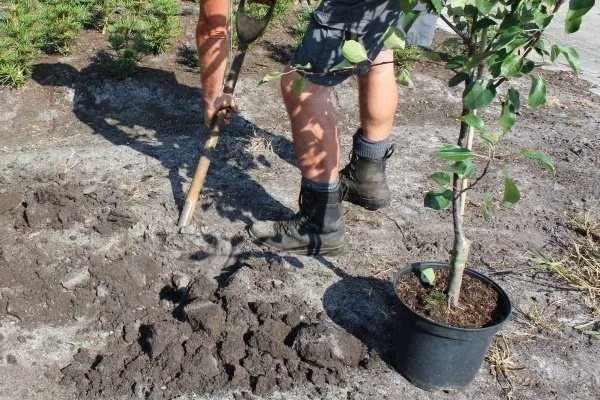
- In a site suitable for growing Chinese pear (sunny, elevated, on the south side, etc.), dig a hole 60 cm in diameter and depth.
- The holes are prepared in the fall. Fertilizer is added:
- humus – 6 kg;
- superphosphate – 60 g;
- potassium chloride – 15 g.
- Add soil on top of the fertilizer. If the soil is rich in elements such as copper, phosphorus, and nitrogen, mineral supplements may not be necessary.
- In the spring, the soil is dug out of the hole and a mound is formed at the bottom. A stake is placed to support the tree.
- Pre-soaked seedlings are placed in the hole, spreading the roots along the mound, and soil is added on top. The tree should be planted so that its root collar is 5 cm above the ground. After compacting the soil, the seedling is tied to a support stake.
- Having formed a depression near the trunk, water is poured into it – approximately 10 liters.
Many gardeners graft Chinese pear rather than plant it; Ussuri pear, Birch-leaved pear, or common rowan can serve as a base.
It is better to graft a pear onto a rootstock of its own species - then the scion will take root better and faster.
One-year-old seedlings are typically planted. However, experienced gardeners recommend buying older seedlings—those 2-3 years old. They take root just as well as one-year-olds and will bear fruit faster.
The spacing between adjacent seedlings depends on the rootstock. If the graft is made on a vigorous rootstock, then the distance between the holes is about 3 m. If the rootstock is dwarf pear trees, then the distance is reduced to 1.5 m. Columnar pears are planted at intervals of 1 m or even less.
Caring for a pear tree
A common feature of all varieties of Chinese pears is their ease of care. The main thing is to water and fertilize the trees regularly, and also to provide insulation if severe frosts are possible in the region.
Top dressing
Fertilizers required by Chinese pear:
- Nitrogen. Pears don't require a lot of nitrogen. To replenish the tree's nitrogen needs, a small amount of ammonium nitrate is added to the soil in the spring—20 g per square meter. This is done annually for the first 3-4 years of the pear tree's life. Subsequently, nitrogen is added as needed. Signs of nitrogen deficiency:
- the tree is lagging behind in growth;
- the leaves are lighter than usual;
- depressed appearance;
- crushing leaves and fruits.
- Organic fertilizers. These include compost and humus. They are added in the fall, once every 3-5 years.
- Potassium and phosphorus. These elements are essential for the pear tree, as they are used up during ripening. A mixture of phosphorus and potassium is applied at rates of 40 and 20 grams, respectively, if the tree is young. A mature tree requires more fertilizer: 60 grams of phosphorus and 20 grams of potassium. It is not recommended to apply fertilizer in the trunk circle. It is better to dig a trench around the trunk and place the phosphorus-potassium mixture in it. Add half a bucket of compost and cover with a layer of soil.
During the period of fruit appearance, trees are fed with wood ash - 1-3 glasses, adding it when loosening the tree trunk circles.
Watering
Methods of watering Chinese pear:
- Sprinkling. This is the best watering method for pear trees. With this system, water is delivered to the tree through a spray nozzle with multiple holes.
- Normal watering. A 15 cm wide trench is dug near the tree trunk circle. Water is carefully poured into it.
| Irrigation method | Efficiency | Water consumption |
|---|---|---|
| Sprinkling | High | 30-40 l/tree |
| Regular watering | Average | 20-30 l/tree |
Pear trees are watered several times—in spring and summer, as needed. During dry periods, water more frequently. After watering, the soil is loosened to ensure oxygen reaches the roots. When watering pears, the recommended watering rate is three buckets per square meter of the tree's trunk area.
Rejuvenation and pruning
As trees age, pruning becomes less tolerant, but it can help extend their lifespan. Pruning is done before warmer weather sets in—the key is to prune the tree before the buds swell.
Principles of rejuvenating pruning of Chinese pear:
- Rejuvenation involves thinning the crown. Excess branches—those that are unhealthy, not bearing fruit, or those with mechanical or other damage—are removed.
- Once thinning is complete, remove any contour shoots. Also remove any shoots that grow parallel to the crown or form an acute angle with it.
- After removing the branches, the cuts are treated with garden pitch. This is done to prevent infection.
It's prohibited to remove more than a third of the branches in a single pruning session. If all excess shoots cannot be removed before the sap begins to flow, rejuvenation pruning should be continued the following spring.
Columnar varieties require virtually no pruning. The main thing is to keep the crown from retaining its shape. Other Nashi varieties require minimal pruning:
- In the tree's second year, all weakened branches are removed. The four strongest are left, with equal spacing between them.
- In a mature tree, only small and damaged branches are removed, as well as branches growing inward into the crown.
Spring pruning is carried out at temperatures no lower than +5°C. Winter pruning is carried out at -15°C.
Diseases and pest control
The Chinese pear is resistant to pests and diseases. It's resistant to scab, fungus, and rust. The only insect that can harm it is the blossom beetle. Thanks to this resilience, the Nashi doesn't require regular chemical treatment.
To prevent damage to trees by the blossom beetle, preventative measures are taken:
- clear the trunks of old and damaged bark;
- whitewash the tree trunks;
- burn fallen leaves;
- They set sticky traps on the trunks.
Beetles are destroyed with insecticides, such as Intavir or Kinmix.
Nash trees should not be planted near junipers, as they can occasionally become infected with fungus. Fungal spores can travel 2 km or more.
Harvesting, storage and transportability
The harvest is carried out taking into account the characteristics of the variety. Early varieties ripen in mid-July, late varieties in mid-September. Nashi fruits cling firmly to the branches, so picking them requires effort and extreme care. You can tell when the fruit is ready by its color. Depending on the variety, the pears turn yellow or bronze. The skin should be firm and clean.
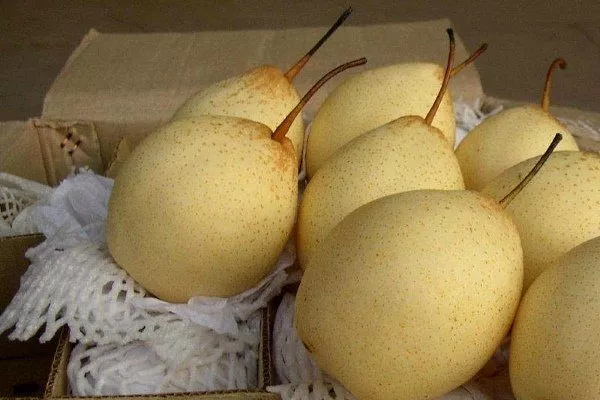
The harvested pears require careful handling. Each pear is wrapped in paper and stacked in a maximum of three layers. The pears are stored in the refrigerator in the same manner, each one wrapped individually. Nashi varieties differ in their shelf life. For example, Kosa is recommended to be eaten early, while Olympic can be stored until the New Year without losing its flavor or aroma.
Nashi pears, unlike regular pears, retain their firmness for a long time. However, they are quite sensitive to bumps and impacts—the skin discolors at the site of the impact, and the fruit loses its marketable appearance. This is why each pear is individually packaged.
Benefits and contraindications
Nutritionists value the Chinese pear as a weight-loss food. Nashi pears are the only pear variety that can be combined with fermented milk products.
Nashi fruits contain a lot of:
- ascorbic acid – to improve immunity;
- essential oils – for a diuretic effect;
- antioxidants – to prevent aging;
- vitamin PP – to improve blood circulation and strengthen blood vessels;
- B vitamins – to strengthen the nervous system;
- vitamins E and K – to balance hormonal levels, prevent atherosclerosis and skin aging.
Chinese pears are recommended for:
- diseases of the gastrointestinal tract;
- tuberculosis;
- constipation;
- liver diseases;
- consequences of alcohol intoxication;
- cough, bronchitis, throat diseases;
- diabetes.
Benefits of eating nashi fruits:
- help digest food;
- cleanse the intestines;
- prevent the formation of stones and blood clots;
- improve the functioning of the heart muscle;
- normalize blood pressure;
- strengthen bone tissue;
- lower cholesterol.
Nashi pears are effective as a cleansing agent for smoking and junk food abuse.
Despite its unusual commercial characteristics, the Chinese pear has every chance of becoming one of the most popular varieties in central Russia. The Nashi pear attracts gardeners with its high adaptability and low maintenance, as well as its unique flavor and aroma.