
The Kyrgyz Winter Pear is a fast-growing winter variety, invaluable for regions with challenging climates. This hardy plant easily adapts to the local climate, and its fruit boasts high commercial quality.
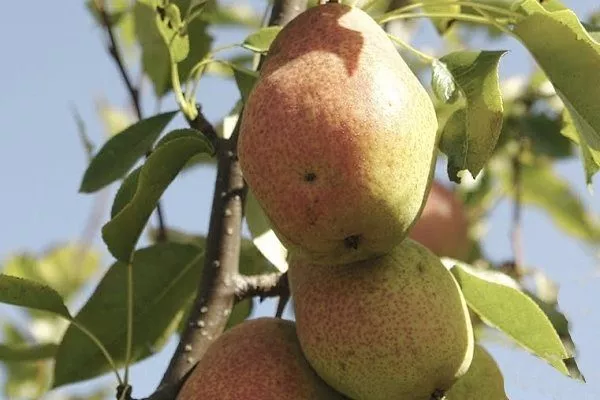
The variety is frost-resistant and resistant to scab.
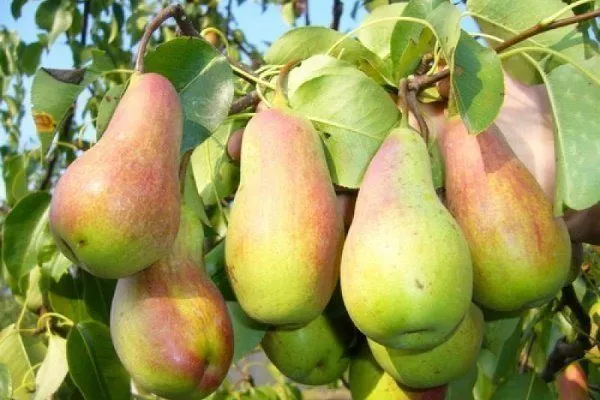
The Kyrgyz winter pear has ovoid or lemon-shaped fruits.
History of the variety's development
The variety was developed in Kyrgyzstan. Breeders, when developing the Kyrgyz Winter Pear, sought to create a variety that would bear fruit in the most adverse conditions. Two varieties—Bere Winter and Lesnaya Krasavitsa—served as the starting point for the new pear.
Find out more about the best varieties of pears from another article on our website.
Description and characteristics of the Kyrgyz winter pear
This winter variety is ready for harvest only in the first ten days of October. Once ripe, the pears do not fall over, clinging firmly to the branches.
Description of the variety:
- Tree. This medium-sized tree has a dense, pyramidal crown. The crown responds well to flattening. Fruiting occurs primarily in the ring-shaped crowns.
- Fruit. Pears are shaped like eggs or lemons. They are greenish-yellow when picked, and golden-yellow when fully ripe. A crimson blush on the sides gives the fruit an aesthetically pleasing, decorative appearance. The creamy, yellowish flesh has a dense, coarse-grained texture. The flavor is sweet and slightly tart.
The main characteristics of the Kyrgyz Winter variety are in Table 1.
Table 1
| Characteristics | Parameters |
| Yield, c/ha | 500-600 |
| Precocity | 3-4 years after planting |
| Fruit weight, g | 220-250 |
| Disease resistance | scab, thermal burns, powdery mildew and bacterial cancer |
| Transportability | good |
| Winter hardiness | high |
| Suitable pollinators | Emerald, Talgar beauty, Golden, the highlight of Crimea |
How to choose the right seedling?
It is recommended to purchase seedlings for planting in fruit tree nurseries or in stores specializing in the sale of planting materials.
To ensure a healthy, full-grown tree grows in your garden in a few years, you need to buy healthy, high-quality seedlings. When choosing them, pay attention to:
- External characteristics – the seedling must be absolutely fresh, without the slightest sign of wilting.
- Product marking – the seedling must have a label indicating the variety and growing zone.
- Root system – It should have 5 main roots and 3 additional roots. The minimum root length is 30 cm. The roots should be light in color, not rotten, and free of growths.
- Age – the best option is considered to be 2-year-old seedlings.
- ✓ Check the seedling's resistance to sudden temperature changes typical for your region.
- ✓ Make sure there is a certificate confirming the variety and growing zone, especially important for regions with harsh winters.
Preparation and planting
To create optimal conditions for the Kyrgyz winter pear to thrive and bear fruit, it's essential to follow proper agricultural practices at every stage of the tree's life. This begins with properly selecting and preparing the site.
Choosing a landing site
Requirements for a site for planting Kyrgyz winter pear seedlings:
- Good lighting. This variety can grow in semi-shaded areas, but will not produce fruit.
- Elevation. The tree grows best in areas with deep groundwater, which prevents root rot. Pear roots can reach up to 8 meters in length, so it's recommended to grow it on slopes and elevated areas.
- Soil with a loamy underlayer beneath. Pears do not grow well in sandy or heavy soils.
- Wind protection. It's best to have a tree stand, wall, or other barrier on the side facing the prevailing winds.
- The recommended planting direction is west and southwest.
Before planting a pear, check the soil for acidity, and if it exceeds the norm, apply lime.
Planting dates
There are two options for planting pear seedlings: spring and fall. The choice of planting time depends on both the gardener's personal preference and objective factors.
In harsh climates, most gardeners choose spring for planting any fruit trees. In regions with short summers, winter arrives so early that a seedling planted in the fall may simply not have time to take root before the cold weather sets in.
Benefits of spring planting:
- The planting hole is prepared in the fall, and when the time comes to plant the seedling, it is in ideal condition to receive the young tree.
- The soil is filled with moisture after the snow melts, which creates optimal comfort for the seedlings.
- During the spring and summer, the young tree gains strength in preparation for winter. During this time, the gardener has the opportunity to adjust the growing and development conditions.
Recommended spring planting dates:
- In areas with risky farming, it is not recommended to plant anything before May;
- in the Volga region, seedlings are planted in the first half of April – before the onset of heat;
- in the middle zone – in the second half of April or the first half of May.
The downside of spring planting is that the seedling must simultaneously take root and begin its vegetative cycle. The exact timing of planting depends on the specific conditions of the region.
Fall planting is practiced in southern regions, where a warm autumn gives way to a mild winter. The advantage of fall planting over spring planting in warmer regions is that it eliminates the risk of seedlings burning before they have time to take root.
Autumn planting dates:
- in the southern regions – the first half of October;
- in the Moscow region – the second half of September – the beginning of October;
- in regions with more extreme climates – until October.
If you receive seedlings in late autumn, it's best to preserve them until spring. To do this, dig a trench, place the seedlings in it at an angle, cover with soil, then peat and fallen leaves, and cover with a non-woven cloth. In this shelter, the seedlings will survive the harshest frosts, and in the spring, they can be transplanted to their permanent location.
Site preparation
To ensure seedlings quickly establish roots in their new location, they are provided with the most comfortable conditions possible. Site preparation steps:
- Pit. If planting in the fall, prepare the hole a month before planting the seedling; if planting in the spring, prepare the hole in the fall. The hole depth is determined by the age of the seedlings. For one-year-olds, dig a hole 0.5 m deep, and for two-year-olds, 0.7 m. The hole diameter is chosen based on the spread of the roots—they should be comfortable in the hole.
- Support. The seedling needs a sturdy support that will protect it from the sun—it's not for nothing that it's placed on the south side—and from the wind. A wooden stake serves as a support. Its height above ground level is 0.5 m.
- Fertilizers. Add superphosphate and ammonium nitrate to the bottom of the hole. Add 2 kg of superphosphate and ammonium nitrate in total, or 1 kg if using granular fertilizer. Add 10 kg of organic fertilizer. If the soil is sandy, add 1/2 bucket of peat. Top the fertilizer with fertile soil—be sure the seedling's roots don't come into contact with the fertilizer.
Avoid applying more fertilizer than necessary to avoid burning the seedling's roots. This can result in the death of the young tree.
Step-by-step planting instructions
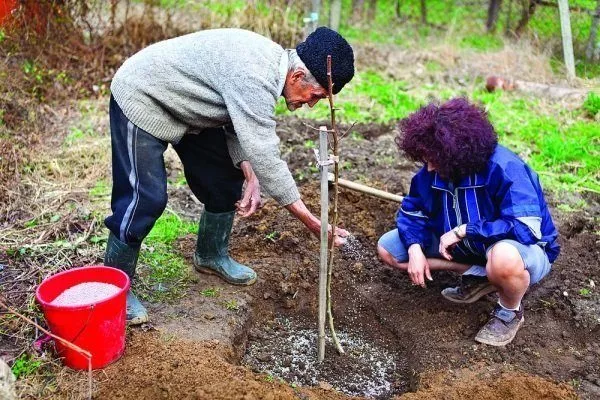
It's best to plant seedlings with an assistant. The second person is needed to hold the tree strictly upright during the process.
Step-by-step planting of a pear tree:
- After trimming the main roots with pruning shears, they are immersed in a liquid clay slurry. A few minutes of soaking is enough to soak the roots in the solution.
- A mound is made in the center of the hole, and a seedling is placed in it, on the north side of the support.
- Distribute the roots evenly across the soil mound. The roots should not bend or break; they should point downward.
- The roots are covered with soil and gently compacted. Each time, the seedling is shaken, keeping its vertical position. Shaking helps eliminate any air pockets between the roots. The grafting point should be 4 cm above the ground.
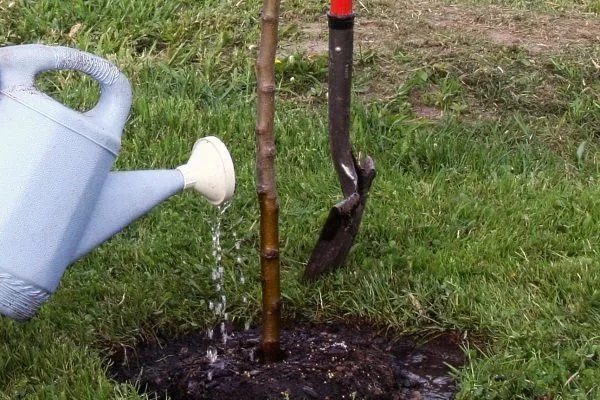
- The planted seedling is watered. Water is applied until the soil is completely saturated. As it becomes moist, the tree lowers, bringing the root collar level with the soil.
- The seedling is pruned to 80 cm to form a crown around a well-ripened bud. Any shoots growing up to 50 cm are removed.
- The seedling is tied to a support with a soft, durable material. Mulch is added to the area around the trunk to help retain moisture in the soil.
Tree care
To ensure the Kyrgyz winter pear continues to delight its owners with abundant harvests, it is necessary to carry out a series of seasonal tasks in a timely manner:
- take care of the soil;
- apply fertilizers;
- shape the crown and carry out sanitary pruning;
- spray the tree with insecticides and fungicides, carry out a set of preventive measures;
- prepare trees for winter.
Soil care
Simple agricultural practices can significantly impact a tree's quality of life. The following soil care measures are recommended:
- Loosening. In the morning, after watering, the soil is loosened to allow oxygen to reach the roots. While loosening the soil, weeds are removed from the area around the tree trunk.
- Mulching. To retain moisture, mulch the soil around the trunk. Suitable mulches include sawdust and peat. Apply a layer up to 10 cm thick.
Features of feeding the Kyrgyz winter pear
You can't expect a large pear harvest without fertilizing. A deficiency of even one vital element—potassium, nitrogen, or phosphorus—immediately affects the tree's health.
Signs of nutrient deficiency:
- Potassium – low growth of shoots per year.
- Nitrogen – yellowing of leaves, shedding of set fruits, cessation of tree growth.
- Phosphorus – inactive formation of fruit buds and, as a consequence, absence of fruits.
Young trees only need nitrogen fertilizers, and seedlings do not need any feeding for two years after planting.
- First year: do not apply fertilizer to avoid burning the roots.
- Second year: Start with nitrogen fertilizer in early spring to stimulate growth.
- Third year and beyond: apply complex fertilizers according to Table 3, starting in spring.
70% of the total annual fertilizer volume is applied in the spring. Fertilizer application times and rates for pear trees are listed in Table 2.
Table 2
| Fertilizer application time | Fertilizer | Note |
| Spring, swelling of buds | Urea/saltpeter/chicken manure. | To improve root nutrition, apply 30 g of urea per 1 sq. m, diluted 1:50. Nitrate is diluted 600 g per 10 l. Manure is diluted 1:20. |
| Spring, after flowering | Mineral fertilizer "Nitroammophoska" (nitrogen + phosphorus + potassium). | To speed up vegetation (60 g per 3 buckets). |
| Summer | At the end of June, foliar treatment with nitrogen-containing fertilizers, repeat after a month, and after 2 weeks, add phosphorus-potassium supplements. | To improve the quality of fruits. |
| Autumn | In the first half of September – spraying with a urea solution, applying liquid mineral fertilizers, and fertilizing with ash. | An example of a solution: potassium chloride (1 tbsp.), superphosphate (2 tbsp.). The ash application rate is 130 g per 1 sq. m. |
Fertilizer rates for feeding pears, taking into account the age of the tree, are in Table 3.
Table 3
| Age of the tree | Organics, kg | Nitrogen, g | Phosphorus, g | Potassium, g |
| Young, before fruiting | — | 6 | — | — |
| Young, beginning to bear fruit | 1 | 9 | 6 | 9 |
| Mature, full fruiting | 1.5 | 12 | 9 | 12 |
| Mature, in years with a rich harvest | 2 | 15 | 12 | 15 |
Spraying
Successful pest and disease control depends on the timeliness of treatment and the effectiveness of the products. The first spraying is done early in the spring, along with fertilizing the bare tree. If the tree's buds have already swollen, the urea solution can burn them, so it is recommended to use biological products such as Akarin, Fitoverm, and others.
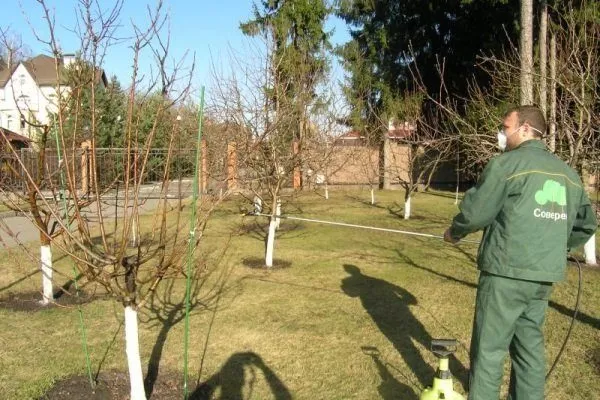
Autumn spraying is aimed at controlling larvae hiding in the soil and tree bark. The plant itself, as well as the soil around the trunk, is sprayed with Nitrofen and 1% Bordeaux mixture.
Table 4 shows the timing and preparations for spraying pears against pests.
Table 4
| Pests | Processing time | Medicines |
| Leafhoppers and aphids | in spring, before the buds open | DNOC 40%, Nitrafen 40% BI-58 |
| after the leaves appear | Metaphos, Fozalon | |
| Gall mite | during bud swelling | Nitrafen |
| after flowering | Karbofos | |
| Leaf roller | before bud break | Nitrafen |
| at the beginning of bud break | Fozalon, Chlorvos | |
| Pear multiflora | during the caterpillar invasion | Kemifosom, Fufanon, Karbofos |
| Codling moth | a month after flowering | Karbofos, Decis |
Diseases affecting pears and other fruit trees can not only deprive their owners of harvests but also destroy the trees. To prevent diseases, preventative treatments are used. Table 5 lists the timing and preparations for spraying pears against diseases.
Table 5
| Name | Diseases | How to cook? | When to apply? |
| Bordeaux mixture 1% | scab, spotting, rust, moniliosis | for 10 liters of water – 200 g | before and after flowering, then at intervals of 10-15 days |
| Bordeaux mixture 3% | scab, spotting, moniliosis | for 1.7 liters of water – 100 g | before and during bud break |
| Urea | spotting, scab | per 10 liters of water – 700 g | before bud break |
| Copper sulfate | scab, spotting, moniliosis, drying out, phyllosticosis | per 10 liters of water – 100 g | before bud break |
| Ferrous sulfate | fungus, lichens | for 10 liters of water – 500 g | before bud break |
| Gentamicin | fire blight | for 5 l – 1-2 tablets | in May-June |
| Colloidal sulfur | powdery mildew, scab | per 10 liters of water – 80 g | when symptoms of the disease appear (a total of 5 sprayings are carried out at intervals of 1-2 weeks) |
Watering
The seedling doesn't need watering for 10 days after planting. Pear tree watering tips:
- The seedlings are watered every 8-10 days.
- The water requirement for one young tree is 15 liters.
- Mature trees are watered every two weeks.
- The water requirement for an adult tree is 30 liters.
- Watering stops as soon as the fruits begin to ripen. Watering resumes only after harvest.
- The best time to water fruit trees is in the evening.
As the pear tree ages, the amount of watering decreases, but the water requirement increases – the older the trees, the more abundant the watering.
Pruning and crown shaping
The most convenient crown type for harvesting is a pyramidal one. To form a pyramidal crown, the pear tree must be pruned starting in its second year.
Principles of pruning a pear tree:
- Once the sapling's scaffold branches have been determined, all remaining branches are pruned. This pruning is performed immediately after planting. The main conductor is also trimmed back by 1/4 of its length. The shoots under the first tier are removed.
- In the spring of the second year, shorten the trunk by 20 cm. Trim the skeletal branches by no more than 5 cm. Pull them back with twine to ensure a 60-degree angle to the trunk. Leave two shoots on each main branch for fruiting.
- Sanitary pruning is performed annually in the spring. Competing branches are removed. Vertical branches directed inward and damaged ones are trimmed. A third of the annual growth is removed.
- Every year, in the fall, pruning of dry, broken and diseased branches.
Large cuts must be treated with garden pitch to prevent infection.
When pruning a pear tree, use a stepladder, as the tree's branches are fragile and can break under load.
Preparing for winter and protecting against rodents
The Kirghiz Winter tree is a frost-resistant variety that requires no insulation. However, the bark is a tasty treat for hares and rodents. To protect the tree from attacks by animals, its trunk is wrapped in fabric up to 1 meter high. The fabric is impregnated with a repellent before use.
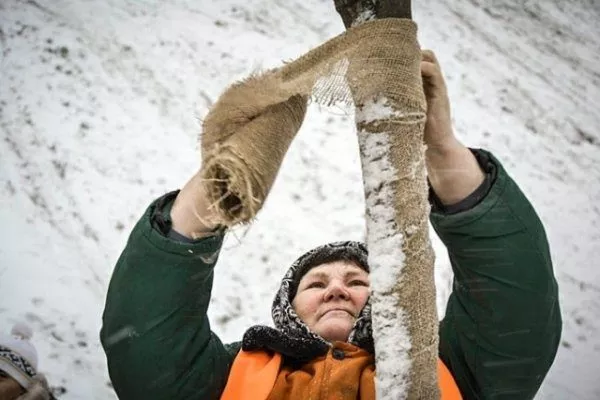
Young trees, unlike mature trees, are covered with spruce branches for the winter. Burlap is wrapped around the branches. This protects the young trees from both animals and the cold. A mound of earth is built around the trunk, which is mulched with straw or peat to a depth of 15 cm. When snow falls, a snowdrift is formed near the trunk.
Harvesting, storage and transportability
The Kyrgyz winter pear is a winter variety with good shelf life and transportability. The fruit is harvested in early October. Once picked, the green and firm pears are ready to eat in 2-3 months. They have a shelf life of 6-8 months.
To ensure that pears retain their taste and commercial qualities, they need to be provided with appropriate conditions:
- humidity – 85%;
- temperature – 0-1 °C;
- container – containers made of natural materials;
- laying pattern - checkerboard or diagonal;
- At the bottom of the containers there are shavings or paper.
Reviews of Kyrgyz pear
By planting the Kyrgyz Winter Pear, you'll have delicious winter pears every year that will keep until April. This variety is easy to care for, undemanding, productive, and frost-hardy, and, most importantly, it bears fruit in harsh climates.