
The Rossoshanskaya Dessertnaya autumn pear variety is prized for its ease of cultivation, early fruiting, abundant yield, and juicy, delicious fruit. To grow a pear tree in your own garden, you need to know the variety's characteristics and care guidelines.
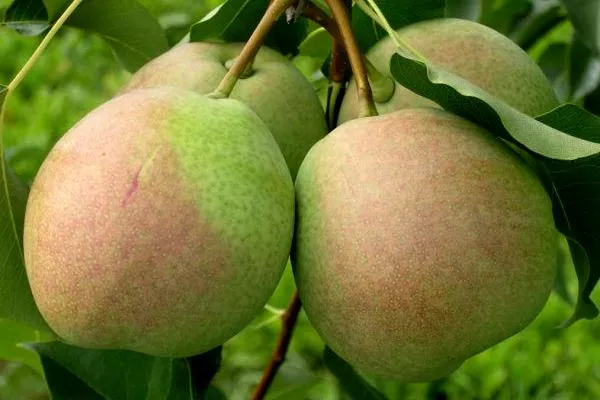
Dessert Rossoshanskaya pear is resistant to scab.
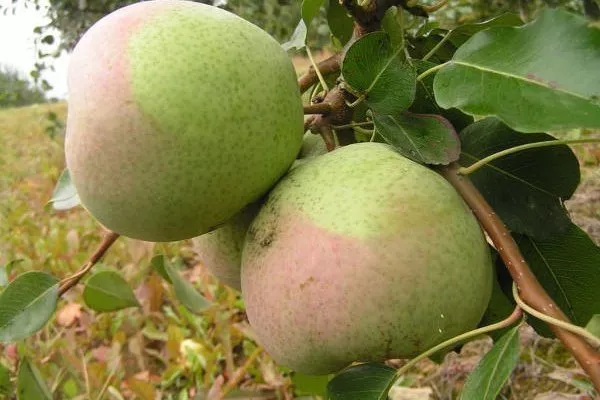
The fruits are apple-shaped or short-pear-shaped with a blurred pink blush
History of selection
Back in 1952, a new pear variety, dubbed "Dessertnaya Rossoshanskaya," was developed at the experimental horticultural station of the same name. The discovery was the work of two scientists, Georgy Dmitrievich Neporozhny and Anna Mikhailovna Ulyanishcheva. They crossed the late-ripening pear "Bere Zimnyaya Michurin" with the Belgian variety "Lesnaya Krasavitsa." Since 1968, it has been cultivated in various regions. However, the Bryansk, Voronezh, and North Caucasus regions are considered the best growing areas.
We recommend that you read the additional article, which will tell you about popular varieties of pears.
Description
The tree is vigorous and medium-sized, growing at a moderate rate. It can reach a height of 6 meters. The crown is broadly pyramidal, but with sparse shoots.
The foliage is green. The tips of the leaves are slightly curled. The leaf blade is medium-sized and oval. The flowers are small, up to 3 cm in diameter, snow-white, sometimes with a pink edge, and are medium-double and cup-shaped. The umbels consist of 8-9 flowers. The petals have smooth edges and are close together.
- ✓ Leaves with slightly curled tips and oval shape.
- ✓ Flowers up to 3 cm in diameter, snow-white, sometimes with a pink border.
The average fruit weight is 150 g, but rarely exceeds 205 g, making them medium-sized. They can be round, apple-shaped, short pear-shaped, or flat-round. The surface is smooth and uneven.
Ripe, edible pears are light yellow and covered with a subtle, diffuse pinkish blush. Large, subcutaneous spots are scattered throughout the fruit, usually gray or green. The stalk is medium-length and curved. The pear flesh is white or light cream, medium-firm, tender, and juicy, aromatic with a sweet, tart flavor.
Periods of ripening, flowering and fruiting
"Dessertnaya Rossoshanskaya" is a pear with autumn-ripening fruit. The first fruits appear on a five-year-old tree. Flowers bloom earlier on the tree than other varieties. Harvesting time varies depending on the growing region. In southern regions, this occurs in early September; in temperate climates, the harvest time shifts.
The pear tree produces a good, stable harvest every year – up to 70 kg can be harvested from one tree.
Pollination
This variety requires additional pollination. If pollinators are not planted near the tree, there will be no harvest. Pear varieties that bloom at the same time as the tree are planted near the tree. The best pollinators are:
- Autumn Yakovleva;
- Tatiana;
- Marble.
Advantages and disadvantages of the variety
The variety is valued for the following advantages:
- undemanding to soil;
- early fruiting;
- the tree bears fruit annually;
- good yield;
- has immunity to scab;
- the fruits are transportable and have good shelf life;
- have excellent commercial qualities and versatility.
The following are noted as disadvantages:
- self-sterility, pear needs pollinating assistants;
- Frost resistance indicators depend on the growing region; in the southern regions they are high, in the northern regions they are average;
- Flowers do not tolerate prolonged spring frosts; at temperatures of -2°C they freeze and die.
Planting time, location and soil preparation
The best option is a site sheltered from wind and drafts. While the pear isn't picky about soil, it grows best in fertile loamy soils. The plant doesn't thrive in clay soils. Soil acidity should also be considered. It should be either slightly acidic or neutral. The tree responds favorably to liming in strongly and moderately acidic soils.
- ✓ Soil pH level should be strictly between 6.0-6.5 for optimal growth.
- ✓ The groundwater depth must be at least 3 meters to prevent root rot.
Pear trees don't like excess moisture, so choose sites where the groundwater table is at least 3 meters deep. The tree has a long root system and will grow better in dry soil than in wet soil. If the soil is too wet, the roots suffer from a lack of oxygen. The area around the trunk must be loosened regularly.
Step-by-step planting process
Experts recommend purchasing varietal seedlings from specialized stores or nurseries to avoid disappointment. Buying planting material from someone else is always a risk, as the seller can sell anything under the same variety name. Before planting, trim the branches and roots of the seedling.
Step-by-step instructions:
- First, prepare the planting sites. The optimal hole size is 70 cm in diameter and about 1 m deep.
- Add humus, compost, or rotted manure (20-30 kg) and mineral fertilizers to the excavated soil: superphosphate (800 g), potassium chloride (100 g), the latter of which can be replaced with 1 kg of wood ash, and lime (1-1.5 kg). The amount of lime added depends on the acidity and structure of the substrate. The bottom is loosened.
- A stake is driven into the center of the hole and a layer of soil is added to form a mound.
- The soil in the hole is well compacted.
- The seedling is placed in the hole, carefully spreading the roots over the surface of the mound.
- The root collar is positioned so that it rises 4-6 cm above the surface.
- The remaining soil is used to completely fill the planting hole and compact it well.
- Make a hole around the tree and pour 2 buckets of water into it.
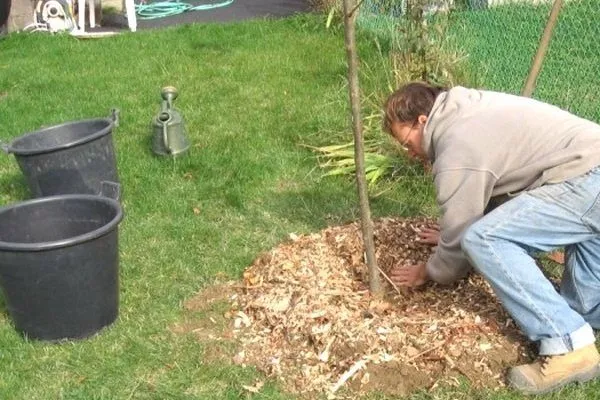
- The soil surface is covered with mulch - peat, mown grass or humus.
Caring for a pear tree
The main components of care are proper watering, pruning and timely application of fertilizers.
Watering
The Rossoshanskaya dessert pear does not tolerate drought well and therefore requires timely watering, but the tree should not be overwatered. Severe drought will cause the fruit to become small, and overwatering will slow growth and cause the plant to drop its leaves prematurely. Water the pear when the soil dries out, applying up to 2-3 liters of warm water per square meter of the tree's trunk circle. Watering is essential during fruit set, fruit ripening, and after harvest.
Trimming
Thanks to its sparse crown, pruning is not required for the first 2-3 years. Then, sanitary and formative pruning is performed. Branches are transferred to the outer branches. For fruiting pear trees, only large branches are pruned.
Fertilizers
Every spring, dig a trench around the tree's trunk and apply ammonium nitrate at a rate of 20 g per square meter. Once every three years in the fall, apply 50 g of superphosphate and 20 g of potassium sulfate, or 0.5 buckets of organic manure.
Preparing for winter
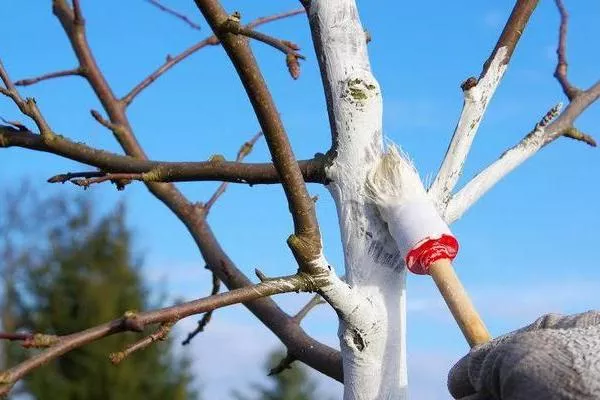
In the fall, pear tree trunks are whitewashed with lime and protected from rodents with a piece of roofing felt or nylon mesh. For added security, traps with "treats" are set around the area.
Mature trees don't need frost protection. Only young seedlings need to be covered. They are completely wrapped in paper or individually wrapped in a modern covering material, spunbond, and covered with it. The area around the trunk is mulched with sawdust or dry soil; the mulch layer should be fairly thick—at least 15 cm.
Diseases, pests and prevention
This variety has excellent immunity to various diseases and rarely suffers from insect attacks. However, it is not immune to some pests. The main pear diseases, their symptoms, and preventative measures are listed in the table.
| Diseases/pests | Signs | Prevention |
| Winter moth | The damage to the plant is caused by its larvae, which chew out all parts of the plant—buds, branches, flowers, and leaves. Of the latter, only the veins remain, often entangled in a web in which the caterpillar lives. | In the fall, dig up the tree trunks; destroy caterpillars and spider web nests by hand. Clean the trunks of moss, and be sure to whitewash them in the spring and fall. |
| Pear moth | Unripe pears begin to fall off and rot prematurely. | They set up traps, dig up the soil in the fall, collect the pests by hand, and burn fallen fruit. |
| Pear sawfly-weaver | A small yellow spot first appears on the fruit's skin, which quickly grows larger over time. The fruit turns brown, and whitish or cream-colored pads appear on its surface. The flesh deteriorates, losing its flavor and becoming loose. Rotten fruits fall off or remain mummified on the branches. The disease spreads from diseased pears to healthy ones. | All fallen fruit is destroyed, and any diseased fruit must be removed from branches and disposed of. The tree is treated with a 4% Bordeaux mixture before the buds open. In summer, the same solution is sprayed, but at a lower concentration of 1%. |
| Rust | Leaf blades become covered with round, red spots. These spots are small at first, then grow larger. In advanced cases, star-shaped growths form on the leaves. Infected leaves fall off. | Before bud break, spray the tree with a 4% Bordeaux mixture. Collect and burn all infected leaves. Loosen the soil around the pear tree. |
| Cytosporosis | Brick-red spots appear on the bark. Damaged areas crack and become flabby. Branches dry out and die. | Follow proper agricultural practices. Treat cuts with garden pitch. Care is taken to avoid damaging the bark. |
Collection, storage and transportability
The fruits are picked green (unripe) and left to ripen until they reach consumer maturity—they turn yellow and develop a pinkish blush. Ripe fruits can be stored for up to 78 days, usually until November.
Pears are picked from the tree by hand, removing each fruit with its stem attached. Shaking the fruit from the tree is not recommended, as falling will cause dents and damage. The fruit is transportable and can be shipped long distances without losing its appearance or quality.
The harvested fruit is stored in wooden or plastic boxes in a dark place at a temperature of 0°C. Several layers of paper, but not newspaper, are placed on the bottom of the container. The pears are laid in several rows, stems diagonally, to prevent them from damaging each other. Each row is interspersed with paper or sprinkled with dry, soft wood shavings or calcined sand.
You can see what the "Dessertnaya Rossoshanskaya" pear variety looks like in the video below:
The fruits of this variety are versatile. They are suitable for compotes, as the pulp does not overcook and retains its shape. They can also be used to make candied fruits, jams, and eaten fresh.
Gardeners' reviews
In most cases, gardeners speak well of this pear variety:
The Rossoshanskaya dessert pear is an excellent choice for a garden plot or a large orchard. With proper care, it will delight with abundant harvests year after year, and its delicious, aromatic fruits will delight pear lovers.