
The Elena pear is a good choice due to its high yield, excellent flavor, and long shelf life. Its disease resistance and ability to grow in a wide range of climates make it a popular variety among gardeners across various regions.
Origin of the variety
It was introduced in 1960 in Armenia. Breeder P. Karatyan developed it. The fruit tree varieties "Lesnaya Krasavitsa" and "Bere Michurin Zimnyaya" were used in the crossing process. The new hybrid has successfully established itself and can be grown in a variety of climates.
The variety was included in the State Register in 1990. It is currently successfully grown in various regions of Armenia, as well as in the central and southern regions of Russia, including colder areas.
Description of the Elena pear tree
The tree is compact, reaching 3 to 3.5 m in height. Distinguishing features of the plant include:
- The crown is characterized by a narrow pyramidal configuration, due to which the plant can be grown in small areas, which significantly facilitates care and harvesting.
- The bark of the trunk and skeletal branches is rough, colored brown with a grayish tint.
- The lateral branches are slightly thickened, initially colored a bright cherry shade, then darken and turn brown.
- The shoots are densely covered with large, elongated-elliptical leaves of a dark emerald color. The foliage is smooth, finely serrated along the edges, and has a smooth, glossy surface. The leaf blades are often folded in half along the midrib.
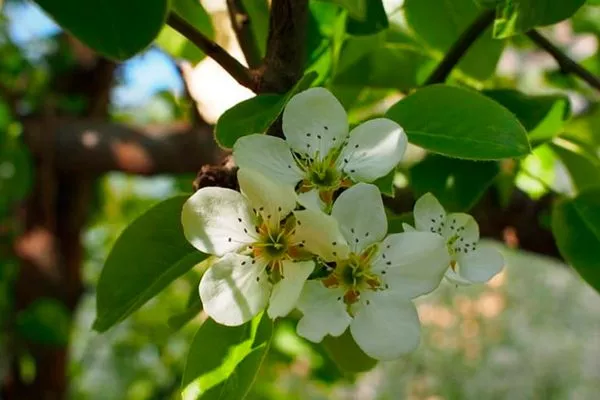
It has large flowers with five petals. Inflorescences contain 5-6 petals. The petals are rounded and white.
Fruit characteristics
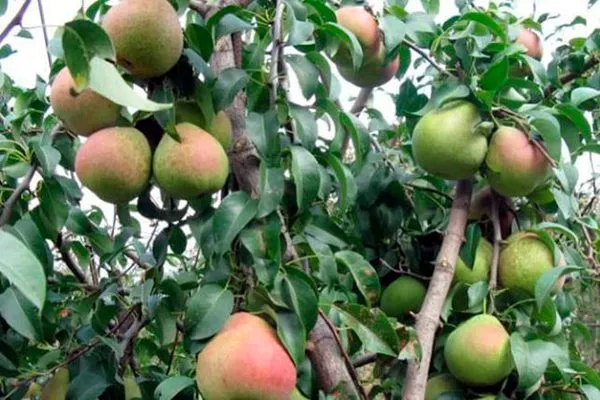
Large, uniform, and have a classic pear shape. Other features:
- The skin is soft and tender, sometimes sticky. The surface is covered with gray bumps and subcutaneous spots.
- On average, they reach a weight of 200 g, sometimes larger specimens are found – up to 340 g.
- Unripe fruits have a yellowish-green hue, while fully ripe fruits have a distinct bright yellow color with a pleasant aroma.
- The white flesh is rich, buttery and juicy in texture.
- The tasting score is 4.7 points.
- Characterized by a slight sourness and a sweet aftertaste.
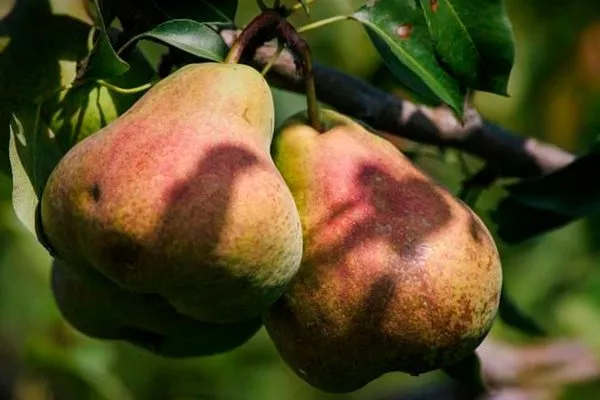
The fruits are most often eaten fresh and are widely used for winter preserves. They contain 0.2% acidity, 12.2% sugar, and 7.4 mg fiber and vitamin C.
Pollinators of the Elena pear
A characteristic feature is self-fertility and the ability to self-pollinate. To increase yields, plant fruit trees with similar flowering periods nearby. The best pear varieties are Kudesnitsa and Yanvarskaya, and the best apple trees are Dubrovka and Zolotaya.
Productivity
It's an early winter variety. A single plant can yield an average of 40 to 50 kg of fruit, provided there's sufficient light.
Ripening period
The first harvest appears 5-6 years after planting the seedling, taking into account the climatic characteristics of the region and the level of care.
Pros and cons of the Elena variety
This crop has its drawbacks, but its advantages far outweigh its disadvantages. Before planting it in your garden, carefully consider its positive and negative qualities.
Among the disadvantages, gardeners note average winter hardiness, a tendency for overripe fruits to fall off quickly, and uneven fruit shape despite high yields.
Optimal conditions for growing
To successfully grow a crop, create optimal conditions for it. Helpful tips:
- Choose a well-lit area with loose and fertile soil and low acidity.
- Make sure to regularly fertilize, water, and loosen the soil around the tree trunk.
- In southern regions, planting of seedlings occurs in the spring. In the central part of the country, it's best to postpone the procedure until September or October, allowing the young plants time to take root and adapt to the new conditions before the onset of frost.
- Selecting high-quality planting material is crucial. Purchase seedlings from specialized nurseries, where they are dug up upon purchase, ensuring their health and good survival rate.
Inspect the seedling for signs of root cancer and ensure that it has enough lateral shoots to root quickly.
- ✓ Soil pH should be between 6.0-6.5 for optimal nutrient absorption.
- ✓ The depth of groundwater is at least 2.5 meters to prevent rotting of the root system.
Planting and caring for the Elena pear
Planting guidelines require preparing the site 2-3 weeks in advance, including clearing excess growth and digging the soil. Here's a step-by-step guide:
- Dig a hole approximately 60 cm deep and wide.
- Before planting, add compost or humus to the hole to enrich the soil with nutrients. This will help the plant take root and thrive.
- Place the seedling in the hole so that the roots are completely submerged in soil. Fill the hole with soil, leaving the root collar level with the soil.
- After planting, water the seedling thoroughly. Make sure the soil around the plant is well-moistened.
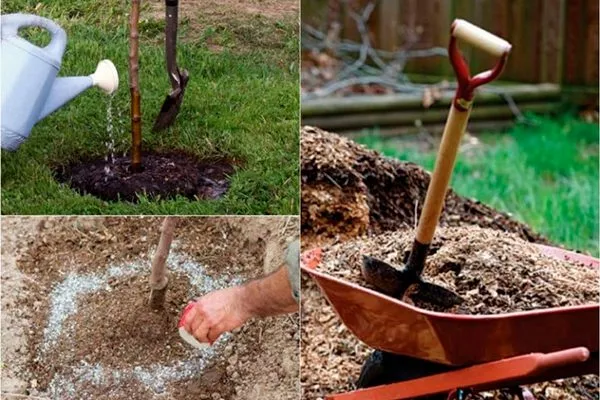
Maintain regular watering during the first year after planting, especially during periods of drought. Provide protection from weeds and regularly loosen the soil around the plant. Other key rules:
- Apply mineral fertilizers from the moment the seedling is planted and every few months. As winter approaches, add phosphates and organic fertilizers to the soil to prepare for the cold weather.
- Prune branches in the spring, removing damaged branches and shaping the crown at the initial stage of growth.
Preparing for winter
Begin preparing the seedling for winter after all the leaves have fallen. Collect them and then water thoroughly. The plant's readiness depends on the amount of moisture it receives. If there is a lack of moisture throughout the year despite a bountiful harvest, the plant may be depleted.
Prune the tree, removing any diseased, damaged, or dead branches. Protect the young tree by covering it with a tarp or cloth, and wrap the trunk with dry straw. For a mature tree, use burlap or cardboard to protect the trunk. Cover the roots with straw, roofing felt, or spruce branches.
Pest and disease control
It has high immunity to scab and is rarely susceptible to fungal diseases. It is often attacked by insects. Without preventative measures, the variety can be affected by the following diseases:
- Rust. Rusty spots appear on the leaves, which can spread to the fruit.
- Powdery mildew. It is characterized by a white coating on the leaves, which leads to their curling and darkening, which ultimately leads to death.
- Black crayfish. It manifests itself in the formation of small wounds on the branches and trunk, which quickly expand and acquire a reddish-brown hue; spots may appear on the leaves and fruits.
- Fruit rot. It begins with the appearance of small brown spots on the fruit, which then spread, covering it completely. Yellow-beige fungal sporulation pads form on the affected surface.
- ✓ Rust: orange pustules on the underside of leaves.
- ✓ Powdery mildew: white powdery coating on young leaves and shoots.
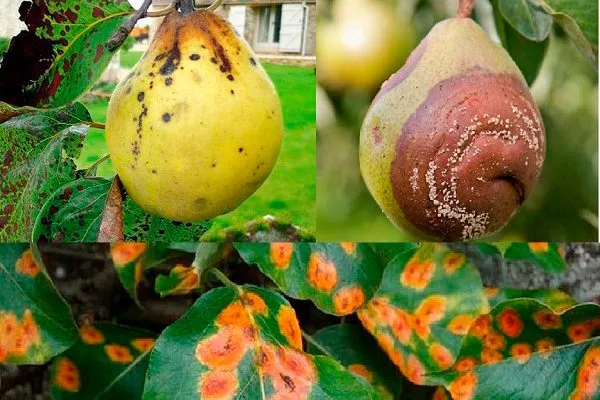
To treat diseases, treat trees with copper-containing products such as Horus, Abiga-Peak, and Bordeaux mixture. It's also helpful to use lime powder at the beginning and end of the season.
Harvesting and storage
In the central part of the country, the harvest is usually in late September, sometimes continuing until the first ten days of December. It is characterized by a long shelf life when harvested at the technical maturity stage. In cool, dark storage areas, it can be stored for up to four months, making the fruit easy to transport.
Gardeners strongly recommend storing fruit in cardboard or wooden crates, stacking them in a single layer and placing them vertically with the stems facing up. This arrangement ensures reliable protection against deformation. Store the fruit in a cool, dry place—a cellar, basement, or garage.
Reviews of the Elena pear variety
The Elena pear has received numerous reviews from gardeners across the country. It exhibits excellent qualities and thrives in various regions thanks to its frost and disease resistance. With proper care, the plant enjoys robust health and a good yield.