
The Chudesnitsa pear embodies the best of its parent varieties, from which it inherited such qualities as high yields, disease resistance, and frost hardiness. However, there are pests that can cause significant damage to the plant—it's best to learn about these in advance to protect your garden from them.
Origin and zoning
Chudesnitsa is a winter pear variety bred at the I.V. Michurin All-Russian Research Institute for Genetics and Breeding of Fruit Plants. This was achieved by crossing the Daughter of Zari and Talgarskaya Krasavitsa varieties. The authors of this variety are renowned Russian breeders: S.P. Yakovlev, N.I. Savelyev, A.P. Gribanovsky, E.N. Dzhigadlo, and V.V. Chivilev.
The Chudesnitsa variety was registered in the State Register of our country in 2004, but was developed three years earlier. It is mainly cultivated in the central regions of Russia, and is also widespread in Belarus, Kazakhstan, Ukraine, and Moldova.
Description of the plant and fruits
This cultivar is considered medium-sized, reaching a height of just 280-300 cm. The variety has a unique characteristic: if a seedling is grafted onto a quince tree, the tree will be shorter. It has a neat, compact crown with a slight density. The plant and fruit are distinguished by the following appearance:
- crown shape – pyramidal;
- bark – brown with a brownish tint, without roughness or pubescence;
- shoots – erect, of medium thickness, with a small number of small lenticels;
- fruiting – mixed, so ovaries are formed on almost all types of branches;
- kidneys – very dense and cylindrical, their tip is pointed, and the surface is smooth, the pressure is tight;
- foliage – medium in size, flattened, smooth-matte with a beautiful green-emerald hue;
- leaf blade shape – oval, blunt at the base and slightly pointed at the tip;
- Features of leaves – the edges have small serrations, the tip is raised upwards, the veins are barely noticeable and thinned;
- petiole – average in parameters;
- stipule – awl-shaped;
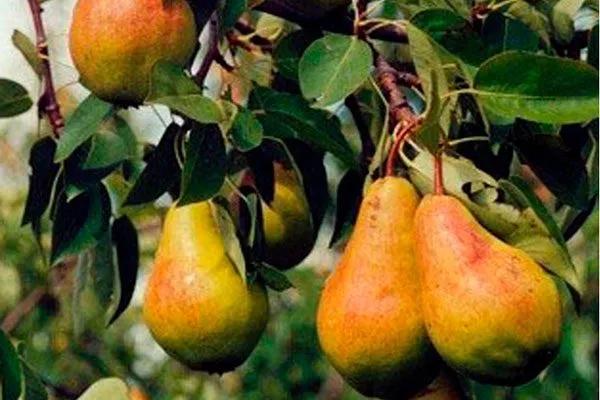
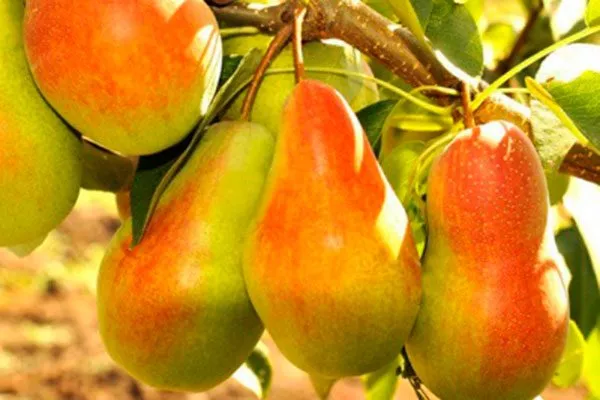
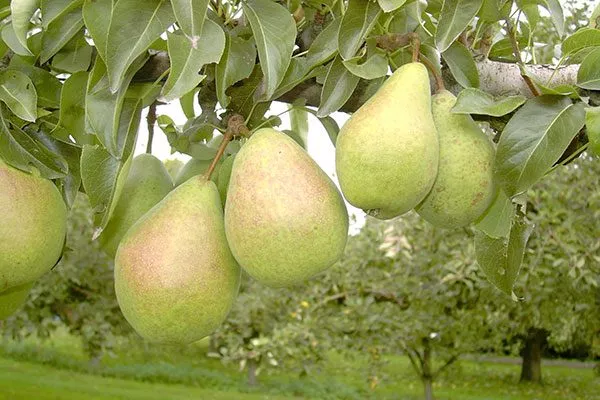
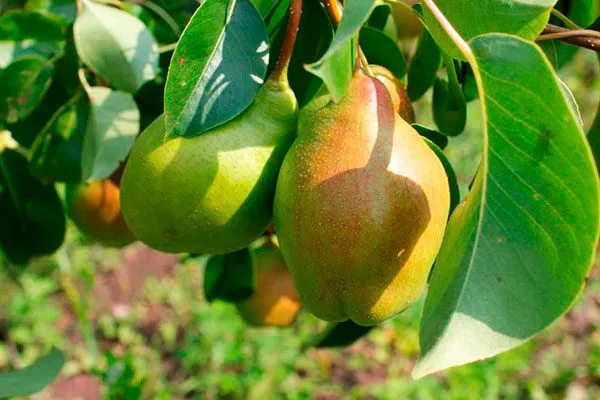
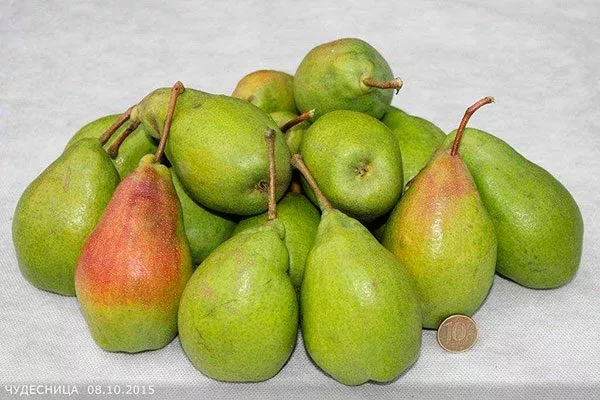
- fruit shape – conical with truncation, but on the same tree there are also shortened pear-shaped specimens;
- surface of pears – even and smooth;
- weight of one fruit – from 130 to 200 g;
- peel – glossy and waxy at the same time, delicate in structure;
- skin color – juicy green with a pinkish cover at technical maturity and yellow-green with a red cover at consumer maturity;
- pulp shade – cream;
- subcutaneous specks – small in size, clearly visible;
- peduncle – set obliquely, with a curved shape;
- saucer – average;
- funnel – small and tapered, conical with a blunt tip;
- cup – non-falling and semi-open type;
- rustiness – insignificant;
- heart – bulbous shape;
- seed chambers – closed;
- bones – conical, medium in size and brown in color;
- pulp density – moderate;
- texture – tender and juicy, half buttery;
- juice - without viscosity;
- aroma – the saturation is medium, there are floral notes;
- granulation – insignificant.
- ✓ The fruits retain their marketable appearance and taste when stored in the refrigerator for up to 5-6 months.
- ✓ The variety requires pollinators such as Pamyati Yakovleva, Nika and Feeriya for successful fruiting.
Lifespan and annual growth of a tree
There are no precise data on annual shoot growth, but experts claim that branches grow quickly. The tree bears fruit for at least 15-20 years, and can live up to 80-100 years without producing large numbers of fruit.
Flowering and pollinators
| Name | Disease resistance | Ripening period | Frost resistance |
|---|---|---|---|
| Wonderworker | High | Winter | High |
| In memory of Yakovlev | Average | Autumn | Average |
| Nika | High | Winter | High |
| Extravaganza | Average | Autumn | Average |
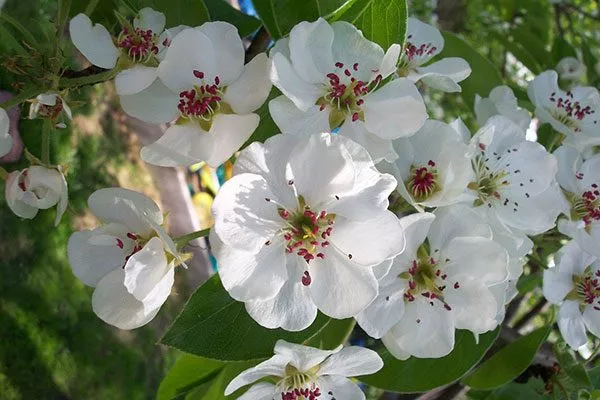
The Chudesnitsa pear tree begins blooming in the last ten days of May and lasts for approximately 7-10 days, producing a distinctive, rich aroma. This variety is characterized by low self-fertility, so for successful pollination, other pear varieties, such as Pamyati Yakovleva, Nika, and Feeriya, must be grown nearby.
Productivity and transportability
It begins to bear fruit in the 4th-6th year, the average yield is 125-135 centners per hectare.
Improving the quality and increasing the volume of the harvest is achieved through the correct formation of the tree crowns and their adequate distribution throughout the garden.
The Chudesnitsa pear variety boasts excellent long-distance transportability, surpassing average long-term storage stability. When maintained at low temperatures and controlled humidity, the fruit can be stored for 110-155 days.
Ripening period
Chudesnitsa is a winter variety and ripens late. The pears gain weight from mid- to late autumn, but they remain on the branches without losing their marketability or flavor.
Resistance to low temperatures and drought
This variety is highly frost-resistant. Experiments have shown that when temperatures were artificially lowered to -37-38°C, cambium damage did not exceed 0.6-0.7 points, and the bark and xylem were not frozen at all. Despite this, gardeners in northern regions insulate the trunk to prevent damage.
The Chudesnitsa pear copes well with drought, as the root system of a mature tree is capable of independently absorbing the necessary moisture from the soil. However, young seedlings require regular watering, especially during periods of insufficient rainfall. Maintaining soil moisture around the tree's trunk is critical during the first three years.
Commercial and consumer qualities of fruits
They retain their consumer properties for a long time during transportation and storage, maintaining their marketable appearance for up to 3-4 months in fruit storage facilities and up to 5-6 months in the refrigerator.
Tasting evaluation and scope of application of pears
Research conducted by the All-Russian Research Institute of Fruit and Vegetable Growing shows that pear pulp contains approximately 13% dry matter, including 9.5 g of sugars, 0.2-0.3 g of organic acids, almost 8 mg of ascorbic acid and 175 mg of P-active substances per 100 g of product.
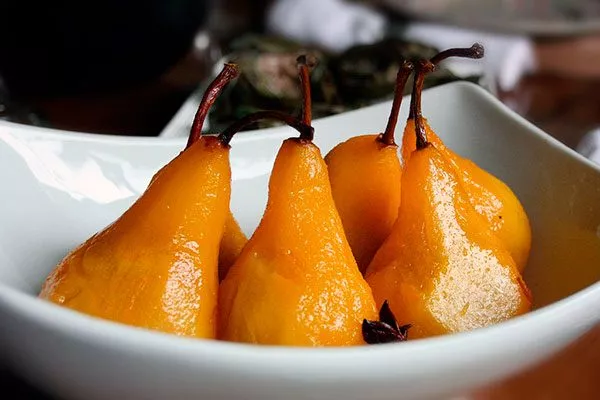
Chudesnitsa pears are a dessert variety: they're excellent for fresh consumption and can be used in cooking to create a variety of dishes and preserves for the winter, including jams, compotes, preserves, and jellies. The fruit retains its amber color and aroma during cooking.
Growing specifics and agricultural recommendations
The Chudesnitsa pear variety prefers well-drained, loose, and breathable soil, such as black soil or loam. Other planting and cultivation considerations include:
- The optimal soil acidity level for this tree is neutral or slightly acidic.
- It is recommended that groundwater not come closer than 200 cm to the surface of the earth.
- To ensure the best growing conditions, seedlings should be placed in areas with sufficient sunlight and protected from strong winds to prevent moisture stagnation.
- Although the Chudesnitsa pear is a compact tree, it still requires a space of about 4-6 meters in diameter for normal development.
- When selecting seedlings from a nursery, it's best to choose those with a healthy root system and a clearly defined taproot. In southern regions, it's recommended to choose seedlings grafted onto quince.
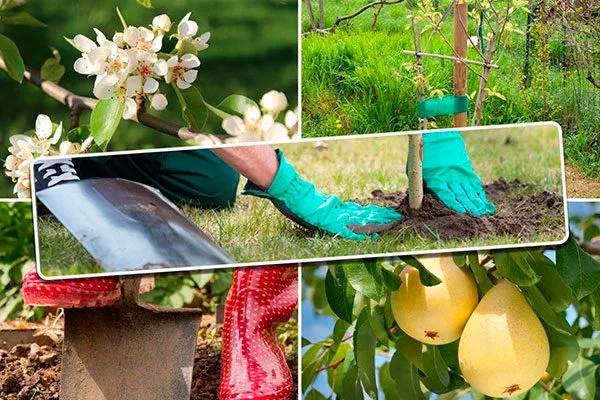
Standard pear tree care includes regular watering, fertilizing, pruning to shape the crown, and protection from pests and diseases:
- Pear trees should be watered generously three times per season: at the beginning of flowering (late May), when fruit buds are forming (mid-June), and 25-35 days before harvest (August). It is recommended to use 10 liters of water per meter of tree height. After watering, loosen and mulch the soil around the tree.
- Fertilizers are also applied three times during the season: in the spring, urea (carbamide) is applied to the pear tree at a dose of 95-100 g per tree, at the budding stage, organic fertilizers are used (27-32 liters of a solution of cow manure or chicken droppings), and to form ovaries, the plant is irrigated with a solution of nitroammophoska (45-50 g per 8-10 liters of water).
During the summer, it is recommended to additionally spray the leaves with a magnesium sulfate solution. In July, it is advisable to apply superphosphate to the root zone, and in the fall, enrich the soil with wood ash. - The Chudesnitsa pear variety is known for its vigorous growth of new shoots. Therefore, it requires regular formative pruning, which is best done in the fall, beginning in the plant's third year. To avoid excessive canopy density, it is recommended to leave 3-4 main branches in each tier, oriented in different directions, each bearing 2-3 fruiting shoots.
Remaining branches should be removed. The cuts should be thoroughly treated with garden pitch to protect the tree from pests and diseases. The recommended distance between individual crown tiers is approximately 555-65 cm.
Diseases and pests
Regarding diseases and pests, the Chudesnitsa pear has good immunity to common fungal infections, allowing for preventative treatment with fungicides such as Fundazol or Skor. However, this variety is susceptible to attacks by green aphids and pear leafhoppers.
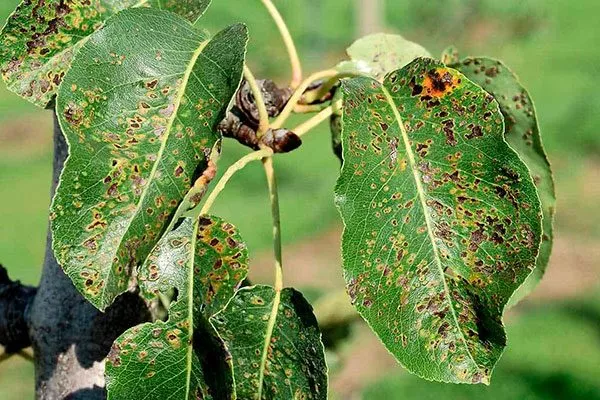
August is a key month for preventative insecticide use against pear psyllids preparing for winter. Using insecticides such as Aktara, Karbofos, and Komandor during this period will significantly reduce the pest population. However, their toxicity should be kept in mind.
If you prefer to avoid using chemicals, you can prepare the following preparation yourself:
- laundry soap – 35-45 g;
- kerosene – 75-85 ml;
- water – 8-11 l.
This composition can serve as an alternative measure for pest control.
Advantages and disadvantages of the variety
The Chudesnitsa pear, a relatively new variety that has already gained recognition among gardeners, boasts numerous qualities. These include:
Despite its many advantages, the Chudesnitsa variety also has its drawbacks, including the need for regular and careful pruning to shape the crown due to the tree's intensive growth.
Gardeners' reviews
Growing the Chudesnitsa pear in your garden isn't particularly difficult if you follow all the proper agricultural guidelines and care. It's important to remember to select the right pollinators to ensure a good harvest and to practice pest control. This winter pear has deservedly gained popularity among consumers and is in demand among gardeners.