
The Chizhovskaya pear is a time-tested variety, hardy and winter-hardy. It is especially prized by gardeners in the central and northern regions of our country. Most importantly, having just one tree in your garden is enough to provide yourself with delicious and juicy pears.
Origin and selection
The variety was developed at the K. A. Timiryazev Moscow Agricultural Academy by Russian breeders in 1956. The authors were S. T. Chizhov and S. P. Potapov. The pear was named in honor of one of its creators.
The Olga and Lesnaya Krasavitsa pear varieties were used in Chizhovskaya's development. From the latter, the new variety inherited its low-maintenance, self-fertile nature, high yield, and excellent fruit flavor. The Olga variety imparted frost resistance, scab resistance, and shelf-stable fruit to Chizhovskaya.
Description and characteristics of the Chizhovskaya pear
Chizhovskaya is a hardy, late-summer variety with a classic appearance. It has a medium-sized tree and produces typical pear-shaped fruits. Its winter hardiness and productivity are outstanding, making it a favorite among gardeners in regions with harsh winters.
Characteristics of fruits and trees
The Chizhovskaya pear has earned the well-deserved attention of Russian gardeners for many years. Despite competition, this time-tested variety remains popular and in demand.
Brief description of the Chizhovskaya variety:
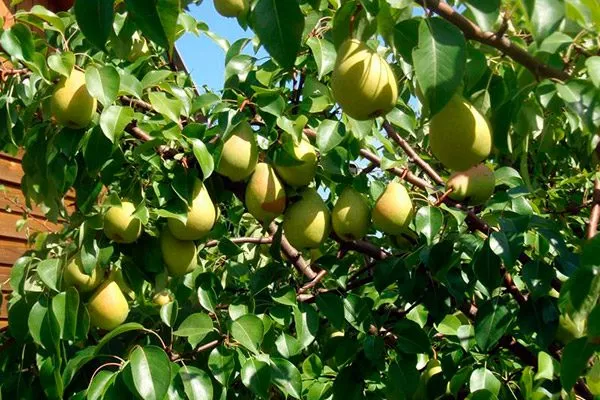
- Tree. A medium-sized, standard tree, up to 2.5 m tall. The crown is dense, narrow, and pyramidal. The bark on the trunk and skeletal branches is gray, and on young shoots, it is reddish-brown.
- Leaves. Smooth, dark green, oval-elongated, densely growing.
- Flowers. White, medium-sized, collected in inflorescences of 5-7 pieces.
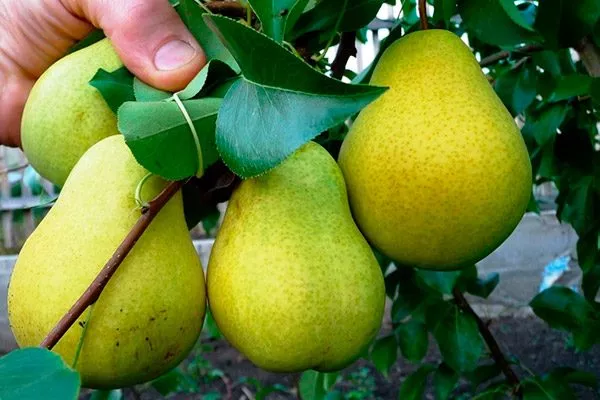
- Fruit. They have a classic pear shape. They are yellow-green in color, sometimes with a pinkish blush. The skin is smooth, thin, dry, and dull, with small subcutaneous dots. The flesh is light yellow and oily. Each fruit weighs 100-140 g. The flavor is sweet and sour. The aroma is subtle and delicate.
Chizhovskaya pears contain 16% dry matter and 13% soluble matter. 100 g of pear pulp contains 9.1 g of sugar, 166 mg of active substances, and 0.45 g of acid.
Ripening time
The tree blooms profusely and abundantly. Fruiting begins in the second half of August and continues until mid-September. The fruits ripen uniformly, with approximately 90% of the harvest reaching technical maturity at any one time.
Once ripe, the fruits remain hanging on the branches for a long time without spoiling or falling off. Even after falling, they retain their quality for about a week, lying there in the grass, waiting to be picked and processed.
Tasting evaluation
Professional tasters rate the taste of Chizhovskaya's fruit at 4.1-4.2 points out of 5. The fruit is quite high in sugar—9.1%. The flavor is balanced, dessert-like, harmonious, refreshing, and sweet and sour.
The best pollinators
The variety is nearly self-fertile. The tree can bear fruit even when completely isolated. However, if pear trees of different varieties are grown nearby (within 4-5 meters), the fruit will be much more abundant and fruiting more consistent. The best pollinators are Rogneda, Lada, and Severianka.
Productivity
This variety is characterized by regular and stable fruiting. The maximum yield is 50 kg per mature pear tree. While the number of fruits increases significantly, a slight decrease in their size is observed. Fruiting begins in the 3rd or 4th year after planting.
Zoning
The Chizhovskaya variety underwent state variety testing since 1980. It was only included in the official register in 1993. The variety is zoned for central Russia. Specifically, it is intended for the Central, Northwestern, Middle Volga, and Volga-Vyatka regions.
Sustainability
Chizhovskaya is distinguished by good winter hardiness and easily tolerates temperatures down to -30°C. Trees that reach five years of age can withstand prolonged droughts and heat. Thanks to its hardy parents, the variety has acquired high immunity to most infections, including fungal and bacterial ones.
Advantages and disadvantages
The Chizhovskaya pear boasts an impressive list of advantages that more than outweigh its shortcomings. This variety certainly deserves the attention of gardeners and will be a valuable addition to any garden.
Advantages:
- high frost resistance;
- early fruit bearing;
- good taste characteristics;
- the harvest can be collected without the use of special means;
- the fruits fall off slightly after ripening;
- excellent presentation;
- the fruits tolerate transportation well;
- undemanding to care;
- high immunity to scab;
- universal purpose of fruits.
Flaws:
- pears become smaller as the tree ages;
- In the first years of life, it does not tolerate moisture deficiency well.
Landing features
There are no trivial details when planting pear seedlings—any mistake can ruin all your efforts. The tree's growth, development, and fruiting depend on a multitude of factors, from the groundwater level to the quality of the soil mixture used in the hole. The gardener's job is to choose the right location and planting material, and to plant according to proper agricultural practices.
Selecting a seedling
The choice of seedling largely determines the tree's future life and fruiting. It is recommended to purchase planting material only from trusted suppliers, preferably specialized nurseries.
- ✓ Check that the seller has a certificate of conformity for the variety.
- ✓ Make sure the seedling does not show signs of disease, such as spots on the leaves or bark.
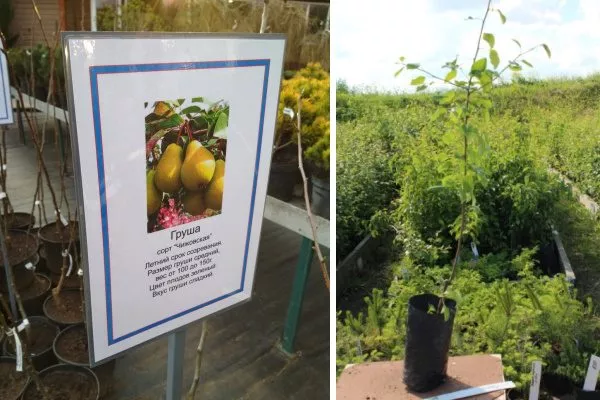
How to choose a high-quality and viable seedling:
- inspect the bark - there should be no damage or signs of disease on it;
- pay attention to the roots - they must be healthy, without dry roots, growths and swellings;
- recommended age — 1-2 years, such seedlings take root best.
Selecting a site
To ensure a tree grows and bears fruit successfully, it's important to choose the right planting location. If growing conditions are unfavorable, the tree will produce poor yields, become diseased, or even die.
Requirements for the landing site:
- good lighting;
- spacious and open area;
- a fence on the north side - to hold back icy winds;
- absence of shade and drafts;
- Lowlands flooded by rain and melt water are contraindicated;
- minimum distance from the surface to groundwater is 2 m;
- Recommended soils: loose, fertile, humus-rich loams;
- acidity - neutral or extremely weak pH 5.5-6.5;
- the minimum distance to the walls of buildings or fences is 3-4 m;
- The maximum permissible slope is up to 10 degrees.
Planting dates
The Chizhovskaya pear is planted in spring or fall. The timing depends on the gardener's preferences and the regional climate.
Boarding time:
- Spring. Planting begins before the buds swell. The exact timing varies by region. In the South, planting occurs in late March, while in regions with a late spring, it begins in early May. The key is soil warming to 5–7°C. Spring planting is recommended for regions with cold winters.
- Autumn. Plant seedlings 4-5 weeks before the onset of severe frost—this time is necessary for establishment and adaptation. Pears planted in the fall are more hardened and frost-resistant.
Bookmarking the planting hole
Dig over the area where the tree will grow in the fall. Add organic matter—6-8 kg per square meter. Prepare the planting hole at least 2-3 weeks before planting.
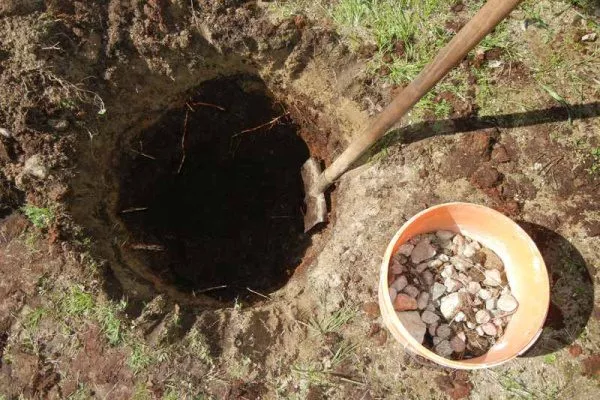
How to prepare a planting hole:
- Dig a hole 60-80 cm in diameter and 70-100 cm deep. The poorer the soil, the larger the hole should be. Immediately divide the excavated soil into two piles. Place the loose, fertile topsoil in one pile, and the soil excavated from the bottom of the hole in the other.
- Place a 10-15 cm layer of drainage material on the bottom. Use broken bricks, stones, shards, etc. for this. If you are planting in sandstone, which is unable to retain water, use a clay layer instead of drainage.
- Use the removed fertile soil layer to prepare a potting mix. Mix the garden soil obtained from digging the hole with humus and peat (1:1:1). Add superphosphate (300-450 g), as well as wood ash (600-750 g) or potassium salt (100-150 g).
- Pour the resulting substrate into the hole, filling it about 2/3 full. You should still have some nutritious soil mixture left over for root coverage.
- Cover the hole with plastic or roofing felt to prevent it from being washed away by rain. After a couple of weeks, when the soil has settled a bit and the fertilizer has dissolved, you can begin planting.
Preparing a seedling for planting
Before planting, trim off any broken or dried shoots from the seedlings. Pay attention to the buds—they should be dormant. If the seedling has developed leaves, it's not suitable for planting—it will die within a short time.
On the day of planting, soak the roots of the seedlings in a clay slurry for 2-3 hours. This will increase the survival rate. Prepare the mixture from water, soil, and Heteroauxin (a growth stimulant). The slurry should have the consistency of sour cream.
Planting a seedling
On the day of planting, inspect the seedling again for suitability after soaking it in water or a growth stimulant solution. Planting material with closed roots should be in containers; simply water it.
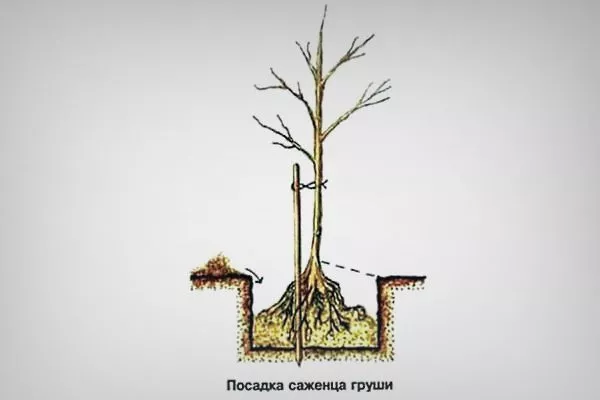
The procedure for planting a pear seedling:
- Remove the covering from the hole and form a small mound in the center of the hole from the soil mixture that was poured into it earlier.
- Drive a support, such as a wooden stake, into the ground about 15 cm from the center of the hole. This will support the young tree and protect it from winds during its first few years. After 3-4 years, the support can be removed.
- Place the seedling's roots on top of the mound of earth and carefully spread them out along the slopes—there should be no kinks. Position the seedling so that its root collar is approximately 3-5 cm above the ground. Once the soil settles, the root collar will sink to the desired level.
- Cover the roots with soil mixture, periodically compacting it and shaking the seedling to ensure there are no air pockets between the roots.
- Form a circle around the tree trunk so that water does not flow out during watering.
- Water the seedling. The norm is 20-40 liters (depending on the soil condition).
- After the water has soaked in, apply a layer of mulch around the tree trunk. You can use any natural material—cut grass, straw, sawdust, compost, etc.
Caring for a pear tree
To ensure the Chizhovskaya pear reaches its full potential, it requires standard care. This variety doesn't require anything special; standard agricultural practices are sufficient.
Watering
The pear tree has deep roots, but this is not enough for the tree to survive droughts successfully - if there is no rain, the plant needs to be watered.
Recommendations for watering the Chizhovskaya pear:
- During the first 3-4 years of its life, a young tree requires regular watering—10-20 liters of water. Watering is done as the soil dries out.
- During the season, depending on the weather, an adult tree is watered 2-6 times.
- The water requirement per 1 sq. m is from 20 to 50 liters (depending on the soil condition and the age of the tree).
- If autumn is dry, moisture-recharging irrigation is carried out in October.
- Watering should be uniform - a sharp change in soil moisture leads to cracking of the fruit.
- After watering and heavy rains, the soil in the tree trunk circle is loosened, weeded and sprinkled with mulch.
Removing the growth
Often, shoots appear on the pear tree trunk below the graft. These are also called wildings. If not pruned immediately, they will begin to invade the crown. Wildings gradually overwhelm the cultivated pear tree, causing the fruit to become smaller and taste less good. These shoots should be broken off or cut out directly at the base.
Fertilization
To produce high-quality, environmentally friendly pears that are large and tasty, it is recommended to feed the tree with organic matter, using as little mineral fertilizer as possible.
Recommendations regarding feeding:
- In early spring, dig around the tree's trunk and add 20-60 liters of compost per pear tree. Distribute the fertilizer evenly over the entire area. If the soil isn't rich enough, add 20-40 g of ammonium nitrate per square meter.
- In the fall, add potassium sulfate and superphosphate during digging - 20-30 g and 40-60 g, respectively.
- If the tree bears fruit early, apply a complex mineral fertilizer to it.
- When a tree grows large shoots with large leaves, to the detriment of fruiting, it should be fed with phosphorus and potassium.
Table 1. Recommended fertilizer rates:
| Period of contribution | Fertilizer | Standard per 1 sq. m (in grams) |
| Spring | urea | 10-20 |
| Summer | superphosphate | 20-30 |
| Autumn | potassium sulfate | 20-30 |
If you use mainly mineral fertilizers for fertilizing, you can add organic matter by combining fertilizing with mulching - adding humus to the tree trunk circle.
Trimming
The pear yield and the quality of its fruits directly depend on the timeliness and correctness of pruning.
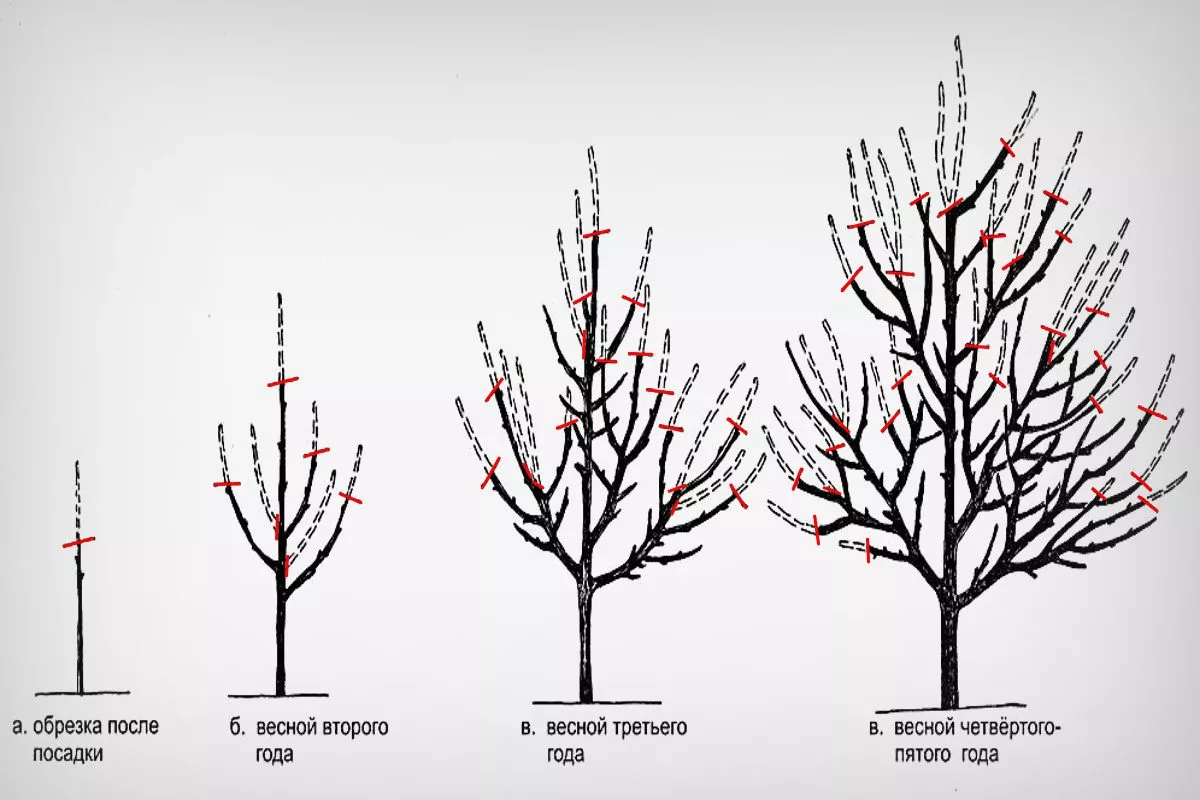
Recommendations for pruning the Chizhovskaya pear:
- In the spring, before the buds open, perform sanitary and formative pruning. Remove all dead, frozen, and damaged branches, and shape the crown. In the fall, perform only sanitary pruning—the tree doesn't need stress before winter.
- In the first year, prune young trees to a height of 1 m.
- In the second year, leave 3-4 large branches on the tree. Cut them back by 1/3. Remove all small branches. Repeat this procedure every spring for 2-3 years. When the tree reaches the desired height, prune the central branch.
- The number of branches pruned at one time should not exceed 25% of their total volume, otherwise the tree will be too stressed and will not be able to fully recover.
- Thin out mature trees to prevent them from becoming too dense. Also, prune branches growing inward or horizontally.
- After pruning, treat the cut areas with garden pitch to prevent infection.
Also watch a video about pruning pear trees in spring:
Preparing for winter
This variety is winter-hardy and doesn't require winter shelter. However, young trees are still covered for the winter. This protects them not only from winter frosts and sunburn, but also from rodents.
- Carry out moisture-recharging watering 2 weeks before the onset of frost.
- Insulate the trunk with burlap or special material.
- Mulch the tree trunk circle with a 10 cm thick layer of organic matter.
Recommendations regarding winter shelters for 1-2 year old Chizhovskaya seedlings:
- collect dry leaves and fallen fruits in tree trunk circles - sources of infection and a delicacy for rodents;
- wrap the trunks with spruce branches, spunbond or other covering material - in several layers, and tie with twine;
- Before covering the trunk, whitewash it and the lower branches - the whitewash smell and taste will scare away rodents;
- Mulch the tree trunk circle - mulch thickness 10 cm (this procedure can also be carried out for mature trees).
Insulating young pear trees is essential in regions with harsh winters. If the trunk isn't wrapped and the soil isn't mulched, the trees will likely freeze or even die.
Harvesting and storage
Chizhovskaya fruits are easy to transport, provided they are picked on time, but their shelf life is poor.
Recommendations for harvesting and storing crops:
- Pears, when overripened on the tree, lose their marketability and shelf life. It's best to pick the fruit slightly underripe and store them in a cool room. Here, they will ripen in 7-14 days, becoming juicy and delicious.
- To extend the shelf life of pears, store them at a temperature of 0 to +2°C. Recommended humidity is 80-90%. Under these conditions, they will last about 4 months; under normal conditions, about a month, no more.
- When storing pears, sprinkle them with dry straw - this will increase the survival rate.
Chizhovskaya pears can be eaten fresh or used for various preserves. They make excellent compotes, juices, wines, marmalades, jams, preserves, and other types of preserves.
Diseases and pests
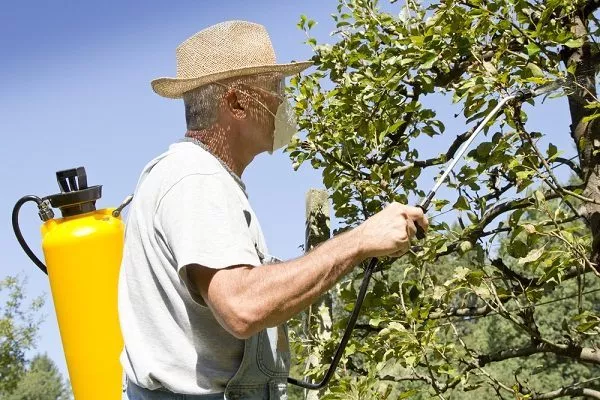
The Chizhovskaya pear has one important advantage: it's resistant to scab, so it doesn't require preventative measures. However, it's not immune to many insect pests, sooty mold, and fruit rot. To prevent widespread infestation, it's important to regularly inspect the tree and take appropriate measures promptly:
Table 2. Diseases and pests and how to control them:
| Name | Symptoms/Description | How to fight |
| Pear aphid | Small insects that feed on plant juices. | Destroy ants, attract ladybugs, spray with Inta-Vir. |
| Pear moth | A small gray butterfly lays its larvae in the fruit. The caterpillars eat the seeds. | Set up trapping belts, remove fallen fruit, burn fallen leaves, spray with Inta-Vir. |
| Pear copperhead | Small sucking insects. | Clean the trunk from old bark, burn fallen leaves, spray with insecticides |
| Fruit rot | The fruits have brown spots that are rotting the fruit. | Dig up the tree trunk circles and spray with 1% Bordeaux mixture at the budding stage. |
| Sooty mold | A black coating appears on the leaves. | Destroy aphids and leafhoppers, wash off plaque from leaves with water. |
Gardeners' reviews
The Chizhovskaya pear is definitely among the best frost-hardy varieties recommended for growing in temperate climates. It's a real find for regions with short, cool summers. Gardeners who plant at least one Chizhovskaya pear in their plots will be well-supplied with fresh pears and pears for winter preserves.