
Not everyone knows how to grow walnuts at home. Therefore, before planting walnuts, it's important to familiarize yourself with the two methods: seedling and seed. Each has its pros and cons, as well as nuances that every gardener should be aware of, as this tree grows in almost all regions of Russia.
Requirements for conditions
Walnut Originating in Asia, it prefers to grow in mountainous areas characterized by high sunlight, moderate moisture, and nutritious soil. The tree tolerates cool climates, but it absolutely does not tolerate shade, dense plantings, or excessive humidity.
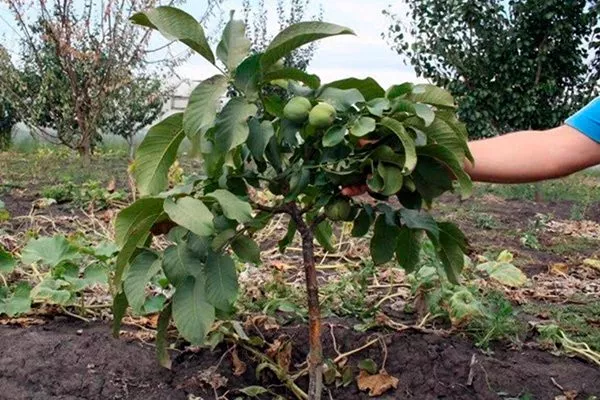
Conditions and requirements for planting walnuts:
- The area should not have shade or even partial shade, so planting the crop near buildings and taller trees is prohibited.
- It is not advisable to have fences at a distance of 5-6 m, since the walnut tree’s root system is very branched.
- The groundwater level should be at least 2.5-3.5 meters. This is because the plant prefers dry conditions to wet conditions. Furthermore, its extensive root system sends its shoots deep into the soil, which can lead to root rot.
- The optimal soil is carbonate loam. Walnut prefers a loose structure.
- If meltwater or rainwater accumulates on the site, it's not suitable. In this case, a solution is to create a slight slope with the soil mixture or dig ditches to drain the water.
- Pay attention to crop rotation. The following crops are best planted near walnut trees:
- bird cherry;
- dogwood;
- viburnum;
- hazelnut;
- quince;
- wild rose;
- raspberry;
- any currant.
- There are also a number of prohibited crops that are negatively affected by the toxins released by walnuts. These include:
- tomatoes;
- corn;
- eggplants;
- chokeberry.
- Wind is unacceptable. The main reason is the impact of spring frosts. If there are no drafts during this period, the tree will not freeze as severely. For reference, walnuts can withstand temperatures as low as -30 degrees Celsius in winter, but a drop in temperature in spring has a negative impact.
- Low-lying areas, gullies, swampy areas, river banks, ponds, and lakes are unacceptable.
Soil characteristics
Soil quality is a crucial factor for walnut cultivation, so agronomists pay special attention to it. To determine whether the soil meets the requirements, they analyze the soil for mineral levels using specialized equipment.
Soil reaction control
The optimal acidity level for walnuts is from 5.5 to 8.8 pH, but it is even better if it varies between 6.5-7.5 pH, and it is important that the soil contains calcium in a water-soluble form.
- ✓ The pH level must be strictly within 6.5-7.5 for optimal calcium absorption.
- ✓ The presence of water-soluble calcium in the soil is critical to preventing rot diseases.
If the soil isn't suitable, adjust it yourself. To do this, follow these steps:
- Lime overly acidic soil, otherwise putrefactive diseases will develop;
- Fertilize overly alkaline soil with acidic substances (magnesium, ammonium or potassium sulfates), otherwise chlorosis will occur.
Organic fertilizers
After correcting the acidity, fertilize the soil with organic matter. Cow or horse manure, compost, and rotted manure are good options. Digging the soil and adding some straw from grain crops is also a good option.
Humus promotes rapid root development, especially of small shoots, which improves mineral absorption. Additionally, aeration is improved, insoluble minerals are converted into soluble ones (making them readily available to plants), and sorption capacity is increased.
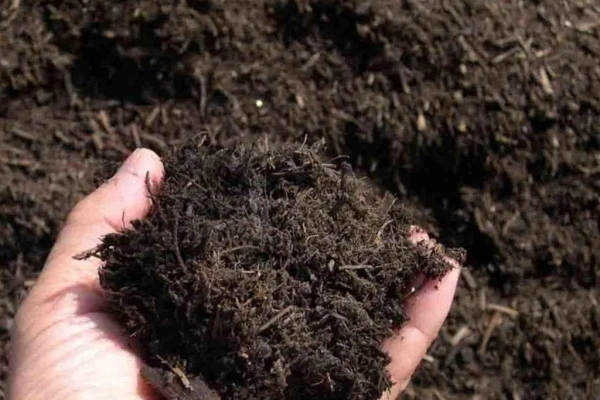
Many gardeners prefer to enrich the soil with humus using green manure. To do this, consider planting next to:
- oats;
- sunflower;
- lupine;
- rapeseed;
- mustard;
- Phacelia.
Mineral composition
Soil mineralization is also important for walnuts—if it's lacking, the tree won't bear fruit. Here's what to add:
- potassium in the form of potassium salt (applied 4-5 months before planting) or potassium sulfate (used when digging during planting);
- magnesium in the form of magnesium carbonate, sulfate or oxide;
- phosphorus and boron in any form.
- 4-5 months before planting, add potassium salt to enrich the soil.
- Before planting, dig up the area with the addition of potassium sulfate.
- After adjusting the acidity, add organic fertilizers (manure, humus).
Planting diagram
Unlike other garden crops, walnut planting patterns are varied, as they depend on many factors:
- The standard distance between both trees and rows is 10 x 10 m. Planting closer is not advisable, as the root systems of nearby trees will become entangled.
- With the standard tree arrangement, walnut trees will bear fruit normally for a maximum of 35-40 years. After this time, such a tree arrangement would be considered too dense, as the roots and aboveground parts become too overgrown.
As a result, the crown dies off at the base, so the nuts will form at the top. - If the soil is poor, the distance of 10 m is reduced by 1-2 m, if it is very fertile, on the contrary, it is increased.
- Some gardeners recommend planting according to an 8x6 m pattern, but it is better not to do this, as the trees will develop slowly, and after 25-30 years the planting will become densely crowded.
- The growth rate of the walnut tree must be taken into account—there are varieties that grow rapidly, while others develop slowly. In the former case, the distance between seedlings should be more than 10 meters.
In the second case, an 8x7 or 8x6 m scheme is quite sufficient. - If space does not allow you to plant trees at a significant distance from each other, feel free to plant them closer, but keep in mind that you will have to apply fertilizer much more often, and also make cuts.
- There are walnut varieties characterized by medium sizes. In this case, the pattern might be 3.5 x 3.5 on sloping terrain, or 4.5 x 4.5 on flat terrain.
Timing and features depending on the time of year
Walnut trees require ample water immediately after planting, so if this isn't possible, plant them in the fall. Seedlings that weren't watered thoroughly during the summer, especially in a dry region, will freeze more severely during the winter than if they were saturated with water in the summer.
The same thing happens if you plant the cuttings late.
Peculiarities:
- In autumn. Planting is permitted only during the period of active root growth. This is approximately from October 10th to 25th (for the central part of the country). Accordingly, it is later in the south, and earlier in the central part and Siberia. To determine the exact date, check the weather forecast – there should be at least 1-1.5 months left before frost.
If a snowless winter is expected, be prepared to create mounds around the trunk before laying down the covering material. In snowy weather, first wrap the tree in burlap and then cover it with snow. - In the spring. Intensive root development begins immediately after the snow melts and the soil begins to warm. This period lasts until the leaves begin to form. This is the most favorable time for planting walnuts in the spring.
If you plant later, all the energy and nutrients will be directed toward the growth of green mass, so the roots won't adapt and won't be able to develop properly. Watering even more generously than recommended can help.
How to plant walnut seeds?
Few people believe that it is possible to grow nuts from a nut, which is a planting material. grow a strong and fruitful treeIn fact, this is true, but to achieve a positive result, it is important to strictly adhere to the sequence of all work - seed preparation, planting.
Rules for selection of planting material
To ensure your seed germinates and takes root, learn how to choose the right planting material. Remember:
- The best month for collecting nuts for planting is considered to be the end of September - beginning of October, when the kernel is already fully ripe, but not dried out;
- good seed is large;
- the surface of the shell is free from chips and holes, traces of mold or disease;
- the internal contents are free of voids (such a nut is usually heavy);
- variety – must correspond to the climatic conditions of your region.
If you buy planting material, get it from trusted suppliers, and never from a store.
Methods of preparing seeds for planting
The seed propagation method for walnuts involves three preparatory technologies before planting in open ground:
- First. This is the simplest method, as it eliminates the need for soaking, stratification, etc. Simply spread the seeds directly on the soil under the tree in the fall and cover with a 15-20 cm layer of leaves. When it's time to plant in the spring, collect the nuts and plant them in the standard manner.
This method involves natural stratification, allowing natural chemical processes to occur during winter. The result is excellent germination with no drawbacks. - Second. Ideal for thick-shelled nuts. This procedure is performed in the spring (April-May) or fall (early November). How to prepare the seeds:
- Moisten the sand and place it in a large container (plastic container).
- Place the nuts in a single layer so that the seed walls do not touch each other.
- Cover with another layer of damp sand.
- Take it to a cool place, such as a basement, where the temperature varies from 0 to +5 degrees (optimal for stratification).
- Keep it like this for about 100 days, periodically moistening the sand.
- Third. Suitable for thin-skinned eggs, as it reduces the risk of rotting of the thin shell. Preparation process:
- Place the nuts in a container and cover with water. The average temperature is about 50 degrees Celsius.
- Cover with a lid (if you don’t have one, cover with thick plastic).
- Place in a warm room (kitchen, near a radiator, etc.).
- After 2 days, drain the liquid so that approximately 5-8 mm of water remains at the bottom.
- Cover and place in a warm place for 21 days, opening the lid for half an hour daily for ventilation. Check the condition of the peels—they shouldn't be too wet or dry.
- Remove any nuts that have sprouted and plant them in the garden.
How to plant a walnut seedling?
Planting seedlings is a common practice for fruit crops, but there are some subtleties that must be followed for successful completion, especially when it comes to the quality of the cuttings.
Cutting requirements – how to choose?
A promising seedling should have 3 to 5 skeletal branches and be completely healthy. Otherwise, the tree will be unable to withstand external factors, and the infection will spread throughout the trunk and roots, leading to its death.
What kind of cutting should I take?
- the trunk must be woody - if it is green, it will not have time to form during the season, since growth will be directed towards the root system;
- the roots should have a branched shape and a uniform structure;
- the bush is fresh if “live” wood appears after the scratch;
- root shoots are light, without black spots;
- bark - smooth;
- the trunk is straight;
- cutting height – about 30 cm;
- age – 1 or 2 years;
- There shouldn't be any leaves.
Preparing the seedling
A mandatory requirement in preparatory work is trimming excessively long roots. Twisted and damaged shoots are removed. If the root system is open, it must be soaked in water for 24 hours before planting. If it is closed, a misting with a spray bottle is sufficient.
You can also grow a seedling yourself. This can be done in various ways, including layering, grafting, and cuttings. The latter is considered the most popular, quick, and effective.
The process of harvesting and rooting:
- Water the tree generously, and after the water has completely absorbed, select one-year-old cuttings growing on the south side and at a height of at least 5 m.
- Measure about 40 cm from the end of the branch.
- Treat pruning shears or a garden knife with a light pink solution of potassium permanganate.
- Cut and then divide the shoot into two cuttings. Keep in mind that the lower cut should be made at a 45-degree angle, and the upper cut should be straight.
- Apply garden pitch to the cut areas on the mother tree.
- Make a potting mix in a container. There are two options:
- moisten the sand;
- Mix peat and turf soil in equal proportions.
- Insert the bottom of the cutting into the soil, having first made a 6-8 cm hole. Compact the soil mixture with your hands.
- Move the container with the seedling to a room where the temperature ranges from 0 to 5 degrees Celsius. A cellar, basement, or greenhouse is ideal. In the latter case, it's advisable to shade the area containing the cuttings.
Rooting occurs within 3-4 months, after which the seedling can be transplanted into open ground. Periodically, while the cutting is in the substrate, moisten the soil mixture and inspect it for moisture. pests and diseases.
Step-by-step planting instructions
The planting pattern, method, and other parameters directly depend on the type of planting material, but it's important to strictly adhere to all individual requirements. Otherwise, the plant will have difficulty adapting to the new conditions.
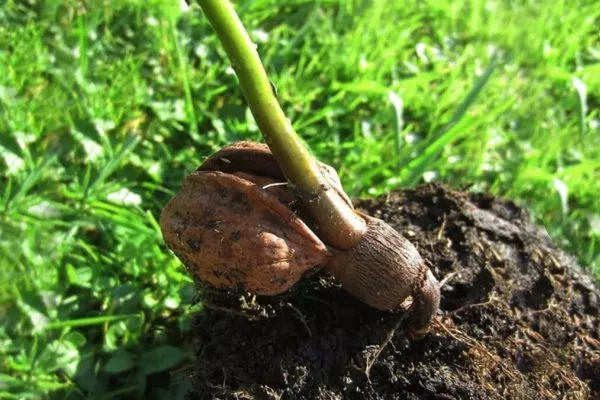
Planting seeds
Walnut seeds can be planted without sprouting. This is especially true for fall planting, as natural stratification occurs. Here's how to do it correctly:
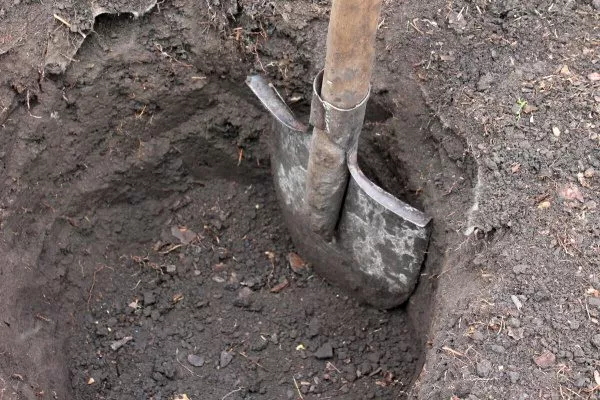
- Prepare the planting hole a couple of weeks before planting. Create a 30x30 cm hole. Add 10 kg of compost, 50 g of superphosphate, and 200 g of wood ash to the excavated soil.
- Leave until planting time, covered with plastic film.
- On the day of planting, make a 10 cm deep hole.
- Place the nuts on one side at a distance of 20-30 cm from each other.
- Cover with a layer of fallen leaves of at least 10-15 cm.
In the spring, you will find sprouts that need to be thinned out, leaving a distance between them according to the chosen scheme.
How to plant a sprouted nut?
If the nuts have already sprouted, proceed as follows:
- Dig a planting hole 90-100 cm deep.
- Add humus to the excavated soil in equal parts to the soil. Add 200 g of charcoal.
- Make holes 15-18 cm deep.
- Moisten the soil (approximately 6-7 liters of water), let the liquid soak in completely.
- Insert the sprouted seed with the sprout facing up.
- Sprinkle with soil and compact lightly.
- Carry out light hilling of the future seedling.
- Water the planting.
How to plant a rooted seedling?
It is advisable to transplant rooted seedlings into open ground together with a lump of earth, that is, with a closed root system, but they can also be planted with bare roots.
The planting process is simple:
- Dig a hole. Its depth should be 10 cm greater than the length of the roots.
- Place broken bricks, stones or expanded clay on the bottom to create a drainage system.
- Prepare the soil mixture as you would for planting seeds. Fill the hole to 2/3 of its total depth.
- If you're planting a bare-root cutting, form a small mound and place the tree on it, spreading out the roots. If you're planting a closed-root cutting, place the seedling in a hole.
- Insert a wooden stake nearby – its height above the ground should vary in the range of 1.3-1.8 m.
- Sprinkle with substrate on all sides.
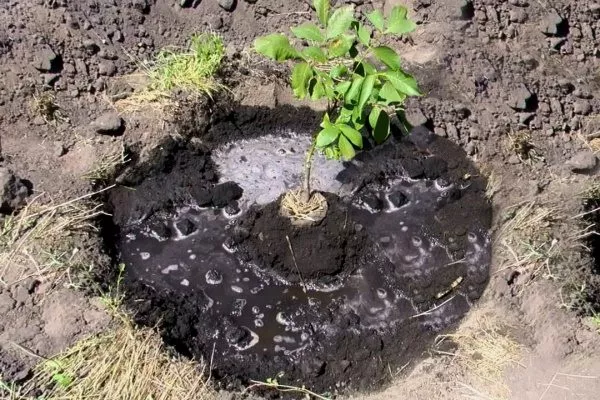
- Form a ridge-shaped mound around the seedling to prevent liquid from leaking outside the trunk circle when watering.
- Water the cutting. One planting hole requires 1–12 liters of water.
- Apply mulch with peat, straw, sawdust, or freshly cut grass. When planting in the fall, it's advisable to use humus, which will provide warmth during the winter.
For more information on planting a walnut seedling, watch the video below:
Is it possible to plant it in a pot at home and what will happen?
Walnuts are planted in pots only in the fall – this way, the seedling can be preserved until spring. To do this, follow these steps:
- Prepare a container with a diameter of 25-50 cm, depending on the age and size of the seedling.
- Make or buy a substrate.
- Soak the cutting's root system in any rooting product (growth stimulant) for the time specified in the instructions. If you don't have any, simply soak the roots in water, but in this case, keep them soaked for at least 24 hours.
- Place a 5-6 cm drainage layer on the bottom.
- Pour the soil mixture into the pot so that a depression is formed in the center.
- Insert the seedling and compact the substrate slightly.
- Water it so that the liquid does not stagnate, but is not dry either.
You can plant seeds in a container in the same way. Keep the following in mind:
- the depth of planting nuts is 5-7 cm;
- place the seeds sideways;
- cover the pot with plastic wrap until sprouts appear;
- each seed requires its own container;
- when the sprouts form, remove the covering;
- The pots should be kept in a warm and well-lit place.
Further care
Immediately after planting a walnut tree, the following care procedures are required:
- There is no need to prune a young tree after planting; this is done after a year;
- Fertilizers are also not applied - for the first time after 2 years;
- You need to water regularly, especially in the summer - one bush requires about 25-30 liters, 2-3 times a month;
- Mulching and loosening after soil moistening are mandatory procedures.
When planting walnut trees, it's important to strictly follow the soil mix preparation guidelines. Avoid overdosing, as this can burn the young roots. Always consider the condition and quality of the soil in your garden, adjusting its acidity, which affects the seedling's survival rate.