
Before storing walnuts, carefully familiarize yourself with the basic methods for preventing the kernels from retaining their bitterness. It's important to know that spoiled nuts are not only unpleasant to eat (due to the deterioration in flavor) but also unsafe for your health, as they are sometimes susceptible to diseases and pests.
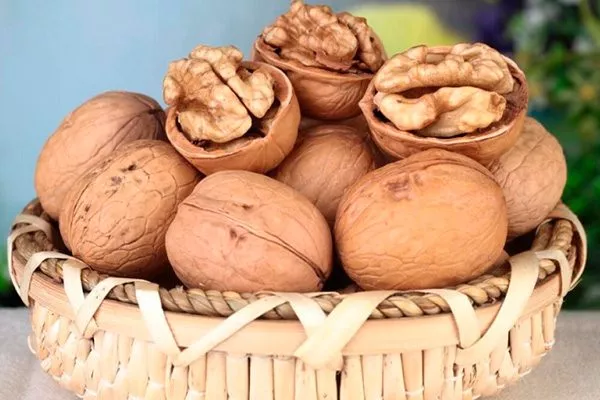
When and how to harvest for further storage?
To walnut fruits To be stored safely and for a long time, they need to be harvested properly. The first thing to know is the harvest time, as if it's not observed, the kernels from the pericarp become saturated with substances that cause the fruit to turn black.
If nuts are left in the grass or open ground for a long time, mold will form. If the nuts are harvested prematurely, the kernels dry out and shrivel, and the shells lose their marketable appearance.
The harvest period depends on the variety:
- the early ripening variety can be picked from the tree from August 20 to September 10;
- mid-season – during September;
- late-ripening – from September 25 to mid-October.
The maturity period also depends largely on climate conditions and the current weather. Therefore, it's best to determine the maturity period based on the nut's signs of maturity:
- cracking of the green pericarp;
- yellowing and slight looseness of the shell;
- yellowing on leaves.
Please note that some walnut varieties may not ripen at the same time. In such cases, you will need to split the harvest into 2-3 times. It's acceptable to pick the nuts 6-10 days earlier, as they will ripen more quickly indoors.
How to harvest:
- for the upper branches you can use a long stick with a hook at the end;
- Collect nuts from the lower tier of the tree by hand;
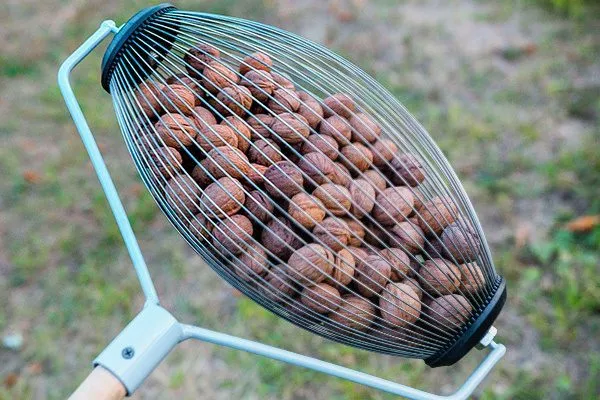
- If the nuts fall off, simply collect them with your hands, remembering to wear rubber gloves to prevent your hands from turning yellow (or use a special device - a roll like the one in the picture below).
Rules for storing walnuts
Not only is it necessary to harvest the nuts correctly and in a timely manner, but also to prepare the nuts and create optimal conditions, which involves pre-selecting the fruit, finding suitable premises and containers, etc.
Product selection
Walnuts intended for long-term storage must be of high quality, so when selecting the fruits, pay attention to good indicators:
- tight fit of two shells to each other (so that there are no gaps between them);
- slightly pronounced ribbing of the surface, slight roughness;
- free separation of kernels into halves and quarters;
- no crumbling, which indicates that the nut is dry;
- when shaking the fruit, there is no ringing sound in the shell;
- the heaviness of the nut, which can be easily checked by placing it in water (it begins to sink);
- specific aroma of nuts (more green shell);
- the color of the kernels is light brown or light gray;
- absence of wrinkling on the core;
- evenness and symmetry of shape;
- there is no amniotic sac.
- ✓ Check the nuts for cracks in the shell, which may not be visible upon cursory inspection.
- ✓ Make sure that the kernels are free of mold, which is especially important for nuts collected in rainy weather.
There are also negative signs that indicate that nuts are unsuitable for storage:
- blackening of the shell and kernel;
- the ability to crack a nut with your fingers (the exception is certain varieties with very thin shells);
- lightness of the fruit;
- wrinkling;
- change in the color of the core to a bright yellow color (more common among sellers who use chemicals as a processing solution).
Optimal storage conditions and locations
It's important to create favorable conditions for walnuts to prevent them from spoiling. Please note the following:
- The temperature range varies from +10 to +20 degrees, but deviations of 5 degrees in either direction are permissible.
- Humidity should be no more than 40-70%. Any higher than this will make the shell susceptible to mold and other diseases. Once the surface of the nut is affected, the infection quickly spreads to the kernel, especially in thin-skinned varieties.
- Expiration date. Determined based on the method:
- If stored in the shell – 1 year, if peeled – 4-6 months.
- Nuts can also be stored in the freezer for 12 months, and in dry conditions for six months.
- In a room in a bag made of natural raw materials in the peel - 5-6 months, in glass jars without shells and in the dark - 9-10 months.
- Without a hard shell in a plastic container - about 3 months, in a canvas bag - only a couple of months.
- Packaging for nuts must be breathable; without ventilation, the fruit will begin to rot.
- The location should be such that small rodents cannot get to it, so it is best to use the top shelves.
- The storage capacity can be as follows:
- corrugated cardboard box;
- wooden box;
- cloth bag;
- honeycomb fruit containers;
- vegetable nets;
- basket made of natural wicker;
- sealed polyethylene bags - exclusively for freezer use;
- glass jar with an airtight lid.
- Storage areas – freezer, cellar, kitchen, pantry, balcony/loggia, etc.
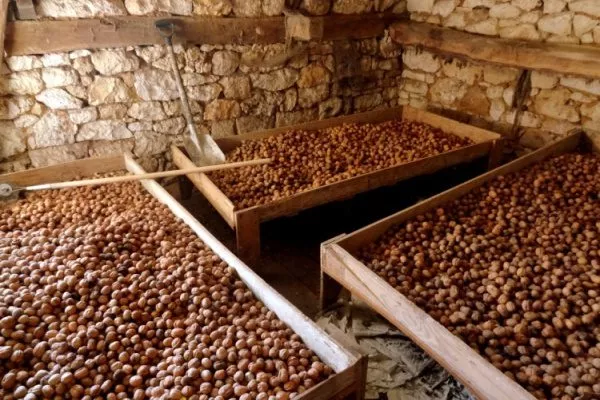
How to store nuts properly?
There are only two ways to preserve nuts, depending on the condition of the fruit—in-shell or out-of-shell. Each method has its own pros and cons, subtleties, and nuances:
- In the shell. The best places to store nuts are a pantry, cellar, or kitchen. Storing them on a loggia or balcony is acceptable, but in this case, you'll need to limit moisture exposure. Sudden temperature fluctuations should also be avoided. Typically, the nuts are stored in canvas bags, nets, or cardboard boxes.
Additionally, the nuts are sprinkled with very dry sand, paper, rags, but best of all – wood shavings/sawdust. Features:- This method has many advantages: increased shelf life, no need to peel a large number of nuts at once;
- There are also disadvantages: whole fruits take up a lot of space, and the gardener doesn't know for sure whether all the nuts are edible, since there is no access to the kernel.
- Cleaned. It's convenient to store kernels in the freezer or simply on the refrigerator shelf, but the former will cause some loss of nutrients. They can be stored in glass or plastic containers.
The main requirement is regular inspection of the kernels, as they spoil faster than the shelled fruit. Features:- Pros: no need to peel before cooking, maximum shelf life in the refrigerator, kernels take up minimal space, the gardener can see the quality of the product;
- Disadvantages: rapid spoilage, high risk of moth infestation, need for cleaning (takes a lot of time and effort).
Methods for extending shelf life
To ensure long-term storage of walnuts, it's important not only to follow proper storage conditions but also to use shelf-life-extending methods. This particularly applies to preparatory work, which many people overlook.
Sorting
Whether you bought walnuts or picked them from your own garden, you need to sort them. This will help them last as long as possible. Here's how:
- First, select damaged specimens and discard them or consume them immediately.
- Then arrange the fruits by size – large to large, etc.
- Next, sort them into piles based on color. Store the light brown ones separately, and add the slightly darker ones to another "group."
If you plan to store peeled walnuts, additionally try to remove all fallen membranes.
Calcination
Drying kernels or nuts in their shells is a mandatory preparatory procedure before storing. However, roasting can also be used. This procedure destroys pathogenic microflora, allowing the product to last much longer than expected. It also improves the product's flavor.
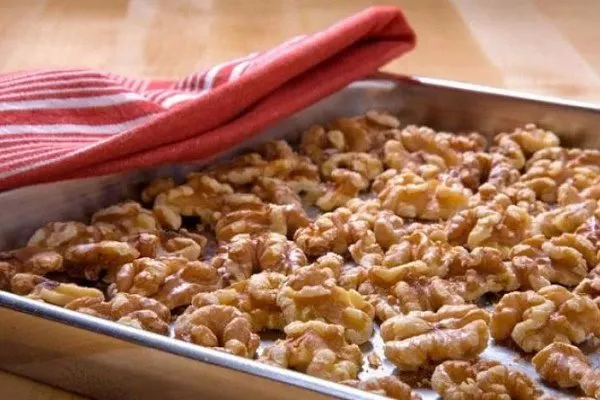
Calcination methods – options to choose from:
- Oven. Both peeled and whole fruits are dried. The only difference is the drying time. The process is as follows:
- Preheat oven to 45 degrees.
- Line a baking sheet with parchment paper if drying peeled specimens, as oil may be released.
- Arrange the nuts in one, maximum two layers.
- Bake in the oven for 3 hours if the fruit is in the shell, or 2 hours if it's unshelled. Leave the oven door slightly ajar to allow moisture to evaporate.
- Turn the appliance on to 70 degrees and continue drying for another 30 or 20 minutes.
- Electric dryer. The process is very simple, but time-consuming. Arrange the nuts in a single layer in sections, set the temperature to 40 degrees Celsius, and bake for 4.5 to 6 hours.
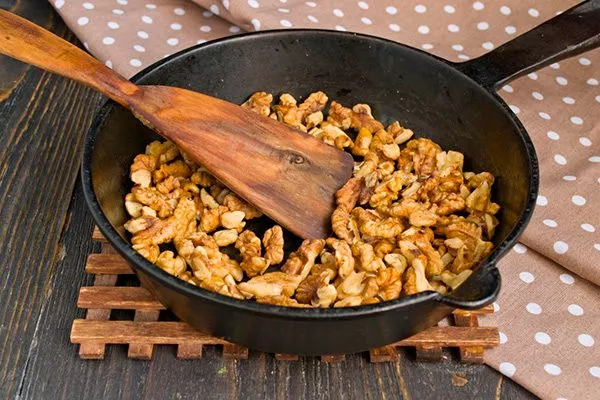
Pay attention to the instructions for your appliance – each model has its own drying parameters for a particular product. - Pan. Nuts can be cooked in a frying pan. To do this, place the kernels or whole nuts on a completely dry frying surface, stirring constantly. Fry the shelled nuts for about 15 minutes, or the shelled nuts for about half an hour.
Freezing
Freezing walnuts will reduce their nutritional value by about 5%, but will kill pathogenic microorganisms. If you don't plan to store them frozen, you'll need to thoroughly dry them after freezing.
- in the sun outside for 5-7 days;
- oven;
- electric dryer.
How to freeze:
- Wash and brush the surface of the fruit.
- Peel the shells.
- Carry out sorting.
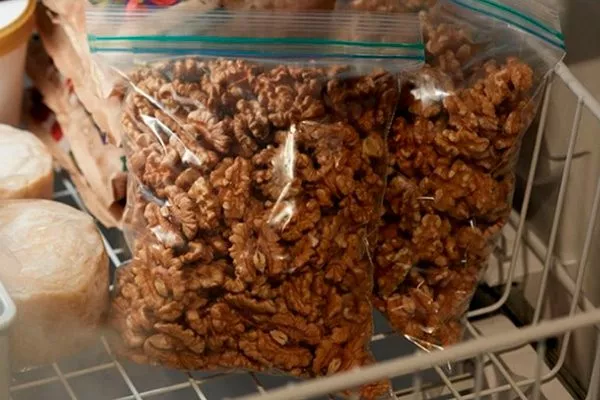
- Place the kernels in a plastic container and cover with a lid. If using plastic bags, pour the nuts into them, trying to squeeze out as much air as possible. Just tie the bag shut. Vacuum-sealed bags are the best option.
- Place in the freezer. If freezing is just a preparatory step, keep the nuts in the freezer for about 2-3 days.
- Rinse the nuts in cold water to remove dust and possible contaminants.
- Dry the nuts thoroughly by spreading them out in a single layer on a towel for 24 hours.
- Pack the nuts in vacuum bags, removing as much air as possible.
Initially, separate the nuts into portions, as they are not subjected to secondary freezing.
Where does bitterness come from?
Nuts with bitter notes are unlikely to be used in cooking. Removing this flavor is difficult, so the simplest approach is to prevent the bitterness from developing.
First, you need to understand where the bitter taste comes from and what the cause is:
- Shell. It's this membrane that causes the bitterness, especially if the membrane is light-colored. This happens in two cases: when the nut has just been picked or when it belongs to a certain variety. Nuts with a dark or normally ripened, dried membrane don't taste bitter.
This bitterness is not at all dangerous to human health. - Oil. Nuts contain a large amount of oil, which shouldn't be bitter. An unpleasant taste occurs when the product goes rancid and isn't stored properly.
The oil structure itself spoils quickly, and given the large percentage of it found in the kernels, the rancidity process is considered rapid.
The main reasons for product spoilage with the formation of bitterness:
- Untimely harvest. In 90 out of 100 cases, nuts taste bitter because they're picked too early. This is because the shell hasn't had time to form yet, resulting in an excessive concentration of iodine compounds.
- Incorrect storage. The oil in nuts is lost when the temperature during storage is too high. Another factor is high humidity, which leads to the development of fungal diseases, the bacteria of which damage the oil structures.
- Incorrect transportation. If storage conditions are not met during transportation, the oil will spoil.
How to remove bitterness from walnuts?
Nut lovers have long tried to find ways to remove the bitterness from nuts. They've succeeded. There are numerous methods, but only a few are truly worth considering.
Washing
If the cause is film-like bitterness, such as when the fruit is picked prematurely, the kernels can simply be rinsed under running water. Here's how to do it:
- Pour water at a temperature of 20 degrees into a bowl.
- Place the peeled nuts and wash them thoroughly with your hands, sorting them with your fingers.
- Drain the water and fill it with clean water at the same temperature.
- Rinse again and drain again.
Repeat this until the bitterness is no longer felt.
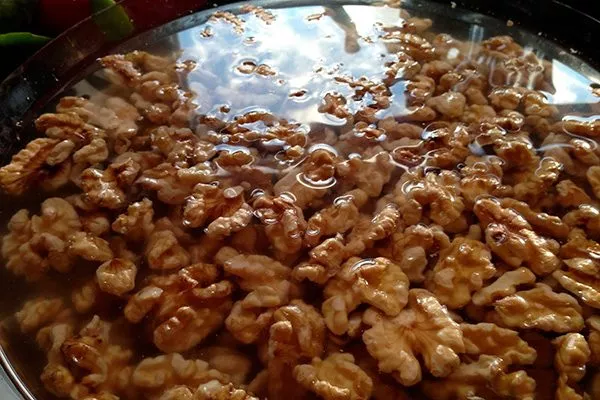
Soak
This method, unlike the previous one, also takes a lot of time, but it requires much less effort. What to do:
- Pour nuts into a bowl.
- Fill them with cold water, the temperature of which is close to 0 degrees.
- Leave for 10-12 hours.
- Drain the water completely.
- Fill the bowl with new water of any temperature and rinse the kernels.
- Drain the water and dry the fruits.
Roasting
Roasting to remove bitterness, unlike the method used to prepare nuts, involves roasting the nuts until they reach a golden brown. The stove should be set to the lowest setting, so the bitterness is released during roasting. All that remains is to cool the nuts and remove the shells.
Cooking in sugar syrup
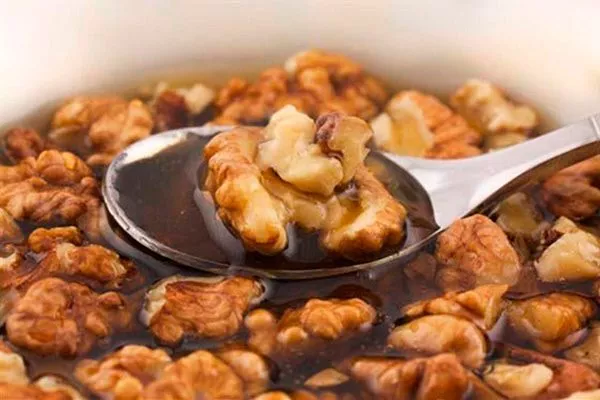
The sweet syrup imparts an appealing flavor and aroma to the kernels, making them perfect for baking or eating. How to process them properly:
- Dissolve sugar in hot water (choose the proportions yourself, based on your own preferences).
- Pour into a metal container and place on the stove.
- Heat until warm and add kernels.
- Bring to a boil (optimal temperature is 100 degrees).
- Boil for exactly 1 minute and immediately remove the kernels from the syrup.
It can be consumed after cooling.
Frequently Asked Questions
There are a number of questions that interest gardeners and walnut lovers:
- Can walnuts be stored in the refrigerator? The answer is a resounding yes. Moreover, this method is considered one of the best, as the low temperature completely halts spoilage. To achieve this, it's best to place the kernels in the freezer.
If you store them on the refrigerator shelf, maintain a temperature between 0 and +4-6 degrees Celsius. You can store them either in their shells or peeled.
Tip: When storing nuts in the refrigerator, don't immediately cover the container with a lid. Leave it uncovered for about an hour to prevent condensation, which can cause spoilage. - Do walnuts need to be washed? This is essential, as the shell surface harbors a large number of pathogenic microorganisms. After washing, it's important to dry the product naturally.
If you plan to store peeled fruits, rinse the shells before peeling, and to kill any infection, scald them with boiling water. This way, you won't have to re-wash the kernels. - Can green nuts be stored? No, you shouldn't do this for several reasons: the product doesn't contain the maximum amount of beneficial elements, the kernels will taste bitter, and the nut will quickly spoil due to the high humidity inside the shell.
- Do nuts lose nutrients over time? If walnuts are stored shelled, some of their nutrients will evaporate due to oxidation. When stored in the shell, the nutrients remain intact for approximately 2.5-3 years.
To prevent nuts from spoiling and becoming bitter, you need to know how to store them properly. There are two main ways to do this: in the shell and shelled. If the kernels have already gone rancid, the situation can be corrected using methods to remove the bitterness.