
The Chandler walnut has been around for a long time, and over that time has become the most popular and sought-after variety not only abroad but also in our country. It is a clear best-seller among various nurseries, as it boasts numerous positive characteristics, particularly high fertility and excellent fruit quality with thin skin.
History of appearance
The Chandler walnut, also known as the Chandler, was developed by CMT in 1979. Its alternative name is Juglans regia 'Chandler'.
Botanical description of the tree
The plant is characterized by medium growth and a spreading, oval-round crown. Trees reach a height of 650-700 cm. Other varietal characteristics:
- crown density is at an average level;
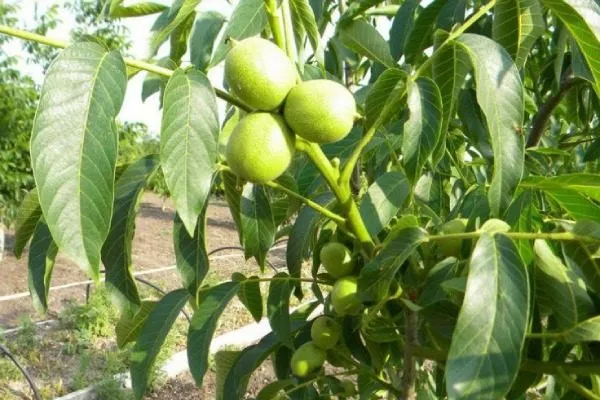
- elliptical leaves with a matte and completely smooth surface, dark green in color;
- the edges of the leaf blades are uniform, without cuts or nicks;
- the shoots are of medium thickness, but quite strong;
- branches of the bare type with brown bark and erect type.
Fruit characteristics
Chandler is a large-fruited walnut with a flat, rounded shape. Other characteristics:
- the weight of fruits varies from 8 to 13.9 g;
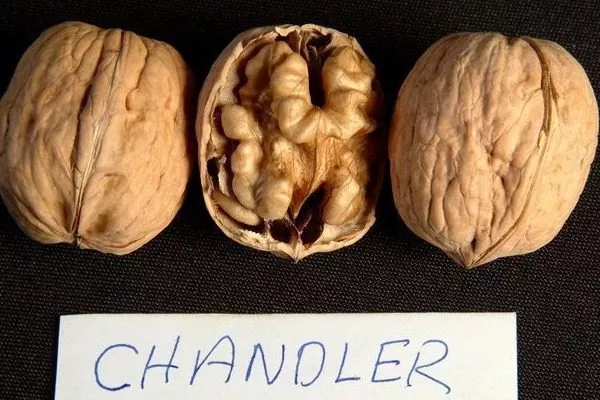
- the shell has a rough surface and strong ribbing;
- the shade is dull brown, and the thickness of the shell is thin;
- the shape of the variety is rounded and pointed (at the base and at the tip, respectively);
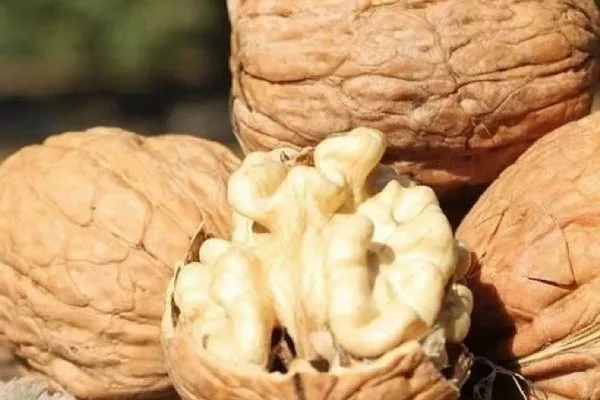
- the shell and kernel are easy to separate;
- the core is also large and compacted;
- the taste is not bitter or astringent;
- white walnut (90%+ whiteness), its oil content is 60-70%;
- The length of the nut is 3.5-4.5 cm.
Key Features
Chandler is self-pollinating, guaranteeing a harvest without the donor tree's intervention. However, using a pollinator significantly increases yield. For Chandler, the Franquette variety is recommended. The ratio of trees should be 95% Chandler and 5% Franquette.
Other characteristics of the variety:
- The Chandler variety is classified as mid-early and harvesting takes place in late August or early September.
- It has high resistance to various diseases and pests, but can be susceptible to attacks by parasitic insects such as the walnut beetle and codling moth.
- In Russia, Chandler is recommended for cultivation in regions such as Krasnodar Krai, Kabardino-Balkaria, Ossetia, Stavropol Krai, Rostov Oblast, Adygea, and some other areas with warm climates.
Despite this, it is planted even in the north of the country. - Chandler impresses with its early fruiting: you'll be able to enjoy a harvest within the first year after planting. However, it takes three years for the trees to produce a commercial crop. The first, most abundant harvest can be expected at five to six years of age, with fruiting occurring annually.
- Chandler's rhododendron typically blooms between mid- and late April, depending on local weather conditions. Deciduous seedlings of this variety begin flowering later than other species. This is an exceptional advantage, as late flowering protects the plants from frost, pests, and rodents.
- Vitality: Trees can live up to a hundred years or more.
- Frost and drought resistance: The Chandler variety, as a late-blooming walnut tree, is not susceptible to frost. It is also drought- and heat-tolerant.
Chandler's yield steadily increases with time after planting, peaking in the tenth year and then stabilizing at this level. A mature, well-maintained tree can yield 30 to 40 kg of dry-shelled nuts annually, equivalent to over 10 tons per hectare.
Experts believe that Chandler's yield at different stages of the tree's life is as follows:
- at the fifth anniversary – 30 kg of fruit;
- in the seventh to tenth years – 70-90 kg;
- at fifteen years old – 150 kg.
Planting and growing conditions
The Chandler walnut, native to Greece, prefers sunny locations and soil that doesn't retain water. Planting this variety is recommended from November to April, taking local weather conditions into account. Regular watering and fertilization are necessary to ensure abundant fruit production.
Landing rules
In southern regions, the optimal time for planting is spring, and in northern regions, autumn. It's important to maintain the ambient temperature between 7 and 9 degrees Celsius for a month.
Preparing for landing:
- Choose a location with fertile soil and dig a hole no more than 60 cm deep and no larger than 60 cm in diameter. If the soil is poor in nutrients, the hole should be at least 1 m deep.
- When preparing for planting, only the top layer of soil to a depth of 30 cm is used.
- Sod is poured into the hole, manure, peat, and potassium preparations are added.
- When planting, carefully distribute the roots of the seedling over the created mound and cover with substrate, which is then tightly compacted.
- After compaction, it is necessary to moisten the planted plant.
- The root collar should be 5 cm above ground level.
- To protect the seedling from damage, it must be secured to a wooden stake, which will prevent breakage.
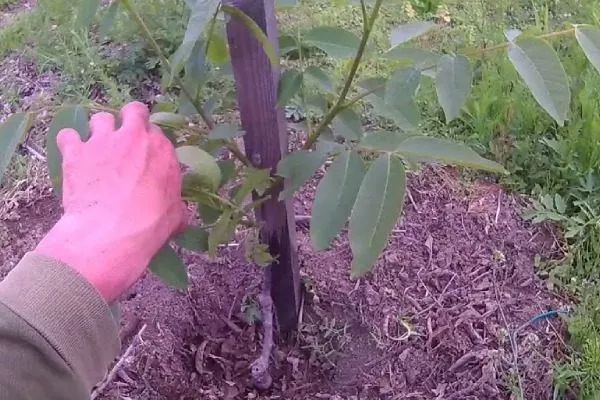
The best planting pattern is 6-7 meters between trees and 5-5.5 meters between rows. This spacing allows the trees to develop freely. With this pattern, approximately 310 trees can be planted per hectare.
Care
During the first seven days after planting, the nut tree requires regular soil moistening. Water should be applied to the roots in the evening. Once the tree reaches four to five years of age, watering intensity can be reduced.
Other care measures:
- Nutrition. If the tree was fertilized at planting, the next application should be made after four years. In the spring, it's important to add nitrogen fertilizer to stimulate crown growth, followed by potassium and phosphorus.
- Trimming. In early spring, excess branches are trimmed, removing diseased and broken parts. Use a saw, pruning shears, or a garden knife for this, and treat all cuts with garden pitch. Formative pruning aims to improve light and ventilation of the crown.
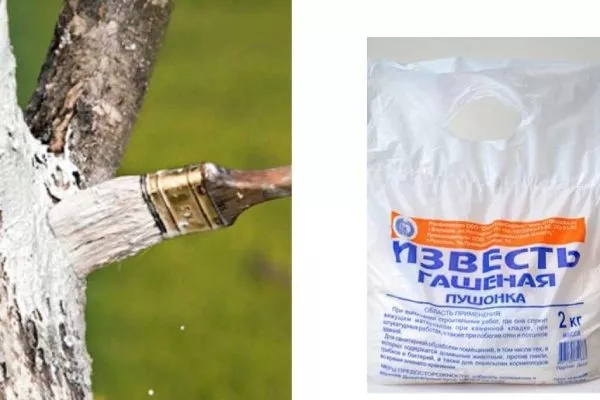
- Whitewash. When the average daytime temperature reaches 3-4 degrees Celsius, it is recommended to whitewash the trunk. This requires a solution of slaked lime. Whitewashing protects the walnut tree from pests and fungal infections and prevents the harmful effects of sunlight.
Preparing for winter
To protect a young tree, cover it with agrofibre or natural burlap. Before frost sets in, carefully cover the top layer of soil around the trunk with at least 10-15 cm of mulch.
Harvesting
The fruits ripen in stages, necessitating multiple harvests. The fruits are picked by hand from the bottom of the crop. In open and windy areas, some fruits may fall off on their own, after which they must be collected, washed, and dried.
Peculiarities:
- When the fruit falls to the ground, the skin often peels off on its own, otherwise it should be removed immediately to preserve the unripe nut.
- For proper drying, it is necessary to lay out the harvest in one layer and stir it periodically.
- If it is not possible to wait for the shells to dry naturally, the nuts can be dried in the oven at a temperature of up to +45-50 degrees.
- Nuts should be stored in a dry place, protected from light.
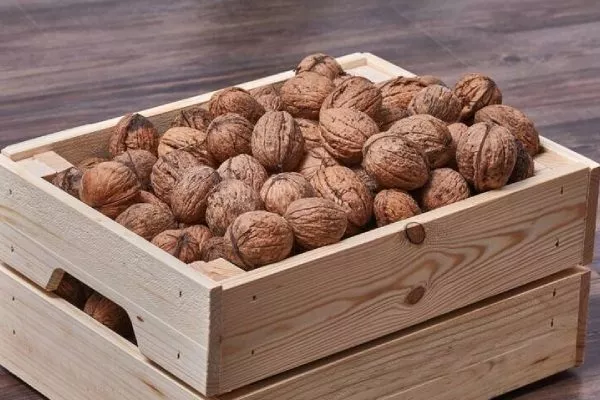
- Sorting is done in canvas bags or wooden boxes.
- There should be no other products in the storage room, as nuts can absorb even mild odors.
Diseases and pests
The Chandler walnut is highly resistant to disease and insect attack. However, even this variety is not completely immune to problems such as fire blight, root canker, and bacterial rot, which can be caused by overwatering.
- To minimize the risk of infection, it is recommended to carry out preventative treatments using copper-based preparations every spring.
- If disease does occur, it is important to remove the infected parts of the tree and dispose of them away from other nut trees to prevent further spread of the infection.
Among the pests that can threaten Chandler are aphids, walnut moths, mites and codling moths:
- To protect the tree from them, you should regularly remove weeds around the walnut trees.
- If pests are detected, acaricidal agents must be used.
Pros and Cons of Chandler
The variety has a huge number of positive qualities, but the following stand out in particular:
Disadvantages: the large size of the crown limits the possibility of planting in a small space.
Reviews
The Chandler walnut is renowned for its abundance of large fruits with a thin yet relatively strong shell. This variety can withstand both drought and cold snaps, blooms late, but produces fruit in the mid-season.