
The Mara cherry plum demonstrates exceptional reliability, delivering consistent yields even in variable weather conditions. One of its notable qualities is its winter hardiness, making it an ideal choice for growing in cold climates.
The origins of the Russian plum Mara
Scientists V. A. Matveyev, M. P. Malyukevich, Z. A. Kozlovskaya, and M. G. Maksimenko developed a variety at the Belarusian Institute of Fruit Growing, which they named "Mara." This hybrid was selected from seedlings obtained by open pollination of wild cherry plum and Chinese plum.
In 1999, the variety was registered in the State Register of Varieties of the Republic of Belarus. Since 1987, Mara has undergone state variety testing in the Russian Federation, and in 2002 it was recommended for use in the Northwestern, Central, and Volga-Vyatka regions.
Description and characteristics
The Mara cherry plum has excellent characteristics and frost resistance. It is popular among both novice and experienced gardeners.
Tree
The Mara tree is a tall tree with a rounded, moderately dense crown. In just five years after planting, it can reach a height of 3-4 meters, demonstrating its rapid growth. The tree's bark is dark brown, turning burgundy on young branches.
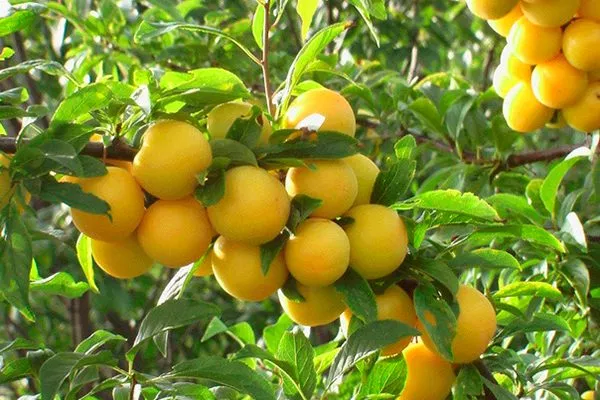
The leaves are bright green, glossy, and elongated oval in shape with a pointed tip and serrated edges. These leaves are relatively large. The flowers are solitary, small, and white. The tree's spring blooms are abundant and lush, making it a true garden ornament.
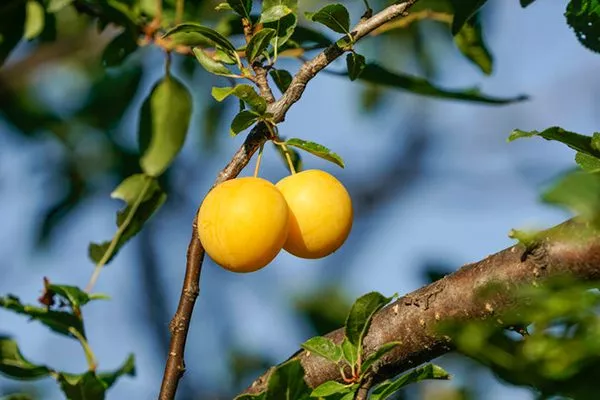
This variety of cherry plum, especially in the first years after full rooting in the area, exhibits a high growth rate.
How it blooms and pollinators
The Mara variety is characterized by a long dormant period, which delays ripening until late in the season. It blooms in May, when the risk of frost is minimal. The young, sticky leaves are almost invisible behind the white flowers.
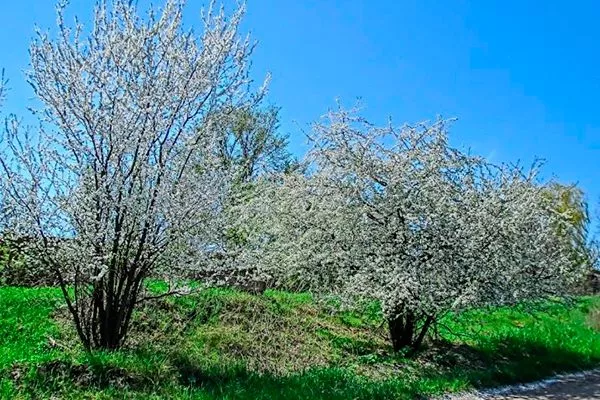
Mara is an excellent pollinator for other varieties, but on its own, without the presence of other types of cherry plum, Ussuri, Russian or Chinese plum, it can produce no more than 4% of the expected yield.
For optimal pollination of this variety, it is recommended to use wild cherry plum or Belarusian-bred cultivars such as Asaloda and Vitba.
Fruit characteristics
The fruits are bright yellow, round, and slightly flattened at the ends. Each berry weighs approximately 25 g. The flesh is loose and juicy, surrounded by a thick skin. A medium-sized seed is embedded in the flesh, making it difficult to separate.
| Parameter | Characteristic |
|---|---|
| Form | Rounded, slightly flattened |
| Skin color | Bright yellow |
| Fruit weight | 23-27 g |
| Pulp | Loose, juicy |
| Bone | Medium size, difficult to separate |
| Tasting evaluation | 4.2 out of 5 |
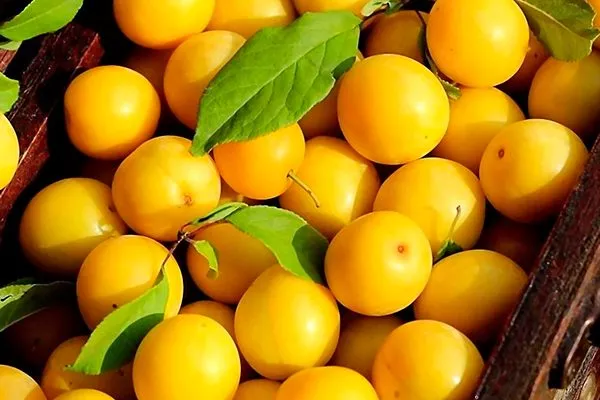
Mara fruits have excellent shelf life. At normal temperatures, they can be stored for up to a month, which helps preserve their freshness and flavor.
When the crop ripens and the harvest
The variety begins bearing fruit 2-3 years after planting. Fruit ripens in late August to early September, depending on the region and growing conditions.
The Mara variety reaches its peak fruiting at 6-7 years of age, with a single tree yielding approximately 40 kg of drupes. If the fruit is abundant, some are harvested when unripe and left to ripen in a cool place.
Fruiting schedule
- 2-3 years: First fruits (3-5 kg)
- 4-5 years: 15-20 kg
- 6-7 years: 35-40 kg (peak yield)
- 8+ years: 25-30 kg (stable fruiting)
How does it tolerate cold?
Mara is one of the most resilient varieties by all standards. It thrives in temperate climates and is rarely susceptible to frost or damping off when properly sited.
Even with temperature fluctuations and minor drops, Mara maintains the viability of all vegetative organs, including particularly sensitive ones:
- fruit buds;
- flowers that have already blossomed;
- last year's increase.
Young trees that have not yet taken root in the area may require shelter for the winter.
To ensure successful overwintering of plants, it is recommended to carry out autumn moisture recharge, fertilize with phosphorus and potassium at the end of the season, and also mulch the trunk circle.
What do you need to know about planting?
The Mara cherry plum variety is planted in the same way as other varieties. In regions recommended for cultivation, planting is done in early spring, before the sap begins to flow. If you plan to plant the tree in southern regions, planting should be done in the fall, after the leaves have fallen.
Choosing a location
Cherry plums require a sunny location protected from strong winds. Mara may temporarily suffer from a lack of light only during the rooting period. Subsequently, it grows rapidly, quickly blocking the light from other trees and shrubs.
Avoid planting cherry plum:
- on steep slopes;
- in damp areas;
- on the northern slopes;
- in the shade.
If groundwater is close to the surface, create a mound 60-80 cm high and 2 m in circumference. If the soil becomes damp, identify the cause and take measures to install drainage or divert the water.
The optimal soil for Mara cherry plum should be:
- fertile;
- with a neutral or slightly alkaline reaction;
- highly permeable.
To improve the soil it is recommended:
- for acidic soils, add garden lime;
- for sandy soils – enrich with organic matter and clay;
- For soils that are too dense, add neutral peat to the planting hole.
It is not recommended to plant Mara cherry plum next to pome crops (apples and pears), walnuts, and raspberries.
Saplings
When purchasing Mara cherry plum, choose 1-2 year-old bare-root plants or mature container-grown trees. Avoid purchasing seedlings that:
- when the central shoot is slightly bent, they start to crackle;
- have wrinkled, cracked bark or any other damaged areas;
- detect signs of dried roots, visible darkened vessels on the sections;
- have growths on any part of the seedling;
- The side branches were pruned and for some reason were cut into a ring shape.
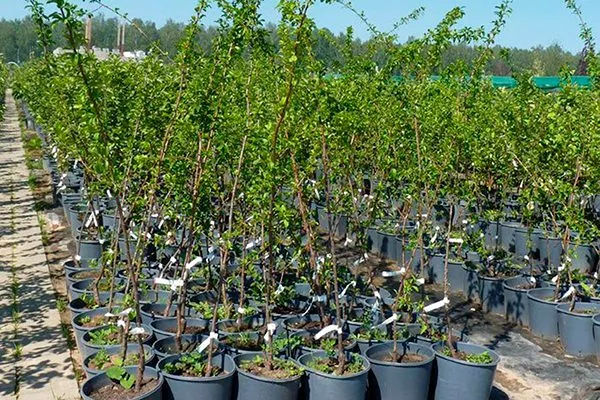
Do not buy Mara cherry plum with an open root system that does not meet standards.
| Age of seedling | Height | Barrel diameter | Root system |
|---|---|---|---|
| 1 year | 1.1-1.4 m | 1-1.5 cm | 25-30 cm |
| 2 years | 1.5-1.8 m | 1.8-2.5 cm | 30-40 cm |
| Container | 0.8-1.2 m | 1.5-2 cm | Completely envelops the lump |
The central conductor should be between 1.1 and 1.4 m, the bark should be smooth and undamaged, and the root should be fresh and 25 to 30 cm long. If there is lateral growth, the branches should be elastic, flexible, and show no signs of drying out.
How to plant correctly?
Typically, for tall, wide-crowned cherry plum varieties, including the Mara variety, a 4x5 m planting pattern is recommended. Prepare the cherry plum planting hole at least a month before planting.
While spring planting is recommended in the regions intended for this variety, preparing the hole can be challenging, so it's best done in the fall. The planting hole should be 60 x 40 cm. Add a fertile soil mixture to the hole, including:
- the top, fertile layer of soil;
- dry mullein – 20 kg;
- potassium sulfate (60 g) or wood ash (500 g);
- Double Superphosphate – 250 g.
Fill the hole with soil, water, and cover until planting time. When it's time to plant, remove a volume of soil slightly larger than the cherry plum's root system and set it aside temporarily.
Preparing a Mara cherry plum seedling includes the following steps:
- For container cherry plum. Water the plant the day before planting.
- For bare root seedlings. Soak the roots in water for 6 hours or more.
Subsequent planting of Mara cherry plum is carried out step by step:
- Drive the support into the center of the hole.
- Place the seedling at a distance of 7-10 cm from the support so that the root collar is 5-6 cm above the ground level.
- Carefully fill the root, compacting the soil with your hands.
- Tie the tree to a stake.
- Water, using 20-30 liters of water per plant.
- Mulch the tree trunk circle.
If planted in spring, prune the Mara seedling. If planted in fall, prune in early spring.
Caring for a fruit tree
The Mara variety requires careful care to ensure high yields and delicious fruit. In large plots, train the Russian plum tree into a bowl-shaped form, which will result in a lighter center and increase the size and sweetness of the fruit.
If space is limited or you want to avoid problems with harvesting, use espalier pruning. Sometimes this type of pruning isn't suitable for the site. In such cases, use low grafting, cutting off the central conductor and shaping the tree into a bush-like form.
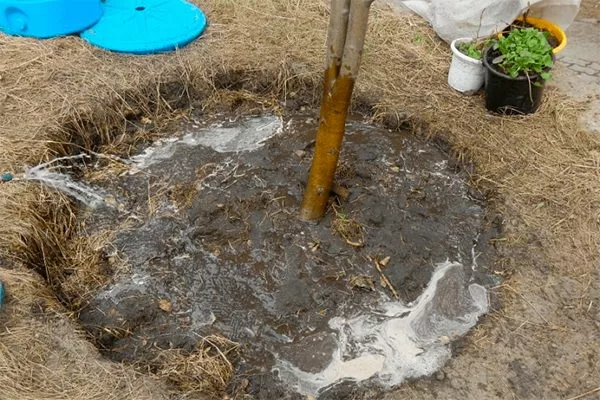
Other caring measures for the Mara cherry plum include:
- Provide regular watering to the young tree until it is fully established.
- Make sure to water the adult plant during flowering and during periods of drought.
- Apply fertilizer every 3 years.
- Treat the tree against pests and diseases.
- Loosen or mulch the tree trunk circle.
- Dig out the weeds.
- Whitewash the trunk and the base of skeletal branches at 1.2 m in spring and autumn.
Be sure to provide cover for newly planted cherry plums during the winter.
Diseases and pests
Cherry plum is characterized by high resistance to fungal diseases. In well-maintained gardens, fungicides are often not even used, although preventative measures are recommended. In addition to spray treatments aimed at preventing infections, care includes:
- Compliance with agricultural practices.
- Maintain cleanliness in the trunk circle and on the tree, excluding mummified fruits, other remains, and weeds.
- Whitewashing of trees twice a year.
- Production of sanitary cuttings.
If the garden is neglected, the following diseases may occur:
- various forms of spotting;
- fruit rot;
- root cancer;
- bacterioses.
There may also be problems with insects, such as:
- silkworm nun;
- aphid;
- leaf beetle;
- geometer moth.
Diseases are successfully controlled with fungicides, while insecticides are used to control pests. Control of aphids may be ineffective without destroying anthills.
Treatment scheme
| Period | Preparation | Purpose of processing |
|---|---|---|
| Early spring | 3% Bordeaux mixture | Prevention of fungal infections |
| Before flowering | Horus | Spotting |
| After flowering | Aktara | Aphids, leaf beetles |
| July | Skor | Fruit rot |
| Autumn | Ferrous sulfate | Disinfection |
Pros and cons
Mara is a robust variety that is successfully grown commercially in cold climates. Its advantages include:
Reviews from gardeners
The Mara cherry plum variety is a versatile berry that can be enjoyed fresh, used to make jams, compotes, preserves, and baked goods. Proper care is essential to ensure a robust plant with a good yield.