
The Big Mama pepper is a sweet variety and belongs to the Big family. The series was developed by the Aelita agricultural company. The line includes several subvarieties: Mama with orange fruit, Papa with purple fruit, Boy with red-burgundy fruit, and Girl with orange-brown fruit. Big means large, so the Big Mama pepper is enormous.
Characteristics of the variety
| Name | Ripening period | Disease resistance | Growth type |
|---|---|---|---|
| Big Mama | 105-120 days | High | Semi-spreading |
| Big Daddy | 110-125 days | Average | Spreading |
| Big Boy | 100-115 days | High | Compact |
| Big Girl | 115-130 days | Average | Semi-spreading |
The hybrid is intended for cultivation in open ground and greenhouses and has a number of individual characteristics:
- Ripening time. This early-ripening variety ripens in just 105-120 days. Harvest occurs in August or September, depending on climate and growing conditions.
- Productivity. The yield is high, as approximately 6.5-7.5 kg can be harvested per square meter, and even more with enhanced agricultural practices. Keep in mind that yields in open beds are always lower than in greenhouses.
- Purpose. It is versatile because the fruits can be frozen, canned, eaten fresh, and used to prepare many hot and cold dishes.
- Regions for cultivation. When developing the hybrid, the goal was to make the pepper grow in all regions of Russia. The breeders succeeded.
- Landing diagram. The distance between bushes is 35 cm, between rows – 50 cm.
- Disease resistance. Plants have a fairly strong immune system, so they are rarely susceptible to diseases and pests. However, poor growing conditions can contribute to problems. Therefore, preventative treatments are used.
- Necessary conditions. Big Mama thrives in any climate—both hot and cold. It's also tolerant of sudden temperature fluctuations. Even if there's a return frost, the plant will quickly recover. To prevent leaf and pepper burn, shade them in the afternoon.
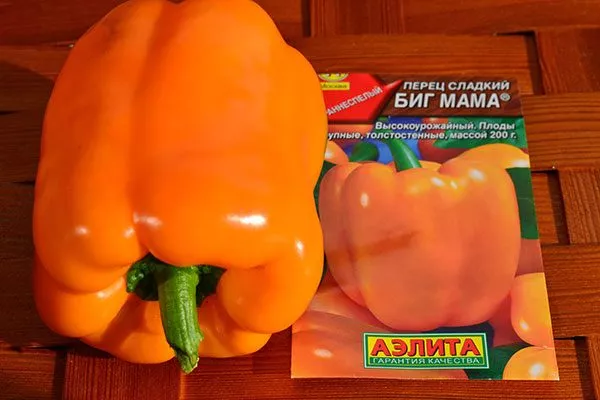
Description of the variety
This variety was developed in 2011-2012 thanks to the efforts of M. Gulkin, N. Nastenko, and V. Kachainik. It is characterized by a high beta-carotene content and large size. Other parameters:
- the shape of the fruit is elongated-cuboid, unusual, with some flattening on the sides;
- growth type – drooping;
- the skin is smooth and glossy;
- ribbing – present;
- color - initially dark green, after ripening bright orange;
- weight – minimum 120 g, maximum 200 g;
- wall thickness – from 7 to 12 mm;
- the peel is dense and does not crack;
- taste – sweet, peppery;
- bush type – semi-spreading;
- plant height – average, from 50 to 70 cm;
- leaves are medium in size, slightly wrinkled and dark green in color;
- the root system is developed and powerful;
- number of peppers – about 8-10 pcs.
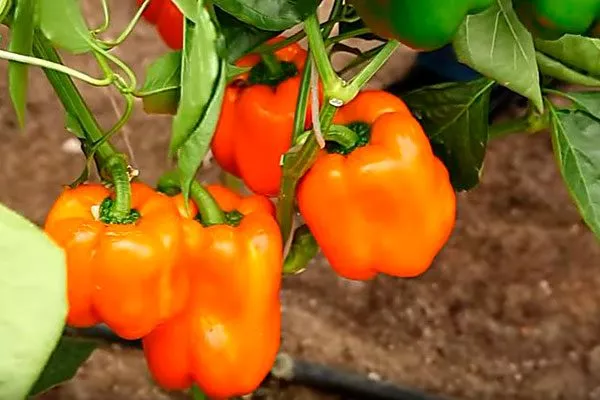
Characteristics of orange peppers
Many people think orange peppers are very sweet, but in reality, red ones have a higher sugar content. However, orange peppers are richest in potassium, vitamin P, rutin, iron, and phosphorus, and especially beta-carotene, as evidenced by the color of Big Mama's fruits.
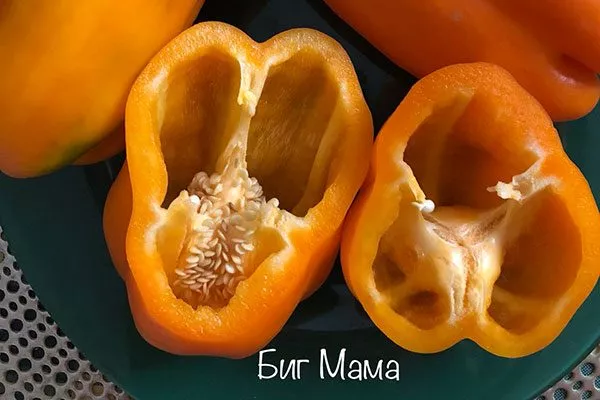
Pros and cons of the variety
The variety has no critical disadvantages, but it has plenty of advantages:
Tips for growing Big Mama peppers
The principles of planting and caring for Big Mama peppers are standard, but you should heed a few recommendations:
- the crop is grown in open beds only in the south, in the Belgorod region and similar regions;
- for the Central part and the Moscow region it is enough to use a film cover;
- greenhouses are suitable for the central and northern regions;
- It takes only 5 days for seeds to germinate, but it is advisable to soak the planting material in any growth stimulator;
- seedlings and adult bushes need to be watered correctly - the warmer it is indoors or outdoors, the more water is needed;
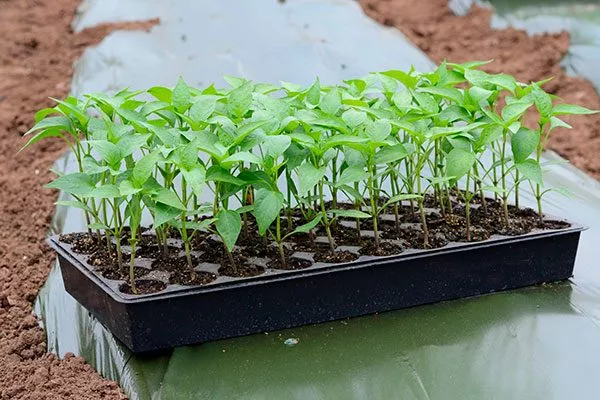
- the seedlings are transplanted to a permanent location on the 60th or 65th day;
- It is better to sow seeds in separate containers, since pepper does not tolerate picking.
Typical diseases and pests
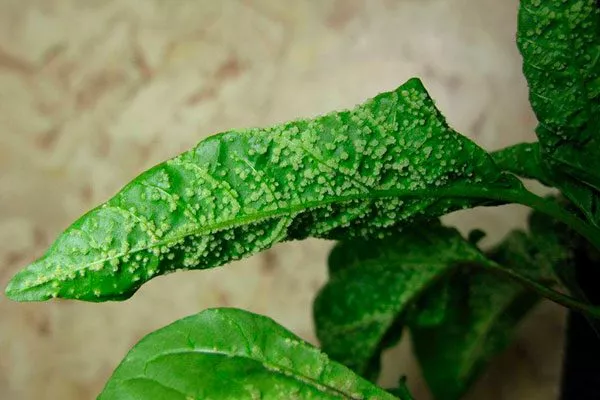
Big Mama is resistant to most pests and diseases, but the following may occur:
| Problem | How does it manifest itself? | What to treat with? |
| Fruit rot | It begins to develop in the places where the fruits are attached, causing them or the ovaries to fall off. | Spraying with Uniflor-bud is carried out. |
| Stem rot | A light-colored coating appears on the leaves and stems. | Watering is immediately stopped, the greenhouse is opened for ventilation, the plaque is removed manually, and the plant is sprayed with a pink solution of potassium permanganate. |
| Spider mite | A white or slightly bronze-colored coating forms on the leaves. | Spraying with Malathion is carried out. |
| Slugs | They leave behind holes in the leaves and slimy marks. | Use Groza or vinegar solution. |
| Aphid | Insects are found on green mass. | Folk remedies are used - a solution of laundry soap, dandelion or tobacco. |
| Pest | Method of struggle | Processing period |
|---|---|---|
| Spider mite | Spraying with acaricides | Morning or evening, every 7-10 days |
| Aphid | Treatment with soap solution | At the first signs of appearance |
Reviews
The Big Mama pepper successfully combines a beautiful appearance, impeccable characteristics, high yield, and ease of cultivation. Its universal use makes this hybrid popular not only among gardeners but also consumers.