
Duck plucking can be done using a variety of methods—traditional and alternative, manual and mechanized. Poultry farmers choose the plucking method based on the number of birds being slaughtered, the availability of tools and resources, and personal preference.
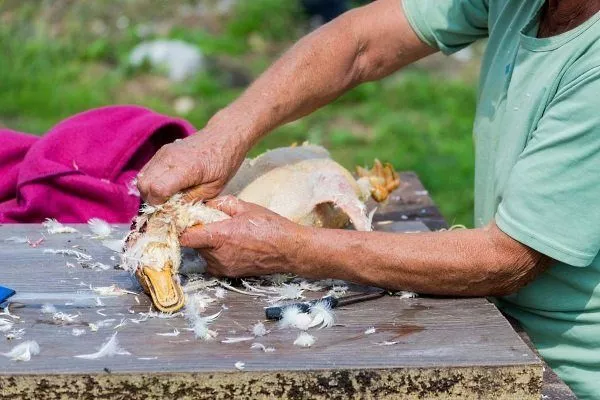
When to pluck a duck?
Many duck lovers don't realize that three hours must pass between slaughtering and plucking. If you immediately begin plucking the feathers after slaughtering the duck, you could inadvertently damage the skin. After three hours, the duck fat will harden, preventing damage to the skin when removing the down and feathers.
Feathers are plucked in the direction of growth, otherwise the bird will be plucked carelessly and its carcass will lose its marketable appearance.
Preparing for plucking
The ease of plucking a duck depends on its age. The best time to slaughter is between 60 and 70 days. By this time, the bird has fledged, but the flight feathers are not yet visible. To make removing them easier, it's recommended to wait until they grow to 10-15 cm. However, waiting longer than 10 days is not recommended; if you wait too long, plucking the feathers will be more difficult—stubs will remain on the skin, which will spoil the appearance of the carcass, and the meat will no longer be as palatable.
If you were unable to slaughter the duck within the optimal timeframe, it is better to wait and slaughter the bird after the juvenile molt, when the young feathers have grown to a length convenient for plucking.
Preparation for plucking involves proper slaughter of the duck:
- For 12-16 hours before slaughter, the birds are not given food, but only water.
- On the last night, the duck is kept isolated from the flock, with the lights on.
- The bird is killed by a blow to the skull.
- After hanging the bird by its feet, its throat is slit. After 10 minutes, when the blood has drained, the carcass is ready for plucking.
The subtleties of fast plucking
Useful rules for plucking:
- Avoid slaughtering a duck during molting. Pull the feathers of a live duck; if they come out easily, the bird is safe to slaughter. During molting, the quills are very difficult to remove.
- After slaughter, the carcass is placed in a cool place—a cellar, garage, or refrigerator. The optimal temperature is +5°C. The fat will solidify within 2-3 hours, and the meat, having dried, will be more flavorful due to the evaporation of excess liquid.
- Plucking is best done in the yard—the process creates too much waste. Prepare containers for large feathers, small ones, and down. Sorting the down and feathers during plucking saves time. It's easiest to pluck feathers while sitting on a chair, with feather boxes between your legs.
- Feathers are plucked in a specific order: first from the tail and wings, followed by the breastbone and back. If the slaughter is traumatic, without bloodletting, they start with the back, then the belly, shoulders, wings, and tail.
- Large feathers are pulled in the direction of growth, and small ones can be pulled in any direction - whichever is more convenient.
- The movements must be confident; pulling the feathers too smoothly can tear the skin. The feathers are pulled in small bunches.
Duck plucking methods
All plucking methods are divided into two groups: dry and hot. Some use one method for years, while others, having tried them all, choose the one that works best for them. Some pluck faster, while others take a long time. But speed isn't the most important factor in poultry plucking; technical nuances are crucial – improper use can degrade the meat's flavor and shorten its shelf life.
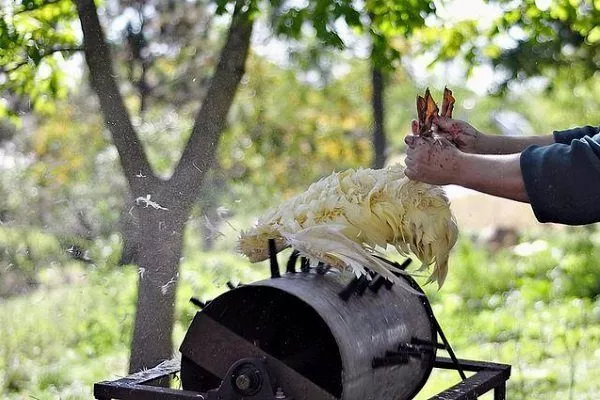
Features of hot and dry plucking:
| Dry methods | Hot methods |
| Pros | |
| Easier than hot methods | A few stumps, the carcass is easily cleaned of feathers |
| Minimum set of tools | Feathers are easier to remove from the skin |
| The carcass can be stored in the refrigerator. | Plucking is faster than with dry methods |
| The marketable appearance is preserved, the leather has a natural shade | |
| The down and feathers are dry and can be used at your discretion. | |
| Can be carried out in field conditions | |
| Cons | |
| Fluff flies in all directions | There is a risk of getting burned |
| It takes a lot of time | The carcasses are used for quick cooking and are not stored for a long time. |
| The carcass turns red | |
| Down and feathers often get damaged. | |
Dry method
This is the simplest plucking method—no pots, bags, or other equipment is required. All you need is running water. When dry plucking, it's important not to damage the duck skin. If the skin tears, further plucking will be difficult, if not impossible.
The procedure for dry plucking a duck:
- Place the duck on some kind of bedding - newspaper, cloth, tarpaulin.
- Start with the largest feathers. Work the wings and tail first, then the back. Pull in the direction of growth to avoid tearing the skin. Finish by plucking the chest and neck—here you'll need to pluck the smallest feathers.
- Remove any remaining fluff using one of the following methods:
- peel with a dull knife;
- hold the carcass over the fire.
- Wash the carcass.
After scalding
Scalding allows you to quickly and easily remove feathers from a carcass. Here's how:
- Take a large pot. It should completely fit the duck.
- Heat the water. Turn off the heat when the water temperature reaches +80°C.
- The duck is dipped in hot water and kept in the pan for no more than a minute.
- Begin with the wings, working toward the tail. Pull the feathers in any direction, regardless of direction. However, keep in mind that with this method, feathers are removed more easily if you pull against the grain.
- The plucking is completed by processing the chest, back and neck.
- Singe the duck carcass over the fire.
- Rinse the carcass with water to remove the soot from the skin.
The breeder describes the procedure for plucking ducks in this way in his video below:
Using a bag and an iron
This method is very popular among private poultry farmers. Here's how:
- Prepare a bag, a basin, and an iron. It's best to use a fabric bag.
- Place the bag in boiling water and cook it there for 10-15 minutes.
- Carefully, to avoid burning yourself, remove the bag from the boiling water and squeeze it out so that no water drips from the fabric.
- Place the slaughtered duck in a bag. Seal the bag and immerse it in a basin of hot water. The water temperature should be around 80°C.
- While the duck is in the water, heat the iron to maximum.
- Remove the bag from the water and iron the duck through a cloth, making sure no creases form. If done correctly, there will be no problems when plucking.
- After ironing the duck, remove it from the bag and begin plucking.
The method of plucking with an iron can be seen in the video below:
If you don't have an iron where you're plucking, or yours is broken, don't worry—the method works just as well without ironing. Just keep the duck in hot water for a little longer than 5-7 minutes.
Singeing
Singeing is an auxiliary process during plucking. The singeing procedure is as follows:
- Hold the plucked duck by the wings or feet and stretch it so that all the folds are straightened out.
- Bring the carcass to the burner, but not too close to the flame. Rotate the carcass in all directions, preventing the down from melting for too long. If the distance to the flame is correct, the feather stubs will fall out of the skin rather than burning within it.
- Rinse the scorched duck under running water.
You can't hold the duck over the fire for more than two minutes, otherwise the subcutaneous fat will begin to melt and the skin will burn.
Using wax
This method is often used by hunters, but it's also convenient for home use. Plucking procedure:
- Remove the duck's wings. Leave the feet on to hold the carcass.
- Pluck the tail and wing feathers. Also remove any larger feathers from the back and belly.
- Prepare two containers: one with cold water and the other with hot water.
- Remove the boiling water from the stove and add the wax – it should melt and a thin film will appear on the surface.
- Place the duck in the container. Hold it there for no more than three seconds; the wax will completely envelop the bird. If you hold it there for too long, the insides may burst and the meat will be damaged.
- Place the duck in cold water for 3-4 minutes to allow the wax to harden.
- After removing the duck from the water, press down on it to break the wax layer. Now remove the wax – you'll have a smooth, beautiful duck with a pleasing presentation.
Using a nozzle
When many ducks are slaughtered at once, plucking them takes a significant amount of time and effort. Farmers are looking for ways to speed up, simplify, and mechanize the feather plucking process. Today, many poultry farmers use devices that allow them to quickly remove feathers from slaughtered birds.
To use this method, you must have:
- drill, hammer drill or grinder;
- a special attachment for the appropriate tool.
This attachment resembles a brush—ribbed rubber elements protrude from the base in different directions. After turning on the power tool, the duck is brought to the brush—it rotates at high speed, and the "fingers" imitate the movements of human hands plucking a bird. The tool must be securely fastened.
Video review of plucking a duck using a plucking attachment:
Field plucking
This method is used in hunting. If you need to cook game in the field, you'll need to pluck it. Depending on what you'll do with the carcass next, the processing method is chosen:
- With feather plucking. This method is chosen for transporting game home or storing it. The dry method is usually chosen, as the down and feathers of wild birds are highly prized.
- Remove skin and feathers. For immediate cooking in the field.
Field plucking rules:
- The duck is dirty and must be washed thoroughly, cleaned of feces and dirt, especially in the tail area.
- Check the bird for parasites, fungal infections, or growths. If so, it's best not to eat the meat.
- If the temperature outside is +5°C or lower, game can be stored without refrigeration for 5 days, in any form.
- Remove the pellet or shot immediately after rinsing the duck.
Preserving down
Down and feathers are valued as raw materials. The procedure for preparing fluff:
- Rinse the fluff in warm water, adding a little washing powder.
- Rinse the fluff in cold running water.
- Squeeze out the water.
- Place the down in a cloth bag and hang it to dry. Ideally, hang the bag in the sun.
- Stir the fluff periodically to prevent it from rotting or becoming caked.
To wash feathers, soak them in soapy water for 30 minutes.
- ✓ Store down in a dry, well-ventilated place, avoiding direct sunlight to prevent yellowing and loss of quality.
- ✓ Use fabric storage bags that allow the down to 'breathe' and prevent mildew.
Manually plucking a duck is a labor-intensive and painstaking process that requires a certain amount of skill. The condition of the duck's skin, the taste of the meat, and even its shelf life depend on how well it's plucked.