
To survive the winter safely and maintain weight, health, and reproductive function, ducks must be well-fed. The winter "menu" differs significantly from the summer one; it is tailored to the bird's breed and other characteristics.
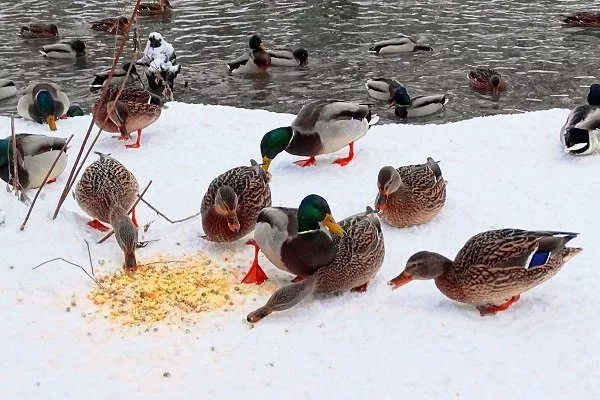
Features of winter feeding of ducks
In summer, ducks eat a lot of seasonal vegetation. These voracious birds happily devour grass and other greenery—it provides them with both satiety and nutrients. During the cold season, they have to find alternatives.
Winter feeding nuances:
- Reducing feed rates. Due to their sedentary lifestyle during the winter, birds gain weight. Their diet should be adjusted to prevent overeating.
- More vitamins. Birds have a hard time surviving the winter due to the cold, lack of light and diseasesVitamin-enriched foods help you survive until spring and maintain your health, including reproductive health.
- Three meals a day. This is quite sufficient for birds that remain in the barn all winter or venture out occasionally. In the morning, the birds receive wet mash, and in the evening, grain or compound feed.
The food they receive for "dinner" takes a long time to digest, so the ducks have enough to last them all night. After gorging on grain, the ducks sleep peacefully. If they aren't fed a substantial meal before bed, they'll squawk and eat their bedding—straw, hay, etc. - Additional nutrition. It is given to laying hens in March, when the birds begin laying eggs. Hens are kept separately from the males and fed four times a day instead of three. If it is not possible to separate the flock, the entire flock is fed four times a day.
- Conditions of detention — Dietary requirements depend on the region's daylight hours and whether the flock goes outdoors. The less sun, the more vitamins are needed; the less exercise, the more modest and calorie-rich the diet should be.
- ✓ The optimal water temperature for drinking ducks in winter should not be lower than +10°C to avoid hypothermia.
- ✓ To prevent vitamin deficiency, it is necessary to add sprouted grains containing vitamin E and B to the diet.
A minimum number of birds are kept for the winter—only to replenish the flock. All other ducks are slaughtered before winter, as feeding them in winter is quite expensive. You can read about the rules for keeping ducks in winter. in the next article.
Winter feeding of domestic ducks
In winter, all animals require a lot of energy to maintain normal body temperature. Nutritious feed and various supplements with vitamins and microelements help replenish this energy.
Duckling food
The ideal situation is to hatch ducklings during the warm season using hens. When there's plenty of green grass outside, the mother duck teaches her offspring how to forage for food herself. If the young are hatched in an incubator and it's still cold outside, special feeding is needed. The diet changes as they mature.
Food for the first week (based on 10 heads):
- greens (dill, parsley, etc.) - 50 g;
- millet or crushed corn - 20 g;
- boiled egg - 1 pc.;
- skim milk - 100 g;
- cottage cheese - 60 g.
- ✓ Activity and quick response to sound are the first signs of ducklings’ health.
- ✓ Uniform fluff without bald spots indicates good absorption of nutrients.
These ingredients are mixed and fed to the ducklings as a wet mixture. On the fourth day, the following is added:
- bone meal – 10 g;
- chalk - 10 g;
- cake - 60 g.
You can use regular water instead of skim milk, but then you'll need to add powdered milk. Gravel is added to the mash on days 5-7.
How to prepare duckling feed:
Ducklings can be fed either wet or dry feed, but the key is to avoid scattering the food on the floor; it should be placed in special feeders. Don't put the food in trays, as the ducklings will trample it.
For adult ducks
The winter diet of adult ducks can include a wide variety of foods—the choice depends on the breed's direction and the breeder's access to inexpensive feed.
What can be included in the “menu” of adult birds:
- Compound feed and grains — they form the basis of the duck "menu" in winter. They provide the birds with a source of carbohydrates and energy. Such feeds fill ducks well and satisfy their hunger for a long time.
- Vegetables and root vegetables — a source of vitamins. The most suitable food is boiled potatoes, carrots, and fodder beets. Cabbage can be given, but in small quantities.
- Silage replaces greens in winter and is one of the main ingredients in ducks' diet.
- Herbal flour used as an alternative to silage or as an additive to the main feed.
- Hay — a source of nutrients. It does not replace grass, but only supplements the ducks' diet. Ducks are fed hay only in a soft, steamed state.
- Vitamins — Add crushed shells, mussels, meat and bone meal, skim milk, cottage cheese, and hard-boiled eggs to the feed. Before introducing commercial medications, consult a veterinarian. Fish scraps and yeast should also be introduced with caution and in measured doses.
- Salt — it's essential for ducks, and it's especially important for laying hens. The recommended salt intake is 0.2% of the daily feed intake.
If salt is added to the mash, it is prohibited to add salted products to the ducks' feed.
Sample diet:
- cereal feed or grits (ground grain) - 180 g;
- bran - 40 g;
- boiled potatoes - 60 g;
- carrots - 80 g;
- beetroot - 30 g;
- skim milk (optional) - 20 g;
- hay flour - 18 g;
- fish waste - 1-5 g;
- baker's yeast - 2 g;
- shells - 6 g;
- chalk - 3 g;
- gravel - 2 g;
- salt - 1.5 g.
If your ducks are rapidly losing weight and appearing unwell, it's recommended to increase the number of feedings. It's a good idea to check your birds for parasites and diseases.
Compound feed and additives
Compound feed is a loose/granulated feed consisting of animal and plant products, minerals, and bioactive components. It is used as a staple feed.
In addition to compound feed, the market also offers:
- Premixes. This is a feed supplement containing vitamins, micro- and macroelements. They are given to balance, improve digestibility, and enhance the biological value of compound feed, especially homemade ones.
- BMW. These are complexes of concentrated bioactive components that improve the health and immunity of birds and support their productivity.
Dry mixes do not replace compound feed, but rather supplement and balance it. The share of premixes in the diet should be no more than 5%, and that of BMVD should be 10-30%.
What to feed wild ducks?
The diet of wild ducks is strikingly different from that of their domestic counterparts. They feed on whatever they find in their habitat, including insect larvae and various small fish. Any plant material, such as seaweed, rhizomes, and the fruits of coastal vegetation, can be a suitable side dish.
Ducks, although they have an unusual mouth apparatus, are practically omnivorous.
Suitable food for wild birds:
- hard grated cheese - birds manage to grab it before it starts to sink;
- thickly cooked oatmeal - it is rolled into small balls, which are thrown into water or fed directly into the beaks of birds;
- berries and fruits, cut into pieces;
- Granulated duck feed - when it gets into water, it does not dissolve or sink for some time.
A more serious approach to feeding wild ducks involves preparing feed mixtures that help the birds survive the winter in urban conditions.
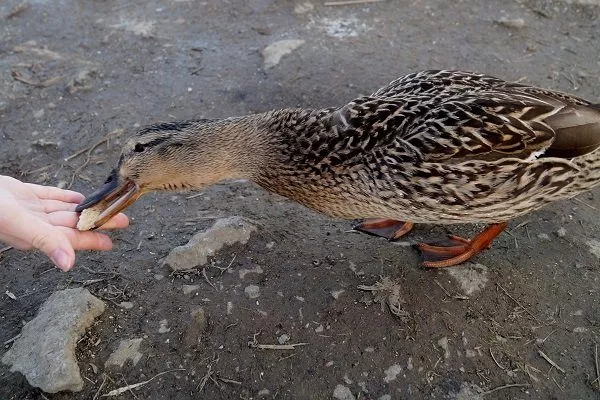
Products for preparing feed mixture:
- cereals;
- flour - bone, grass, coarsely ground wheat, legume;
- wheat sprouts;
- yeast;
- boiled and fresh vegetables.
How to prepare compound feed yourself?
The ducks are being fed Prepared feed or homemade feed. Producing these requires specialized equipment and raw materials. Before purchasing machines for grinding and mixing feed, it's important to evaluate the economic feasibility of such a step.
Raw materials and composition
The ingredients for homemade feed depend on the breed of duck. The composition of feed for meat, egg, and meat-and-egg breeds varies slightly. There are universal grains suitable for all ducks, but others are designed specifically for one type of bird.
Options for the base for preparing compound feed:
- Crushed grain. Wheat or corn are commonly used. They are 90% digestible by the bird's digestive system. They are suitable for meat-producing and laying breeds.
- Oilcake. Rapeseed and sunflower by-products are best suited for ducks. Soybean and peanut cakes are added less frequently. The choice depends on the farmer's access. The by-products must be fresh, otherwise they will do more harm than good.
- Seasonal fruits. Any fruit or berries will do—apricots, plums, strawberries. The main thing is to get the large pits.
- Animal feed. It is only necessary when fattening ducks for meat and meat-and-egg production. Without it, the birds cannot quickly gain muscle mass. Such feeds include boiled eggs and dairy products. The diet of laying ducks should include up to 10% animal feed, and 20% meat feed.
It is not recommended to feed whole grain to ducks, as it is less digestible than crushed grain, slows down metabolism, and reduces the rate of weight gain.
Once the base is prepared, additives are added to it - some can be added immediately, while others must be pre-ground:
- Vegetation. Grass and garden scraps are rich in vitamins E and B. This supplement is especially important for laying hens, as it has a positive effect on the health of ducklings. If ducks get plenty of greenery, their offspring are strong and disease-resistant.
- Bone/fish meal. It's essential for meat-producing birds. Young birds are given it in minimal doses.
- Chalk and shells. These are the best sources of calcium. Small shells also help digest hard food. The amount of chalk in the diet should not exceed 3%.
- Yeast. A source of vitamin B, amino acids, and various microelements. Recommended intake: 1 g per 1 kg of live weight.
Equipment
Equipment is differentiated by the type of feed—there are machines for preparing loose or pelleted feed. The former is simpler to prepare and is the type typically used by duck breeders. Pelleted feed is more often produced for sale to farmers, as it's easier to store and transport.
The necessary equipment is selected taking into account the technology for preparing loose compound feed:
- Crushing. The grain is crushed using special crushers.
- Crushing. Grass and hay are finely chopped using special choppers.
- Mixing. Various nutrient compounds are introduced into the resulting base using special screw mixers.
Foods prohibited for ducks
Despite the omnivorous nature of ducks and the greed with which they consume any food, there are foods that are not recommended for feeding them.
Ducks are harmed by:
- nuts;
- sweet;
- fatty and salty - birds should not be fed chips, cookies, or gingerbread;
- onions - they make ducks sick and in large quantities can cause death;
- finely ground flour - causes clogging of the respiratory tract;
- pumpkin - causes digestive upset and leaches calcium;
- raw root vegetables, zucchini - too hard for ducks, they need to be boiled;
- crackers - when they enter the stomach, they swell, tripling in volume;
- leftovers - porridge with milk is especially dangerous, birds cannot digest them;
- Bread - causes fermentation and can cause stomach blockage.
Moldy foods are especially dangerous for ducks—they can kill them. Also, avoid giving them ice-cold water and overfeeding them with vitamins.
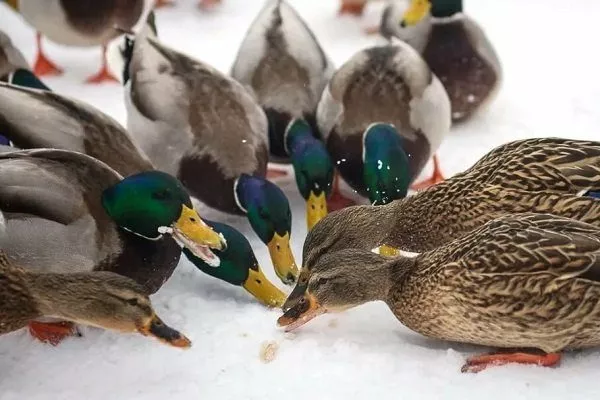
Raising ducks isn't particularly difficult if you know what you can feed them and what you absolutely shouldn't. Proper feeding will help prevent bird diseases and losses during breeding. Good feeding helps ducks survive the harshest winters and maintain productivity.