
Hatching eggs in an incubator allows you to manage your duck population's growth without depending on the ducks' desires. It's important to carefully study the incubation process: select and prepare suitable eggs, place them in the incubator, monitor the conditions, and ensure healthy young are hatched on time. The article below describes all the steps in detail.
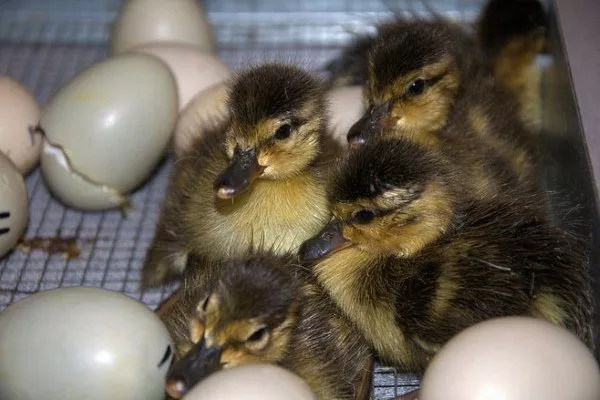
Selecting eggs and preparing for incubation
Hatching strong and healthy ducklings begins with selecting the eggs. Duck eggs are larger than chicken eggs, and their thick white shells have a greenish tint.
Eggs are rejected:
- Irregular shape. Specimens with any deviations—those too round or, conversely, excessively elongated—are unsuitable.
- With defects. Specimens with chips, shell deformations, and cracks are discarded.
- With limescale deposits.
- With two yolks.
Optimal egg parameters for an incubator:
| Parameter | Meaning |
| Weight | 75-90 g |
| Translucent properties |
|
| Form | standard |
| Shell | smooth and clean |
Store the eggs in a ventilated area. Optimal conditions include a temperature of 8-13°C and a humidity of 75%. Place the eggs in trays, blunt ends down. Fresh duck eggs intended for breeding are not recommended to be stored for longer than a week.
- ✓ Eggs should be stored in a room with minimal temperature fluctuations to prevent moisture condensation on the shell.
- ✓ Relative humidity in the room should be maintained at 75-80% to minimize moisture loss from the eggs.
To maximize duckling yield, eggs are candled. This procedure helps detect microcracks, uneven shell thickness, and internal defects. Candling allows you to see what's behind the shell, such as mold or damaged yolk.
To wash eggs or not?
Duck eggs are often covered in droppings. Many people wonder whether they should be washed or not. Some argue that washing eggs before incubation is unnecessary. However, experienced poultry farmers advise washing eggs if more than half are soiled.
Wash the eggs with extreme care—any eggs damaged during washing are discarded. Eggs can be washed by hand, using a soft sponge, or with a spray bottle.
Washed eggs are disinfected in potassium permanganate to destroy pathogenic fungi, mold, and salmonella.
How eggs are incubated is shown in the video below:
Those who oppose egg washing will argue that no one actually washes eggs. But a duck is an aquatic animal, and when it's incubating its eggs, it uses its wet feathers and feet to clean the eggs of any droppings.
Rules for hatching ducklings using an incubator
Basic rules of incubation:
- Incubators must be high-quality and reliable – the slightest breakdown threatens losses.
- It is important to strictly adhere to the incubation regime – temperature, humidity, etc.
- Only high-quality eggs are selected for hatching – they are determined by their appearance and after candling.
To obtain offspring, it is necessary:
- Provide fresh air supply to the incubator.
- Maintain a set humidity level.
- Control the heating temperature.
- Prepare equipment for work:
- wash and dry the trays;
- pour water into the holes;
- raise the temperature to the set values.
Features of the incubation apparatus
An incubator is a device that maintains the conditions necessary for hatching chicks. When properly configured, the entire incubation process is automated.
The incubator is controlled by:
- ventilation;
- gas exchange;
- temperature;
- humidity.
The market offers models of varying levels, from the most basic to the most innovative. A typical incubator includes:
- egg trays;
- ventilation system;
- alarm – informs about overheating;
- air heater;
- mechanism for turning eggs.
In more expensive and modern models, the trays are flipped alternately, first one way and then the other, at a 45-degree angle. Another option is to flip the eggs with a special "pusher." However, this is less safe, as it can damage the embryos.
The industry offers incubators that can hold from 35 to 100 eggs.
Comparison of Muscovy, Mulard, and Wild Duck Eggs
| Name | Egg weight, g | Incubation period, days | Shell color |
|---|---|---|---|
| Muscovy ducks | 75-80 | 30-35 | White |
| Mulards | 50-60 | 30-31 | Yellowish with a speckled pattern |
| Wild ducks | 75-90 | 26-28 | White, brownish-greenish |
Comparison of duck egg varieties:
- Muscovy ducks. The eggs are white, with a smooth, dense shell. They weigh 75-80 g. Because of their strong shells, they are difficult to break. The eggs are usually clean—Muscovy ducks are neat birds. Incubation for Muscovy duck eggs is 5-10 days longer than for other ducks, lasting 30-35 days.
- Mulards. A hybrid between a domestic duck and a Muscovy duck. The eggs are smaller than those of ducks and Muscovy ducks, weighing only 50-60 g. They are typically oblong in shape, like all other ducks. The yellowish shell is covered with a speckled pattern, resembling turkey eggs. The incubation period for Mulard eggs is 30-31 days.
- Wild ducks. The eggs come in a variety of shades—white, brownish-green. The incubation period is 26-28 days.
The incubation schedules for ducks, mallards, mulards, and Muscovy ducks are virtually identical, but the hatching times vary. It's easiest to incubate both domestic and mallard ducks together—their chicks hatch almost simultaneously, but when the hatching times are spread out by a full week, the process becomes more complicated.
Loading the material into the incubator
The selected eggs have been washed, the incubator has been cleaned, and all that's left is to mark the sides. A "+" is written on one side of the eggs, and a "-" on the other. These marks help ensure proper egg turning—without markings, it's easy to get confused about which eggs are upside down and which aren't. It's recommended to set the eggs in the morning.
Bookmark order:
- Heating the device to +38 °C.
- Pouring water into the gutters of the incubator.
- Warming eggs at room temperature.
- Laying eggs. The largest eggs are laid first, followed by the rest after 4 hours.
The entire incubation period of duck eggs is shown in the following video:
Temperature conditions before laying duck eggs:
| Period | Temperature, °C |
| Storage before incubation | 8-13 |
| Warming up before laying | 25 |
| Warming up the incubator | 37.8-38.3 |
The eggs shouldn't be packed too close together, as this will make it difficult to turn them. If the incubator has an automatic turning feature, cover the eggs with a mesh cloth.
Incubation of duck eggs at home
Before placing eggs in an incubator, novice farmers should understand the process, its nuances, and its schedules. Duck eggs must be kept comfortable at all times, and conditions such as temperature and humidity vary depending on the hatching stage.
What modes are there?
There are 4 modes of "hatching" eggs in an incubator, which change depending on the period.
The incubation conditions for duck eggs depending on the period are described in the table:
| The incubation period of duck/Muscovy duck eggs, days | Temperature, °C | Humidity, % | Hardening | Number of coups | Note |
| 1-7 | 38 | 70 | No | 4 | There should be small gaps between the eggs - they should not be pressed tightly against each other. |
| 8-14 | 37.6 | 60 | No | 4-6 | There's no need to add water; simply mist the eggs daily. Turn on the ventilation. |
| 15-25/15-30 | 37.8 | 60 | 2 times a day – cool by spraying to 30 °C | 4-6 | Turnings increase to 6 times per day. Cool the eggs by opening the incubator twice a day for 20 minutes. |
| 26-28/31-35 | 37.5 | 80-90 | No | No | If there are few eggs, the temperature is maintained at 37.5 °C; if there are many, 37.2 °C. |
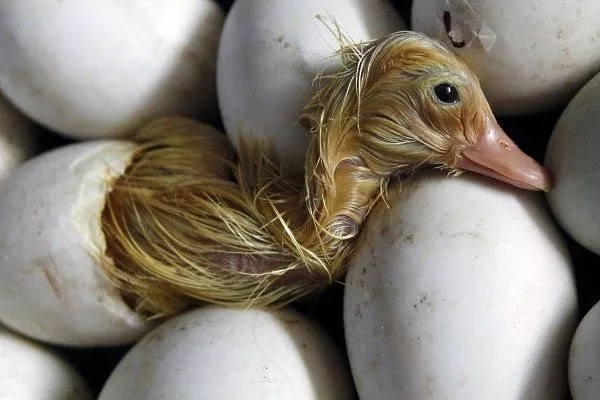
Duck eggs contain a lot of fat and little water, and, unlike chicken eggs, they are more likely to overheat.
Stages of embryo development in an incubator
Embryo development:
- First week. During this period, the organs of the future ducklings are formed, and the heartbeat begins. The embryo is 2 cm long.
- Second week. The chick's skeleton is forming. Respiration gradually increases. Initially, the embryo breathes oxygen from the yolk, then from outside oxygen entering through the shell.
Stages of embryo development:
| Embryo age, days | What's happening? |
| 2 | The circulatory system is formed |
| 4 | The rudiments of the limbs are formed |
| 5 | The allantois (embryonic membrane) is visualized |
| 8 | The beak begins to form – its shape is established |
| 10 | Nipples are formed under the feathers on the back |
| 11 | The beak is finally formed |
| 13 | The allantois is formed inside the shell |
| 14 | Fluff appears on the head |
| 15 | The body is covered with fluff |
| 23 | The chick sucks in the yolk |
| 24 | Eyes are beginning to open |
| 26 | Eyes fully open |
| 27 | The hatching process begins |
Breeding time
The hatching time for duck eggs depends not only on the duck species (wild, Muscovy, or mulard), but also on the conditions. In an incubator, chicks hatch in 26-28 days; under a broody hen, it takes 28-33 days.
To speed up hatching, poultry farmers often use 20% formalin. But only if the hatching time has been exceeded. For example, if the incubator's operating procedures have been violated.
When and how to spray?
During incubation, the egg loses moisture through evaporation through the pores of the shell. And the closer to hatching, the more moisture is lost. That's why, during the final stage, humidity in the incubator is increased to 90%. Additionally, moisture evaporation is compensated for by misting.
Misting simultaneously cools and humidifies the eggs. The eggs are sprayed with warm water from a spray bottle. Some incubators don't require misting—they can cool the eggs and raise the humidity to 95%. Similar systems are found in industrial incubators designed for thousands of eggs.
Do you need to turn the eggs?
The yolk, having a lower specific gravity, always remains in the upper position. Turning eggs during incubation is essential for successful hatching for the following reasons:
- Preventing the embryo from adhering to the shell membrane. Prevents internal organs from sticking together.
- Correct position of the embryo at the end of incubation.
- Even distribution of overheating throughout the egg.
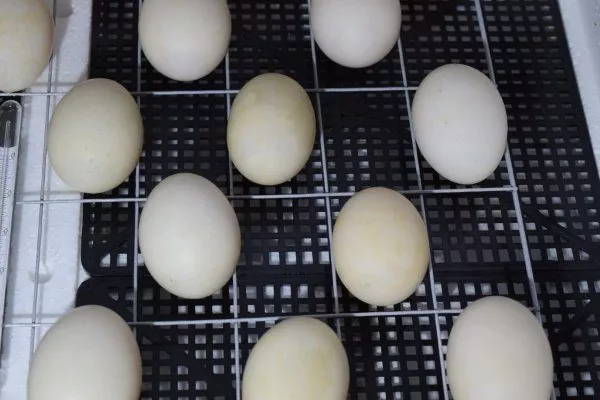
It is recommended to turn the eggs 4-6 times per day. This is especially important during the first week of incubation. This increases the hatchability rate.
Studies have been conducted that have shown a dependence of hatchability on the number of turnings:
- the eggs were not turned at all - 15% of the set eggs hatched;
- 2 revolutions per day – 45%;
- 5 rolls – 60%.
To avoid confusion with turning, keep a journal in which the time of turning and the symbol are indicated - the egg is marked on both sides.
Ventilation
Every incubator has a ventilation system. It allows the future ducklings to breathe oxygen and expels carbon dioxide. There are two types of ventilation:
- Constant. Here the air circulation is not interrupted.
- Periodic. With this system, the fan is turned on once a day.
If there isn't enough air, the embryos may die. To prevent embryonic death, consider the oxygen requirements of the future ducklings:
- 2 weeks – 2.5-3 liters of air per day;
- the day before hatching – 8-10 liters of air per day.
Ventilation is turned on on the 3rd day after the start of incubation. On days 18-20 of incubation, ventilation is turned on to maximum.
How are Muscovy ducks incubated?
Muscovy ducklings take longer to hatch than regular ducks – they hatch only on the 34th-35th day.
Incubation of turkey eggs:
| Parameters | period from 1 to 16 days | period from day 17 to day 29 | period from 30 to 34 days |
| Optimum temperature, °C | 38 | 37.5 | 37 |
| Number of coups | 6 | 6 | — |
| Spraying once a day | 1 | 1-2 | 3-4 |
| Humidity, % | 70 | 60 | 85 |
| Cooling | 1 time after 10 days | 2 times for 20 minutes | — |
If temperature and humidity conditions are maintained, hatchability can reach 70%. Since the incubation procedures for common ducks and Muscovy ducks differ, it's not recommended to place their eggs in the same incubator.
Ovoscoping and culling
During incubation, eggs are candled to ensure timely rejection of eggs:
- First illumination. This is performed on the 7th or 8th day of incubation. It shows which eggs are fertilized and which are not. In the fertilized ones, embryos are visible. If the embryo dies, a blood ring encircling the yolk is visible.
- Second transillumination. This is performed on the 14th day of incubation. The embryonic membrane—the embryonic respiratory organ involved in gas exchange—is visible. Embryos that die during this period are called dead eggs. Blood vessels are not visible in such eggs, and the fetus is dark and shapeless.
- Third illumination. This is performed on the 26th day, 2-3 days before the hatching of the young. Dead embryos are identified and the development of living ones is assessed. The embryo occupies the entire egg, and its contours and movements are discernible.
The presence of a transparent light spot on the pointed end is a sign of developmental delays in the chick. If the embryo doesn't move, it is dead. Embryos that die during this period are called "suffocated." These are fully formed but unhatched chicks. The absence of the allantois is often visible in the pointed end.
If there are many dead or unhatched chicks, it's a good idea to determine the cause. A high embryo mortality rate is observed in the following situations:
- hereditary pathologies;
- infectious lesions;
- embryonic dystrophy;
- excessive or insufficient humidity;
- insufficient heating or overheating;
- violation of gas exchange.
You can see how duck eggs are candled and culled in the video below:
The emergence of chicks and further actions
The order of hatching of chicks:
- When the time comes to hatch, the chick makes a hole in the shell with its beak.
- The chick gradually expands the hatch.
- The chick, resting its paws on the sharp edge of the egg, breaks the shell.
- If the chick is positioned incorrectly in the egg, the process becomes more difficult. If the chick fails to emerge within 24 hours, it is assisted by making a hole in the egg's surface to facilitate breaking the hard shell.
Before hatching, the egg is candled. The developed chick appears dark, and the light air cell is also visible. If the vascular network is visible, do not break the shell, as the chick will die from blood loss.
The hatching process takes approximately 24 hours. The weight of a healthy newborn duckling is 50-70 g. A day after hatching, the chicks:
- stand on their feet;
- actively move;
- evenly covered with down;
- They eat with appetite.
The first steps of a poultry farmer when ducklings appear:
- Waiting - all the ducklings should dry out.
- Carefully inspect the flock to identify any non-viable birds. The poultry farmer examines the beak and eyes – they should be clean. The abdomen should be firm and not hanging. It is important to check the umbilical cord to ensure it is scarred.
- Transplant the young plants into a box.
- Maintain an optimal temperature of 28°C up to the 10th day, and 22-24°C from the 10th to the 21st.
What mistakes can beginners make?
The most common problems and omissions when hatching ducklings:
- The eggs are heated unevenly. Before turning on/initiating ventilation or cooling, eggs should be mixed—those in the center should be moved to the edges, and vice versa. Insufficient heat absorption leads to high mortality rates.
- High temperature. Overheating can kill the entire brood. Heatstroke causes the chicks to stop developing, and this can happen at any stage of hatching.
- Low humidity. The eggs' weight decreases, and enlarged air chambers are visible when candled. The chicks begin to hatch prematurely. The ducklings are small.
- High humidity. Hatching is delayed. Many chicks die at hatching, drowning in amniotic fluid.
- There is no ventilation. The chicks are born with defects. The embryos lie head-on toward the sharp edge—a pathology.
By comparing the incubation regime with the hatching results, it is possible to determine the cause of the problem:
- If there is a delay in hatching, it is likely that the eggs were not warmed up enough before being placed in the incubator.
- If the chicks are weakened and die within the first day, it is likely that defective eggs were laid for incubation.
- If early hatching is observed, it is likely that the temperature was maintained at a high temperature during the second half of incubation.
- If hatching was difficult, it is possible that defective eggs were incubated or the humidity conditions were disrupted.
If many unfertilized eggs are rejected, you should take a closer look at the parent pair; they may need enhanced vitamin nutrition.
With an incubator and high-quality duck eggs, you can breed ducks yourself. If you're new to hatching ducklings, get detailed instructions. By strictly following all instructions, you can achieve a high hatchability rate the first time.