
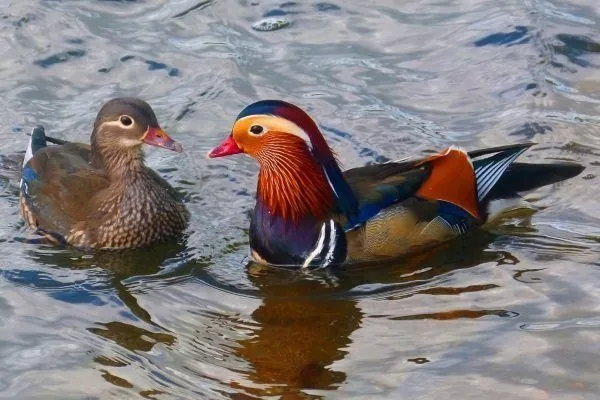
The Mandarin Duck is a very colorful little bird. Ancient Chinese artists depicted it in their paintings, which is why the Mandarin Duck is also called the Chinese Duck. According to legend, these birds bring love, happiness, and longevity to newlyweds.
Habitats
The mandarin duck's primary habitat is the Far East. In Russia, they are found in Khabarovsk Krai, the Kuril Islands, Sakhalin Oblast, and Astrakhan, from where they migrate to China and Japan in the fall. Suitable habitats are also found in Ireland, California, and the United Kingdom.
Their habitats necessarily include a mountain river, cliffs, and tall trees, so their favorite habitats are the taiga, deciduous and mixed forests, and mountains. Mandarin ducks are difficult to spot; their nests are well hidden from human eyes. These birds are well adapted to forest life, easily moving between tree branches and shrubs, and seeking refuge in thickets when threatened.
With the arrival of cold weather, they fly south. In warmer climates, they can lead a sedentary lifestyle.
Description of the Mandarin Duck
According to legend, these birds were named by the Chinese. In China, officials and nobles, known as mandarins, wore bright, rich clothing, the color scheme of which resembled the ducks' patterns. Keeping these ducks in their ponds was a matter of prestige, pride, and boastfulness for them. The significance of mandarins in Chinese culture can be gauged by their references and depictions in various art forms. It is widely believed that having figurines of these birds in the home can help achieve harmony in family life.
Appearance
An adult weighs between 0.5 and 0.7 kg and is about 45 cm long. The birds' heads are small and round, with large, almost black eyes. The bill of females is gray, while that of males is red. The wingspan reaches 0.7 m. The legs are red, with sharp talons. These ducks quickly gain altitude, maneuver easily through the forest, and climb and hold on to trees.
Mandarin ducks are good and enjoyable swimmers, but rarely dive. Their call is unlike the usual quack. It's characterized as a distinctive whistle.
Plumage of drakes
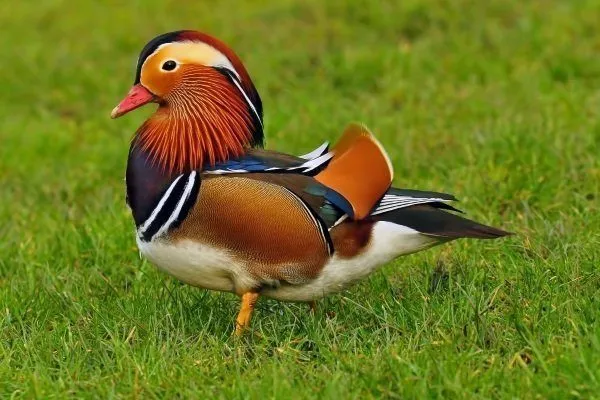
The plumage of drakes is particularly bright and beautiful. The bird resembles a toy, drawing particular attention. The feathers on their heads are a pattern of several colors: red, orange-brown, and white.
The central part of the crown has elongated, bright red feathers, with their tips and bases shimmering purple and green. The plumage around the beak is rufous. The sides of the head, including the area around the eyes, are covered with white feathers, forming a small, colorful crest at the back. Closer to the neck, the plumage is orange-brown, striped. The bill is smooth, red, with a slightly downward-curved white tip.
The male's body coloration is similar in brightness to its head. It has a smooth black back and a white chest. The plumage from the neck to the chest is iridescent with violet-blue tones. The center of the chest has a transverse pattern of two white circles framing it. Below, the coloration is beige-orange.
A prominent orange feather curls upward on the dirty beige wings. The tail feathers are black and white, with the tail itself drooping slightly downward. The legs are orange-red.
Twice a year, drakes molt their plumage. Their plumage becomes very similar to that of the females.
Plumage of females
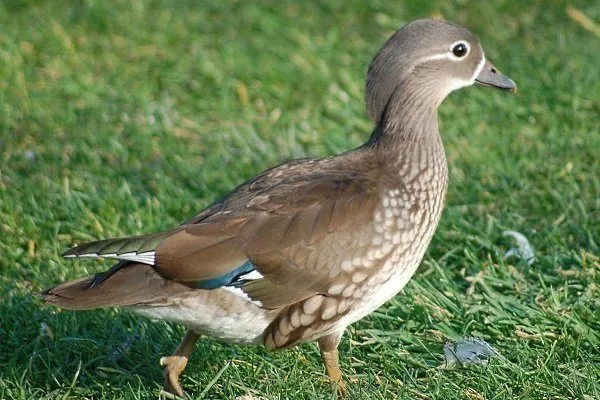
The female's plumage doesn't offer a wide variety of colors, but it is still attractive in its own way. Gray dominates the duck's coloring. Only the breast, the eye outline, and the base of the dark gray bill are white. The wings are brownish-gray, and the neck and flanks are a rippled pattern of small white and gray spots. The feathers on the crown are longer than the rest and slightly raised. Discreetness is essential for laying eggs and hatching chicks. The legs are yellow-brown.
Character and behavior
Mandarin ducks are curious but very shy. When threatened, they fly away abruptly, disappearing into the thicket of tall trees.
The bird is a good swimmer, submerging its body minimally in the water and raising its tail. Mandarin ducks enjoy swimming, finding pleasure in the process. They dive only in extreme cases, such as when injured or in danger. They are friendly toward other birds in bodies of water.
The duck's flight is maneuverable, nimble, and fast. Mandarin ducks rise into the air at a right angle, almost vertically.
Lifestyle and duration
The natural habitat of this duck species is areas with mountain rivers and forests near bodies of water. Mandarin ducks' favorite perch is tree branches overhanging the river. They often perch on rocky surfaces, resting and basking in the sun.
Hunting these ducks is strictly prohibited due to the extinction of the species.
Mandarin ducks are bred in squares and parks with ponds as ornamental birds.
In the wild, due to the environmental conditions and natural predators, mandarin ducks live an average of 15 years. In captivity, with constant care, safety, and high-quality nutrition, their lifespan can be extended to 20-25 years.
The mandarin duck population numbers approximately 25,000 individuals, approximately 60% of which live in our country.
Care and maintenance of Mandarin ducks
Proper care and adherence to certain conditions allows you to independently raise beautiful Mandarin ducks.
Diet
Mandarin ducks are omnivorous birds. They fly out to feed at dawn and before sunset. In summer, plant matter makes up a large portion of their diet. They feed on plant seeds, especially acorns, which are rich in nutrients. They gather them under oak trees or pluck them from the trees by climbing.
Their diet includes terrestrial and aquatic plants. They obtain animal protein from fish eggs, mollusks, and other small river and pond creatures, as well as various worms.
To ensure healthy mandarin ducks when bred at home, ensure they receive a balanced, fresh diet. Allow the birds to roam freely in their enclosure, allowing them to forage for food on their own, while also leaving food in their feeders.
Suitable plant foods include alfalfa, plantain, dandelion, and duckweed. Chopped raw and steamed vegetables are also acceptable. Grains include corn, wheat, barley, and others. For the winter, prepare silage, grass meal, and vegetables for your pets.
| Type of food | In nature | In captivity |
|---|---|---|
| Plant-based | Acorns, plant seeds | Alfalfa, plantain, vegetables |
| Animal | Fish roe, shellfish | Minced fish, insects |
Don't forget about animal protein. Mandarin ducks can get it from minced fish and frogs, small insects, ground meat, and snails.
It is advisable, especially in winter, to add vitamins and minerals to food.
During the mating season, increase the amount of protein by 20%, and after this phase, return the protein volume to normal levels.
The chicks' diet is more modest. They require small insects and boiled carrots.
Reproduction and offspring
Early spring marks the beginning of the mandarin duck's mating season. Several males sometimes compete for a single female. Having chosen a mate, the drake begins active courtship. Fluffing his head feathers to appear larger and more massive, he circles the duck across the surface of the pond, attracting attention with his vibrant plumage.
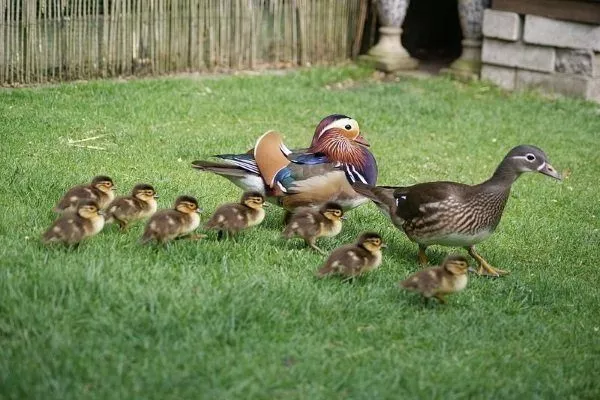
Once a female chooses the best drake, a strong, lifelong pairing is formed. Mandarin ducks remain faithful to their partners. If one drake dies, the other spends the rest of their lives alone.
The duck nests both on the ground and in tall trees, preferring to build nests in tree cavities whenever possible. She lays 7 to 14 eggs. The young hatch after about a month of incubation. During this time, the drake is especially protective of the female, foraging for food and feeding her. Weather conditions greatly influence the brood size and the health of the chicks; cold is harmful to the young.
Newly hatched ducklings immediately learn to swim and forage for food. When they fall from their nest, which is located in a tree, the babies don't crash to the ground. They glide above the ground like parachutists, landing gently. Their diet consists of small insects.
At the slightest sign of danger, the duck takes her chicks into the undergrowth, while the male distracts the predator by attracting its attention. After six weeks, the young fly alongside the adults, foraging for food, and are therefore not tied to the parental nest.
Mature males molt, changing their plumage to brighter colors, and then form a separate flock. Sexual maturity occurs in the first year of life, but reproductive capacity fully develops somewhat later. Therefore, the older the mandarin duck, the more fertilized eggs it can lay.
Home care
Mandarin ducks love warmth. Therefore, when deciding to keep this breed of bird, create optimal conditions. Lay hay and straw on the floor, and provide additional heating during the cold season. If the air temperature drops below 5°C, it is recommended to keep the birds in shelters and not expose them to the cold.
- ✓ The temperature in the poultry house should not fall below 5°C, especially during the breeding season.
- ✓ The enclosure must be equipped with a pond with clean water, the area of which is at least 1 square meter per pair of ducks.
The enclosure must have sufficient space, at least 15 square meters, for each pair. The ceiling is covered with mesh to prevent the mandarins from escaping. A body of water is essential within the breeding area. It makes no fundamental difference whether this is a natural river, a nearby lake, or an artificial depression filled with clean water.
Another requirement for keeping mandarin ducks is the presence of various trees, shrubs, and other elevated areas near water. Providing them with as close a resemblance to life in the wild as possible will have a positive impact on the birds' development and reproductive abilities. When they live comfortably in captivity and trust humans, the birds reproduce more actively.
Don't place nests on the ground in the coop; attach them to walls or perches at a height of at least 1.5 meters. Nests should be approximately 40 x 40 cm. Keep in mind that each pair requires its own enclosure. This is because, while Mandarin ducks are friendly with other birds, they do not get along with each other. Having two or more pairs in the same area increases the risk of competition and fighting between the drakes, and the females may stop laying eggs.
Sometimes, when kept in captivity, a duck will abandon the clutch after laying eggs. In this case, it's best to use a broody hen from a different duck species. A better option is to place the eggs in an incubator.
It's best to move the drake to another location while the eggs are incubating. This increases the chances that the duck will hatch the eggs without abandoning the nest.
Pay special attention to the chicks. Without human assistance, they have little chance of surviving in artificially created conditions. A feeding schedule and maintaining a favorable temperature in the pond and the birdhouse are essential.
We recommend reading the article about feeding ducks at home.
Mandarin ducks are most often bred for the love of this duck breed, but commercial breeding is also sometimes pursued. Both single individuals and pairs are offered for sale. Prices for mandarin ducks range from 10,000 to 15,000 rubles per duck.
The video below provides an overview of the Mandarin duck breed:
Natural enemies
Mandarin ducks' natural enemies include squirrels that visit tree nests, otters, and raccoon dogs. All of these prey primarily on chicks and eggs, but are also dangerous to adults. Furthermore, since these "Chinese ducks" are miniature, encounters with any predator larger than them pose a danger.
Poachers play a key role in the extermination of mandarin ducks. They are primarily attracted by the male's coloring, which is often later used to make a stuffed specimen. However, it's not uncommon for hunters to mistake the drake for another bird species during molting.
Interesting features
Interesting features of tangerines include:
- The color of the drake's feathers. No other duck has such vibrant plumage.
- Every year the duck builds a new nest in a new place.
- Vertical takeoff during flight. Mandarin ducks' legs are so strong that they can take off at a right angle. This makes takeoff possible even in very dense forests.
- They have sharp claws and are capable of climbing trees. They also prefer to build their nests at a height of 5-7 meters from the ground.
- When moulting, the drake hides in the thickets, thus forming entire flocks of males.
- Aversion to diving. Ducks enjoy swimming, but they don't dive for food, only in case of serious danger.
- Whistling and other sounds instead of quacking. Mandarin ducks are quite silent. Their voices are rarely heard.
- Due to genetic incompatibility, it is not possible to cross them with other duck species.
- Albinos among mandarin ducks have white plumage. Scientists are working to develop new color variations of these birds.
Mandarin ducks are stunning birds. Once you've seen them, you'll never forget them. Few people remain indifferent to these vibrant creatures. To ensure our descendants can experience mandarin ducks firsthand, we must reduce hunting by every means possible and create conditions that allow them to reproduce in the wild.