
Goldeneyes are a genus of birds in the duck family with distinctive bright yellow, sometimes white, eyes. In some regions, they are also called "nestlings" because they nest in the hollows of tall trees near bodies of water. Read more about this bird species, its characteristics, types, and care below.
Origin
North America is considered the bird's native land. However, chronicles indicate that even in Kievan Rus', goldeneyes were prized for their down and raised in private farms. The phrase "to walk like a goldeneye" originated from comparing humans to them. On land, they move in a curious manner: they throw their head back and walk with a slow, waddling gait, as if presenting themselves as a very important person.
Description and types
Ornithologists distinguish three species of ducks of this genus:
- Common gogol.
- Little Gogol.
- Icelandic Goldeneye.
They differ from each other in the size of their beak, body weight and habitat.
Icelandic goldeneye
The duck is very similar to the common duck. Females, males, and young of both species are indistinguishable, except during the breeding season. During this time, the Icelander's head becomes covered in purple-violet feathers, and an elongated white "spot" appears, larger than that of the common duck and shaped like a triangle with rounded corners. The female's bill is black in spring; the rest of the year, it is orange.
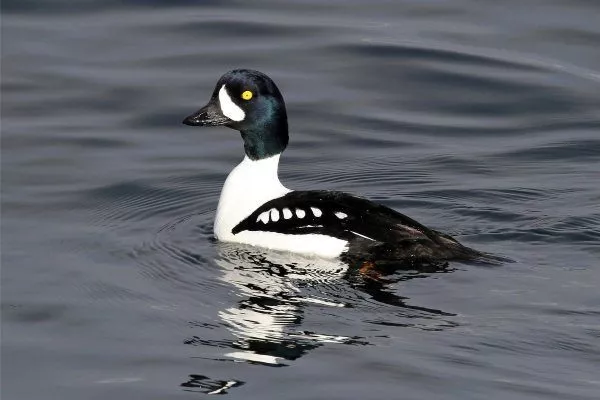
| Name | Beak size | Body weight | Habitat |
|---|---|---|---|
| Common gogol | Short | 750 g to 1.25 kg | Europe, Asia, North America |
| Little Gogol | Short | up to 450 g | North America |
| Icelandic goldeneye | Short | 750 g to 1.25 kg | Iceland, Greenland, North America |
Common gogol
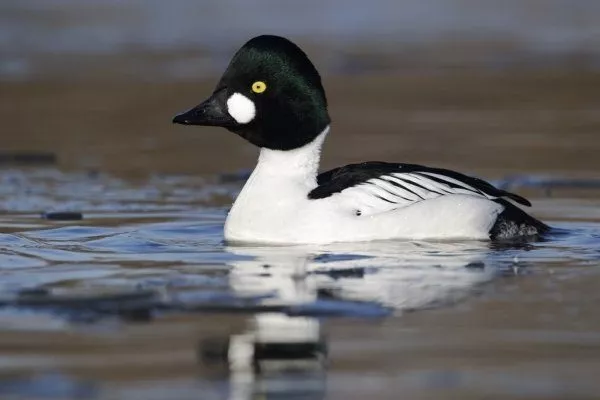
Most commonly seen in the wild, it is a beautiful bird with contrasting plumage. Its head is large, with an elongated and pointed crown, appearing triangular. The neck is short. The bill is also short, high at the base, rounded, and tapering toward the tip.
Eye color varies with age. Chicks' eyes are red until they are two years old, then turn golden yellow. Their legs are short, so they cannot achieve great speed on land. For the same reason, they prefer to spend most of their time in the water. The webbing on their feet is thick and orange; in females, it is paler, closer to yellow.
Coloration varies by season. In spring, the drake dons a fashionable plumage to impress the female. Snow-white feathers cover the belly, flanks, and neck, as well as under and above the tail. Contrasting black braids are arranged diagonally across the upper wing. The head and back are a rich black with a greenish shimmer, clearly visible in the sun. White "coins" appear near the base of the bill. The wings are covered with brownish-black or dark gray feathers. The tail is black with a greenish sheen.
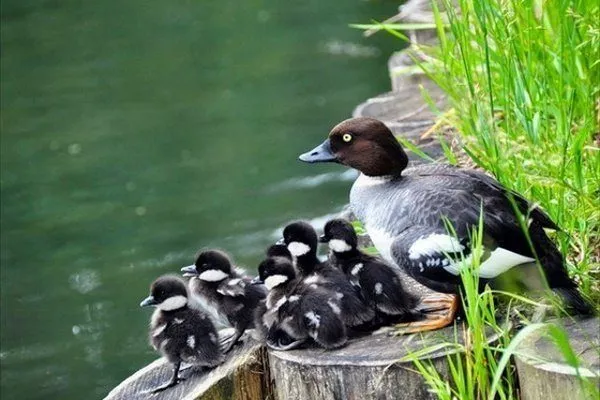
During the rest of the year, the post-molt drake is the same coloring as the female and the young. The male's plumage is much more subdued than the spring attire of the dandy drakes. Their coloring features gray and brown tones. The back and sides are smoky, and the belly is snow-white. The wings are darker—blackish-gray. The eyes are pale yellow or white. The bill is gray, with a yellow or orange band at the base. The brown head is separated from the body by a narrow white collar.
Males are larger than females. On average, males weigh between 750 g and 1.25 kg, while females weigh between 500 g and 1.18 kg. Their body length does not exceed 50 cm, and their wingspan ranges from 65 to 85 cm.
Some ornithologists distinguish two subspecies of the common goldeneye:
- American;
- Eurasian.
This is explained by the differences in beak size and weight among members of the same species. The plumper specimens are classified as belonging to the American subspecies. Other experts consider the species monotypic, and attribute the variation in beak size to the influence of physical and geographical factors, as well as the fact that these two subspecies regularly interbreed.
Little Gogol
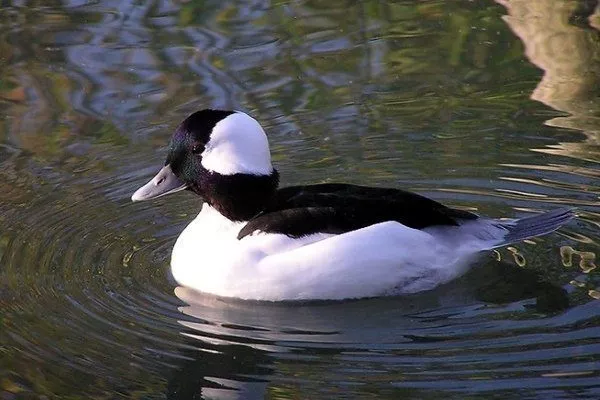
The lesser goldeneye is similar in build to the common goldeneye, but is significantly smaller. The lesser goldeneye weighs no more than 450 grams, and its length is no more than 40 cm. Males have a black back, white sides, and belly. The back of the head and sides are covered with snow-white feathers. The bill is dark gray, and the eyes are brown.
Females are inconspicuous. The abdomen, sides, and chest are gray, and the back is gray with a brown tint. The head is brown, with a white spot under the eye.
Habitat
Goldeneyes are migratory birds. In winter, they migrate south or west of their nesting sites, to the coasts of seas and large inland bodies of water. Common goldeneyes nest in forested areas across Europe, Asia, and North America, preferring coniferous forests. Some birds can be sedentary, but all are found in northwestern Europe.
The Icelandic representatives have a scattered range. Some are found on the northwest coast of North America, others in Labrador, and are also found in Greenland and Iceland. These birds nest near lakes, swamps, and rivers in forested areas.
The lesser goldeneye has been recorded only in northern North America. In winter, it migrates to the southern continental United States and Mexico. These ducks prefer shallow waters near mixed forests and avoid open tundra.
Mating season
Birds reach sexual maturity in their second year. Early in the spring—in March, when the snowmelt patches are just beginning to appear—they return to their nesting sites in pairs or small flocks. Often, the male and female migrate to different latitudes for the winter, so they spend this time alone.
In the spring, after arrival, the mating season begins. The drake, having changed into a new plumage, fluffs up his head and spreads his tail to attract a female. With his head thrown back, he begins to pirouette. Sharply throwing his head up and forward, he thrusts his body forward, creating a fountain of spray around himself.
In April-May, the pair builds a nest. It can be located in a hollow pine, spruce, aspen, or oak tree up to 15 meters above the ground. When choosing a location, they prefer isolated trees near water. Woodpeckers often occupy old nests; rarely, they build nests in the ground—in a hare's burrow, between roots, or in the hollows of a stump. If the female is satisfied, she may use the nest for several years in a row. They do not defend the area around it, but each pair maintains their own private patch of water.
The duck lays between 5 and 13 eggs. Their shells are green with a bluish or brownish tint. At first, she sits on the clutch inconstantly, emerging occasionally to feed. When leaving the nest, she covers the eggs with down plucked from her breast. The drake plays no role in hatching the chicks. After the duck settles on the clutch, he remains near it for about 9 days, then flies off to the seasonal molting grounds.
It also happens that two females lay eggs in one nest, in which case they are left unattended and the embryo inside them dies.
The chicks hatch after 29-30 days of incubation. They remain in the nest for 24 hours, where they dry thoroughly. Then they follow the duck to the ground. They land smoothly, parachuting with their outstretched wings and webbed feet, and follow their mother to a body of water. After 5-10 days, the ducklings become independent and live separately from their mother in small groups of 2-3.
Lesser goldeneyes share the responsibility of caring for the future generation, hatching the ducklings together.
Nutrition
Ducks feed on aquatic life—small fish, insects, larvae, arthropods, and mollusks. Plant matter accounts for a small portion of their diet. They enjoy algae, seeds, and various roots of plants growing along the banks of bodies of water. They forage for food from the bottom, diving to depths of 4 meters or more and staying underwater for more than 30 seconds. By two weeks of age, ducklings are already good divers and can organize their own feeding.
The goldeneye population is currently the least concerning to experts, but it is noted that it is still declining due to human activity.
Home maintenance
Goldeneyes are rarely kept as pets. Common goldeneyes are usually used for breeding. If goldeneyes are chosen for breeding, certain care guidelines are followed.
- ✓ The depth of the reservoir must be at least 4 meters to ensure comfortable diving.
- ✓ The presence of natural vegetation around the reservoir to create shelters and resting places.
- ✓ Absence of strong currents, so as not to hinder the feeding process for the birds.
Conditions of detention
Since the goldeneye is a waterfowl and an excellent diver, a body of water surrounded by trees is essential for comfortable captivity. If natural lakes or ponds are unavailable, an artificial pond can be created. However, it's important to remember that no more than three females can coexist per square kilometer of water. Otherwise, they will chase away competitors and displace them from their territory.
Nests, also known as hollow nests, are hung in trees. They are placed at a height of over four meters to ensure the female is not disturbed. The nest should be 10–14 cm high and attached at a forward angle. The bottom is left rough to allow the chicks to emerge on their own. The entrance is made facing the water. Ideally, the distance to a body of water should be no more than 10 meters.
During the warmer months, birds thrive outdoors and don't need additional shelter. A shelter will suffice, providing protection from the scorching sun or rain. With the onset of cold weather, the flock is moved to spacious coops. Since wild birds tolerate cold well, no heating is required in the barn. Simply insulating the coop is sufficient—caulking all cracks and laying a thick layer of straw bedding on the floor. In the fall and winter, they are provided with at least 14 hours of daylight with lamps.
Ventilate the room to avoid stagnant air. Regular cleaning will help prevent the spread of diseases.
Features of the diet
In the wild, goldeneyes' diet consists of 70% animal and 30% plant matter. In captivity, this ratio is maintained. They are fed hard varieties of buckwheat and barley, chopped fresh fish, bloodworms, and crustaceans. Free access to clean water is essential, and they are also provided with a container filled with fine pebbles or grainy sand.
Reproduction
Females have a strong maternal instinct and care for their offspring independently. The most you can do to help them is install nests. However, not all females like nests; each female decides for herself where she feels most comfortable. Goldeneye chicks grow quickly and have strong immune systems.
Taste qualities
They are raised solely for their eggs and down. The meat of the gogol is of little culinary value, as it has a distinctive flavor and odor. To reduce this, the carcass is trimmed of not only the skin but also the fat. Before cooking, the meat is soaked in a marinade for 24 hours and then roasted or stewed. It is not suitable for boiling.
Interesting facts
- Goldeneyes are capable of diving to depths of up to 11 m;
- the oldest gogol lived to be 14 years old;
- These ducks are aggressive during the nesting season and can fearlessly attack anyone who enters their territory;
- ducklings, following their mother, can jump from a height of 15 meters, but they will learn to fly only by the 57th to 66th day after birth;
- During flight, birds emit a characteristic whistle, by which they can be recognized even with closed eyes.
The behavior of these ducks in nature is demonstrated in the video below:
Goldeneyes are mostly wild birds and don't like being kept in captivity. If a farmer decides to breed them, they should be as hands-off as possible, as they are quite independent. They were listed as endangered in the 1980s, but their population has since increased.