
The red duck is an easy-to-care-for bird, although many poultry farmers mistakenly consider it demanding due to its appearance. Read on to learn more about this duck's characteristics, origins, diet, and reproduction (both domestic and wild), as well as the specifics of keeping and breeding it.
Origin
The red duck originated in Western Europe, but is now rare there and found only in steppe regions. They originally inhabited the desert regions of the African continent. A small population was spotted in Central and Middle Asia during bird migration. They migrated to and settled in the provinces of China, India, and Taiwan.
The red duck arrived in Moscow relatively recently. In the early 20th century, several individuals were brought to the Moscow Zoo, where they quickly adapted and began to reproduce rapidly.
After their wings were no longer clipped, several individuals escaped and began exploring the waters of numerous parks. Thanks to their easygoing nature, they quickly adapted to the urban environment and now serve as natural ornaments for ponds and lakes.
Description of the bird
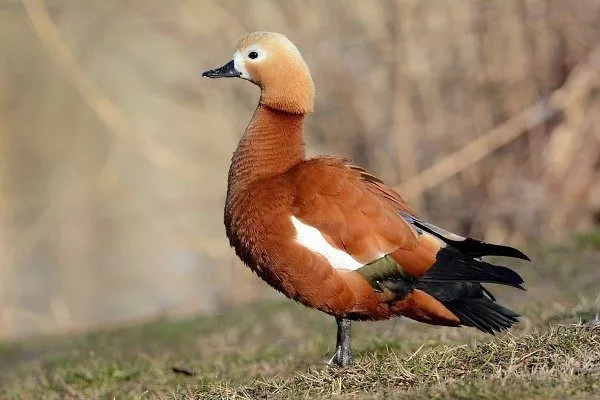
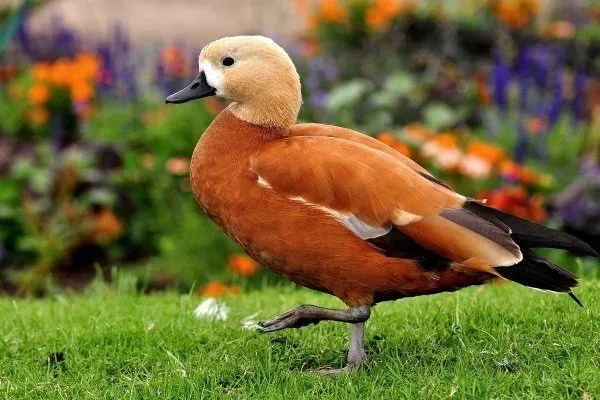
The Ruddy Shelduck is a distinctive bird. Both males and females have beautiful rufous-brown plumage. Distinguishing features include:
- The head and neck area are lighter than the rest of the body—the feathers are ochre, but birds with white heads are also found. The beak, feet, and tail are black. The tail feathers can have a beautiful dark green sheen. The underside of the wings is almost white. This can be seen when the bird is in flight.
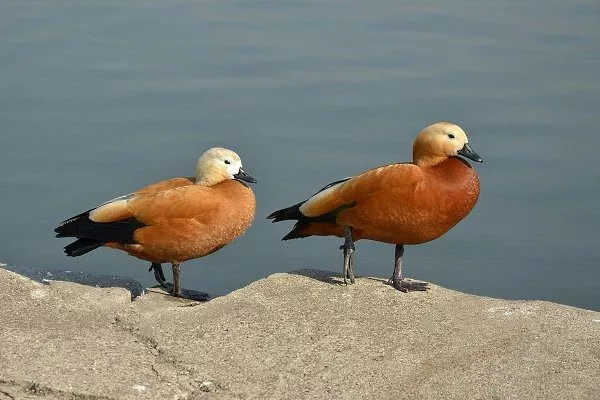
- During the mating season, the "female" doesn't change her attire. Her only adornment at this time is a few small white spots around her eyes. The male, on the other hand, is a true dandy. His reddish feathers become more vibrant, and a narrow bracelet of black feathers encircles his neck.
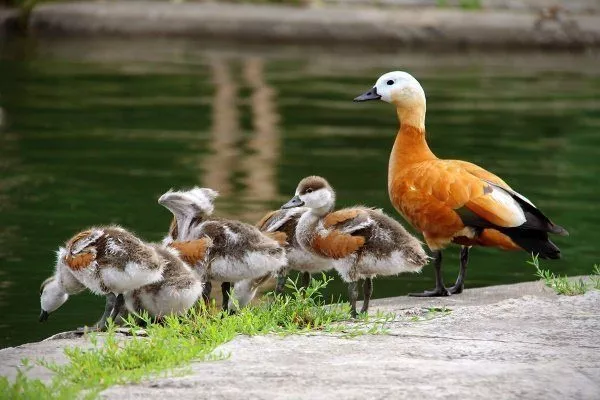
- Juveniles differ from adults only in the duller coloration of their feathers. With age, the plumage becomes richer and brighter. The bird reaches 70 cm in length, with a wingspan of 100-135 cm.
- The birds are easily identified by their call, which is completely unlike a quack and is not typical of ducks. It resembles a goose's honk—low, rough, and morphing into a donkey-like bray. Females produce sharper, more drawn-out calls. They are more vocal. The drakes' calls are rhythmic.
The lifespan of these beauties in the wild is 6-7 years. In captivity, they live twice as long under favorable conditions and good care—up to 12 years.
Character and habits
It's hard to call these cute ducks friendly. They're quarrelsome and short-tempered, unsociable and cautious. Perhaps because of their bad temper, they don't form large flocks like mallards, for example.
They usually live in groups of several pairs. The maximum size of such a flock is eight individuals. Only in the fall, before migrating to warmer climates, do they gather in large flocks of up to 40-60 birds.
They do not tolerate other species nearby. Males aggressively defend their territory not only from their own kind, but also from other waterfowl.
An overview of the Ruddy Shelduck breed is presented in the following video:
Distribution and habitat
The shelduck is found as an ornamental bird in almost every corner of the world. In the wild, its range is not as extensive.
It settles near bodies of water—fresh, brackish, and salt. It can be seen in rock crevices or tree hollows. The bird population is unevenly distributed. In some countries, it is abundant, while in others, it is listed as an endangered species on the Red List.
The shelduck lives:
- in the Asian part of the Eurasian continent - in its central part, as well as in the territory of China (in the southeastern and central provinces), Mongolia;
- in North Africa (Morocco and southern Algeria), Ethiopia;
- on the northern coast of the Aegean Sea;
- on the western coast of the Black Sea in Bulgaria and Romania;
- The duck is also found in Afghanistan, Iraq, Iran, and Turkey.
In Russia, it inhabits almost all regions, with a predilection for the southern regions—from the western Amur region to the western Caucasus region and Krasnodar region. The northern boundary of its range runs along the southern forest line to the taiga.
It is also found in Kazakhstan, bordering Russia, and Ukraine, but its population there is so small that it is listed as endangered. The duck does not inhabit the taiga, coastal areas, or areas with dense vegetation.
Nesting and winter range
During the nesting season, ducks migrate to the steppes or deserts from west to northeastern China to Greece. The Asian population migrates south during the winter. During this period, it is found at Lake Issyk-Kul, the southern Caspian region, and in southern Eurasia.
The shelducks living in Turkey lead a sedentary lifestyle and move short distances in search of better housing.
Wildlife Nutrition
The shelduck is an omnivorous bird. Its diet includes both plant and animal matter, found on land and water. In the spring, its main food source is numerous seeds and young shoots. In the summer, after the chicks hatch, the duck goes in search of protein-rich food. It catches insects near bodies of water, frogs and small fish in the water, and also enjoys crustaceans and mollusks.
From late summer onward, they forage for food on land. They can often be seen in grain fields or on grain-transporting roads. They typically feed in the evening and at night.
During the day, shelducks prefer to rest near or on water. Therefore, while walking in the park, you can often see a sleeping duck standing on one leg.
Reproduction
Ruddy shelducks reach sexual maturity in their second year and begin building nests to raise their young. The process of pairing, nest construction, and breeding has some nuances for shelducks.
Formation of a pair
The red duck is a monogamous bird. It forms a mate for several years in advance. However, if one partner dies, the other creates a new family.
Young females and males begin to form a pair bond in the first days of nesting or begin to consider this decision during wintering. Interestingly, it's not the male who chooses the female; rather, the female chooses a loyal companion. She does everything she can to attract the male's attention.
To do this, the ducks form a circle and begin to flirt with the male, making noises. However, most often, the male shows no activity. He either stands on one leg and waits for this whole "mess" to end, or follows the female, dragging his wings and hanging his head.
Once the female has made her choice and found a worthy drake, they rise into the sky together, circling in a wedding dance. The mating season lasts from mid-March to mid-May.
Nest
After mating, the parents-to-be begin building a nest. In the wild, they may choose badger or fox dens, or build a nest in rock crevices or coastal washouts. The nest is typically located 10 meters or more above ground level.
About 1.5 months before laying, the female lines the nest with white down and a small amount of grass. A clutch contains 7-12 eggs. The shells are cream or white. The female lays one egg per day.
Incubation and breeding
Only the female incubates the young. She remains permanently in the nest for four weeks. The male, the future father of a large family, is constantly on guard. During this period, the drake is very aggressive. When threatened, the female emits a snake-like hiss, and the male attacks, driving the intruder a considerable distance from the nest. He is not intimidated by the size of the enemy. Ruddy shelducks often attack adults.
Ducklings hatch almost simultaneously. In cities, you can sometimes see tiny chicks jumping out of the attic. One parent is below, encouraging the chick with loud noises. The other parent is above with the brood, watching the chicks jump out.
There's no need to interfere with the birds' movements. The ducklings weigh very little at this time, and they glide to the ground like feathers and land without injury. After hatching and drying off, the family heads almost immediately to a body of water, sometimes traveling several kilometers.
At first, the brood follows their mother closely, spending most of their time on the water. They only come ashore to sleep. Both parents care for the ducklings, with no division of labor.
After about 8 weeks, once the young have learned to fly, they are freed from parental care and begin an independent life.
The Value of the Red Duck
On farms, ducks are mostly bred for ornamental purposes. Some poultry farmers keep shelducks for their warm, lightweight down and feathers. Due to their large size and rapid weight gain, they are considered a meat breed.
Duck meat is lean and tender, especially in summer when they are fed natural food.
Productivity
Ruddy shelducks are among the highest egg-laying females compared to other species. They lay their first eggs as early as six months of age. A single female can lay up to 120 eggs per year. If shelducks are raised for breeding, each egg will hatch into a healthy and strong duckling.
With good nutrition at home, the weight of the male reaches 6 kg, the female - 4 kg.
Advantages and disadvantages
The breed has its advantages and disadvantages. The advantages of shelducks include:
- good egg production;
- meat with good taste;
- strong maternal instinct;
- omnivorousness;
- decorativeness;
- ease of care.
However, they also have their downsides:
- noisiness, loudness;
- aggression during nesting;
- manifestation of jealousy towards the owner.
Care and maintenance of the Red Duck
Since shelducks dislike being in large, mixed-feather groups, it's important to ensure each pair has its own separate area. A small lawn and a pond are essential for walking. However, they don't require large bodies of water. Otherwise, the birds won't build nests or breed.
- ✓ The optimal temperature in the poultry house should be maintained at +7°C and above, especially in winter.
- ✓ For each pair of ducks, it is necessary to provide a separate area of at least 1.5-1.7 sq. m.
During winter frosts, they are kept in dry, enclosed spaces, but separated from other breeds to prevent crossbreeding and the creation of hybrid ducklings. Ultimately, this leads to the complete elimination of the lineage.
Shelducks have excellent immunity. With proper care, they are not susceptible to disease. They are only vaccinated against viral hepatitis.
Poultry house arrangement
In a winter poultry house, a heated floor is installed, for example, by laying a thick layer of bedding such as sawdust or straw. This will provide the birds with warmth from the winter cold and allow them to lay eggs. The room temperature should be 7°C or higher.
In the summer, they are kept in an enclosure. The required space for one pair is 1.5-1.7 square meters. A small house is also built inside to provide shelter in adverse weather conditions. If there is no natural body of water nearby, an artificial pool will have to be provided.
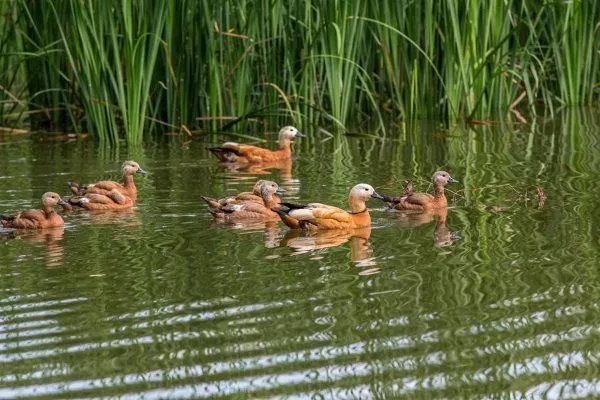
The wings of two generations of red ducks are clipped.
Ruddy shelducks are unpretentious birds with strong immune systems. Basic care includes:
- in timely change of bedding;
- maintaining cleanliness and dryness in the barn;
- in increasing daylight hours in winter with the help of artificial lighting.
- A constant supply of clean, fresh water in the water bowl. The manufacture of water bowls for ducks is described in here.
Feeding
When kept in captivity, ducks are fed twice a day—morning and evening. During the day, they forage freely. They are supplemented with compound feed, which is additionally enriched with minerals and vitamins.
During the winter, when ducks are kept indoors, grains such as wheat, corn, oats, bran, and legumes are added to their diet. Fresh, chopped root vegetables such as carrots, beets, potatoes, and cabbage are also given.
We recommend reading the article about feeding ducks at home.
Breeding
Breeding red ducks is not difficult. You just need to know a few basic rules.
Incubation or natural brooding?
Female ducks have strong maternal instincts, so private farms don't use incubators to hatch ducklings. After hatching, both the male and female parents constantly care for the young, protecting them from enemies and teaching them the ropes of life.
Care and maintenance of chicks
The parents easily cope with their responsibilities and keep their chicks close to them 24 hours a day. Human assistance in caring for the chicks is kept to a minimum.
To moisten the floor, use damp burlap. Place it on the floor and sprinkle straw and sawdust on top.
Feeding the chicks
The chicks are fed a special starter feed designed specifically for ducklings. To enrich them with vitamins, they are given finely chopped spinach, lettuce, duckweed, and nettles, as well as protein-rich foods such as small insects and earthworms. It is essential to ensure that the chicks' drinking bowls are always stocked with fresh water.
Ducklings are fed immediately after they dry off. In the wild, ducklings respond only to movement, so their main food at this time is flying and crawling insects.
You can attract their attention to the feeder by tapping it. If the duckling refuses to eat for several hours, force-feed it with a liquid mixture from a pipette. This mixture consists of boiled egg yolks and milk. Ducklings are fed 4-5 times a day. Crushed chalk, shell rock, and fine sand are always added to the feed.
Red Book
Although the red duck population is numerous and is listed as "not of concern," it is listed in the Red Book of Threatened Species in some Russian regions, and hunting is prohibited. This applies, for example, to the northern regions, where this duck is a rare visitor.
You can hunt it in the southern regions of our country—Krasnodar and Stavropol Krais, Astrakhan and Orenburg Oblasts, as well as in Kalmykia. However, hunting in the latter region can be a challenge, as Buddhism is widespread in the republic. For Buddhists, the ruddy shelduck is a sacred bird, so catching it, much less hunting it, is strictly prohibited.
The number of people interested in hunting wild red duck increases as autumn approaches, when the birds prepare to migrate. At this time, their meat becomes more delicious because the distinctive smell disappears.
However, the decline in bird numbers cannot be attributed solely to hunting. Shooting is not the only factor contributing to the population decline. There are a number of other factors, primarily related to human activity.
For example, in the steppes, ducks like to nest in marmot burrows. The population of these animals has declined significantly in recent years. Consequently, without marmots, there are no burrows, and the birds have nowhere to nest, resulting in a decline in the ruddy shelduck population. Therefore, many nature reserves are trying to increase the ruddy shelduck population by installing artificial nests or creating burrows.
Price
Birds are purchased from farms that breed them. The price per bird varies greatly. Adult birds can be purchased from private poultry farmers for as little as 1,500 rubles. Prices are often much higher—from 5,000 to 10,000 rubles.
Reviews of the Red Duck breed
Few people decide to breed red ducks; they are mostly kept for their beauty. Reviews of the breed are overwhelmingly positive.
The red duck, or shelduck, is rarely found on private farms, although breeding it doesn't require any special skills or special conditions. It's enough to know some of the breed's characteristics and behavioral traits. With proper care, shelducks delight their owners not only with their beauty but also with their productivity.