
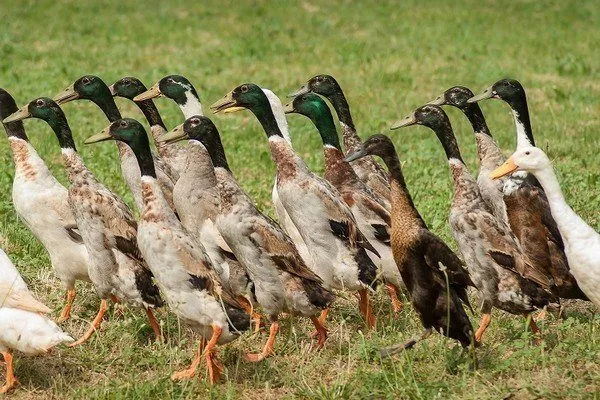
Indian Runners are domestic egg-laying ducks that resemble penguins in appearance. These birds are popular in agriculture due to their low-calorie meat and healthy eggs. Before breeding Runners, carefully familiarize yourself with the specifics of this breed.
History of the breed's origin
The first Runners were not used for breeding. With their distinctive appearance and comical gait, these domesticated birds were part of circus troupes and eagerly participated in public performances. They were often exhibited at zoos, where they attracted plenty of spectators.
Indian Runners first appeared over 2,000 years ago in eastern India and became particularly popular in Southeast Asian countries. Over time, these unusual birds migrated to England, and in 1926, to Russia. There is a misconception that their origin is in Great Britain.
Over the past 30-40 years, Indian Runners have been distributed throughout Europe, America, and Australia. English breeders continue to experiment with this breed to improve productivity, alter its appearance, and diversify its coloring.
Appearance of Indian Runners
This breed of domestic duck was once called "penguin" due to its unusual bottle-shaped body. These birds have a most unexpected coloring, making them a striking addition to any poultry yard. In appearance, Indian Runners resemble penguins, but their running speed is several times faster.
Exterior
Indian Runners have an elongated, vertical body with a slightly rounded chest. Their small heads are set on a thin, slender neck. The domestic duck has an upright posture, flattened flanks, a rounded chest, and an arched back.
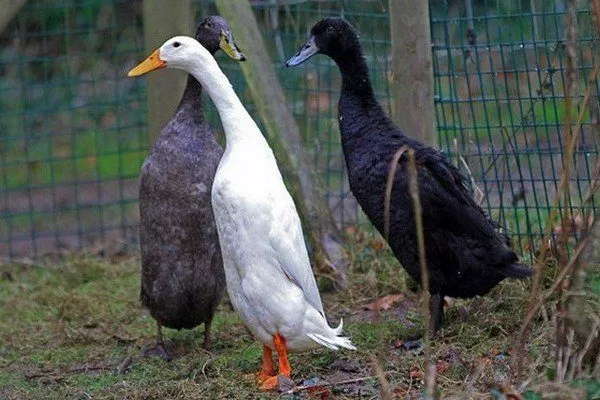
The runner's wings are massive and lie close to the body. The eyes are dark brown, set wide apart, and positioned vertically above the tips of the flippers. The bill is wedge-shaped, pale pink, and long, matching or slightly larger than the head.
The orange feet resemble the lower limbs of penguins. Their hue depends on the bird's coloring and gender. The multicolored tail is shortened, contains 18 tail feathers, and does not reach the ground, making it easier for domestic birds to move around.
Color
| Name | Weight of an adult (kg) | Egg production (pieces/year) | Color |
|---|---|---|---|
| Wild | 2.0-2.5 | 200-250 | Emerald head and neck, brown chest, black tail |
| Trout | 1.8-2.3 | 220-270 | Green neck, red chest, gray wings |
| Silver-wild | 2.1-2.6 | 210-260 | Silvery belly, dark red breast, black head |
| White | 1.9-2.4 | 230-280 | White feathers, yellow beak and feet |
| Black | 2.0-2.5 | 200-250 | Black feathers with an emerald sheen |
When purchasing Indian Runners, breeders are faced with a variety of colors. Below are the most popular colors and their brief descriptions:
- WildThe drake and the duck have different coloring. The male has an emerald neck and head, a bright brown breast, a black tail with a green tint, and dark gray wings. The female has brown plumage and a rich yellow bill.
- TroutThe drake has an olive bill, a green neck, a red breast, gray wings, and a dark back. The female duck is less colorful, with a yellow bill and light brown feathers that vary in color intensity in different areas of the body.
- Silvery-wild. Drakes have a silvery belly and dark red breast, a black head with a green sheen, white wings, and an olive bill. Ducks have light yellow feathers, a more subdued coloration.
- White. Ducks and drakes have white feathers all over their bodies, and a rich yellow bill and lower legs. Individuals differ in body size (drakes are larger).
- Black. Males and females are uniformly colored, with black feathers that take on an emerald hue in the sun. The bill is dark green. The coloring of the drake and hens is identical.
For an overview of the Indian Runner duck breed, watch the video below:
Weight
The ducks themselves are small in size. The average weight of an adult female ranges from 1.5 to 2 kg. The drake is slightly larger, up to 2.5 kg. Ducklings are precocial and gain weight quickly. By 2 weeks, they reach 1-1.5 kg. proper feeding and maintenance, the weight of an adult individual is gained by the age of one month.
Breed characteristics
A distinctive feature of Indian Runners is their ability to run fast and swim well over long distances. When breeding, these ducks don't require an artificial pond and can easily survive without bathing.
By nature, these birds are calm and non-confrontational, but they are constantly on the move and bustling about. They make noise and show signs of restlessness when they sense a threat or danger. They quickly become accustomed to new environments, adapt even to harsh climates, and are stress-resistant.
You can distinguish a drake from a duck by several criteria. For example, a female has more light-colored feathers on her body. If the birds are brown, black, or a solid color, the color of the bill and feet is the determining factor. In ducks, these are always lighter. Females quack, while drakes make more hoarse, muffled sounds.
Productivity
The Indian Runner is an egg-laying breed that attracts breeders due to its high production rates. In one year, these birds lay up to 360 eggs, each weighing 70-80 grams. The eggs are tasty, filling, and last longer than those of other poultry breeds.
The color of the shell depends on the color of the Indian Runner, and varies from white to light olive.
Duck farming produces soft, dietary meat with a delicate flavor, popular even among true gourmets. A 2 kg adult duck yields 1.5-1.7 kg of fresh meat. This dietary product contains cholesterol-free protein, making it ideal for those losing weight and beneficial for those with low immunity.
Content Features
Indian Runners can easily withstand Russian cold. The key is to maintain a proper diet and feeding schedule, and adhere to the care and maintenance guidelines for these unusual birds. If possible, provide an artificial pond in the enclosure. While these ducks generally thrive without water, this can reduce their productivity.
Poultry house
The requirements for a poultry house are standard. The room must have dry and clean litter, otherwise the ducks are sick, and from dampness, they can even die.
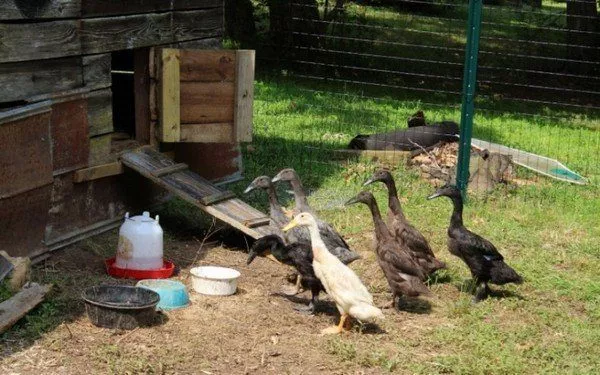
When equipping a poultry house, consider other equally valuable recommendations from experienced breeders:
- During winter frosts, heat the poultry house. For this, use mineral wool for the exterior walls and a stove or infrared lamps inside.
- Maintain a constant room temperature. Daylight hours should be 12-14 hours.
- Avoid drafts and dampness in the poultry house, otherwise such factors negatively affect the health of ducklings and adults.
- Provide ventilation in the room, avoid stagnant air and specific odors of the poultry house.
- Clean the room regularly, change the ducks' bedding once every 2-3 days, or more often if necessary.
- Install feeders in the poultry house and sippy cups, check their cleanliness, the presence of fresh food and clean water.
Set up an aviary near the poultry house, keeping in mind the following requirement: 10 square meters per bird. If this rule is violated, the birds will not have enough fresh grass, and they will begin to argue and fight.
An artificial pond is also welcome. Indian Runners feel comfortable in the water, rinsing their wings and brushing dirt off their feathers (to avoid bringing it back into the coop).
Care
Clean the coop, clean the feeders and waterers, and let the Indian Runners out to pasture daily. Beforehand, make sure the enclosure is fenced to prevent the birds from escaping and other pets from entering their territory.
While out for a walk, ducks run, frolic, and hunt for insects, worms, and snails. Make sure Indian Runners don't get into your garden, as they will ruin your grain crops and reduce your harvest. This is especially true for ducklings, which have only recently been allowed out for a walk.
Keep your poultry healthy. Disinfect the coop regularly and examine the plumage of each bird. If parasites are detected, consult a veterinarian immediately and begin prompt treatment. Bird care includes a number of preventative measures, including vaccinations.
The video below tells about this interesting breed of duck, which is constantly on the move, has excellent egg production, and is easy to care for.
Feeding
In winter, the birds' diet includes crushed grain, compound feed, and vitamin and mineral supplements. In summer, you can save on feeding costs by regularly letting the birds out foraging for food. In the latter case, it's important to monitor what the Runner eats and in what quantities.
The daily diet depends on the age of the individuals, the time of year and the purposes of breeding in agriculture.
Adults
Indian Runners have a good appetite. Don't restrict their food intake, but balance their diet, enriching it with vitamins, mineral supplements, and premixes.
Nutritional features:
- Serve grains in the evening, crushing them into crumbs first (for better digestion). Focus on corn and wheat.
- Throughout the day, feed the ducks fresh greens such as spinach, cabbage leaves, dill, nettle leaves and dandelions.
- Be sure to include special compound feeds in the daily menu.
- Feed your birds wheat bran, alfalfa, bone meal, shells, sand, and gravel. Boiled potatoes, carrots, and beet greens promote weight gain and satiety.
- Monitor the amount of clean water in drinking bowls, disinfect and refresh them regularly.
Ducklings
During the first few days of life, feed ducklings only pre-crushed yolks, which you sprinkle on their backs. This is essential to developing the grasping instinct necessary for foraging for food later on. Gradually introduce egg whites, also crushed, starting at 2-3 days of age.
Starting at day 4, add a small amount of pre-softened compound feed to the ducklings' diet. This is essential for digestion, a strong immune system, strong bones, and the prevention of vitamin deficiencies. Fresh greens, including cabbage leaves, lettuce, and dill, are especially beneficial for the growing generation.
Winter period
During the cold season, access to fresh greens is limited. To maintain weight gain, include raw potatoes, chopped eggs, beet and carrot tops, silage, sprouted grain, and vitamin and mineral supplements in the daily diet.
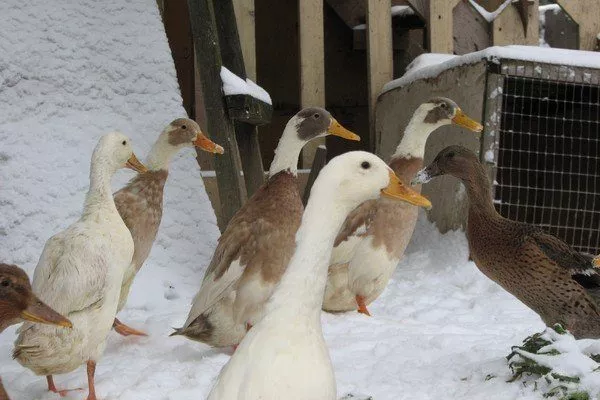
Fruit and vegetable scraps and wet mash strengthen the immune system and minimize the risk of disease. In winter, feed ducks four times a day, monitor digestion by monitoring feces in the coop, and promptly respond to the first signs of illness.
Breeding Features
White ducks lay eggs well in winter, while black ducks do so in summer. There are up to five productive females per drake.
There are special requirements for ducks:
- well developed, rounded chest;
- spectacular plumage;
- well-spaced pelvic and pubic bones;
- voluminous belly.
If ducks molt prematurely, they are considered defective and are not used in breeding Indian Runners. A mandatory requirement is that the female must be 5-6 months old, when she is already in reproductive activity. With the right mating pair, the fertility rate of eggs is 80%.
The hatch rate for natural hatching is 90-95%, but drops to 80% when using an incubator. Because ducks are small, they can hatch no more than 8-10 eggs. Russian breeders often choose natural hatching with laying hens.
- ✓ Eggs should be of medium size, without visible shell defects.
- ✓ The optimal storage period before incubation is no more than 8 days at a temperature of 9-11°C.
Incubation
Whole, medium-sized eggs without deformations or other external defects are used in the incubator. Before incubation, they are stored for 8 days at a temperature of 9-11 degrees Celsius with a humidity of 70-75%. The eggs are then placed in the incubator, where they remain for 25-28 days until hatching.
Basic requirements for incubation:
- Days 1-7: The permissible temperature is 38.2-38.0 degrees Celsius, humidity is 70%. The eggs are turned 4 times a day without natural cooling of the incubator.
- Days 8-14: Temperature: 37.8 degrees, humidity: 60%. Eggs are turned 4-6 times a day without natural cooling.
- Days 14-25: Temperature: 37.8 degrees, humidity: 60%. Eggs are turned 4-6 times a day with natural cooling of the incubator for 20 minutes, twice a day.
- from day 26: Temperature: 37.5 degrees, humidity: 85-90%. Eggs do not turn over, and natural cooling of the incubator is not required.
Read more about incubation of duck eggs This is discussed in our next article.
Caring for chicks
The ducklings are highly active, have a strong immune system, and reach adult weight by one month. After hatching, transfer them to a clean box, provide a temperature of 26-28 degrees Celsius, and provide 24-hour light (especially during the first day).
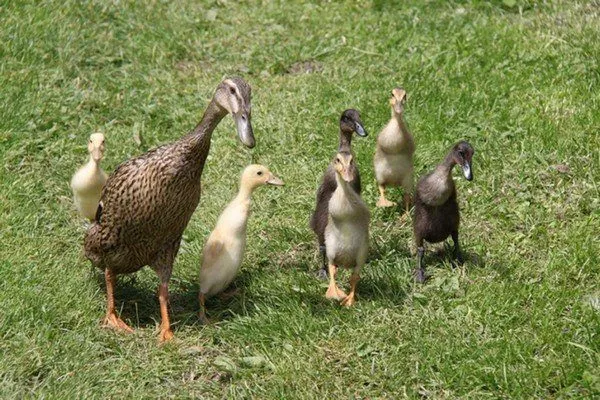
Gradually reduce the ducklings' day length to 14 hours, like adults. Maintain a suitable humidity level of 60-75%. Avoid drafts and dampness, otherwise the Indian Runners' immature immune system may be overwhelmed.
- ✓ It is recommended to take the first walk in calm and sunny weather.
- ✓ The air temperature should be at least 15°C to prevent hypothermia.
If the weather is fine and there are no strong winds or frosts, let the ducklings out for a walk, starting at two months of age. Make sure they don't end up outside the enclosure, where they could be trampled by other poultry.
A duck teaches its babies to swim from an early age. Provide a shallow container of fresh water for this purpose, otherwise the ducklings may drown.
Diseases
Indian Runners are generally healthy and have a strong immune system. There are no specific diseases specific to the breed, but it's important to be aware of the following conditions common to all poultry:
- AvitaminosisIf dietary errors occur, ducks may not receive sufficient vitamins, minerals, and trace elements. Potential complications include rickets, feather loss, apathy, loss of appetite, and weight loss.
- CuticulitisChicks under one month of age are at risk. The disease is accompanied by loose stools, loss of appetite, and insignificant weight gain. Poultry may even die from exhaustion.
- CloaciteThe duck's cloaca becomes inflamed, forming a growth containing pus. Potential causes include a vitamin deficiency in the diet. Consequences include the death of the young.
- Urovskaya diseaseThis is a consequence of poor nutrition, causing birds to pluck their own feathers and eat sawdust. Potential complications include cannibalism.
Advantages and disadvantages
The Indian Runner is attracting the attention of most Russian breeders. This poultry is suitable for producing dietary meat and eggs. The main advantages of this breed include:
- high egg production;
- quiet behavior;
- strong immunity;
- attractive exterior;
- rapid maturation of chicks;
- frost and stress resistance;
- rapid acclimatization;
- tasty, dietary meat.
During breeding, minor defects are discovered, which it is better to be aware of before purchasing Indian Runners:
- light weight;
- timidity;
- not a meat breed.
Farmer Reviews of Indian Runner Ducks
The Indian Runner is a popular duck breed among Russian breeders. These ducks are fidgety and skittish by nature, requiring constant supervision. They can produce up to 400 eggs per year and delicious, dietary meat.