
Ostrich leather processing requires special skill, as it has a unique texture. The importance of proper processing stems from the need to obtain a high-quality product, as selection is based on varietal characteristics—the higher the quality, the more expensive the leather.
Features of ostrich skin
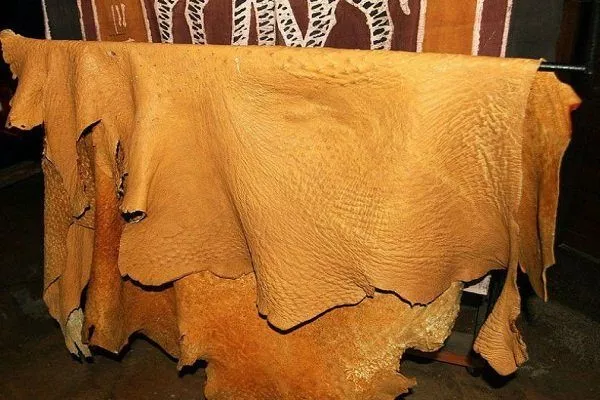
Ostrich leather is considered prestigious and very expensive. It not only looks beautiful but also offers numerous advantages, including incredible durability and low wear resistance, according to experts. Other distinctive features include:
- water resistance – clothes and shoes do not get wet, as water is simply repelled by the skin;
- soft to the touch - it's nice to touch;
- viscosity - you can sew any product from it (besides, it is elastic, does not tear or crack);
- colorability – perfectly absorbs and retains coloring pigments;
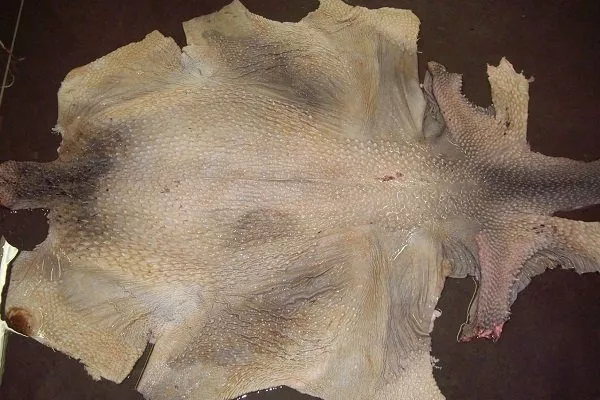
- graininess of texture – feather follicles-sacs add originality and sophistication to the products.
The most sought-after part of ostrich skin is the back, as it has the best relief.
What is ostrich skin used for?
A wide range of products are made from ostrich skins:
- haberdashery – wallets, handbags, bags, belts, hats, accessories;
- cloth – jackets, coats, trousers, skirts;
- shoes – exquisite women's and men's shoes/boots;
- stationery – folders, book bindings, notepads;
- decor – fragments for interior decoration;
- auto industry – finishing of car interiors, seats, panels, etc.;
- furniture - sofas and armchairs, poufs.
Every collection of global fashion houses (Gucci, Prada, Veneta, etc.) includes elements and wardrobe items made from ostrich leather.
Types of skins
Salted hides are evaluated based on their surface area and quality, which determines the final price of the hide. This is done using specialized equipment in the wet-salted state.
First, the elasticity, strength, texture, and size (minimum 0.8, maximum 1.5 square meters) are determined, which influences subsequent use (the manufacture of specific products). The presence of cuts, microcracks, scars, scratches, the quality of preservation, and the skinning of the meat are also assessed.
Ostrich skin comes in the following grades:
- First. Considered the best. The inside of the skin should be free of any scraps of meat. It should be complete, including the neck, wings, and paws. No scratches or other defects, just the freshest, highest-quality canning.
- Second. Some minor imperfections are allowed:
- size - incomplete;
- opening lines are not precise;
- preservation – average level;
- cuts, holes and other damage;
- defects in the follicles;
- the presence of fatty spots and a “red cap”, that is, spots on the inside of the skin (occurs due to bacterial damage).
- Third. The same requirements apply as for the second grade, but defects are allowed to a greater extent.
Indicators such as staleness, ammonia smell, poor preservation, and spongy structure indicate that the material is unsuitable for further use.
Preparation for dressing
Unlike chickens, geese, and other poultry, ostriches have a unique spirit and character. When slaughtering, handle them correctly to avoid fright, which can lead to injuries that negatively impact the skin (bruises and lesions).
Time to slaughter the bird
Ostrich slaughter occurs when they reach a weight of 100-120 kg (the former applies to females, the latter to males). Further rearing is pointless, as the quality of the skin deteriorates. Ostrich farm owners retain only a few females, exclusively for egg production.
The rate of development of ostriches is influenced by their diet. The recommended age for slaughter is between 12 and 14 months. If ostriches are slaughtered later, difficulties with tanning the skin arise—it cracks, dries out, and becomes stiff (young ostriches produce natural oils, while older ostriches do not).
Slaughter instructions
First, prepare your tools. You'll need a thick rope, a knife, a sturdy metal hook (to hang the carcass), and a hammer. Slaughtering is done in stages. The first step involves stunning. On larger farms, this is done with a 240-volt electric current.
It is applied for a maximum of 7 minutes. The main advantage of this method is that it can simultaneously immobilize several individuals. For small ostrich farms, hammer stunning is used.
How to slaughter an ostrich:
- Tie the bird so that it cannot move.
- Mark the exact center of the head (at the crown) and strike with a hammer. Try not to miss, as the ostrich will become enraged and may attack.
- After the bird falls, bleed it dry by severing the jugular vein in the neck or removing the head completely. Be careful, otherwise bruising will form in the neck area, which will reduce the quality of the skin.
- Hang the animal upside down on a hook to allow the blood to drain quickly and prevent the carcass from turning blue. To speed up the bleeding process, cut the artery near the heart.

- Pluck the ostrich immediately. Keep in mind that pouring boiling water over the ostrich is strictly prohibited, as the feathers will lose their value. Place the carcass on a comfortable surface and carefully pluck each feather.
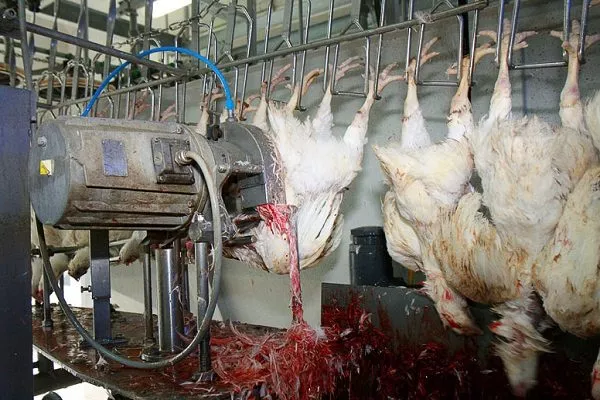
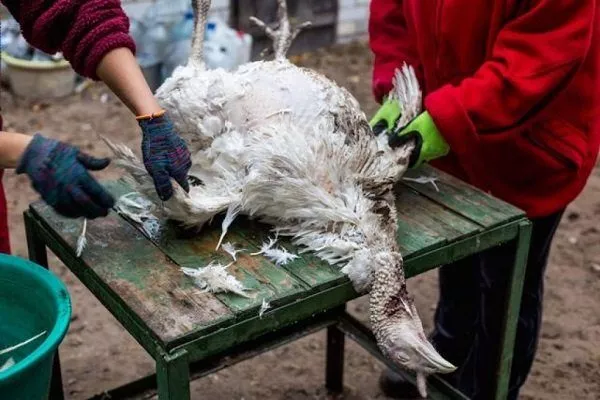
If the skin is damaged during plucking, a tear will form, which will reduce the grade.
The skinning process
The process of separating the outer skin from the meat is quite complex. It must be done very carefully to avoid jagged pieces. Here's how to remove the skin correctly:
- Make a cut near one wing and continue along the abdominal cavity toward the other wing. Continue cutting as you go—the line should be smooth and continuous.
- Now place the knife near the cloaca and draw it down to the beak through the neck and belly.
- Make an incision in the area of the toe joints and run the knife all the way down to the belly.
- Remove the skin, scraping away the meat and bones with the blunt side of a knife. Remove all fat and other debris.
- Wash the coating with water and laundry soap and wipe dry.
- Lay the skin out to cool for 15-20 minutes with the outer side facing down.
Primary processing of raw materials
After cooling, preserve the hide. To do this, follow these instructions:
- Sprinkle with salt. Do this immediately, as the decomposition process will begin quickly. Use 1 kg of coarse salt per 2 kg of leather. Too much salt will draw all the moisture out of the leather, causing it to dry out, leading to brittleness and fragility.
- Roll the skins and stack them.
- Transfer to the refrigerator (not the freezer).
- Leave for 60 hours.


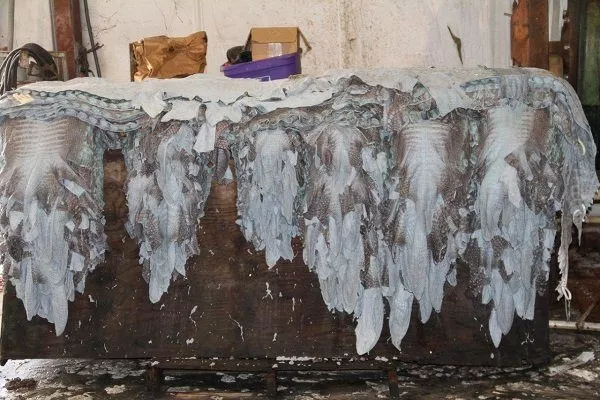
Leather tanning
Dressing is carried out in several main stages. Be sure to strictly adhere to the sequence and correctness of the steps:
- Soak the leather. Water should be 20-25°C. To prevent putrefaction, add 40 g of salt, 3 g of washing powder, and 1 g of formalin to 1 liter of water. Soak the leather in this mixture for 40-48 hours, changing the mixture every 6-8 hours.
- Hang the skin to drain off any liquid.
- Clean with a scraper or knife (blunt side) on both sides.
- To soften and degrease the hide, soak it in an acidic environment for 24 hours. Kerosene can also be used for the same purpose, at a 2:100 ratio to water.
- To make the leather resistant to adverse conditions, tan it. Use aluminum chromium alum or chromate according to the instructions. The entire process also takes 24 hours.
- Dry the leather in a cool, dark place for 48 hours. Hang it up to dry.
- Straighten and stretch the skin until it is perfectly flat.
- Polish with a special oil that gives smoothness and shine (you can also use Vaseline).
What mistakes can be made?
Ostriches are highly sensitive birds with a herd instinct. It is strictly forbidden to slaughter them on a farm. If their fellow birds witness this procedure, they will become extremely stressed and will scatter, breaking down any fences in their path.
What problems may arise and how to avoid them:
- Ostriches are very strong creatures. Don't hit them or even frighten them before slaughtering them—they can attack and cause serious injury.
- Slaughter the bird yourself, or if you don't know how, have a professional slaughter it. A few days before the procedure, the professional should come and get to know the ostrich better (so it gets used to it and then lets you approach).
- If the pets in the herd see their owner killing his "brother", be prepared for the fact that they will not let you near them again.
- Do not store the leather rolled up for too long and do not allow it to become too damp, as this will cause the leather to develop a red cap.
- Do not force the ostrich into the slaughterhouse, as the resulting stress will deteriorate the quality of the meat and skin.
- Stun the bird correctly – exactly in the center of the head, which will immediately immobilize the bird and prevent it from harming you.
- To prevent “red cap”, use boric acid and naphthalene (1% each) and table salt (98%) during storage.
How to care for ostrich leather?
Because ostrich leather has follicles, caring for it is a bit more challenging, as dust accumulates between the ridges. Basic rules:
- Areas with smooth skin can be simply wiped with a soft, cotton cloth.
- Slight dampening of the cloth is allowed, but soaking the product completely in water is not recommended.
- Because ostrich skin contains oils, they periodically appear on the surface as greasy stains. These can be removed with talcum powder. Sprinkle it on the surface, leave it for 2-4 hours, then shake it off and blow it away.
- Chemicals are absolutely not suitable for treating leather. Use conditioner specifically designed for reptile items.
- If the contamination is severe, it is permissible to use a soap solution (made from laundry soap).
- Avoid contact with alcohol-based products as they corrode leather fibres.
- Conditioners containing lanolin are excellent. Afterwards, polish the surface using a special polishing cream or paste, applied in a very thin layer.
- If you apply wax, its color should be neutral, ideally colorless.
- Store your items properly – avoid exposure to direct sunlight, drying out, or freezing.
Knowing all the rules for ostrich leather processing allows you to process the hide yourself, without having to hire a professional. It's recommended to do this for the first time under the close supervision and guidance of a knowledgeable person, but subsequent times you'll be able to easily slaughter and dress the ostrich without assistance.