
When slaughtering an ostrich, it's important to properly prepare the animal for slaughter and perform the slaughter itself. Below, we'll explore the nuances of this complex but essential process in poultry farming and the mistakes that can be made due to inexperience. This article provides complete instructions for slaughtering this exotic bird.
When is the time for slaughter?
Ostriches are slaughtered once they reach a certain weight. The bird is considered ready for slaughter:
- males – weighing 120 kg;
- females – weighing 100 kg.
There is no point in keeping males after they reach 120 kg, but females can be kept for egg production.
- ✓ Plumage condition: absence of damage and cleanliness as an indicator of health.
- ✓ Behavioral signs: Aggression or apathy may indicate stress or illness.
The rate of weight gain depends on diet and nutrition regimenThe better you feed ostriches, the shorter their lifespan. Experienced farmers slaughter birds based on their weight rather than their age. Ostriches typically reach the desired weight in their second year. Birds being prepared for slaughter are fed a special diet.
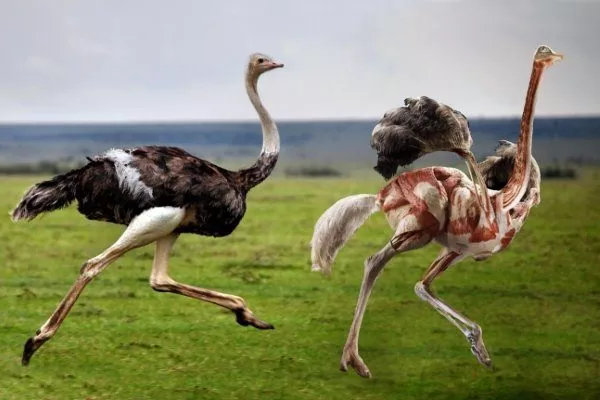
Where are ostriches slaughtered?
Slaughtering an ostrich isn't as easy as slaughtering a regular poultry. And the first challenge awaits farmers right from the start: ostriches are not allowed to be slaughtered on the farm. These birds are so skittish that they panic at the slightest noise or danger, running away, destroying everything in their path. Ostriches are slaughtered in a special slaughterhouse with sturdy walls.
If ostriches are slaughtered on a farm, the surviving flock will suffer tremendous stress. The birds will not allow humans to approach them; in fact, they are capable of attacking people if they perceive them as enemies. These birds are so strong that they can even kill.
An ostrich being prepared for slaughter is transferred to the slaughterhouse. However, this is done in a manner that ensures it does not experience stress, as this will reduce the quality of the meat.
Preparation for slaughter
The ostrich's large size and strength pose a challenge during slaughter. They're not as easily handled as a duck or a goose. If threatened, these giants can become aggressive, strike, and even kill. This is why taming ostriches is so important. When it's time to slaughter, they can be calmly led to the slaughterhouse without panic or resistance.
Domestication begins from a very early age so that ostriches perceive humans as feeders and waterers.
Tools and equipment are prepared for slaughter:
- stun hammer;
- a sharply sharpened knife;
- thick rope;
- metal hook – for hanging the carcass.
On large farms, ostriches are electrocuted before slaughter, requiring the purchase of special, expensive equipment.
Step-by-step instructions for slaughter
The slaughter process consists of several stages, which must be performed sequentially. The quality of the product depends on the precision of each stage.
Stun
Stunning is carried out in one of two ways:
- Electric shock. A 240V current is applied to the birds for 6-7 seconds. Several birds are immobilized simultaneously. This method is used on large farms.
- With a hammer. The ostrich is hit on the head—right in the center—with a hammer. It's important to hit accurately and hard so the bird is knocked out immediately.
- Check the condition of the hammer: it should be clean and free from defects.
- Determine the point of impact: the center of the head, between the eyes and slightly higher.
- Ensure immediate bleeding after stunning for humaneness and meat quality.
Exsanguination
The stunned bird's jugular vein, located in the neck, is severed. Or the entire head is cut off. The carcass is then hung by its legs with hooks to allow the blood to drain. Once all the blood has drained, they move on to the next step.
To ensure that the blood flows out as quickly as possible, the main artery, located near the heart, must be cut.
The video below shows how ostriches are slaughtered:
Plucking
Plucking is performed by a professional—it's recommended to hire one specifically for this job. If you entrust the plucking to non-professionals, the feathers will be of poor quality and difficult to sell.
Primary processing of raw materials
To ensure high-quality hides, they must be harvested strictly according to the proper technology—it's a good idea to watch a special video explaining all the intricacies of the process. The most important factors when skinning are the shape of the resulting hide and its absence of defects. Size is less important than quality. To achieve the correct shape, cuts are made along specific lines.
Skinning rules:
- To remove the skin from the wings, cut from the outer edge of the first wing to the outer edge of the second wing. The cut should be continuous and extend through the abdomen.
- The main incision is made from the bottom up, from the anus to the beak. It is also continuous.
- On the legs, the skin is cut from the distal joint of the fingers to the abdomen through the thigh.
The removed skin is sent to cool for 15 minutes.
If the skin is contaminated with excrement or blood, it is thoroughly washed under running water. Any remaining meat and fat are carefully trimmed off with a blunt knife, being careful not to damage the hide.
Next, the hide is preserved. This is necessary to prevent the breakdown of the protein structures before the raw material is tanned. Salt is used for preservation—it removes excess water and kills bacteria. However, complete dehydration must be avoided; the water content must not be less than 15%. Otherwise, the fragile hide will begin to crack.
Preservation process:
- The skin is spread out on a wooden surface, with the inside facing up. It is then sprinkled with salt—the weight of the salt should be twice the weight of the meat being preserved.
- The salted skins are placed in the refrigerator for 60 hours. Cool, but do not freeze.
Ostrich leather is very delicate, and if the tanning process isn't followed correctly, the raw material quickly deteriorates. Well-tanned leather is highly prized.
Types of skins
| Name | Skin size (sq. m) | Price |
|---|---|---|
| Adults | 1.5 | High |
| Subadults | Less than 1.5 | Average |
| Juvenile | The smallest | Low |
After salting, the raw materials are sorted and assessed for quality. Skins are classified by size:
- Adults.
- Subadults.
- Juvenile.
A male's hide measures approximately 1.5 square meters. The larger the hide, the more expensive it is. Skins from juveniles and chicks are much smaller and therefore cheaper.
Dressed hides are also classified by grade. Grading depends on the quality of preservation, shape, correct removal, size, and the presence of defects.
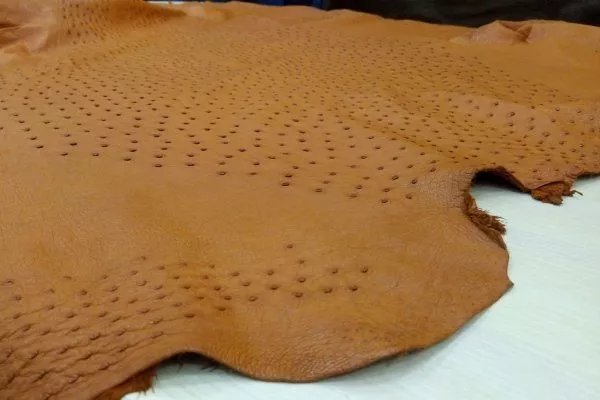
Types of ostrich skins:
- First class. Well-preserved raw material, retaining its original freshness. The interior is free of traces of meat, fat, or fascia. The size and shape are complete. There are no defects.
- Second grade. Similar to the first, but one of the following defects is allowed:
- incomplete removal;
- the cuts are not made accurately – they do not match the lines established by the technology;
- poor quality preservation;
- grease stains;
- red cap defect;
- damaged bulbs.
- Third grade. Similar to the second grade, but the presence of two defects from those listed above is allowed.
"Red cap" is a defect that occurs when hides are stored rolled up for long periods at high temperatures or in a humid environment. Red-colored microorganisms multiply, forming red spots.
If the raw material shows signs of decomposition and smells bad, it was improperly preserved. Such hides are not classified as grades; they are considered substandard raw material.
Leather tanning
After the preservation process, the hide is processed. This process takes place in several stages:
- Soaking. The raw material is immersed in a special solution, completely covering it. This stage lasts 48 hours. The solution is changed four times during this time.
- Hanging. The skin is removed from the mixture and hung up so that the solution can completely drain off.
- Cleanup. The skin is cleaned on both sides using a scraper or a blunt knife.
- Acid soak. Its purpose is to make the leather soft and supple. The raw material is placed in an acidic solution, which softens the collagen fibers. The process lasts at least 24 hours. Readiness is tested by bending a fold – if the fold turns white, the hide is ready to be removed.
- Tanning. The goal is to make the leather resistant to adverse factors by immersing it in a special tanning solution. Chromium phosphate, alum, or oak/willow bark are used for tanning. The process takes at least 24 hours.
- Drying. The hide is hung in a cool, dark room and dried for two days. The dried hide is straightened and stretched until it becomes smooth and even.
- Polishing. Special oils are used for this procedure. The goal is to give the material a smooth, shiny, and beautiful appearance.
During hide tanning, powerful chemicals are used that are dangerous to humans and can be harmful to health. Working with tanning agents requires specialized experience.
Cutting and gutting
Ostriches are gutted like other poultry. They are hung by their wings, making them easy to gut. The abdominal cavity is cut open, pulled apart, and the entrails are removed. The gutted carcass is washed and refrigerated.
Gutted carcasses are butchered on wooden surfaces. Butchering involves separating the carcasses into:
- boneless meat;
- shins;
- hips;
- half carcasses;
- quarters.
The carcasses are cut without touching the muscles, which allows for the perfect steak cut. The cutting process is quick to avoid damaging the protein structure of the tissues. The remaining trimmings and small muscles are sold as low-grade meat.
The yield of pure meat from a black ostrich is 30-40 kg, from a rhea – 9-12 kg.
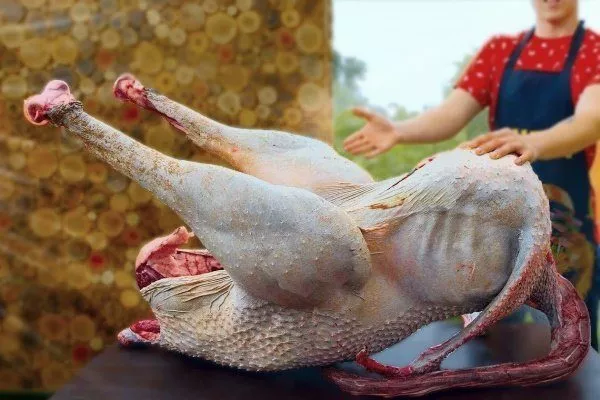
What mistakes can be made?
Ostrich slaughter is a responsible undertaking that requires comprehensive preparation. Mistakes farmers can make due to inexperience include:
- Slaughter in front of the herd. This is absolutely not allowed. The ostriches will become stressed. If they start running, they could break the enclosure fence.
- Attempts to drive ostriches into the slaughterhouse. Using force or showing aggression will cause panic throughout the herd. And those animals destined for slaughter will become stressed, which will reduce the quality of their meat.
- Incorrect stunning technique. If the hammer blow is not applied hard enough or not in the center of the head, the bird may start to run away, show aggression, and given its strength, the outcome of the fight is unpredictable.
Slaughtering ostriches shouldn't be entrusted to a novice—the process requires professional experience. This important procedure is usually entrusted to farm workers who have cared for the birds since birth. Ostriches become accustomed to them and trust them. Inexperienced people should not be allowed to slaughter them; it's important to remember that an ostrich can kill a person with a single kick.