
The natural world contains many mysterious and inaccessible phenomena. Sometimes, even the strangest animal behaviors can be questioned. One such myth is that ostriches bury their heads in the sand when they sense danger.
Is it true that ostriches hide their heads in the sand?
Ostriches can't simply bury their heads in the sand due to an anatomical peculiarity. They have a long, flexible neck, which allows them to lean against the ground or tilt their heads downwards. This isn't done to hide their heads, but rather to detect food or assess their surroundings.
Where did the myth come from that ostriches bury their heads in the sand when they are scared?
The common misconception that ostriches bury their heads in the sand to escape predators was first described by Pliny the Elder. In one of his many works, the ancient Roman scholar wrote: "Ostriches believe that by burying their heads and necks in the ground, they conceal their entire bodies."
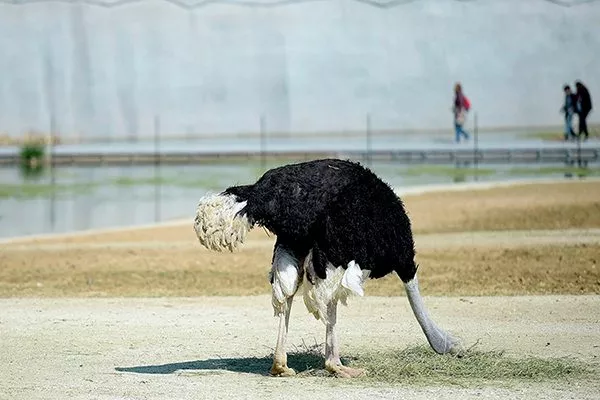
This story resonated with Europeans, and for some reason, it was widely adopted. The expression "burying one's head in the sand" exists in the languages of virtually all Old World nations. It's used to describe people who prefer to ignore a problem, hoping it will resolve itself.
How do ostriches actually escape from predators?
Ostriches typically either ignore small predators such as jackals or, if the threat is serious, may attempt to drive them off. The limbs of an ostrich, which weighs approximately 200 kg, are incredibly strong and can strike with a force of over 30 kg per square centimeter, capable of knocking out a potential threat.
Even after successfully escaping their pursuers, ostriches can become extremely tired. Sometimes they become so exhausted that they can't even hold their necks up straight, and their heads fall to the ground.
- ✓ The presence of powerful legs with two toes, which distinguishes them from other birds.
- ✓ The ability to reach speeds of up to 80 km/h, which is unique among birds.
In what situations does an ostrich lower its head to the ground?
Ostriches lower their heads to the ground in various situations. This is due to various aspects of their behavior and adaptation to the environment.
Camouflage during incubation
Female ostriches actively incubate all laid eggs, but the primary responsibility for this lies with the dominant females. Their gray-brown plumage provides excellent camouflage in the surrounding environment, and the only thing that might give away their presence is their long neck.
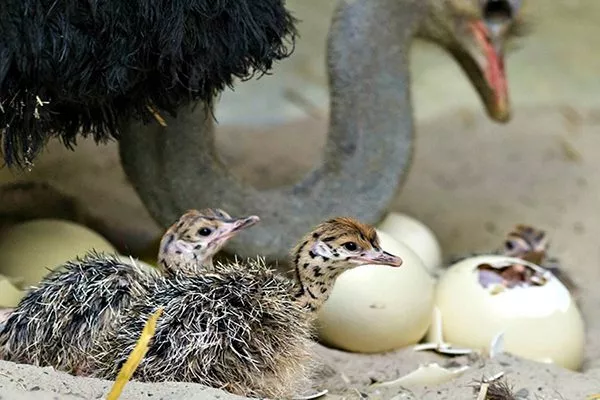
When threatened, the birds lower their heads to the ground, making them nearly invisible. Males, with their black and white plumage, have difficulty camouflaging themselves, so they prefer to incubate their eggs only at night to avoid attracting predators.
Feeding
Ostriches inhabit savannas and semi-deserts, and searching for food in the wild takes a long time. Given their enormous size, they require a large amount of food, and can consume around 4-5 kg of food per day. Their diet consists of vegetation and small animals.
Ostriches, while searching for food, often stand with their heads down for long periods of time. It's possible this behavior gave rise to the myth that ostriches bury their heads in the sand.
Finding stones for digestion
Ostriches, like some other birds, seek out stones for digestion. This occurs for the following reasons:
- Ostriches actively explore their surroundings, searching for appropriately sized stones. They select stones that suit their needs and size to use in digestion.
- Birds swallow these stones whole. They have no teeth or taste buds in their mouths, so the food, along with the stones, passes through the esophagus and into the stomach.
- In the ostrich's stomach, stones play an important role—they help grind food and improve digestion. They act like "millstones," helping to grind and crush solid food particles.
- The stones found in ostriches' stomachs gradually wear down and wear away. The birds periodically search for new stones to replace the old ones.
- Food processed by the stones in the stomach passes into the esophagus and then into the glandular stomach, where it is further infused with enzymes and acid before passing into the muscular stomach. There, the stones further mash the food.
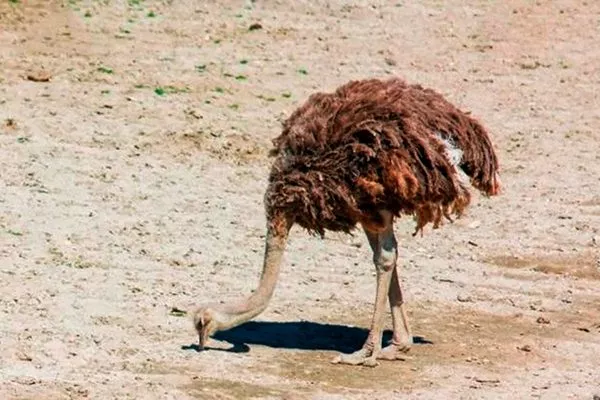
Finding and using stones plays an important role in the digestive process and allows ostriches to effectively digest solid food.
Situational control and camouflage
Ostriches are powerful birds capable of defending themselves, but even they can be vulnerable. To avoid danger and assess their surroundings, they lower their heads to the ground and listen attentively for sound vibrations.
It can be difficult to quickly assess a situation, so they remain in this position for some time. This sometimes makes it appear as if ostriches are hiding their heads in the sand, although this is not the case. If they detect a potential threat, they can lie low, bending their long necks downward to provide cover.
Parasites
Ostriches are susceptible to attacks by external parasites. The most common external parasites include insects belonging to the class Arachnida and ticks. These ectoparasites live on the ostriches' bodies, feeding on their blood and causing severe discomfort.
They are most often found on the head, and also around the eyes and beak of birds. That's why ostriches sometimes bury their heads in hot sand—they're trying to get rid of these unpleasant parasites and relieve the itch.
Rest
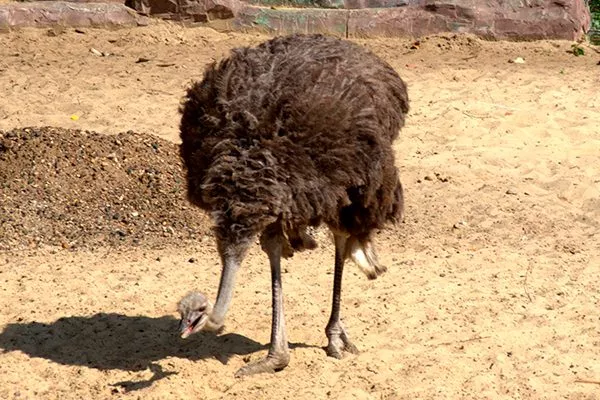
Ostriches tuck their heads in after a long run. Despite their impressive strength and endurance, they still need periods of rest. Ostriches can only run at high speed for about 15 minutes before exhaustion sets in.
How to set up a walking yard for ostriches, taking into account the bird's characteristics?
When breeding ostriches, which have a unique character and specific environmental requirements, a well-maintained environment plays a crucial role. Creating a spacious outdoor enclosure is essential for the successful breeding of these birds.
When designing such a structure, it is necessary to take into account the specific needs and behavior of ostriches, while the enclosure must be reliable and safe, given their impressive size.
The ideal ostrich enclosure must meet a number of criteria:
- Spacious territory. The enclosure must provide the birds with sufficient space for walking and mating.
- Diverse vegetation cover. The area should be planted with perennial plants that the ostriches will use as food.
- Water supply. It is necessary to ensure constant access to water within the enclosure.
- Grassy and rocky areas. Ostriches use stones to digest their food, so the presence of rocky areas is important.
- Feeders and drinkers. A sufficient number of feeders and waterers should be installed in the enclosure area.
- Shelter. Birds must have access to shelters where they can take refuge from bad weather.
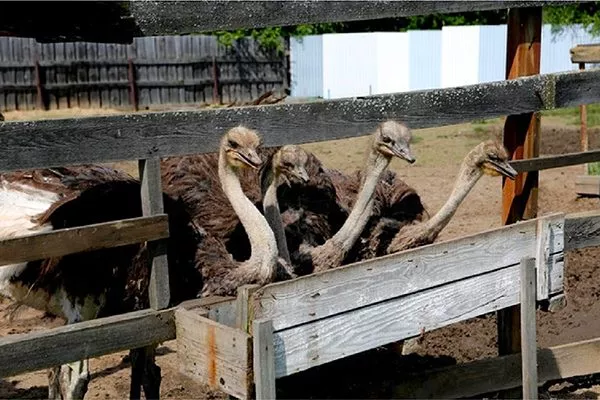
Helpful tips:
- Avoid selecting sites close to major roads, as ostriches are sensitive to noise and stress. High levels of stress can negatively impact their egg production.
- The walking area should be sunny and free of tall trees that could create strong shade. Instead, use small shrubs or a hedge to protect the area from strong winds.
- If running water is not available on site, the presence of a natural body of clean water is essential. Provide ostriches with opportunities for basking, especially during hot weather.
- The fence must be sturdy, and the posts must be carefully concreted. The minimum height of the fence is 2 m to prevent adult specimens from attempting to jump over it.
- The area should be equipped with rain shelters, and plastic covered with straw is often used to create them.
The myth of ostriches burying their heads in the sand is a misconception about the behavior of these birds. In fact, this is not true at all. This myth should be viewed as a misconception that does not correspond to the actual behavior of ostriches.