
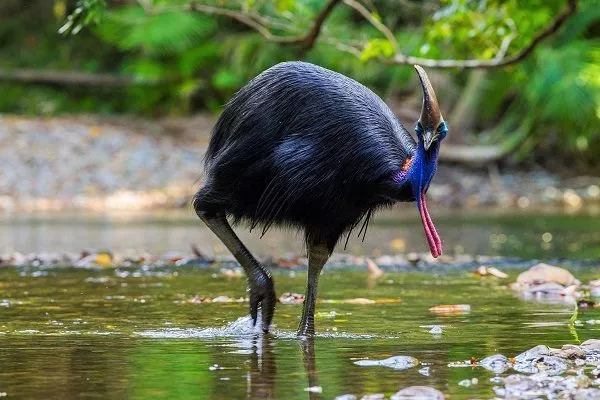
The Australian cassowary is a large, beautiful, yet formidable and unpredictable bird that lives deep in the rainforest and is rarely seen by humans. Its appearance earned it the nickname "horned head." In its native Australia, the cassowary is nicknamed "dinosaur."
Origin
Scientists have determined that the entire lineage of ratites (including cassowaries, ostriches, emus, kiwis, and others) originated on a single supercontinent, which eventually broke up into several continents. These birds are now no longer found in a single area.
Evidence of common ancestry is the loss of the keel in all birds of the class. This is a skeletal appendage unique to flying birds, atypical for ratites.
Archaeologists rarely find remains of the Australian cassowary. All that have been discovered have been in the same area, in the northeastern part of the continent. An exception: one bird was discovered in South Australia. This proves that the cassowary's distribution was once larger, but has declined over time.
Nowadays, the territories except for the north-eastern part are sparsely populated by cassowaries; it is almost impossible to find them there.
Description of the bird's appearance and life
The Australian cassowary is a large bird, vaguely resembling an ostrich. Members of the same class are distinguished by their brightly colored neck and a characteristic growth on their head. The bird uses this headdress as a weapon during battles for mates, to overcome obstacles while searching for food, and so on.
External features:
- Depending on the species, the neck may be bare or feathered. Some groups have one or two so-called "wattles" on the neck closer to the body.
- The bird has wings, but during the process of evolution they became vestigial, i.e. they are not used by the bird for their intended purpose.
- Cassowaries reach human height, ranging from 160 to 180 centimeters, but in some specimens it can reach up to two meters.
- Weighing 50–60 kilograms, cassowaries are the largest birds in Australia and Oceania.
- Male cassowaries are smaller than females and have a paler coloration. Cassowary feathers are brown when young, but turn black as they mature.
- The birds have strong, well-developed legs with three toes and long claws. This makes the cassowary a dangerous opponent (its feet can injure or kill).
Australian cassowaries are solitary by nature. They are reclusive birds. Unless disturbed, they are not aggressive. However, they are capable of defending their young or their territory at the slightest intrusion.
Cassowaries in Australia spend most of their time foraging for food. They do this in the dark, in the evening or early morning. During the day, the birds rest.
The exact lifespan of cassowaries in Australia is unknown, as they have been poorly studied in the wild. Researchers estimate that in the wild, their lifespan is 12–19 years, while in zoos, they have lived up to 40 years.
Types of cassowaries
| Name | Height | Weight | Plumage color |
|---|---|---|---|
| Helmeted | 160-180 cm | 50-60 kg | Black |
| Orange-necked | 160-180 cm | 50-60 kg | Orange/yellow-red |
| Muruk | 110 cm | 50-60 kg | Bright blue |
Cassowaries can be found in the forests of northeastern Australia. Three common species are known to exist on the continent:
- Helmeted. Also known as the common or southern scaly-sided ...

- Orange-necked or single-lobed. Their population has also become very small in recent years. It can be identified by a growth on its head, which is larger than that of other species. Another distinctive feature is the orange or yellow-red plumage on parts of the neck and a single "wax."
- Muruk. The smallest cassowary, it reaches a height of only 110 centimeters. The head protrusion is black and triangular (in other species, it is brown and elongated).
The muruka's neck is bright blue, with occasional pink spots on the cheeks. It lacks "earrings." It is the most common species in Australia.
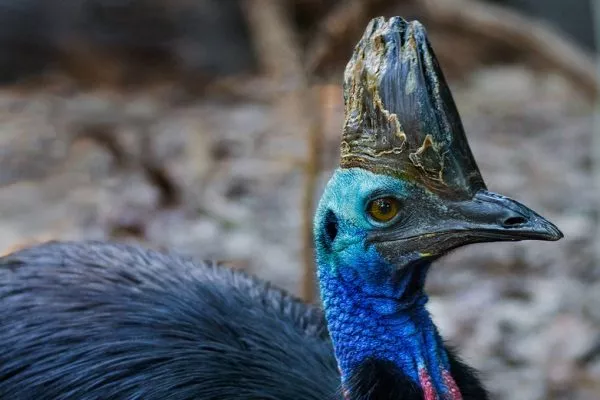
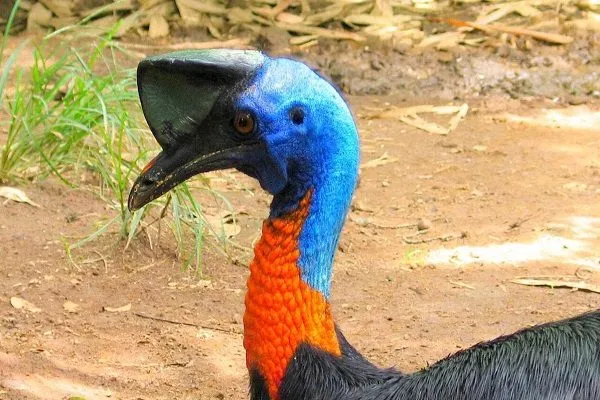
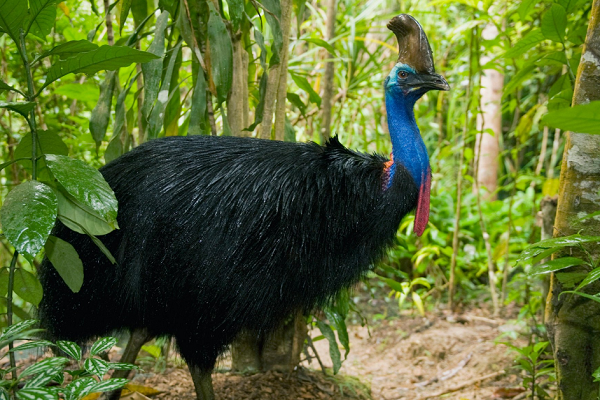
Different species have distinct habitats. The orange-necked cassowary prefers lowland forests, the helmeted cassowary prefers mid-altitude forests, and the muruq inhabits high mountain forests. Despite their different appearances and habitats, all members of the family share a similar lifestyle and diet.
What does a cassowary eat?
Cassowaries live in a humid environment, so their diet is appropriate.
Cassowaries feed primarily on fallen fruit or edible mushrooms from lower branches. They also eat small animals, such as:
- snails;
- snakes;
- frogs;
- insects.
Sometimes they swallow stones as gastroliths to grind up hard, dense food. In short, the cassowary eats whatever is under its feet, so it won't die. Its diet also includes large quantities of water, without which it cannot survive.
Social structure and reproduction
Scientists haven't yet determined the exact breeding season for Australian cassowaries. Most individuals breed in the summer and fall. However, there have been cases where the birds' mating season occurred at other times.
The male selects an area of up to five square meters and waits for the female. When she arrives, the mating ritual begins. The male raises his feathers, circles his mate, and makes a long, dull call.
They spend a couple of weeks together after mating. This is the only time when cassowaries are not alone. The male builds the nest, and the female lays no more than eight eggs in it.
The responsibility for incubating the eggs and raising the young falls to the male. The females then return to search for a mate. The gestation period for chicks ranges from 40 to 60 days. Within one year, cassowaries reach adult size, reaching sexual maturity at three years of age.
Natural enemies
Cassowaries have few enemies in Australia. The continent's inhabitants prefer not to tangle with the large, powerful bird.
People are attracted to the bright plumage and long claws of members of the cassowary family. Their prey is used to create jewelry, including for ritual purposes. The birds are killed for their meat, which is tasty and nutritious.
Wild pigs and dogs pose a threat to cassowaries. They damage nests and eggs, preventing their reproduction. These animals are their main competitors during periods of food shortage.
Interesting facts
Beyond their appearance, Australian cassowaries possess characteristics unique to this continent. One of these is their heightened aggression. In 2004, this flightless species was listed in the Guinness Book of World Records as the most dangerous bird.
Cassowaries dislike not only people but also their own kind. When they meet in the same territory, they begin to fight. Scientists still haven't found the reason for this aggression.
Other interesting facts about the appearance and life of representatives of the cassowary family:
- The cassowary's status as Australia's largest bird can only be challenged by the ostrich;
- they cannot fly because their wings are small and not strong enough to lift such a weight into the air;
- in contrast to the lack of ability to fly, the bird runs fast (accelerates up to 50 kilometers per hour);
- the helmet on the head is a hard, spongy material that is covered with a horny layer, and the plumage is more similar in structure to wool;
- Cassowaries are the saviors of the forest, because by eating fruits they spread seeds throughout their habitat (they do not chew their food, even if it is large);
- During the mating season, the female can change three partners, while the males incubate the eggs, sacrificing themselves.
- ✓ The presence of a helmet on the head, which is used for protection and in mating games.
- ✓ Ability to reach speeds of up to 50 km/h despite being unable to fly.
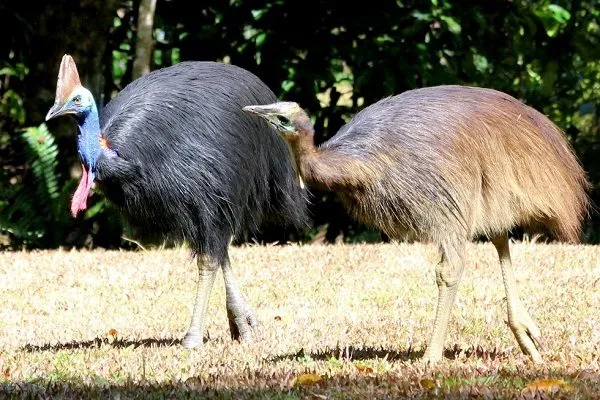
Australian cassowaries are unique birds. With a striking appearance (no other living creature on earth has such headgear), they are solitary. Cassowaries remain poorly studied. Scientists believe their ancestors were reptiles. These characteristics negatively impact population growth. They suffer from excessive human attention. Two species of this family in Australia are critically endangered.