
The emu is a native Australian bird. Discovered in the 17th century, the ostrich (as the emu is commonly known) continues to fascinate ornithologists. These birds have a docile nature and are renowned for their hardiness. Australian farmers breed the birds on their backyards, a practice that Russian breeders have also adopted.
Origin of the species
The emu was first discovered by European explorers in western Australia in 1696. After the first settlement was established in the east of the continent in early 1788, Captain Arthur Phillip and ornithologist John Latham made the first written record of the birds.
In the late 18th century, the species was named after a region of Australia. At the time, the area was known as New Holland. The birds were called "New Holland Cassowaries."
During the course of research, the etymology of the word "emu" was never determined. There are two theories:
- In Arabic, "emu" means a large bird;
- comes from the word "ema" (it has Portuguese roots) and is intended to denote large birds.
Until 1880, emus were classified as ostriches. Later, it was concluded that the birds had many significant differences. Ultimately, emus were placed in the cassowary family.
Emu farming was attempted in Australia in 1987. The attempt was successful.
Appearance and character
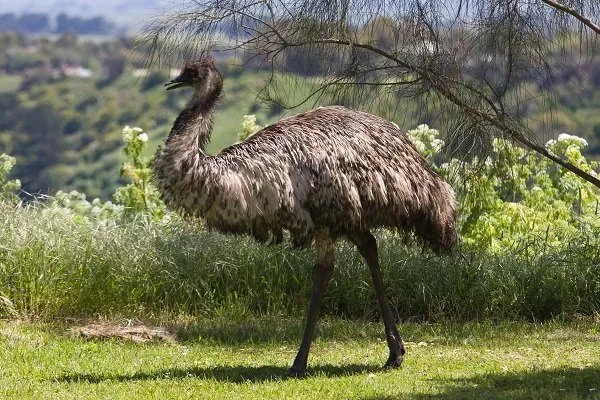
The emu is a large, flightless bird. It ranks second among the feathered giants.
Emu dimensions:
- the height of the male is about 2 meters, the female is a little smaller - no more than 1.5 meters;
- weight reaches up to 55 kg;
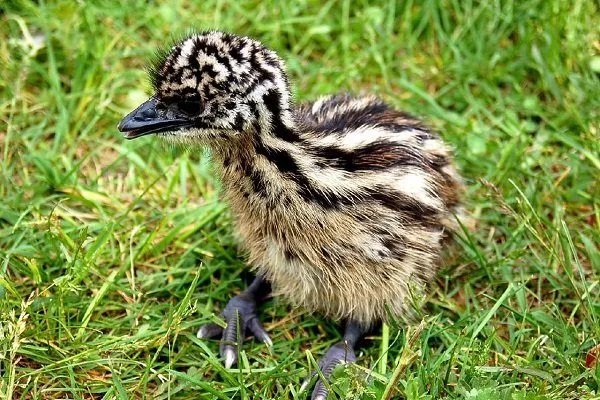
- Newborn members of the family weigh no more than 500 grams.
In appearance, the emu is very similar to the ostrich:
- the body is dense and has an elongated shape;
- three fingers on both limbs;
- the wings are small and poorly developed, pressed as close to the body as possible (they mainly serve to protect the chicks from predators);
- the small diameter head is located on a narrow but long neck;
- the beak is predominantly pink;
- color is gray with a brown tint.
The color range of males and females is approximately the same. Scientists distinguish several species of emu based on the richness of their plumage:
- Woodward - has a pale shade of feathers, lives in the north of Australia.
- Rothschild — has a darker plumage color, lives in the south-eastern part of the continent.
- New Dutch ostriches — grey-black colour (representatives can be found in the same places as Rothschild).
Emus have excellent vision. They can spot danger moving as far as 100 meters away. Ostrich eyes are protected by a membrane, and their eyelashes are long and prominent.
What makes emus unique is their speed. They have muscular legs, easily reaching speeds of up to 50 km/h.
An emu can be heard long before it appears in sight. If the bird decides to communicate with its fellows, its call can carry up to 2 kilometers.
Despite its size, the emu is a friendly bird. It lives peacefully near people and enjoys eye contact. The only time to be wary of these birds is during mating season, when they become aggressive.
Peculiarities of lifestyle and behavior
Emus prefer open steppe areas. They live alone. Occasionally, they may gather in groups of no more than seven individuals. In these cases, their goal is to find food or a new feeding site, but only during breeding season.
The ostrich drinks water once a day. However, the bird can often be seen near a body of water. It loves to swim.
Where does it live and what does it eat?
The largest concentration of emus has been recorded on the Australian mainland. The birds live in the wild.
The bird can be found in areas with few people or dense vegetation, but with plenty of water. In their native habitat, ostriches can live in any environment. They tolerate climate change well, feeling comfortable in temperatures ranging from +45°C to -15°C.
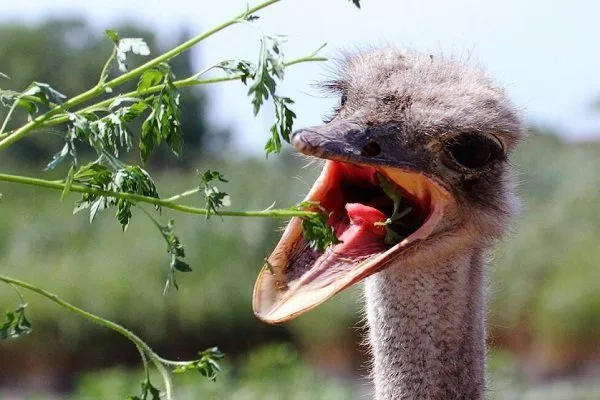
The emu's main diet consists of plant foods:
- young shoots;
- plant roots;
- cereal crops;
- grass;
- juicy fruits.
They don't refuse to feast on animals:
- insects;
- mollusks;
- lizards;
- small birds.
Ostriches feed exclusively in the morning. Ostriches lack teeth, so to digest their food, they eat sand, small pebbles, and sometimes glass.
Ostriches may wander onto private property and feast on vegetables from garden plots. They behave unruly and can cause serious damage to agricultural crops.
In the 1920s and 1930s, this led to a full-scale emu hunt. The war resulted in over 57,000 animals killed.
The battle against the birds is not over. However, no such large-scale killings have been recorded so far. The birds are protected by Australia's Environment and Biodiversity Conservation Act.
Reproduction
The emu is a bird that reproduces by laying eggs. This process involves mating displays. The male behaves as follows:
- located in front of the female;
- lowers his head as low as possible;
- swings it in both directions;
- After this, it heads to the place where the future nest is located.
It's the males who prepare the brooding site. They create a small hole in the soil, lining it with leaves or dry grass.
Females can lay only one egg at a time. Each egg weighs at least 700 grams. Around 50 eggs from different females are concentrated in one spot.
Not all 50 chicks will be born. The ostrich can't cover all of her offspring with her body, even though she sits on them for 20 hours a day for 55 days.
The male leaves his future ostriches only to search for food. During the entire incubation period, the female loses about 20 kg of weight. The fat accumulated in advance helps him survive.
After hatching, the father also takes care of the chicks. He protects the young emus from enemies, feeds them, and cares for them for seven months. After mating, the female goes in search of a new mate.
Natural enemies
Due to its size, emus have few natural enemies. They fear the dingo (a domesticated wolf). The dingo tries to kill the emu by aiming for the bird's brain. The emu pushes the animal away, jumps up, and delivers a powerful blow to the head with its beak.
Their leaps are so high, making it difficult for wolves to outmaneuver ostriches. Dingoes don't affect emu mortality.
Another predator that threatens emus is the wedge-tailed eagle. It doesn't attack adults because it can't handle them. The eagle's primary prey is on young birds.
Adults are rarely threatened, but they are not averse to enjoying ostrich eggs:
- large lizards;
- red foxes;
- wild dogs and wild boars (the latter can eat chicks);
- eagles;
- snakes.
The economic importance of poultry
Emus became a hunted species in Australia. They killed the birds not only for their meat. Their fat was used as a medicine (rubbed into the skin) or as a lubricant.
Ostrich breeding for commercial purposes began in Australia, in the western part of the continent, in 1987. People received their first profit in 1990.
The bird is bred for:
- meat - is considered lean because it contains less than 1.5% fat, and the cholesterol level does not exceed 85 mg per 100 g;
- leather - because of its patterned surface, wallets and shoes are often made from leather;
- oils and fats - materials for the preparation of cosmetics;
- feathers - use in decorative or applied arts;
- eggs - they are eaten, and the shells are used in crafts.
There's increased interest in emus worldwide. Ostrich farms are located in almost every country. The largest ones are:
- in China;
- in the USA;
- in Canada;
- in Peru.
Breeding emus at home
Emus are widely raised as pets, even in northern regions of the world. The demand for them stems from their undemanding nature regarding living conditions and feeding.
There are farms in Russia that specialize in emu breeding, but they are few in number—just over 100 across the country. Legalizing the import of birds and opening a business in our country is not easy. Before purchasing young birds, farmers must apply to government agencies for a permit to breed the birds.
Once approved, authorities will regularly visit emu habitats to inspect the birds' living conditions. If any discrepancies are found, the profitable business may be shut down.
You can learn more about the ostrich business in the following video:
Requirements for premises and conditions of detention
Russian farmers should be especially meticulous when it comes to emu husbandry. Before starting to raise the birds, consider several points:
- the area of the room in which the emus will grow and live should be equal to 15 sq. m. per mature individual;
- The job won't be done without a thick and comfortable bedding;
- cleaning and disinfection of floor coverings should be carried out regularly and in a timely manner;
- air circulation will be required (opening windows will be sufficient);
- during incubation, the optimal room temperature is + 30°C;
- When constructing feeders and drinking bowls, the growth of the ostriches is taken into account (if there are individuals of different ages on the farm, there should be several feeders).
- ✓ The temperature in the room for incubating eggs should be maintained at +30°C.
- ✓ The area of the enclosure for one adult individual should be at least 50–60 square meters.
Aviary
In the wild, emus live in large, open areas. A farmer who wants to successfully breed ostriches must keep this in mind and properly equip their enclosure:
- the area is spacious, about 50–60 square meters per adult;
- individual corral;
- a canopy so that the animal can take shelter from the scorching sun;
- protective fencing at least 1.5 meters high;
- The fence is made of fine mesh (the ostrich won't stick its head through and won't get injured).
Wintering
Australia doesn't experience severe frosts. Therefore, emus need comfortable accommodations on the farm. Ideally, the premises would have:
- warm and dry;
- ventilation must be present;
- there will be no draft.
Ostriches can easily survive temperatures as low as -20°C. If temperatures in the area drop below that, the enclosure is insulated with natural materials.
Feeding
Emus are considered omnivorous birds. On farms they are usually fed Combined feed. The nutritional mixture helps you gain weight faster.
Approximate diet of an emu:
- rye bread - 200 g in summer and 400 g in winter;
- oats or barley - 150-300 g;
- oatmeal - 100-150 g;
- carrots, beets, cabbage or potatoes - 200-300 g.
Those farmers who do not trust compound feed may feed ostriches:
- fermented milk products;
- fish waste.
What are the benefits of emu meat and eggs?
The meat is prized for its high juiciness. It contains virtually no fat. 100 grams of the product contains less than 100 calories. The most valuable part is the fillet, which contains a huge amount of micro and macronutrients essential for the human body.
Experts recommend diabetics and people with gastrointestinal diseases to regularly consume emu meat in moderation. The product has a beneficial effect on cholesterol levels (helping to lower them).
Interesting facts about the bird
The emu is a unique bird. In addition to the above, it has other characteristics:
- the fastest bird on the planet;
- in one day the birds cover about 30 km;
- the size of the ostrich's eye exceeds the size of its brain;
- the legs are very powerful, one kick can kill a kangaroo;
- birds are excellent swimmers;
- the eggs have an interesting color - from black to deep green (sometimes you can find blue eggs);
- The chick grows rapidly, growing 1 cm in 24 hours.
Emus are not related to ostriches, although they are commonly referred to as such. These birds have a gentle nature, making them suitable for farming. Farm breeding is not prohibited in Russia, but a special permit and comfortable living conditions for the animals are required. Breeders receive healthy, tasty meat and eggs for their efforts.
A dingo is not a domesticated wolf, but a feral dog! And believe me, this is a very important difference!
This is a contentious issue. Some CSG (the global body for scientific and practical knowledge on the status and conservation of all canine species) experts consider the dingo a subspecies of wolf, others a subspecies of dog, and some even a separate (independent) subspecies. In 2019, at a regular CSG (Canid Specialist Group) seminar, they "agreed" that dingoes are secondarily feral dogs... but for how long?! Because of this, the animal was removed from the Red List, and when the subspecies becomes extinct (and in Australia, dingoes are being actively hunted), it will likely be called a wolf again. Call it what you will, but it has nothing to do with the essence of this article.