
It's hard to imagine a bird capable of running at speeds of up to 70 km/h, with a huge body mass, and the ability to survive almost anywhere. This is all about the African ostrich, a remarkable and versatile bird.
Description of the African ostrich
The African ostrich is an unusually large bird that is flightless and lacks a keel. It is the only ostrich species surviving to this day.
Origin
Scientists have discovered that the most ancient ancestor of these birds lived in South Africa approximately 23 million years ago. It was medium-sized (smaller than today's) and primitive. About 15 million years ago, some ostriches migrated to Turkey, and from there, they spread throughout inner Asia.
The further evolution of these birds took place in Eurasia during the late Miocene. Climatic conditions included cooling and drying of the land. However, savannas spread across the vast grasslands, where these ostriches, still in a rather underdeveloped and primitive state, lived for a long time.
Appearance
The African ostrich is the largest bird species currently known to scientists. Let's take a closer look at every detail of its appearance:
- Head. Fairly small and flattened. The eyes are large and bright, usually with long, thick eyelashes on the upper eyelid and none on the lower. Vision is very good. The hearing apparatus is clearly visible due to the sparse feathering around the head; the auricles resemble small human ears.
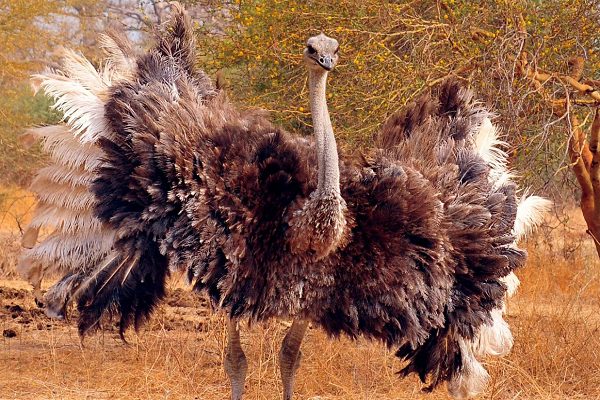
- Wings. Underdeveloped, they have toes with claws. The plumage is evenly distributed over the entire body, with dense feathers on the wings. Males typically have black plumage, while females, which are noticeably smaller, are less vibrantly colored—gray or dirty white.
- Limbs.The African ostrich's legs and chest are completely featherless. Their strong, long limbs have two toes, one of which has a distinctive hoof. Their legs are so powerful that a single blow from an ostrich can cause serious injury and even kill any large predator.
- Height and weight.These are the largest and heaviest birds in the world. They reach a height of 2.5 meters and weigh approximately 120 kg for females and 150 kg for males.
The ostrich has an incredibly long neck that stretches well, allowing it to swallow large prey whole.
Lifestyle and behavior patterns
Ostriches can become aggressive toward humans if they encroach on their territory. These incidents are rare, but nevertheless, they demonstrate their freedom-loving and willful nature.
They prefer a gregarious lifestyle. They can live in family groups consisting of a male, several females, and their offspring. A flock can reach up to 30 individuals, while young ostriches in the south live in groups of up to a hundred birds.
African ostriches often live alongside other herbivores, cohabiting, and being very friendly. Due to their height and excellent eyesight, they can alert all nearby animals to danger.
Hibernation
African ostriches are able to survive winters in the central regions of the CIS countries very well, thanks to their lush plumage and excellent genetic health.
When kept in captivity, specially adapted, warm coops are built for these birds. Individuals born in winter are much healthier and more resilient than those born and raised in summer.
Subspecies
| Name | Average weight (kg) | Plumage color | Habitat |
|---|---|---|---|
| Common ostrich | 120-150 | Black (males), gray (females) | Africa |
| Masai ostrich | 100-130 | Red (during breeding season), pink (at other times) | East Africa |
| Somali ostrich | 150 | Bluish-gray (males), bright brown (females) | Somalia |
| Southern ostrich | 110-140 | Dirty gray, light black | Namibia, Zambia, Angola |
Today, only four subspecies remain, all found in Africa. There used to be more, but their populations have declined significantly due to the extermination of the birds. Let's look at each subspecies separately:
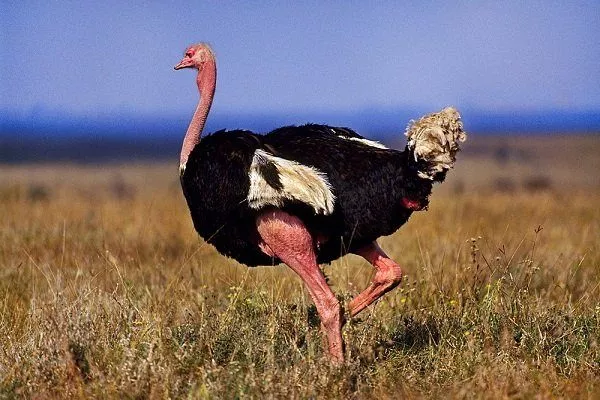
- Common ostrich. The largest species. It has a bald head, and its legs and neck are pinkish-red. The female's skin is whitish-pink instead of red. The common ostrich's egg has star-shaped pores.

- Masai ostrich. It lives in East Africa. During the breeding season, its coat turns bright red, and at other times it has a pinkish tint. Females have brownish-gray plumage and whitish limbs.
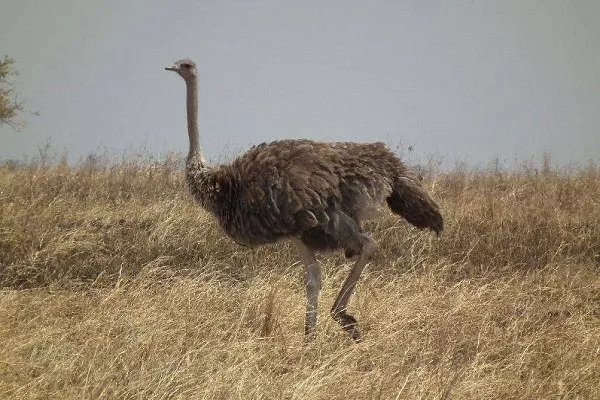
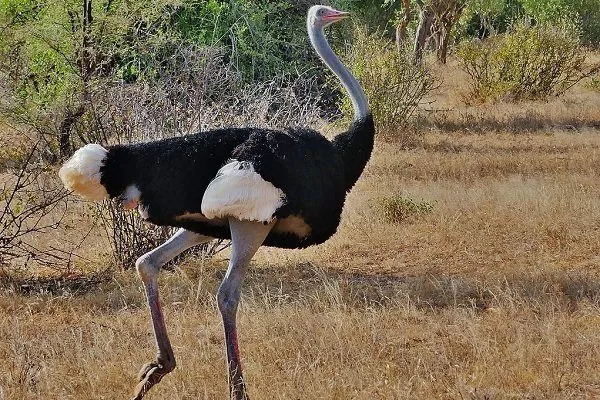
- Somali ostrich. Some scientists and researchers classify it as a separate species due to reproductive isolation, revealed through DNA analysis. Female Somali ostriches are always larger than males, weighing up to 150 kg and standing approximately 2.5 meters tall. Males have bluish-gray skin, while females have bright brown feathers.
- Southern ostrich. They have a dirty gray and light black coloration. Their habitat is extensive: Namibia, Zambia, and Angola.
Natural habitats
The habitat of the African ostrich varies depending on the subspecies. Most often, these birds seek out the following natural habitats:
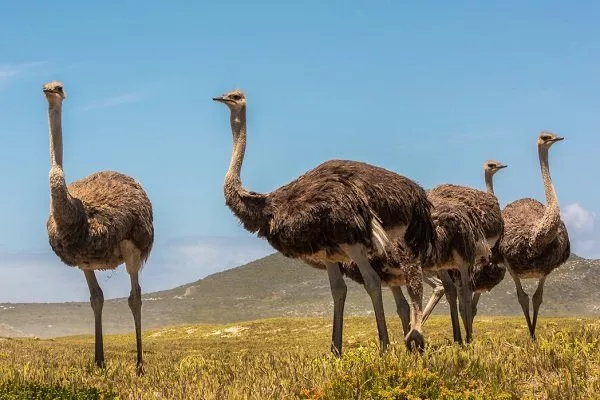
- Savannah. Ostriches, due to their natural characteristics and need for rapid movement, prefer grassy savannas and areas with few trees. Plains are an excellent place to reproduce and feed.
On flat ground, all nearby animals, including predators, are clearly visible. Therefore, in case of danger, ostriches can flee in advance. - Semi-desert.While brooding, groups of African ostriches can be found there. However, they don't live in the Sahara Desert. Because the type of sand there makes it difficult for the birds to run, which is essential for them. The optimal habitat is a semi-desert with firm ground and small shrubs.
Natural enemies
Ostriches have a wide variety of natural enemies. Let's take a closer look at how serious and frequent the danger they pose:
- Predators. These are hyenas, jackals, and birds that attack and destroy their nests containing defenseless chicks. This is why the African ostrich population suffers enormous losses during the incubation and growth period. However, the offspring can flee from danger as early as 30 days after birth.
Only large predators such as lions, tigers, leopards, and cheetahs attack adult ostriches. However, ostriches have effective defense mechanisms, so predators are wary of attacking them. - Poachers. They are the ones who cause the most irreparable damage to the population. Hunters kill entire herds of 30-80 individuals. They illegally sell their skin, feathers, meat, and eggs. The only current method for combating poaching is to breed ostriches on farms, so as to reap the full benefits of a specially bred flock, rather than killing all the birds.
- Tourists. For them, it's just a pastime, so they enjoy hunting the birds from helicopters. They're difficult to control, and the government has banned the export of any ostrich products from the country.
Diet of African ostriches
Ostriches have a variety of dietThey can eat grass, branches, roots, plants, and flowers. But they will also eat small rodents, the remains of predators, and insects.
These birds can survive for long periods without water, obtaining moisture from plants. However, when they find a body of water, they take advantage of it and not only drink but also bathe.
Population and status of the species
In past centuries, ostrich feathers were very popular, causing the population to decline significantly. However, thanks to artificial breeding, this species has been saved from extinction.
The African ostrich is currently listed in the Red Book due to its rapidly declining population in the wild. This is driven by the construction of new roads and buildings, hunters, and even ordinary people who believe ostrich meat can cure diabetes.
Reproduction and lifespan
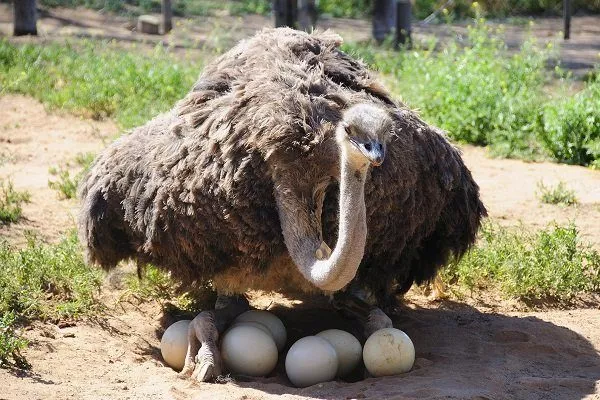
Before laying eggs, the male digs a hole himself. The lead female in the flock incubates all the eggs for about 40 days. She spends the entire day incubating, leaving only to feed and chase small rodents. At night, the male sits on the eggs.
After 40 days, the chick hatches. This process takes about an hour. It breaks the shell with its beak and head. If some of the chicks fail to hatch, the mother pecks the egg herself. The chicks weigh 1 kg, can see immediately, and have down. By the 30th day, they can run quite quickly.
Ostriches weigh around 25 kg within six months of birth. After two years, males acquire black feathers; before this, they resemble females. Their development is generally gradual and slow. Their plumage development takes a particularly long time.
Economic importance
People keep and breed these birds for their valuable leather and meat. The latter is valuable because it is lean. Feathers and eggs are also available.
Most farms are located in Africa, but even colder countries are already getting into the trade. Let's take a closer look at why ostriches are so beneficial:
- Meat. It's very similar to low-fat beef. Ostrich meat is the leanest meat on the planet, with a very low cholesterol content. You can increase the weight of an ostrich by feeding it inexpensive green fodder and hay, yielding up to 40 kg of pure meat per animal. This is much more profitable than raising pigs, which require expensive feed.
- Leather. Ostrich skin produces a sought-after, valuable, and expensive leather, comparable in quality to crocodile skin. Ostriches are at their best when they're one year old, and have not yet suffered any damage.
- Feathers.Since ancient times, ostrich plumage has been in great demand among women. Luxury items were made from it. Most often, the feathers were used as decorative elements in ladies' hats, which nearly led to the extinction of ostriches.
- Eggs. The energy value of an ostrich egg is 118 kcal per 100 g. It's not much different from chicken eggs. One whole egg is enough to feed 11 people.
- Other products. Medical scientists are conducting experiments on ostriches. The fat is used in cosmetic products, such as those that reduce wrinkles and smooth skin.
| Product | Yield per individual (kg) | Receipt period |
|---|---|---|
| Meat | 40 | 12-14 months |
| Leather | 1.5 | 12 months |
| Feathers | 1 | 6 months |
Domestication of the African ostrich
It is reliably known that attempts to domesticate the African ostrich began in ancient Egypt. However, it was only in the 19th century that the first farm opened, located in the Americas. Since then, ostrich farms have proliferated across almost the entire globe. They are now bred in over 50 countries.
Birds are able to adapt to harsh weather conditions fairly quickly, despite their African origins. They can easily withstand temperatures as low as -30 degrees Celsius, but sudden temperature changes, drafts, and wet snow are particularly detrimental to them, causing them to become ill and even die.
Is it possible to breed it?
The ostrich is a large and exotic bird, but it's also hardy and omnivorous. For a bird to thrive on a farm, the following conditions are necessary:
- there should be a spacious grassy area nearby where various plants will grow;
- the presence of an insulated poultry house, since ostriches love warm climate conditions, despite their hardiness;
- For one male, you need to keep 3-4 females, thanks to this, their correct reproduction is ensured.
- ✓ Optimal ratio of males and females in the herd: 1:3-4 to ensure effective reproduction.
- ✓ The need for a spacious walking area with a variety of vegetation for natural feeding.
You can learn about breeding African ostriches in this video:
Species protection
The ostrich needed radical and serious conservation measures. An organization dedicated to protecting the Sahara Desert decided to call on the public to help save the population and return the ostrich to the wild. Today, the Sahara Desert Foundation has already achieved significant success in protecting the African ostrich.
The company assisted in several important steps in the construction of hatcheries and consulted with experts on captive breeding. It also provided significant assistance to one zoo in ostrich breeding.
A nursery with all the necessary conditions for ostriches was established in an African village in the east. Government support helped bring a flock of birds to protected areas and release them into nature reserves to continue their life in the wild.
The ostrich is a unique bird. It has a long history, is well-suited for farming, and doesn't require any special living conditions. Many farmers are happy with their decision to start breeding ostriches, as they derive considerable profit from them.