
When breeding ostriches in captivity, properly equipped pens play a crucial role. When constructing them, it's important to consider the ostrich's habits, needs, and abilities. The pen must be strong and secure, and certainly spacious and safe.
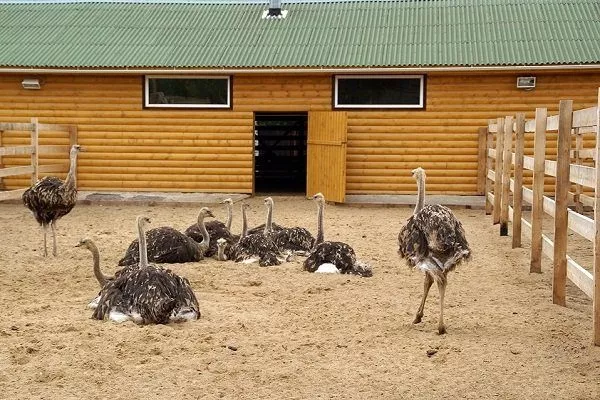
Site requirements for equipping a corral
Ideally, the area designated for setting up ostrich pens should be:
- big;
- sown with perennial grasses;
- with water supply;
- with alternating rocky and grassy areas;
- equipped with a sufficient number of feeders, waterers and shelters in case of bad weather.
- ✓ The site must have a natural slope for water drainage, preventing waterlogging.
- ✓ The soil should be sandy or sandy loam for better drainage and to prevent leg diseases in ostriches.
It's absolutely forbidden to use ostrich pastures adjacent to busy highways. Ostriches have a low stress tolerance, so cars rushing back and forth will stress them out, negatively impacting their weight gain and egg production.
In addition, nervous females may lay eggs in the most inappropriate places, making them difficult to find and leading to losses.
The ostriches' pasture should be well-lit, so the area should be free of vegetation that casts strong shadows. Scattered shrubs and low trees are acceptable. A hedge of shrubs can be used to protect the ostriches' pasture from northerly winds.
Equipment for ostrich pens
If it is impossible to install a water supply into the ostrich enclosure, there must be a natural reservoir on the site from which water can be taken.
In hot weather, ostriches drink a lot and love to bathe. It's a good idea to set up special showers for the birds. Lawn sprinkler systems are suitable for this. You can also periodically shower them with a hose with a spray nozzle.
Basic requirements for the arrangement of pens:
- Stray dogs should not be allowed into the enclosure. Therefore, it is recommended to install the fence on a foundation (logs reinforced with clay), and to concrete the base of the fence posts.
- Ideally, the enclosure should be made of mesh with a mesh size of less than 30 cm, to prevent a curious bird's head from getting stuck. Boards, poles, and even metal pipes can be used. The distance between them should be either small enough to prevent the bird's head from getting through, or large enough to allow it to pass easily without getting stuck.
- The height of the fence should not be less than two meters, otherwise an adult ostrich can jump over it.
- To protect the animals from rain, shelters are installed in the enclosure. Lightweight plastic can be used, with straw laid on top. Shelters can be placed either along the fence or secured between trees.
- Low-lying and marshy areas are not suitable for building pens. If other soil is not available, drainage can improve the situation. Fine gravel and sand can be used for this purpose.
It is strictly forbidden to use barbed wire for fencing.
Enclosures for free-range keeping of ostriches
When ostriches are kept free-range (extensive), the range area is fenced. Eight adult ostriches are allocated a hectare of pasture. Shelters are required to provide protection from cold winds and rain.
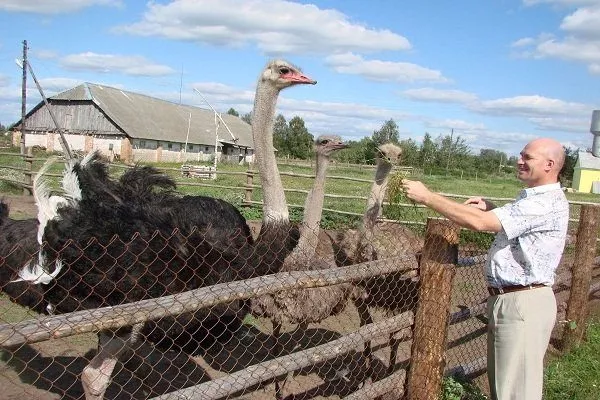
Although this method of keeping the birds is used to feed on pasture, it is necessary to install drinking bowls and feeders in the pasture area to feed the ostriches during dry or excessively rainy summers.
Enclosures for semi-free keeping of ostriches
The climate, which differs from their native habitat, does not allow for extensive year-round ostrich husbandry. However, during the cold season, and even in the freezing winter, ostriches can roam freely.
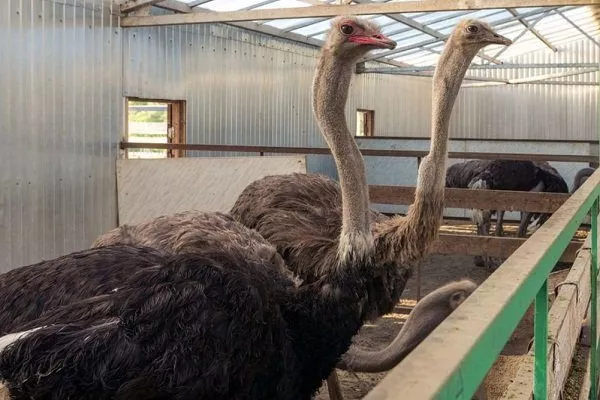
For these purposes, pens are set up with doors leading from the poultry house that open in both directions. The ostriches are free to leave, wander around, and reenter the warm space.
Each adult ostrich requires 10-15 square meters of enclosure, and each chick requires 5 square meters.
Pens for young animals
If you are purchasing young animals from outside or hatch chicks in an incubator, make a separate enclosure for the ostriches.
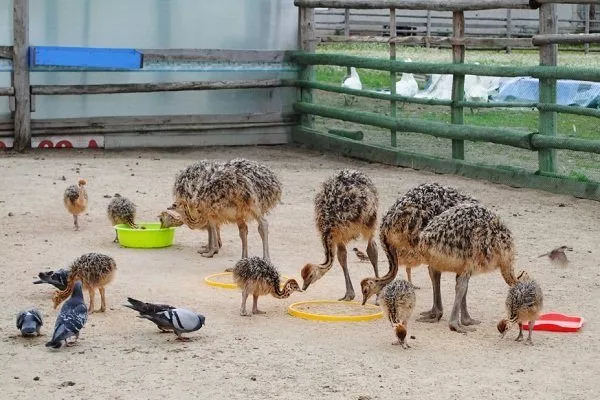
Keeping adult birds and young birds together is not recommended. Firstly, adult ostriches may harm the young of others, and secondly, the microflora of adult birds and young birds differs. This can lead to illness in the young.
- ✓ The temperature in the ostrich pen should be maintained at 28-30°C during the first weeks of life.
- ✓ Provide soft floor covering such as straw or sawdust to prevent injuries.
During cold and rainy weather, an electric heater should be installed in the pen to keep the chicks warm. A frame covered with film (150-200 microns thick or more) is installed, with the heater placed underneath. This structure not only keeps the chicks warm but also protects them from rain and cold winds.
Quarantine pen
A quarantine pen is used to separate sick birds. Newly acquired birds and young birds are placed there before being moved into the main pens with the older birds.
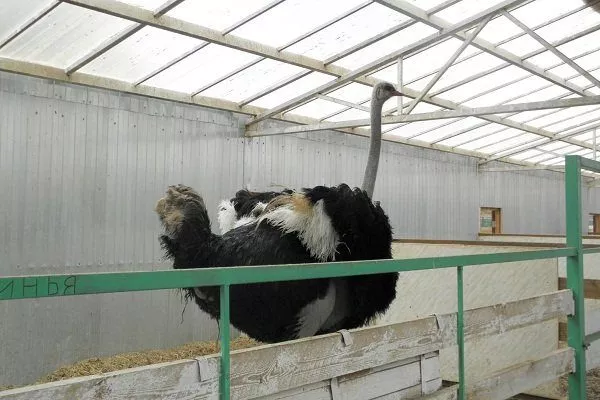
The quarantine pen must be disinfected regularly, especially after sick birds have been there.
Security measures
Make sure that there are no unnecessary objects on the ground, especially sharp or metal ones (glass, wire, nuts, etc.).
Sand should not be used as soil in nesting pens, as the chicks may confuse it with food and swallow it.
Requirements for feeders and drinkers
Regardless of the conditions and methods of keeping ostriches, the pens must be equipped with a sufficient number of feeders and drinkers.
Feeders
The best ostrich feeder design is a hanging one. It can be attached to a fence or to trees under overhangs.
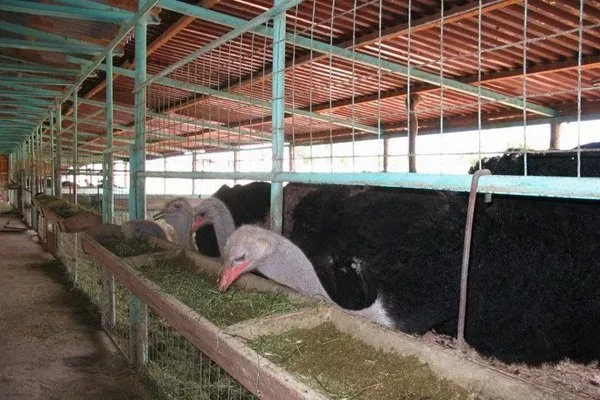
You cannot sprinkle ostrich feed on the ground.
For adult ostriches, feeders are mounted at a height of one to two meters. This is especially important for pens with extensive housing systems, where livestock is also housed. Only ostriches will have access to high-mounted feeders.
Length of feeders:
- for adult birds – 1.5 m;
- for two-month-old chicks – 50 cm.
This size will help prevent crowding and fighting over food. Everyone, even the weakest birds in the flock, will receive adequate nutrition.
Plastic feeders are preferred. They can be either freestanding or hanging.
A budget option is to use tires cut in half (the most suitable size is 750 x 16 cm). They can hold three to four kilograms of feed.
To prevent water from stagnating in the feeder and spoiling the food, make drainage holes in the bottom. The tire feeders can be suspended at the desired height using thick wire.
You can make your own feeders from 10mm planks. They should be well-planed and knot-free. Don't paint them to avoid poisoning the ostriches.
You cannot use feeders made from:
- concrete (located only on the ground, and if a crush occurs, the bird may be injured by hitting the feeder);
- metal (rust can cause poisoning of ostriches, and sharp edges can cause damage).
For green fodder, mangers are used, which are attached at a height of 50-70 cm.
Feed accounts for half the cost of ostrich maintenance. Therefore, use feeders designed to minimize losses. Fill the feeders two-thirds full.
You can learn about the rules for feeding ostriches from the article: "How and what to feed ostriches: all about feeding methods and regimens.»
Drinking bowls
Ostriches need water, as an adult requires 12 liters of water per day. Water in the drinking bowls should always be sufficient and fresh. If there is insufficient water or it is stale, ostriches may enter another colony's territory, which can lead to aggressive behavior from the territorial owners, including fighting.
It is possible to install drinkers used in large poultry farms.
It is easy to make an automatic waterer for ostriches yourself from a barrel (made of food-grade plastic, wood or metal), a tube (1-1.5 cm in diameter) and a valve:
- Attach a tube with a valve to the bottom of the barrel on both sides.
- Place the end of the tube in the trough.
- Close the valve.
- Open the barrel and pour water into it.
- Close the barrel tightly and open the valve.
Water will be poured into the drinking trough until the end of the tube is submerged. Now, whenever the ostriches drink, the same amount will flow back into the trough from the barrel.
Keep feeders and waterers clean. Wash them regularly (ideally daily, before feeding), removing dirt from crevices and corners.
Well-equipped pens, tailored to the ostriches' housing method and population size, with sufficient waterers and feeders, help raise healthy flocks. Proper equipment helps prevent feed waste and reduce ostrich-keeping costs.