
Young quail are kept in a brooder—a specially equipped box or rack that serves as a broody hen. You can buy one at a store, or you can make one yourself, meeting certain requirements for heating, lighting, and equipment. If properly constructed, such a brooder can be used to raise multiple generations of quail.
Why craft it?
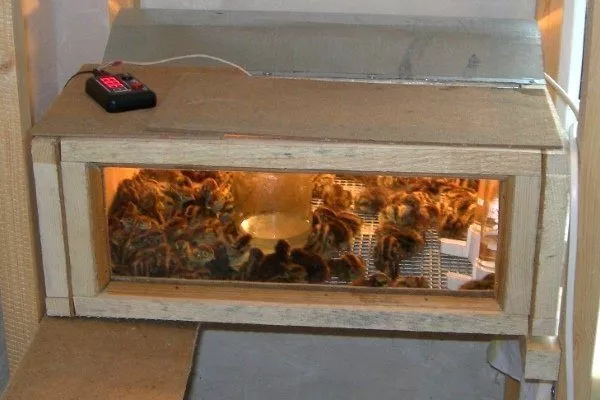
A brooder (from English – a hen) is a specially equipped structure in the form of a rack or box. It creates optimal conditions for chicks during their first days of life, allowing them to gain strength and prepare for moving into the general coop.
Why is it so important to keep newborn chicks in a brooder? Eggshells create a unique microclimate that disappears once the chicks hatch. They can suffer from both overheating and hypothermia. Proper lighting is equally important, as both darkness and excessively bright light are equally harmful to quail chicks.
If kept in unfavorable conditions, chicks lag behind in development and can even develop rickets. To prevent these consequences, they are kept in a brooder, which provides an optimal microclimate.
Moreover, brooders have a secondary purpose: to relieve the hens' stress. Newly hatched hens typically devote a great deal of attention to their brood and do not lay eggs until the next season. Brooders, however, act as a substitute for the brood hen, thereby increasing the hens' annual production. They no longer expend energy on the chicks, so laying continues.
Advantages of a homemade design
You can buy the necessary structure at a store to save time on making it. However, to save money, you can make it yourself. Moreover, it can be difficult to find a model that fits your specific size and shape in stores. A homemade design has a couple of advantages:
- Allows you to save on materialsYou can use scrap materials, such as those from old furniture, to make it. Nails and other fasteners are readily available in almost every home, and heating and lighting lamps are much cheaper to purchase for a pre-fabricated frame.
- Easily optimized for personal needsThe brooder design can be customized to accommodate a specific number of birds. It's also easy to allocate additional space for feeders, waterers, lights, and heaters.
Experienced breeders recommend equipping homemade brooders feeders And drinking bowls For remote feeding and water delivery. This will minimize constant human intervention, which frightens the quail chicks and leads to stress.
Requirements
The brooder will act as a broody hen for the chicks, so it's crucial to set it up according to a number of guidelines. Particular attention should be paid to the following parameters:
- DimensionsThe brooder should be sized to fit harmoniously within the space allocated for it. Of course, the number of chicks planned for the brooder must also be taken into account. If there are approximately 100 birds, a brooder measuring 100 x 50 x 50 cm can be used. After two weeks, the chicks will have grown, so space will become critically limited. The chicks will need to be moved to cages. If you plan to raise more quail or don't intend to move them to cages after two weeks, it's better to build a larger brooder.
- Stability and reliability of the bodySome poultry farmers use cardboard boxes, plywood crates, or wicker baskets instead of brooders. Although these structures are very economical, they are extremely unstable and do not provide the necessary environment for quail chicks. Choose materials that are resistant to damage and not too light, otherwise active chicks may tip over or break the structure.
- Lighting modeThe development of quail chicks depends on the duration and intensity of light, as well as the light spectrum. During the first two weeks, they need to be provided with continuous light. It's important to note that if red light predominates, quail chicks reach maturity earlier. Of course, early maturity is only in the breeder's best interest.

- VentilationThere must be sufficient air for the chicks to breathe and for moisture and odors to evaporate. Drafts and hypothermia must be avoided.
- Heating systemThe brooder can be equipped with infrared heating elements. These will maintain an optimal temperature without burning the chicks. They can be conveniently mounted on the back wall of the brooder. To prevent heat loss, there should be no drafts inside the brooder.
- Hygiene and cleanlinessBrooders equipped with feeders and drinkers are difficult to maintain cleanliness—scattered food, excess moisture, and droppings combine to create unsanitary conditions, which pose a danger, as chicks can become ill or even die in such conditions. Therefore, to maintain cleanliness in a brooder, feeders and drinkers must be specifically designed for it, taking into account the number of chicks.
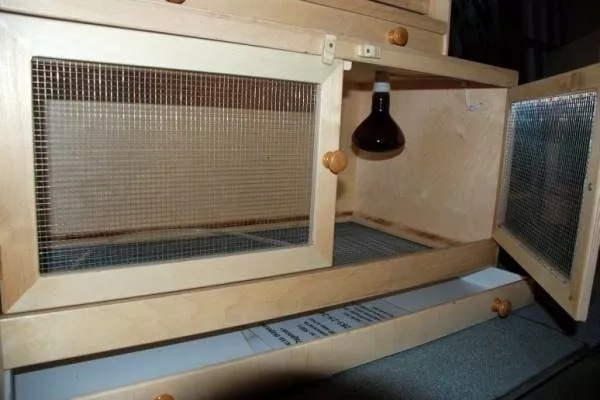
- ✓ Optimal stocking density: no more than 100 quails per 1 m² in the first days of life.
- ✓ The temperature regime must be strictly controlled: the first 5 days - 36°C, from the 6th to the 14th day - 30°C, then gradually reduce to 22-24°C.
What materials to use?
As noted earlier, a brooder should be constructed of durable material, as it is designed for long-term use. The most suitable options are:
- Board or plywood sheetIt's important to remember that the board thickness should be 2.5 cm, and the plywood thickness should be 2-3 cm. Otherwise, the structure will be unstable. Furthermore, the material should be treated with an antiseptic. If plywood is used, it's best to choose an environmentally friendly varnish that won't release harmful toxic substances. The brooder walls can be made from fiberboard sheets, but their lifespan is shorter than that of plywood or boards.
- PolycarbonateThis is a durable and hygienic material that's easy to clean and disinfect. However, one significant drawback should be considered: it's not breathable, so the chicks will be uncomfortable inside the brooder, even with good ventilation.
- Galvanized meshUnlike metal mesh, it won't rust quickly. It's used as the front wall and bottom of the structure. The mesh size for the wall depends on how long the quail will be in the brooder. If they're 10-14 days old, the mesh size should be 1 x 1 cm, and if they're 25-30 days old, 2.5 x 1.5 cm is better. A 5 x 5 mm mesh is used for the bottom.
- Galvanized sheet or plasticThese are suitable materials for a litter box because they are easy to clean, non-corrosive, and don't accumulate odors. If you use plywood, however, the wood will quickly absorb odors, leaving the room smelling of bird droppings.
| Material | Durability | Hygiene |
|---|---|---|
| Plywood | High | Average |
| Polycarbonate | Very high | High |
| Galvanized mesh | High | High |
Under no circumstances should multi-layer cardboard be used to make a brooder, as it is a fire hazard and is virtually impossible to clean.
Step-by-step assembly instructions
There are various ways to set up a brooder. We recommend reviewing the best options below.
Option No. 1
The assembly is carried out in two stages:
- Build a container for the chickens.
- Make a mesh bottom and a litter collector.
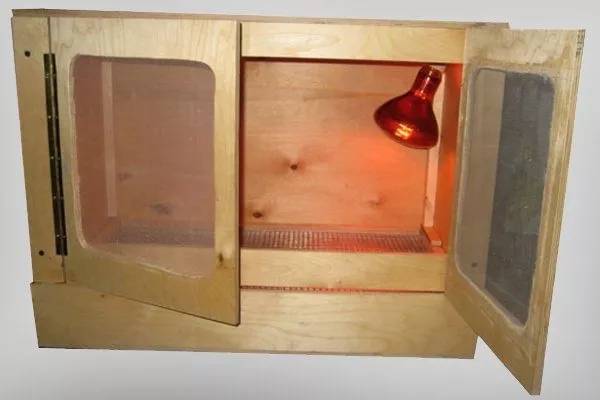
The finished brooder measures 700x500x500 mm, with an internal height of 400 cm. It looks like this:
To assemble it, you need to prepare:
- a sheet of plywood 1 cm thick and 152.5 x 152.5 cm in size;
- a wooden beam with a cross-section of 2x3 cm and a length of 12 cm;
- galvanized mesh with 1x1 cm cells;
- PVC panel;
- self-tapping screws;
- 2 piano hinges, 30 cm each.
You will need to cut out the following elements from a sheet of plywood:
- 2 side walls measuring 48x50 cm;
- back wall, bottom and ceiling – 3 pieces, size 70x50 cm;
- supports for the tray and mesh bottom: 4 pieces measuring 46x2 cm and 2 pieces measuring 66x2 cm;
- for the front part: 1 piece each measuring 64x5 cm (upper part) and 64x6 cm (lower part), two side pieces measuring 40x5 cm;
- 2 doors measuring 40x44.5 cm;
- for the mesh bottom frame: 2 pieces each measuring 66x2 cm and 48x2 cm for one side, and 2 pieces each measuring 68x2 cm and 46x2 cm for the other side;
- for the pallet: a front piece measuring 70x9.5 cm, 2 pallet frame slats measuring 65.5x2 cm and 47.5x2 cm for one side, and 2 pieces measuring 67.5x2 cm and 65.5x2 cm for the other side.
The step-by-step instructions for assembling a brooder are as follows:
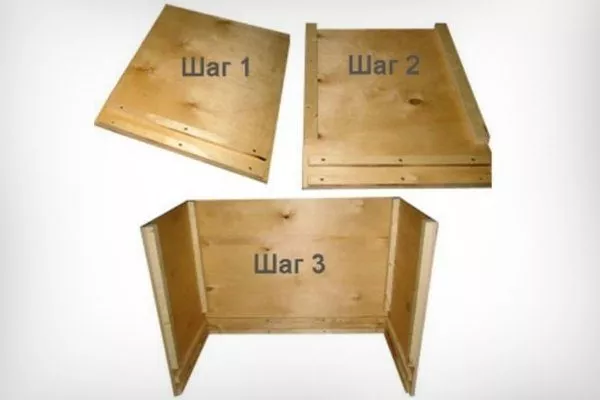
- To ensure the litter tray moves freely, create a sliding system similar to that used in furniture tables for installing drawers. To do this, cut four plywood strips measuring 46 x 2 cm for the side walls and two strips measuring 96 x 2 cm for the end wall. Attach one strip to the underside of the wall, trimming it so that it stops 1 cm short of the side walls. Place the second strip parallel to the first, 2.5-3 cm apart. It is important to maintain the proper spacing between the strips on all walls to ensure they align during installation.
- Cut the timber into four equal pieces, each 40 cm long, to form the brooder's ribs. Attach two pieces of timber to the side walls, wide-side down, using screws. The top edges of the wall and the timber should match.
- Connect the three walls using screws. If everything is done correctly, the grooves between the planks will match on all walls. Here's a visual illustration of all the steps up to this point:
- Begin assembling the front piece by making a frame from the previously prepared pieces. The side pieces should overlap the bottom and top pieces by 2 cm. Attach piano hinges to the front of the side pieces.
- Cut the doors to dimensions of 40 x 44.5 cm and attach them to piano hinges. If you plan to make the doors with mesh, you will need 5 mm thick plywood and mesh with a 5 x 5 cm or 7 x 7 cm mesh size to fit the door. Cut two strips per door: 40 x 3 cm, 38.5 x 3 cm, 44.5 x 3 cm, and 34 x 3 cm. Assemble them as a mesh bottom in the next step (step #6). Hang the assembled doors on piano hinges and connect the front part to the main body. If everything is done correctly, the doors will open and close freely, and the structure itself will remain level. To complete this step, all that remains is to attach the ceiling and plywood bottom.
- To make the frame for the mesh bottom, prepare some 1x1 cm mesh mesh measuring 48x98 cm, and use the four slats cut earlier. Assemble the bottom using the "sandwich" principle: insert the mesh between the slats and secure with screws. Ideally, the mesh bottom will rest on top of the tray rails. To prevent the quail from sinking into the mesh bottom, it's a good idea to make a temporary bottom out of 5x5 mesh.
- Assemble the litter box using the same principles as for the mesh bottom, but use a sheet of plastic (such as PVC) or galvanized metal instead of mesh. Attach a plywood strip to the outside of the tray to cover the bottom entrance and prevent litter from spilling out.
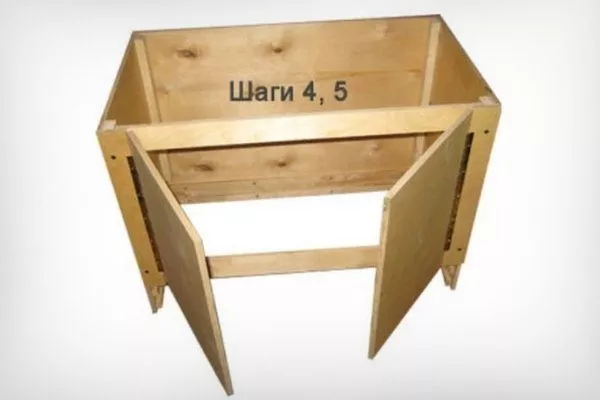
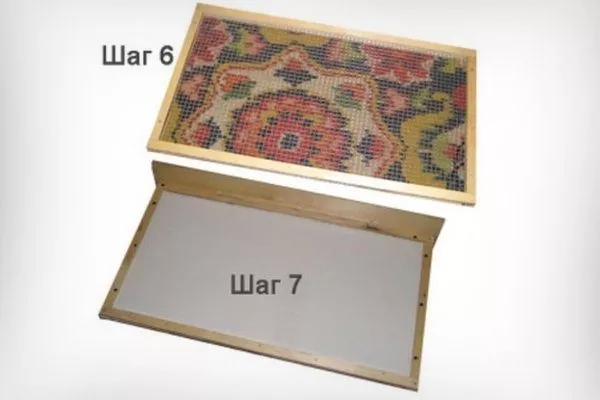
Unlike other chicks, quails are not very skittish, so they don't scatter when the brooder door is opened and may even try to jump out. To prevent this, attach a bar about 10 cm high from the floor to the bottom of the door.
The following video explains and demonstrates how to assemble a quail brooder:
Option #2
The brooder can be assembled in the following sizes:
- length – 1 m;
- width – 0.5 m;
- height – 0.5 m;
- internal height – 0.45 m.
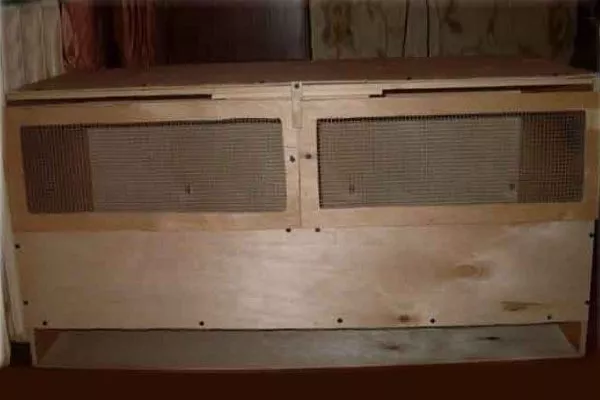
The assembly principle remains the same as in the previous instructions. So, to avoid repetition, here's a quick reminder with detailed photos:
- Cut out blanks from plywood.
- Assemble the frame of the structure using self-tapping screws.
- Cover the cut plywood doors with mesh and attach them to the brooder using a hinge and stops.
- Stretch and secure the mesh for the main bottom.
- Make a frame with a mesh for a removable bottom.
- Attach the bottom to the brooder tray.
The following video demonstrates step-by-step the process of assembling a brooder from scrap materials:
Installation of heating and lighting systems
Once the brooder box is assembled, it's time to install lighting and heating. To do this, you'll need to choose between an infrared lamp or underfloor heating film elements. We'll consider each option separately.
Infrared lamp
If the farm is small and only one brooder is needed for keeping chicks, installing infrared lamps with a thermostat is sufficient to create the necessary conditions. A dimmer allows for simultaneous adjustment of both light and heat. Typically, the maximum power of such lamps is 500 watts.
In this case, installing a heating system involves connecting the infrared lamps required by the specific flock and a thermostat into a single circuit. When calculating the required number of lamps and their height above the floor, it's important to assume a brooder temperature of 36°C for the first few days. The simplest electrical design looks like this:
Heating a brooder with a 250-300W infrared lamp will consume approximately 7 kW of electricity per day. Heating a bank of nine brooders will consume up to 63 kW daily, and approximately 2,000 kW monthly. This will require a significant investment, which will significantly impact the cost. To avoid this, it's better to use an underfloor heating system for heating.
Film elements of underfloor heating
For large-scale quail rearing (500 birds or more), a full battery of nine brooders will be required. To achieve more than threefold energy savings, use underfloor heating elements. In this case, the lamp will only be used as a light source in one brooder compartment.
Film heating mats, or rather individual elements of them, are attached to the back wall of the brooder and connected by a manual thermostat, creating an electrical circuit.
To heat the brooder, you can equip it with infrared film. You can learn more about it in the video below:
Creating a microclimate
In a homemade brooder, it's important to create a number of conditions to ensure the quail chicks feel comfortable and thrive. The table below shows which parameters require special attention:
| Parameter | Implementation |
| Temperature | During the first few days after removing the chicks from the incubator, maintain the temperature at 36°C. Subsequently, it can be lowered to 30°C. To monitor the temperature, hang a thermometer on one wall, making sure it's easily visible without opening the door. Also, keep the thermometer away from direct sunlight and avoid contact with the heating element. |
| Lighting | During the first week, lighting should be provided 24/7. Starting on the 8th day, daylight hours can be reduced by 3 hours per week. The optimal light duration is up to 12 hours for meat breeds and up to 8 hours for egg-laying breeds. Light intensity on the first day should be 20-25 lux, and from days 2 to 21, 5-8 lux. It is advisable to place the light bulb behind the grate to prevent it from coming into contact with the chicks. |
| Ventilation | Any drafts near the brooder should be avoided, and ventilation is best provided through mesh doors. If dust clouds or hydrogen sulfide or ammonia odors appear inside the box, air circulation is insufficient. |
| Humidity | During the first few days, it should be 60-70%, and then lowered to 50-60%. Humidity should be measured several times a day with a special device. To make life easier, the poultry farmer can install a thermometer and hygrometer combination in the brooder. |
| Feeder | It's best to install automatic or hopper-type feeders. For the latter type, you can install an auger made of corrugated tubing to facilitate filling the feeder without opening the brooder door. Installing a metal mesh on top of the feeder will allow the chicks to eat through it without scattering the feed. However, it's crucial to avoid sharp edges and torn mesh, as this could cause injury to the quail. |
| Drinking bowl | Avoid using saucers or troughs, as the water will need to be changed frequently, irritating and frightening the birds. Furthermore, water from such bowls splashes freely, creating a mess along with droppings and fluff. Therefore, it's better to use nipple or vacuum-type waterers. |
To ensure quail chicks grow strong and viable, they need to be kept in a brooder during their first days of life. You can make one yourself using ready-made plans and instructions. However, a number of requirements must be met, otherwise the homemade structure will be unsuitable for keeping the birds.